
AI and RFID for Water Infrastructure
AI-Driven Asset Management for Water Infrastructure
AI can improve water infrastructure management by connecting asset identity, maintenance history, field activity, inventory records, and operational data to decision-support systems. RFID provides a practical identification mechanism for pumps, motors, valves, meters, pipe components, tools, chemical containers, spare parts, and other physical assets distributed across treatment facilities, pumping stations, reservoirs, distribution networks, and utility depots. AI can then use these identified assets together with information from SCADA, sensors, CMMS, EAM, GIS, ERP, and field-service systems to identify maintenance priorities, detect abnormal patterns, improve inventory planning, and support field decisions. UHF RFID is useful for longer-range and multi-tag identification, while HF RFID and LF RFID can serve controlled or specialized identification requirements. The objective is not to make RFID responsible for process measurement. Instead, it establishes reliable physical asset identity so AI can associate operational information with the correct water infrastructure component.
AI-Driven Water Infrastructure Management with RFID, IoT, and Smart Analytics
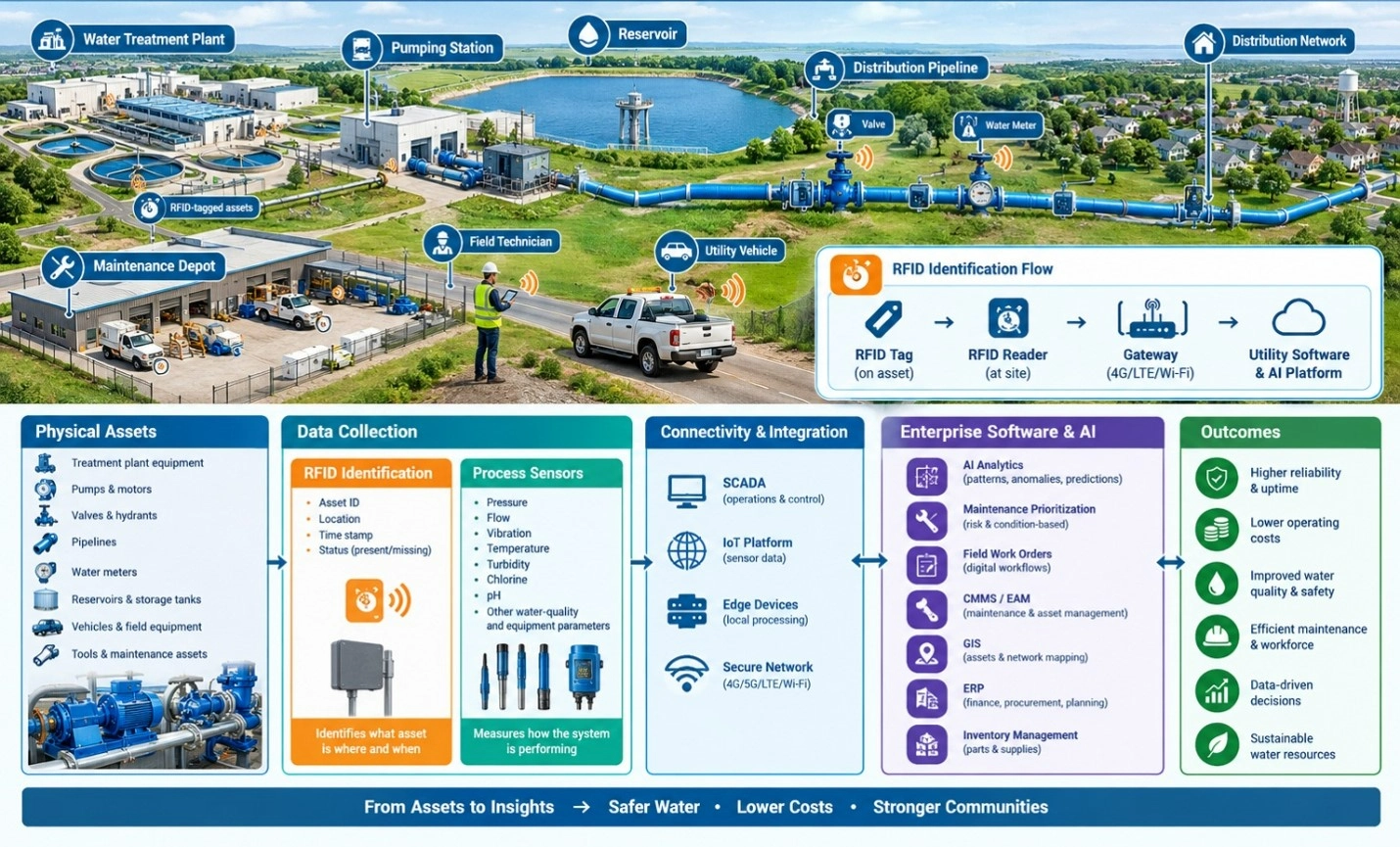
This enterprise infographic illustrates how municipal water infrastructure connects physical assets, RFID identification, process sensors, SCADA, IoT platforms, and enterprise systems with AI analytics. It highlights the flow from asset identification and operational data to maintenance prioritization, field work orders, and smarter utility decisions.
Understanding AIoT and RFID in Water Infrastructure
Artificial Intelligence of Things, commonly called AIoT or AI and IoT, combines artificial intelligence with IoT devices, sensors, connected equipment, and industrial systems. Water infrastructure is well suited to this approach because treatment plants and distribution networks already produce information from process instrumentation, electrical equipment, telemetry, SCADA systems, laboratory systems, maintenance applications, and field operations.
AI adds analytical capabilities to this connected environment. Machine learning can identify patterns across equipment histories, anomaly detection can highlight unusual operating behavior, computer vision can support inspection activities, and Edge AI can process selected information close to remote infrastructure where response time or network availability is important.
RFID contributes a different function. It gives physical equipment a machine-readable identity that can be linked to a digital record.
A tagged pump, for example, can be associated with its manufacturer, model, serial number, installation date, service history, spare-parts requirements, inspection schedule, and work orders. When a technician scans the tag, the maintenance system can retrieve the correct asset record instead of relying on a manually entered equipment number.
That distinction is important for water utilities. RFID is not a replacement for pressure transmitters, flow meters, vibration sensors, chlorine analyzers, turbidity instruments, or other process-control equipment. It provides identification and traceability that allow those measurements and operational events to be associated with specific physical assets.
GAO provides RFID hardware products and systems that can support these water infrastructure identification and tracking requirements, including applications where physical equipment must be connected reliably to digital asset records.
Water Infrastructure Applications for AI-Enabled Operations
AI Asset Tracking for Water Treatment Plants
Water treatment facilities contain thousands of physical components whose maintenance status can affect treatment reliability. Pumps, motors, valves, actuators, filters, chemical dosing equipment, analyzers, electrical panels, control equipment, tools, and replacement components all require accurate identification.
RFID-tagged assets can be identified during maintenance, inspection, receiving, staging, and inventory activities. AI can use the resulting asset history together with maintenance records and operational information to identify recurring service patterns and prioritize attention.
A technician servicing a chemical dosing pump, for example, can scan its RFID tag before beginning work. The connected maintenance software can retrieve the correct pump record, previous work orders, required inspection steps, and relevant replacement components. This reduces the risk of performing work against the wrong asset record.
AI Predictive Maintenance for Pumps and Motors
Pumps and motors are critical to water treatment, raw-water intake, booster stations, wastewater-related pumping operations, and distribution pressure management.
Predictive maintenance models can analyze vibration, motor temperature, current draw, runtime, pressure, flow, starts and stops, alarm history, and previous failures. These models can identify operating patterns that justify inspection before a failure becomes disruptive.
RFID contributes the asset identity needed to connect the prediction with the correct physical equipment.
A maintenance system could therefore associate an anomaly with a specific pump motor, retrieve its service history, check whether replacement bearings are available, and generate or prioritize a work order.
The quality of the prediction depends on the quality and quantity of operational data. RFID does not independently predict pump failure. Its role is to improve asset traceability and connect the physical equipment to the data used by predictive models.
AI Valve and Distribution Network Management
Water distribution networks contain isolation valves, control valves, hydrants, meters, fittings, access points, pressure-reducing equipment, and other components spread across large service territories.
Manual identification can become difficult when components have similar appearances, labels have deteriorated, or field crews are working in unfamiliar areas.
RFID can provide a unique machine-readable identifier for selected components. AI can combine that identity with GIS records, inspection history, failure patterns, work orders, service areas, and network information.
This can help utilities prioritize valve inspection and maintenance based on actual operational history rather than relying solely on manually maintained lists.
A field technician can scan the RFID tag to confirm the component before opening or servicing it, reducing the possibility of selecting the wrong asset.
AI Water Meter and Customer-Service Asset Management
Water meters represent another important asset category for utilities. Meter identification must remain synchronized with installation records, service locations, replacement programs, inspection activities, and billing-related systems.
RFID can support physical meter identification during installation, replacement, warehouse handling, and field verification. AI can analyze meter replacement histories, service records, consumption patterns, and operational data where appropriate.
The value comes from establishing a reliable relationship between the physical meter and its digital record. This can help reduce asset-record discrepancies and improve the coordination of field maintenance and meter replacement programs.
AI Inventory Management for Water Utility Spare Parts
Water infrastructure maintenance depends on the availability of replacement components. Typical inventory can include pump seals, bearings, motors, valve assemblies, actuators, electrical components, pipe fittings, meters, instrumentation, gaskets, fasteners, and specialized maintenance tools.
RFID can identify tagged items as they enter a utility warehouse, move between storage locations, are issued to technicians, or return from field work.
AI can analyze historical consumption, equipment failure rates, work-order demand, procurement lead times, and stock levels to support replenishment decisions.
The system can distinguish between frequently consumed components and critical low-frequency spare parts. That distinction is important because a component that is rarely used may still require immediate availability when a critical pump or valve fails.
Water Utility Inventory Flow: RFID and AI Spare-Parts Management
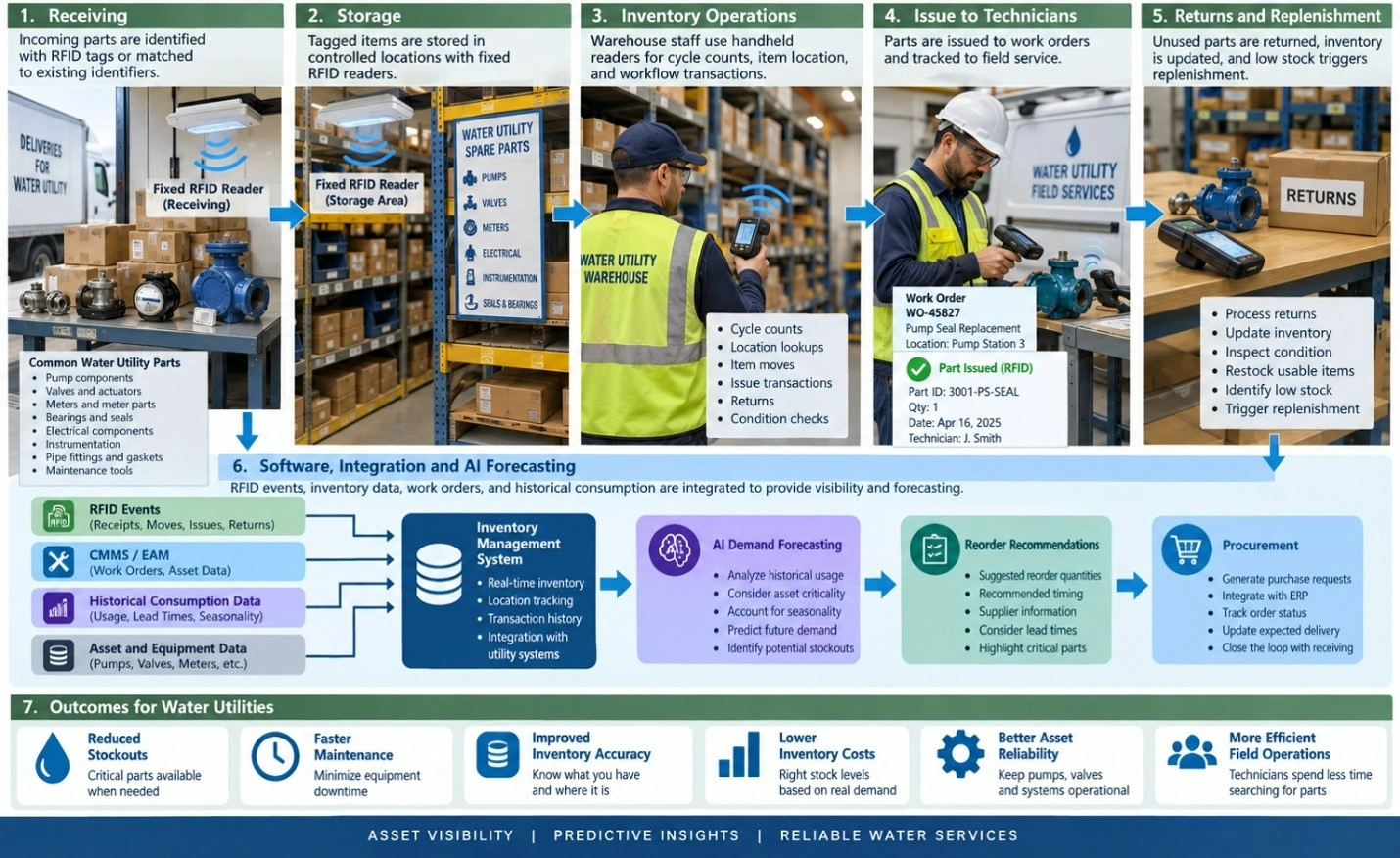
This technical infographic illustrates how a municipal water utility can use RFID identification, inventory software, CMMS/EAM data, historical consumption, and AI demand forecasting to manage maintenance spare parts. It follows the flow from receiving and storage through technician issues, returns, replenishment, procurement, and operational outcomes such as improved inventory accuracy and fewer stockouts.
AI-Assisted Field Maintenance
Water infrastructure frequently requires technicians to work outside centralized facilities. Pumping stations, reservoirs, valve chambers, remote meters, pressure-control installations, and distribution assets can be separated by significant distances.
Field maintenance software can use RFID identification to confirm which asset the technician has reached. The technician can then retrieve the relevant asset record, inspection requirements, previous work orders, service history, and documentation.
AI can assist by prioritizing work, identifying recurring maintenance patterns, recommending inspection attention, or summarizing historical information.
The final engineering decision should remain based on verified field conditions, applicable procedures, and qualified personnel. AI should support rather than obscure the reasoning behind maintenance decisions.
Water Infrastructure Operational Workflow from RFID Capture to AI Decision
Physical Asset Identification
A deployment begins by determining which water infrastructure assets require machine-readable identification.
Candidate assets may include:
- Raw-water intake pumps
- High-service pumps
- Booster pumps
- Motor control equipment
- Valve assemblies
- Actuators
- Hydrants
- Water meters
- Chemical dosing equipment
- Filter components
- Laboratory equipment
- Portable testing instruments
- Maintenance tools
- Spare parts
- Mobile maintenance equipment
The RFID tag should be selected according to the physical environment. Metal surfaces, moisture, chemical exposure, temperature variation, outdoor conditions, vibration, and mechanical abrasion can affect tag selection and mounting.
RFID Data Capture
UHF RFID can support longer-range identification and multiple-tag reading where the water utility needs to identify several assets or inventory items efficiently. HF RFID can be appropriate for shorter-range controlled interactions, while LF RFID can be considered for specialized identification environments.
Reader selection should consider the required read zone, antenna orientation, tag mounting position, asset material, interference, environmental exposure, and expected technician workflow.
A handheld reader may be appropriate for field inspection, while fixed readers can be useful at controlled locations such as maintenance depots, receiving areas, or equipment staging points.
Edge Processing and Communications
Raw RFID reads should not automatically be treated as meaningful business events. Software can filter duplicate reads, validate tag identifiers, associate a read with a known location, and determine whether the event corresponds to receiving, maintenance, inspection, movement, or another operational activity.
Local processing is particularly useful at remote pumping stations and field locations where network connectivity may be intermittent.
Depending on the water infrastructure environment, readers and gateways may communicate through Ethernet, Wi-Fi, cellular networks, or other approved communications methods.
Edge processing can also reduce unnecessary transmission of repetitive RFID events and allow selected functions to continue during temporary network outages.
Middleware and Water Utility Software Integration
RFID information becomes significantly more useful when integrated with the systems already used by the water utility.
Relevant software can include:
- Computerized maintenance management systems
- Enterprise asset management systems
- Geographic information systems
- Enterprise resource planning systems
- Warehouse management systems
- Field-service management software
- SCADA systems
- Laboratory information management systems
- IoT data services
- Asset registries
- Work-order management systems
Middleware can translate RFID events into application-level records. For example, a tag read at a maintenance depot could become an inventory transaction, while a field scan could open or update an asset-related maintenance workflow.
Unique asset identifiers and consistent master data are critical. If the same valve has different identifiers in the GIS, EAM and RFID database, AI analytics can inherit those inconsistencies and produce unreliable results.
AI Analytics and Maintenance Decisions
After RFID events have been connected to reliable asset records, AI can combine identification information with operational and historical data.
Possible analytical functions include:
- Anomaly detection for equipment behavior
- Predictive maintenance prioritization
- Work-order prioritization
- Spare-parts demand forecasting
- Asset criticality analysis
- Maintenance history analysis
- Inspection scheduling
- Field-service optimization
- Inventory risk analysis
- Failure-pattern identification
The resulting recommendation can trigger a human review, maintenance work order, inventory action, inspection request, or operational escalation.
AI-Enabled Water Infrastructure Data Flow: RFID, Sensors, Systems and AI Decisions
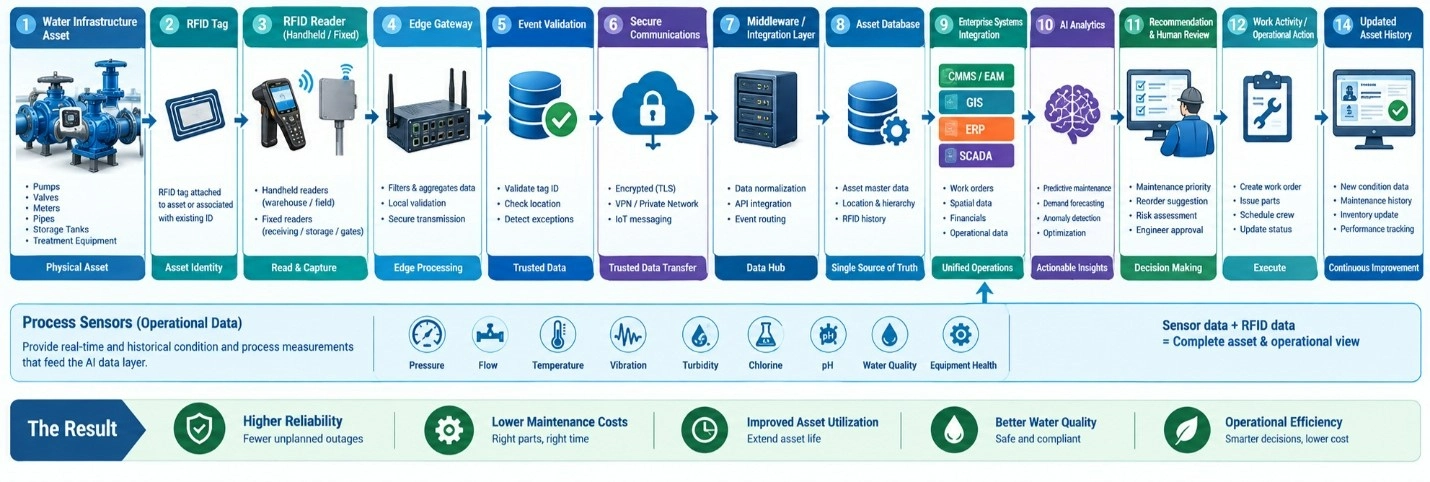
This end-to-end engineering workflow illustrates how RFID identifies water infrastructure assets while process sensors provide condition and operational data. The data moves through edge gateways, secure communications, middleware, asset databases, enterprise systems, and AI analytics before supporting human-reviewed recommendations, field actions, and continuously updated asset histories.
Engineering Design Considerations for Water Infrastructure RFID
RFID deployment should begin with the physical and operational characteristics of the water infrastructure rather than with reader specifications alone.
Treatment facilities can expose equipment to humidity, condensation, chemicals, washdown procedures, temperature changes, vibration, and corrosive conditions. Outdoor distribution assets can introduce additional challenges involving weather, physical impact, buried infrastructure, accessibility, and vandalism.
Metal is another important engineering consideration. Pumps, motors, valves, pipe assemblies, tanks, electrical cabinets, and other water infrastructure components frequently contain metal surfaces that can affect RFID coupling and antenna behavior. Tags designed for mounting on metal may therefore be necessary.
Reader placement also requires testing. A reader that performs well in a laboratory environment may behave differently near electrical equipment, pipework, steel structures, motors, and other infrastructure.
A practical deployment process should include site surveys, representative tag testing, reader-position testing, read-zone validation, environmental assessment, network testing, integration testing, and operational acceptance testing.
GAO’s experience supplying RFID hardware products and systems to organizations can support this engineering-oriented evaluation, particularly where RFID equipment must be selected around the actual physical and operational conditions of water infrastructure.
Selecting UHF, HF, or LF RFID for Water Infrastructure
| RFID Type | Water Infrastructure Fit | Typical Consideration |
|---|---|---|
| UHF RFID | Asset tracking, maintenance depots, equipment staging, spare parts, selected field assets | Longer read ranges and efficient identification of multiple tagged items |
| HF RFID | Controlled close-range identification, technician interactions, selected equipment records | Shorter-range intentional reads |
| LF RFID | Specialized identification requirements | Lower-frequency characteristics may suit particular applications |
The correct selection depends on tag construction, mounting surface, reader design, required read distance, environmental conditions, data workflow, and regulatory requirements.
No RFID frequency should be selected solely because it provides a theoretically longer read distance. Water infrastructure deployments should optimize the complete identification workflow, including tag durability, reader placement, technician behavior, data accuracy, and system integration.
Technical Components for AI-Enabled Water Infrastructure
A practical water infrastructure solution combines asset identification, operational sensing, communications, computing, software integration, analytics, and controlled human action. Each layer has a distinct engineering responsibility.
RFID Hardware for Water Infrastructure
RFID hardware selection should reflect the asset, environment, read distance, and workflow.
- UHF RFID tags and readers can support longer-range identification of equipment, maintenance inventory, tools, and selected field assets.
- HF RFID readers and tags can support deliberate close-range interactions where a technician intentionally presents an asset to a reader.
- LF RFID equipment can serve specialized identification requirements where its operating characteristics are appropriate.
- Handheld RFID readers are useful for field technicians inspecting pumps, valves, meters, reservoirs, and other distributed infrastructure.
- Fixed RFID readers can automate identification at controlled points such as maintenance depots, equipment receiving areas, storage locations, or staging zones.
- RFID antennas establish the read zone and should be positioned according to asset geometry, tag orientation, surrounding metal, and expected movement.
- Industrial gateways can connect readers and local equipment to utility networks and upstream software.
- Durable RFID tags should be selected according to moisture, chemical exposure, UV exposure, temperature, vibration, impact, and mounting-surface requirements.
RFID hardware should be validated against representative pumps, valves, meters, tools, pipe components, and inventory items before a large deployment. Water infrastructure frequently contains metal and electrically active equipment, so laboratory specifications alone are not sufficient for final reader placement.
GAO supplies RFID hardware products and systems that can be evaluated for these asset identification, maintenance, inventory, and field-service applications.
AI and Machine Learning Components
AI functions should be selected according to the decision that the water utility needs to improve.
- Anomaly detection can identify unusual patterns in pump, motor, valve, or other equipment data.
- Predictive maintenance models can estimate maintenance priorities using historical failures, operating conditions, runtime, and sensor information.
- Time-series models can analyze changing operational measurements from pumps, pressure systems, reservoirs, and treatment processes.
- Classification models can categorize inspection findings, maintenance events, or asset conditions when appropriate training data exists.
- Forecasting models can support spare-parts demand and maintenance workload planning.
- Computer vision can complement RFID identification during selected visual inspection activities.
- Natural language processing can help analyze maintenance notes, technician reports, and historical work-order descriptions.
- Edge AI can process selected data locally when a remote water facility requires low latency or reduced dependence on continuous connectivity.
AI models should be monitored for data quality, model drift, false positives, false negatives, and operational relevance. A technically sophisticated model is not useful if the underlying asset records are incomplete or the recommended action cannot be executed by the maintenance organization.
Communications and Data Infrastructure
Communication requirements vary between centralized treatment facilities and geographically dispersed water infrastructure.
Ethernet can provide reliable connectivity within treatment plants, maintenance buildings, and controlled facilities. Wi-Fi can support selected local handheld and equipment workflows. Cellular connectivity can support remote pumping stations, field-service vehicles, and distributed assets where appropriate.
Gateways can aggregate RFID and sensor information before transmitting it to centralized software. Network segmentation can separate operational technology from ordinary business traffic, while secure remote access can support authorized maintenance and support personnel.
Protocols should be selected according to the connected equipment and existing utility environment. Common integration mechanisms may include HTTPS, MQTT, REST APIs, OPC UA, database interfaces, and vendor-specific interfaces where required.
The objective is interoperability with existing water infrastructure systems rather than creating another isolated data repository.
Cloud Version and Server Version for Water Infrastructure
Cloud Version
A Cloud Version uses cloud-hosted software managed within cloud infrastructure. RFID events, asset records, analytics, dashboards, and selected AI services can be accessed by authorized water infrastructure personnel across multiple facilities or service territories.
Cloud deployment can be appropriate when a utility needs centralized visibility across numerous treatment facilities, pumping stations, warehouses, and field teams. It can also simplify centralized software updates and provide scalable computing resources for analytics.
However, cloud connectivity should not be assumed to be continuously available at every remote pumping station. Edge processing can retain essential identification and operational functions locally and synchronize information when connectivity becomes available.
Server Version
A Server Version deploys software on customer-managed servers, private data centers, edge servers, utility-owned computing infrastructure, or other privately hosted environments.
This model can be appropriate where water infrastructure operators require tighter control over data location, network boundaries, operational technology integration, or internal cybersecurity policies.
A private deployment may also be useful where remote infrastructure has restricted external connectivity. Local servers can process RFID events and integrate with internal CMMS, EAM, GIS, SCADA, and inventory systems without requiring every transaction to travel to an external cloud service.
The choice should be based on utility requirements rather than assuming that either model is universally superior.
| Consideration | Cloud Version | Server Version |
|---|---|---|
| Multi-site visibility | Strong fit for centralized operations | Strong fit when connected through private networks |
| Remote facilities | Requires suitable connectivity, with edge processing recommended | Can provide local processing within private infrastructure |
| Software maintenance | Centralized management can simplify updates | Utility manages deployment and updates |
| Data control | Depends on cloud configuration and governance | Greater control over private hosting environment |
| Scaling analytics | Cloud resources can support variable workloads | Scaling depends on available private computing resources |
| Integration | APIs and secure network connections required | Direct integration with private systems may be practical |
| Best fit | Distributed utilities seeking centralized access | Utilities requiring private hosting or tightly controlled networks |
Cybersecurity and Data Protection for Water Infrastructure
Water infrastructure systems require cybersecurity controls because asset information may connect to operational technology, maintenance systems, remote facilities, and critical public services.
RFID should therefore be treated as one component of a broader security design.
Relevant controls include:
- Unique credentials for readers, gateways, applications, and administrative users
- Role-based access control for maintenance, engineering, operations, IT, and management personnel
- Encryption for data transmitted between RFID readers, gateways, servers, and cloud services
- Network segmentation between operational technology and enterprise IT environments
- Secure API authentication for CMMS, EAM, GIS, ERP, and other integrations
- Audit logging for asset identification, configuration changes, maintenance transactions, and administrative actions
- Firmware and software update procedures for readers, gateways, and connected computing equipment
- Backup and recovery procedures for asset records and operational databases
- Device inventory and lifecycle management
- Controlled remote access for authorized technical support
- Security testing before production deployment
- Incident response procedures covering connected RFID and IoT components
Water infrastructure cybersecurity should also consider the consequences of incorrect data. A manipulated asset identifier or inaccurate maintenance record may lead to an operational error even if the underlying RFID reader remains functional.
GAO’s support model includes remote or onsite expert assistance, which can be valuable during system configuration, deployment, troubleshooting, and technical evaluation.
Cybersecurity Layer Diagram for AI-Enabled Water Infrastructure
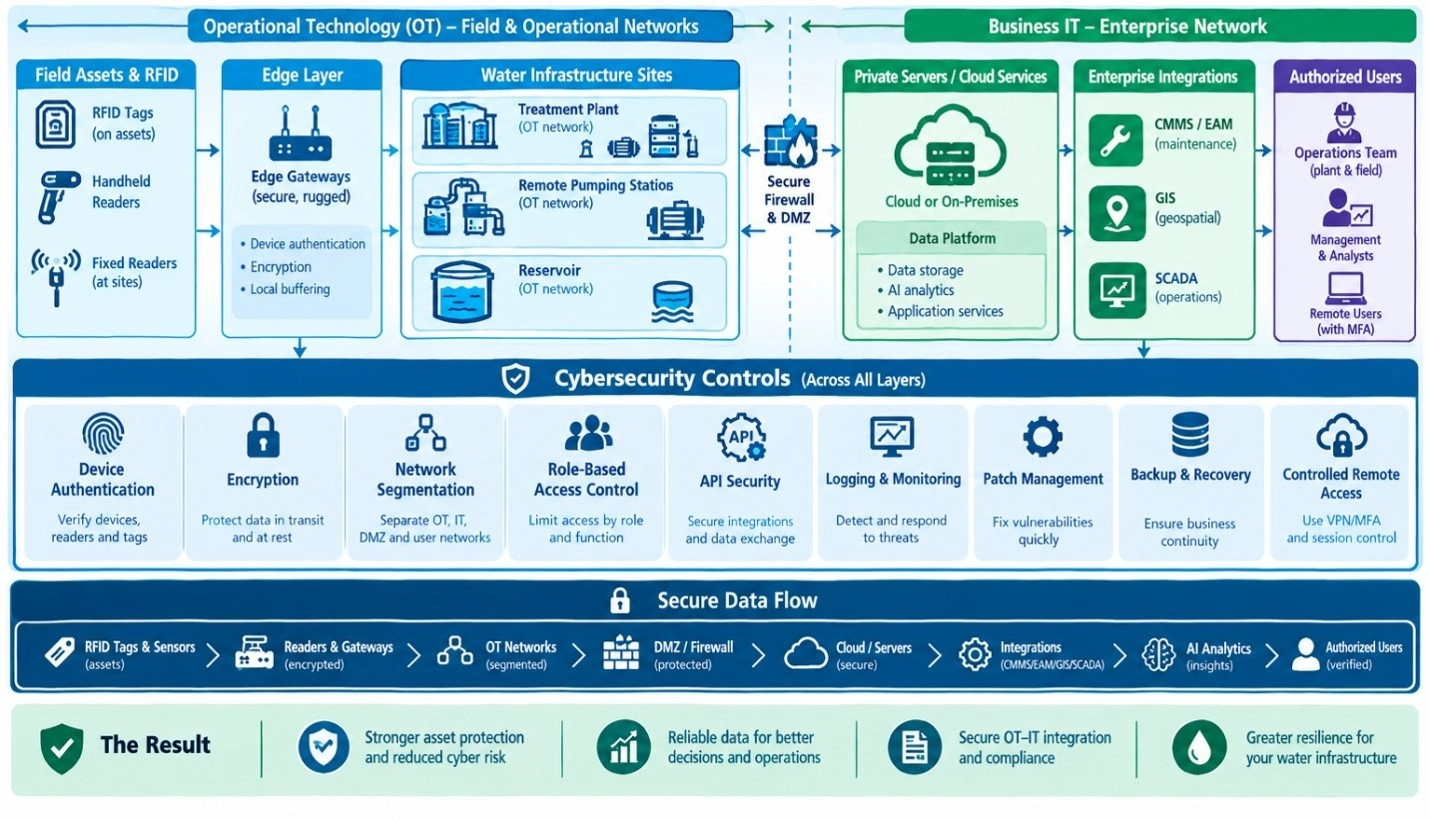
This layered cybersecurity diagram illustrates how security controls protect an AI-enabled water infrastructure solution from RFID tags and field devices through OT networks, edge gateways, cloud or private servers, enterprise integrations, AI analytics, and authorized users. It highlights device authentication, encryption, network segmentation, role-based access, API security, monitoring, patch management, backup and recovery, and controlled remote access. The key takeaway is that layered security enables secure data flow while protecting operational technology and business IT.
Integrating AI and RFID with Existing Water Utility Systems
Integration should preserve existing operational investments wherever practical.
A CMMS or EAM system can remain the system of record for maintenance history while RFID supplies physical asset identification. GIS can continue managing spatial relationships while RFID confirms the physical identity of selected components during field work.
SCADA can remain responsible for supervisory control and process monitoring, while AI applications analyze selected historical or streaming data for decision support. ERP and inventory systems can continue managing procurement and financial records while RFID improves physical inventory transactions.
A typical integration sequence is:
- Define the authoritative identifier for each asset.
- Map RFID identifiers to existing asset IDs.
- Establish data ownership between CMMS, EAM, GIS, ERP, SCADA, and RFID software.
- Define which RFID events represent meaningful business transactions.
- Configure APIs, middleware, or database interfaces.
- Validate timestamp, location, asset, user, and transaction information.
- Test duplicate events and communication interruptions.
- Verify synchronization between field transactions and central records.
- Establish monitoring and error-handling procedures.
The most important integration lesson is to avoid treating every RFID read as an independent business transaction. A reader may detect the same tag repeatedly because an asset remains inside the read zone. Middleware must distinguish between raw reads and meaningful events such as asset arrival, inspection confirmation, inventory movement, or maintenance activity.
Implementing AI-Enabled RFID Across Water Infrastructure
Planning and Asset Prioritization
The initial deployment should focus on a defined operational problem.
Suitable pilot areas can include a maintenance depot, a major pumping station, a water treatment facility, or a specific field maintenance program.
Asset criticality should influence tag deployment. A high-value pump or critical valve may justify more detailed tracking than a low-cost consumable component.
Site Survey and Hardware Selection
Engineering teams should document:
- Asset construction materials
- Metal mounting surfaces
- Environmental exposure
- Required read distance
- Expected number of tags in each read zone
- Reader and antenna mounting locations
- Electrical power availability
- Network availability
- Technician workflow
- Equipment accessibility
- Required tag durability
- Potential sources of radio interference
Representative tags should be physically tested on actual water infrastructure equipment before procurement at scale.
Commissioning and Acceptance Testing
Testing should verify both technical performance and operational usefulness.
Important tests include:
- RFID read reliability
- Read-zone boundaries
- Tag identification accuracy
- Reader connectivity
- Network resilience
- Duplicate-event filtering
- Asset-record matching
- CMMS/EAM integration
- Work-order creation or updating
- Inventory transaction accuracy
- AI data quality
- User access controls
- Failure recovery
- Offline or degraded-connectivity behavior
Acceptance criteria should be defined before deployment rather than after problems appear.
Optimization and Maintenance
RFID installations require ongoing attention. Tags may become damaged, equipment may be relocated, reader environments may change, and software integrations may be modified.
Maintenance programs should therefore include periodic tag inspection, reader health monitoring, database reconciliation, firmware management, integration monitoring, and review of AI model performance.
Water infrastructure also changes over time. New pumping stations, pipeline extensions, replacement valves, upgraded meters, and renovated treatment equipment should enter the asset identification process as part of normal capital-project and maintenance workflows.
Measuring the Value of AI-Enabled Water Infrastructure
Water utilities should define measurable outcomes rather than evaluating the solution solely by the number of RFID tags installed.
Relevant KPIs can include:
| KPI | What It Measures |
|---|---|
| Asset identification accuracy | Correct association between physical assets and digital records |
| Maintenance work-order accuracy | Correct assignment of work to the intended asset |
| Mean time to repair | Time required to restore equipment after a maintenance event |
| Preventive maintenance compliance | Percentage of scheduled maintenance completed as planned |
| Unplanned equipment downtime | Disruption associated with unexpected equipment failures |
| Spare-parts stockout rate | Frequency of unavailable required maintenance components |
| Inventory accuracy | Agreement between physical and recorded inventory |
| Field-service productivity | Maintenance activity completed per technician or work period |
| Inspection completion rate | Completion of required asset inspections |
| Asset-record completeness | Availability of required information for maintained assets |
| RFID read success rate | Successful identification under defined operating conditions |
| AI alert precision | Proportion of AI alerts that lead to relevant investigation or action |
The appropriate KPI set depends on the water infrastructure problem being addressed. A pumping-station predictive-maintenance project should emphasize equipment availability and maintenance outcomes, while a utility warehouse project should place greater emphasis on inventory accuracy and stockout reduction.
Operational and Business Benefits for Water Infrastructure
Better Asset Traceability
Reliable identification connects pumps, valves, meters, tools, and spare parts to their digital records. This can reduce uncertainty during maintenance and field inspection.
Faster Maintenance Workflows
Technicians can spend less time manually searching for equipment records when RFID identification automatically retrieves the relevant asset information.
Improved Maintenance Prioritization
AI can analyze equipment condition and historical information to identify maintenance priorities, allowing teams to focus resources on assets presenting greater operational risk.
Better Spare-Parts Availability
AI-assisted demand analysis combined with RFID inventory tracking can provide a clearer view of which components are available, where they are stored, and how frequently they are consumed.
Improved Data Quality
Automated identification can reduce errors associated with manually entering equipment numbers, particularly during repetitive warehouse and field-service activities.
Scalable Multi-Site Operations
A common asset-identification approach can be extended from a treatment plant or depot to multiple pumping stations, reservoirs, maintenance facilities, and field-service operations, provided the deployment is standardized appropriately.
Stronger Maintenance Accountability
RFID events can establish an auditable relationship between an identified asset, technician activity, maintenance transaction, and updated asset record.
GAO Expertise for Water Infrastructure RFID Solutions
GAO is headquartered in New York City and Toronto, Canada, and is ranked among the top 10 leading B2B and B2G BLE and RFID suppliers in the world. Our RFID hardware and systems can support organizations that need practical identification and tracking capabilities across maintenance, inventory, field operations, and physical asset management.
GAO, GAO Research Inc., and GAO Tek Inc. form GAO Group, with operations based in New York City and Toronto. For three decades, the group has served customers in the United States and Canada, including Fortune 500 companies, leading research and development organizations, universities, and government agencies.
Our work in RFID and related IoT technologies includes hardware products and systems designed for different operational environments. Stringent quality assurance processes and remote or onsite expert support are important considerations when deploying connected identification systems within operational water infrastructure.
Key Implementation Recommendations for Water Infrastructure
Successful AI-enabled water infrastructure projects generally depend more on disciplined implementation than on deploying the largest number of connected devices.
- Start with a defined water infrastructure problem such as pump maintenance, valve verification, inventory accuracy, or field asset identification.
- Establish authoritative asset IDs before connecting RFID data to AI applications.
- Test UHF, HF, and LF RFID options against actual asset materials and environmental conditions.
- Use on-metal or environmentally durable tags where the physical installation requires them.
- Separate RFID identification from process sensing and do not expect RFID tags to replace dedicated water or equipment instrumentation.
- Use edge processing where remote sites have unreliable connectivity or require local response.
- Integrate RFID events with existing CMMS, EAM, GIS, ERP, SCADA, and inventory systems rather than creating isolated records.
- Treat raw RFID reads as events requiring validation before they become business transactions.
- Apply cybersecurity controls to readers, gateways, servers, APIs, and user accounts.
- Establish measurable KPIs before implementation.
- Pilot the system in a representative treatment plant, pumping station, maintenance depot, or field-service workflow.
- Perform acceptance testing using actual water infrastructure equipment and technician workflows.
- Expand the deployment only after read reliability, integration, data quality, and operational benefits have been demonstrated.
- Maintain tags, readers, software integrations, asset records, and AI models throughout the infrastructure lifecycle.
Advancing AI-Enabled Water Infrastructure with GAO
AI can make water infrastructure maintenance and asset management more data-driven, but useful results depend on trustworthy physical asset identity and reliable operational data. RFID provides that identity layer for selected pumps, valves, meters, tools, spare parts, and other infrastructure components, while AI can analyze the resulting information alongside sensor, SCADA, maintenance, GIS, and inventory data.
The strongest deployments begin with an operational requirement, validate the physical RFID environment, integrate with existing utility software, protect connected systems, and measure outcomes through defined KPIs.
GAO can help organizations evaluate RFID hardware products and systems for water infrastructure applications and develop practical approaches to asset identification, tracking, maintenance, and field operations. Readers seeking additional information can explore GAO’s RFID technology solutions, products, engineering resources, and technical support for their specific water infrastructure requirements.
Building the Future of Industrial AI and IoT with Aperture Venture Studio and GAO RFID Inc.
For more than three decades, GAO Group of Companies has invested heavily in R&D of industrial RFID, BLE, and IoT. As generative AI has become useful in industrial applications, we have continued developing AI and IoT technologies, including RFID and BLE, and have founded Aperture Venture Studio to advance AI and IoT solutions relevant to areas such as water infrastructure, asset management, and industrial operations.
Aperture has attracted AI and IoT technical experts, entrepreneurial and operational executives, influential investors, and leading companies. We have also developed Aperture Ventures Summit and TekSummit to discuss advanced AI and IoT topics and build vibrant technical communities around these technologies.
We welcome you to join us as:
- Advisors, Co-founders, or Employees
- Investors
- Customers