
AI for Household Products Manufacturing with RFID
How AI Improves Household Products Manufacturing
AI is increasingly being applied to household products manufacturing to improve inventory accuracy, production visibility, quality control, material traceability, demand planning, and warehouse execution. Household products such as cleaning products, cookware, storage containers, paper goods, small household accessories, personal-care-related items, and other consumer products often involve high SKU counts, frequent packaging changes, multiple material inputs, and large-volume production. These conditions create operational data challenges that conventional manual records and disconnected systems may not adequately address.
AI becomes more useful when it can work with reliable physical-world data. RFID provides that data by identifying raw-material containers, work-in-process items, finished goods, cases, pallets, reusable handling assets, and selected production equipment. UHF RFID is particularly applicable to receiving, warehouse, production, and shipping processes, while HF or LF RFID can be appropriate for shorter-range identification requirements.
AI software can combine RFID events with information from MES, ERP, WMS, QMS, production schedules, inventory records, and transportation systems. The resulting system can detect discrepancies, forecast material requirements, identify abnormal production patterns, prioritize inventory actions, and provide operational recommendations. GAO supplies RFID, BLE, and IoT hardware products and systems that can provide the physical data required for these applications.
AI Applications Across Household Products Operations
Household products manufacturers operate interconnected processes from raw-material receiving through finished-goods shipment. AI applications should therefore be selected according to specific operational decisions rather than deployed simply to collect more data.
AI Inventory Management for Household Products
Inventory management is a major application because household products manufacturing can involve thousands of individual SKUs, packaging configurations, ingredients or materials, components, cartons, labels, and finished products.
RFID events can establish when tagged materials enter receiving, move into storage, reach production staging, or leave the facility. AI can combine those events with ERP and WMS records to identify inventory discrepancies and unusual material movements.
Relevant applications include:
- Automated inventory reconciliation between physical stock and WMS records
- Detection of unexplained material movements
- Identification of slow-moving household-product SKUs
- Demand forecasting for raw materials, packaging components, and finished goods
- Production-material availability prediction
- Identification of inventory approaching required shelf-life or storage limits
- Automated verification of pallet and case movements
- Prioritization of cycle counts based on predicted inventory risk
The strongest results occur when RFID identification is associated with meaningful business context such as SKU, lot, batch, purchase order, production order, storage location, and inventory status.
AI Production Scheduling and Material Staging
Production environments for household products may operate multiple filling, molding, forming, assembly, labeling, printing, packaging, or case-packing processes. Production schedules can change because of customer orders, material availability, equipment downtime, quality holds, or packaging requirements.
AI can evaluate production orders against material availability and historical production performance. RFID provides physical confirmation that required materials or components have reached the appropriate staging location.
For example, a production-order analysis system could compare:
- Scheduled production orders
- Required raw materials
- Packaging-component availability
- RFID-confirmed material locations
- Current work-in-process status
- Equipment availability
- Historical cycle times
- Quality-hold conditions
- Warehouse replenishment status
The resulting recommendation can help production planners identify orders at risk of delay before the shortage becomes visible at the production line.
AI Quality Control and Product Traceability
Quality management is particularly important when household products involve multiple production lots, formulations, components, packaging versions, or supplier inputs. A traceability system can associate RFID events with production and quality records to reconstruct the movement of materials through manufacturing.
AI can analyze production and inspection data to identify relationships between quality deviations and factors such as:
- Raw-material lot
- Supplier
- Production line
- Machine operating conditions
- Production shift
- Packaging configuration
- Operator-entered process information
- Environmental measurements
- Inspection results
RFID does not determine whether a product is acceptable. Instead, it supplies reliable identification and movement events that can strengthen the data used by QMS and AI analytics.
This distinction is important for technically responsible system design. AI should support quality investigation, anomaly detection, and prioritization while established quality procedures remain responsible for product disposition.
AI Warehouse Management for Household Products
Finished household products frequently move through staging areas, storage racks, picking zones, cross-docking locations, and shipping docks. Manual scanning can introduce gaps when cases or pallets move rapidly through these processes.
AI-enabled warehouse software can use RFID events to analyze inventory movements and identify operational exceptions.
Potential applications include:
- Pallet and case location verification
- Automated receiving confirmation
- Shipment-content verification
- Picking-error detection
- Dock-door movement analysis
- Storage-location optimization
- Inventory-dwell analysis
- Replenishment prediction
- Exception prioritization
- Shipment readiness analysis
A useful implementation does not require every individual item to carry an RFID tag. Manufacturers can determine whether item-level, case-level, or pallet-level identification provides the appropriate balance between visibility, read reliability, tag cost, and operational value.
AI and RFID Use-Case Matrix for Household Products Manufacturing
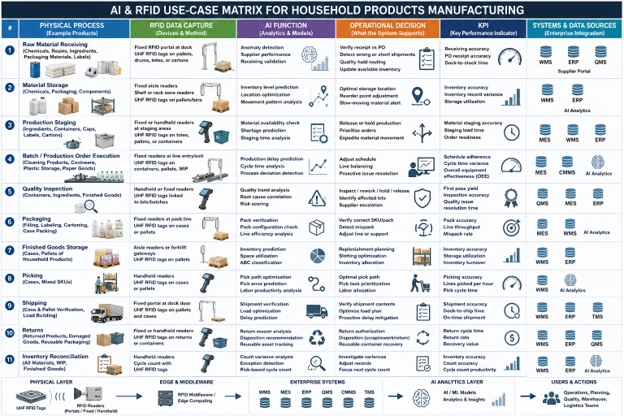
This matrix maps household-products manufacturing workflows to RFID data capture, AI analytics, operational decisions, KPIs, and connected systems. It shows how UHF RFID events can support inventory, production, quality, packaging, warehouse, and shipping processes.
RFID-Enabled Data Collection for AI Decisions
AI models are only as useful as the operational data supplied to them. Household products manufacturing generates data from machines, warehouse transactions, production orders, quality inspections, material movements, and shipping activities. RFID can add a physical-event layer that helps establish what actually happened in the facility.
Raw Material and Packaging Identification
RFID tags can be attached to suitable raw-material containers, component bins, packaging materials, cases, or pallets. A fixed reader at receiving can capture identification events as materials enter the facility, while handheld readers can support exception handling and inventory verification.
The RFID record can be associated with:
- SKU or material number
- Supplier
- Lot or batch
- Purchase order
- Quantity
- Storage location
- Quality status
- Production order
- Receiving timestamp
AI software can subsequently analyze these records alongside ERP and WMS data.
Work-in-Process Visibility
Household products can pass through multiple manufacturing and packaging stages before becoming finished goods. RFID can provide event records when tagged containers, totes, cases, pallets, or production assets enter designated read zones.
AI can use these events to estimate production progress, identify unusual dwell times, and detect deviations from expected process sequences.
For example, if a production order normally moves from material staging to processing and packaging within defined time ranges, repeated deviations may indicate material shortages, equipment constraints, quality holds, or workflow congestion. The AI system can flag the condition for an appropriate production or operations team rather than treating the RFID event itself as the decision.
Finished Goods and Shipping Verification
Finished household products can be identified at packaging completion and again when pallets or cases enter shipping areas. RFID readers can capture movement through designated read zones and provide electronic evidence of shipment activity.
AI can compare RFID-confirmed contents with planned shipment data and identify discrepancies such as:
- Missing cases
- Unexpected SKUs
- Incorrect quantities
- Unreleased inventory
- Products assigned to the wrong shipment
- Unusual shipping delays
- Repeated picking exceptions
This creates a closed operational data loop between manufacturing, warehouse execution, and outbound logistics.
Household Products AI and RFID Workflow
A practical system begins with physical identification and ends with an operational action. The sequence is more important than simply installing RFID readers or selecting an AI model.
From Physical Event to Operational Decision
The workflow generally follows these stages:
- Data acquisition: RFID readers capture tag identifiers and timestamps as materials, products, pallets, cases, or assets pass through defined read zones.
- Connectivity: RFID readers communicate with local gateways, industrial computers, or network infrastructure.
- Data normalization: Middleware converts raw RFID reads into meaningful events such as received, moved, staged, packed, stored, picked, or shipped.
- Context enrichment: Events are associated with SKU, lot, production order, location, supplier, shipment, or quality status from business systems.
- Data storage: Operational events can be retained in databases suitable for transaction analysis, historical reporting, and time-series or event-based analytics.
- AI processing: Machine-learning models, anomaly detection methods, forecasting algorithms, optimization models, or other AI methods analyze the combined data.
- Decision support: The system generates an exception, prediction, risk score, forecast, or recommended action.
- Business action: Warehouse, production, quality, planning, or logistics personnel act through the appropriate software system.
- Feedback: Actual outcomes are retained so that rules, thresholds, forecasts, and AI models can be evaluated and improved.
Deployment Considerations for Household Products Manufacturing
Successful deployment depends on more than RFID tag selection. Read-zone engineering, metal and liquid interference, antenna positioning, tag orientation, reader power, conveyor speed, network connectivity, data-event filtering, and integration with existing manufacturing software all influence system performance.
Household products can present challenging RFID conditions. Liquids can attenuate UHF RFID signals, while metal cookware, appliances, metal containers, shelving, and machinery can affect RF behavior. Plastic packaging can have different read characteristics depending on material composition and geometry. Consequently, RFID testing should be performed using representative products, packaging configurations, pallets, and operating conditions before a large deployment.
Read zones should be designed around actual movement patterns. A portal at a receiving dock, for example, should capture intended pallet movement without generating excessive reads from adjacent staging areas. Production applications may require smaller controlled read zones or handheld readers where fixed-reader deployment does not provide sufficient selectivity.
GAO’s RFID hardware and IoT systems can be incorporated into these data-collection layers according to the identification range, read-zone, environmental, and integration requirements of the household-products operation.
RFID Hardware and AI System Components
A household-products solution typically combines identification hardware, communication infrastructure, enterprise software, and AI processing. Each layer has a specific engineering responsibility.
UHF RFID
UHF RFID is generally suited to longer-range identification of cases, pallets, containers, and selected individual products. Fixed readers and antennas can create controlled read zones at receiving docks, production transfer points, warehouse aisles, packaging areas, and shipping locations.
Tag selection should account for the physical product. Household products containing liquids, metal components, foil packaging, or dense materials may require specialized tag designs and validation.
HF and LF RFID
HF RFID can be appropriate for shorter-range identification where controlled proximity reading is preferred. LF RFID provides shorter-range identification and can be useful for specialized applications where the operating environment and required read distance favor LF technology.
The appropriate RFID frequency should therefore be selected from the workflow and physical environment rather than from a generic preference for one RFID type.
RFID Readers, Antennas, and Gateways
Fixed readers capture tag events within defined zones, while handheld readers provide mobile identification for cycle counting, exception handling, inventory verification, and troubleshooting.
Gateways or edge computers can perform local filtering and event processing before forwarding validated information to enterprise software. This reduces unnecessary raw reads and helps separate physical RFID events from meaningful business transactions.
AI Analytics Software
AI processing can include demand forecasting, anomaly detection, inventory-risk scoring, production-delay prediction, process mining, classification, and optimization. The appropriate model depends on the decision being supported and the quality and volume of available historical data.
AI should not be treated as a replacement for the manufacturing control system. Its role is generally to interpret operational information, identify patterns, predict conditions, and support decisions made by authorized personnel or established business software.
MES, ERP, WMS, and QMS Integration
Integration connects RFID events with the systems already used to manage household-products manufacturing.
- MES can provide production-order, routing, work-in-process, and production-status context.
- ERP can provide material, purchasing, inventory, order, and financial information.
- WMS can provide warehouse locations, receiving, picking, replenishment, and shipping transactions.
- QMS can provide inspection, quality-hold, nonconformance, and release information.
- CMMS can provide maintenance records when RFID or related IoT identification is applied to equipment or reusable maintenance assets.
Middleware and APIs can transform RFID events into the formats required by these systems while maintaining timestamps, identifiers, locations, and transaction relationships.
Cloud Version and Server Version
A Cloud Version can host AI analytics and associated software within cloud infrastructure. This model can be useful for household-products manufacturers operating multiple plants that need centralized analytics, cross-site demand forecasting, common KPI definitions, or consolidated inventory visibility. Reliable network connectivity and appropriate data governance remain important considerations.
A Server Version can run on an edge server, factory server, customer-managed server, private data center, or other privately hosted infrastructure. This approach can be appropriate where manufacturing data must remain within controlled infrastructure, where local processing is important, or where network connectivity to external cloud infrastructure is constrained.
Hybrid implementations are also possible. RFID event processing and immediate exception detection can occur locally, while aggregated historical data can be transferred to centralized analytics services.
Engineering Design Priorities Before Deployment
Household-products manufacturers should validate the physical and software layers together. RFID performance that appears acceptable in a laboratory may change substantially when products are stacked, wrapped, placed near metal, filled with liquid, or moved rapidly through a production or shipping environment.
The initial engineering assessment should examine:
- Product materials and packaging construction
- Liquid and metal content
- Tag attachment surface and orientation
- Required read distance
- Conveyor or forklift movement speed
- Reader and antenna placement
- Adjacent RFID read zones
- Electromagnetic interference
- Network availability
- Existing MES, WMS, ERP, and QMS interfaces
- Required event latency
- Data retention requirements
- Cybersecurity controls
- Operator workflows
- Exception-handling procedures
- KPI definitions and baseline measurements
A pilot should use representative household products and actual operating conditions. Testing should measure read accuracy, missed reads, unintended reads, duplicate events, event latency, location accuracy where applicable, and the effect of packaging changes.
GAO has served organizations in the United States and Canada for three decades, including Fortune 500 companies, research and development organizations, universities, and government agencies. GAO, headquartered in New York City and Toronto, works with RFID, BLE, and IoT hardware products and systems and provides technical support for deployments that may require remote or onsite assistance.
AI Models for Household Products Manufacturing
AI implementation should begin with the operational question rather than with a particular machine-learning technique. Household products manufacturers can apply different AI methods depending on whether the objective is forecasting demand, detecting abnormal inventory movement, predicting production delays, or identifying patterns associated with quality problems.
Demand Forecasting
Demand forecasting models can analyze historical sales, seasonality, customer orders, SKU-level demand, promotions, regional requirements, and production history. RFID-derived inventory movements can provide additional evidence about actual material and finished-goods flows.
Forecasting can support:
- Raw-material purchasing
- Packaging-material planning
- Production scheduling
- Finished-goods replenishment
- Safety-stock decisions
- Warehouse capacity planning
- Multi-site inventory allocation
A useful forecasting implementation should distinguish between demand variability and physical inventory availability. An apparent inventory shortage may result from inaccurate records, material held in quarantine, production staging, or inventory located at an unexpected warehouse position.
Anomaly Detection
Anomaly detection is particularly useful when manufacturers have large volumes of RFID events and transactional records that are difficult to inspect manually.
AI can identify unusual patterns such as:
- Unexpected material movements
- Repeated inventory discrepancies
- Abnormally long production dwell times
- Unusual picking sequences
- Repeated shipment exceptions
- Unexpected production-order delays
- Unusual movement of reusable containers
- Deviations from normal material-flow patterns
Rather than treating every unusual event as an error, the system can assign an anomaly score and provide contextual information for investigation.
Predictive Production Analytics
Historical production data can be used to estimate whether a household-products production order is likely to finish on schedule. Useful variables may include production-line history, changeover duration, material availability, equipment status, work-in-process dwell time, quality holds, and actual RFID-confirmed material movement.
The objective is not simply to predict a completion time. A more useful system identifies the factors contributing to a predicted delay so that production planners can intervene.
AI-Assisted Quality Investigation
AI can correlate quality records with production history, material lots, supplier information, equipment conditions, and RFID-based genealogy events. This can reduce the time required to identify potentially affected lots or determine where a process deviation occurred.
For example, if a quality investigation identifies a problem associated with a particular packaging component lot, the system can query historical identification and movement events to determine which production orders and finished-goods batches received that component.
Quality personnel can then investigate the relevant records using established procedures.
Cybersecurity for AI and RFID Systems
Connecting RFID readers, edge computers, manufacturing systems, and AI software introduces additional network and data-security considerations. A household-products manufacturer should treat the RFID and AI environment as part of its broader operational technology and information technology security program.
Important controls include:
- Network segmentation between operational technology and business networks
- Authenticated communication between readers, gateways, and servers
- Role-based access control
- Least-privilege permissions
- Encryption for data transmitted across networks
- Secure API connections to MES, ERP, WMS, and QMS
- Centralized event logging
- Device inventory and configuration management
- Controlled firmware updates
- Backup and recovery procedures
- Monitoring for unauthorized device or account activity
- Protection of AI models and analytical data
- Defined retention policies for operational records
RFID readers should not automatically receive unrestricted access to production systems. A gateway or middleware layer can provide a controlled boundary between identification hardware and enterprise applications.
The system should also distinguish monitoring and decision-support functions from safety-critical machine control. RFID and AI applications can provide operational recommendations without being directly responsible for emergency stops, machine interlocks, or other safety functions unless a separately engineered and validated control system is specifically designed for that purpose.
KPIs for AI-Enabled Household Products Operations
Performance measurement should be established before implementation so that the manufacturer can determine whether the solution produces measurable operational improvement.
Relevant KPIs include:
| KPI | Application | AI and RFID Contribution |
| Inventory accuracy | Raw materials, packaging, finished goods | RFID physical events help reconcile inventory while AI identifies discrepancies |
| Inventory record variance | Warehouse and production staging | AI detects recurring differences between physical and system records |
| Stockout frequency | Materials and finished goods | Forecasting helps identify potential shortages |
| Forecast accuracy | SKU and material planning | AI evaluates historical demand and operational data |
| Production schedule adherence | Production orders | AI identifies orders at risk of delay |
| Material staging time | Production supply | RFID events measure movement from storage to production |
| Production dwell time | Work-in-process | Event histories identify abnormal waiting periods |
| Picking accuracy | Warehouse | RFID verifies selected cases or pallets where deployed |
| Shipment accuracy | Outbound logistics | RFID events can compare actual contents with planned shipments |
| Quality investigation time | QMS | RFID genealogy helps locate relevant material and production records |
| RFID read accuracy | Identification zones | Measures whether deployed read zones capture intended events |
| Exception response time | Warehouse and production | AI prioritizes operational exceptions |
KPIs should be defined according to actual business processes. A manufacturer should not use RFID read counts as a substitute for operational performance. The important measurement is whether reliable physical-event data improves inventory control, production execution, quality investigation, or logistics decisions.
Deployment Lifecycle for Household Products Manufacturing
A phased implementation is generally more practical than attempting to tag every product and connect every manufacturing process simultaneously.
Use-Case Selection
The initial project should target a measurable operational problem. Examples include inaccurate finished-goods inventory, poor material staging visibility, shipment discrepancies, or difficulty reconstructing material genealogy.
The selected use case should have:
- A defined operational owner
- A measurable baseline
- Clearly identified data sources
- A specific business decision
- A manageable physical deployment area
- An agreed success criterion
Site Assessment and RFID Testing
A site survey should examine receiving docks, warehouse aisles, production lines, staging areas, packaging operations, and shipping zones.
Testing should use actual household products because RF performance can vary substantially according to product composition and packaging.
Engineers should test:
- Tag attachment positions
- Tag orientation
- Reader antenna placement
- Read distance
- Product stacking
- Pallet configuration
- Conveyor movement
- Forklift movement
- Metal proximity
- Liquid-filled products
- Packaging changes
- Adjacent read-zone interference
Integration and Commissioning
After hardware selection, readers and gateways can be commissioned and connected to the appropriate network. Middleware should convert raw tag observations into business events before those events reach MES, WMS, ERP, QMS, or AI software.
Integration testing should verify:
- Correct identifier mapping
- Correct SKU and lot associations
- Accurate timestamps
- Correct location mapping
- Duplicate-event handling
- Offline-event recovery
- API reliability
- User permissions
- Exception routing
- Data synchronization
AI Baseline and Pilot
AI models should initially operate against validated historical and live data. A baseline period can establish normal inventory movement, production dwell times, demand patterns, or shipment behavior.
The pilot should then measure whether the AI produces useful predictions or exceptions without creating excessive false positives.
A practical pilot should include operational users. Warehouse personnel, production planners, quality specialists, and IT teams can identify problems that may not be visible from technical testing alone.
Optimization and Expansion
After the pilot, the manufacturer can refine tag placement, reader locations, event rules, AI thresholds, integration logic, dashboards, and user workflows.
Expansion should be based on measured results rather than the number of RFID readers installed.
Scaling AI and RFID Across Household Products Plants
Multi-site household-products manufacturers can extend successful deployments across plants, distribution centers, and regional warehouses. However, scaling should not assume that identical RFID configurations will work everywhere.
Product packaging, building construction, production-line layout, network infrastructure, warehouse processes, and local operating procedures can differ between facilities.
A scalable deployment should therefore standardize the logical data model while allowing site-specific physical configuration.
Common data elements can include:
- Material ID
- SKU
- Lot or batch number
- Production order
- Pallet ID
- Case ID
- Location ID
- Reader ID
- Event type
- Timestamp
- Quality status
- Shipment ID
Standardized event structures allow AI software to compare processes across plants while preserving the physical differences of each site.
Multi-site analytics can identify variations in inventory accuracy, production dwell time, shipment exceptions, or material staging performance. Site-level teams can then investigate the operational reasons for those differences.
Practical Integration with Existing Manufacturing Systems
AI and RFID should complement the systems already used by household-products manufacturers instead of creating parallel records that conflict with established applications.
A practical division of responsibilities may look like this:
- RFID hardware: Captures physical identification events.
- RFID middleware: Filters and interprets raw reader observations.
- Edge computing: Performs local processing, buffering, and selected low-latency analytics.
- WMS: Manages warehouse locations, receiving, picking, replenishment, and shipping transactions.
- MES: Provides production-order and work-in-process context.
- ERP: Provides enterprise material, purchasing, inventory, order, and planning information.
- QMS: Maintains quality inspections, holds, nonconformances, and release information.
- AI software: Identifies patterns, predicts conditions, detects anomalies, and supports operational decisions.
- CMMS: Manages maintenance records when equipment-monitoring applications are included.
- Dashboards: Present KPIs, exceptions, predictions, and operational trends to authorized users.
APIs, message brokers, MQTT, OPC UA, industrial Ethernet, and other integration methods may be selected according to the existing IT and OT environment.
The key engineering principle is to define which system owns each business record. RFID should not become a second uncontrolled inventory database, and AI predictions should not silently overwrite authoritative ERP, MES, WMS, or QMS records.
Business Value of AI for Household Products Manufacturing
The value of AI becomes measurable when physical manufacturing events are connected with decisions that affect cost, throughput, inventory, quality, and customer service.
H3: More Accurate Inventory
RFID can provide automated physical observations, while AI can identify discrepancies and predict inventory risks. Together, they can reduce dependence on manually updated location records and help warehouse teams focus cycle-counting activity where discrepancies are more likely.
Better Production Visibility
Production planners can gain better visibility into whether materials have reached staging areas and whether work-in-process is moving according to expected patterns.
AI can distinguish normal process variation from conditions that warrant attention, helping teams prioritize production constraints.
Improved Traceability
Associating RFID events with lots, production orders, cases, pallets, and quality records can create more complete material and product histories.
This can support quality investigations, internal audits, inventory reconciliation, and targeted identification of potentially affected products.
Reduced Operational Exceptions
AI can prioritize unusual inventory movements, shipment discrepancies, production delays, and other exceptions rather than requiring personnel to manually inspect every transaction.
The goal is not to eliminate human involvement. The objective is to direct human attention toward the events most likely to require intervention.
More Predictable Scaling
Once data structures, integration methods, security controls, and deployment procedures have been validated at one facility, the manufacturer can use those standards as a foundation for additional plants.
This can reduce repeated engineering work while still allowing site-specific RFID testing and process configuration.
AI-to-Action Workflow for Household Products Manufacturing
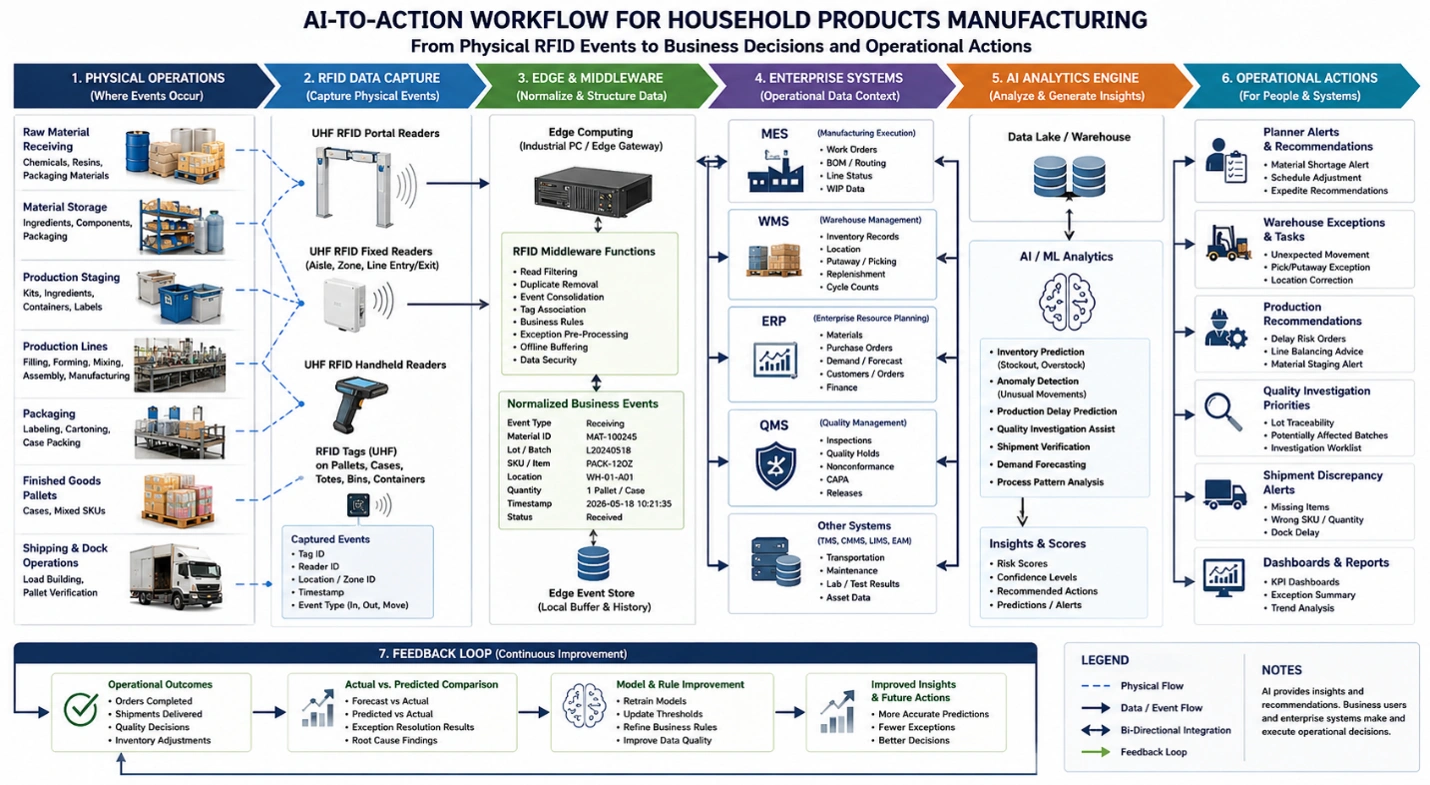
This workflow shows how RFID events from receiving, storage, production, packaging, and shipping are captured and normalized before entering MES, WMS, ERP, and QMS systems. AI analytics then converts the operational data into predictions, anomaly scores, alerts, and recommendations for production, warehouse, quality, and logistics teams.
Implementation Recommendations for Household Products Manufacturers
A technically sound AI and RFID program should start with a business process and measurable decision rather than a hardware-first approach.
Recommended practices include:
- Select one high-value workflow with a clearly measurable baseline.
- Determine whether item-level, case-level, or pallet-level identification is appropriate.
- Test RFID tags on actual household products and packaging.
- Validate read performance under real operating conditions.
- Separate raw RFID observations from validated business events.
- Define authoritative systems for inventory, production, quality, and shipment records.
- Establish data ownership before connecting AI software.
- Use AI to support predictions, anomaly detection, prioritization, and optimization.
- Keep safety-critical machine control separate from general AI decision-support functions.
- Establish cybersecurity controls before connecting readers and gateways to production networks.
- Measure false positives and false negatives for AI-generated exceptions.
- Involve warehouse, production, quality, planning, IT, and OT personnel in pilot testing.
- Establish KPI baselines before deployment.
- Expand only after the pilot demonstrates measurable operational value.
- Maintain documented procedures for RFID device replacement, firmware management, calibration, and troubleshooting.
- Reassess tag selection when household-product packaging changes.
GAO provides RFID, BLE, and IoT hardware products and systems that can support identification, sensing, asset visibility, and operational data collection. GAO Group companies have served organizations across the United States and Canada for three decades, including Fortune 500 companies, leading R&D organizations, universities, and government agencies. Its R&D investment and quality-assurance processes support deployments where hardware reliability and technical assistance are important considerations.
Key Takeaways for AI and RFID in Household Products
AI can improve household-products manufacturing when it is connected to reliable operational data and clearly defined business decisions. RFID provides a practical mechanism for capturing physical movement and identification events across receiving, storage, production staging, packaging, finished-goods handling, and shipping.
The strongest implementations combine RFID with WMS, MES, ERP, QMS, edge computing, secure networking, and AI analytics. Machine learning can then be applied to demand forecasting, anomaly detection, production-delay prediction, inventory-risk analysis, and quality investigation.
Manufacturers should begin with a focused workflow, validate RFID performance using real products, establish cybersecurity and data ownership controls, measure operational KPIs, and expand after the pilot demonstrates measurable results.
GAO can support organizations evaluating RFID readers, tags, gateways, BLE and IoT devices, and related technical systems for household-products manufacturing applications. Readers can learn more about GAO’s products, engineering capabilities, and technical support when evaluating an appropriate implementation approach.
Building the Future of Industrial AI and IoT with Aperture Venture Studio and GAO RFID Inc.
For more than three decades, GAO Group of Companies has invested heavily in R&D for industrial RFID, BLE, and IoT. As AI has become increasingly useful for industrial applications, we have expanded our work in AI and IoT technologies and founded Aperture Venture Studio to support practical AI and IoT innovation, including applications relevant to household-products manufacturing, inventory management, traceability, and connected operations.
Aperture has attracted AI and IoT technical experts, entrepreneurial and operational executives, investors, and leading companies. We have also developed the Aperture Ventures Summit and TekSummit to discuss advanced AI and IoT topics and bring together technical communities.
We welcome participation as:
- Advisors, co-founders, or employees
- Investors
- Customers