
AI and RFID for Casinos
AI-Driven Casino Operations and RFID-Enabled Data
AI for casinos combines artificial intelligence, IoT-connected equipment, operational data, and RFID-enabled identification to improve how gaming properties monitor assets, manage casino operations, support security teams, and understand operational activity. RFID can provide machine-readable identity and location data for selected assets, equipment, inventory, and operational items, while AI converts those data streams into predictions, classifications, alerts, and recommended actions. For casino operators, the value is not simply identifying an RFID-tagged object. The greater opportunity is connecting physical casino activity with gaming management systems, surveillance operations, asset management software, workforce systems, inventory records, and analytics. AI can identify unusual movement patterns, predict maintenance requirements, detect operational exceptions, optimize replenishment, and help personnel prioritize actions. A casino AI solution can combine UHF RFID for longer-range identification, HF RFID for controlled short-range interactions, and LF RFID for specialized identification scenarios with computer vision, IoT sensors, edge computing, machine learning, and existing casino software. The resulting system can support gaming floors, cage operations, surveillance, security, facilities, hospitality services, warehouses, back-of-house areas, and casino technology maintenance. GAO supplies RFID, BLE, and IoT hardware products and systems that can serve as the physical data-acquisition layer for these applications. The engineering objective is to select sensing and identification technologies according to the casino workflow rather than attempting to use one technology for every operational problem.
AI-Enabled Casino Operations with RFID, IoT, and Intelligent Analytics
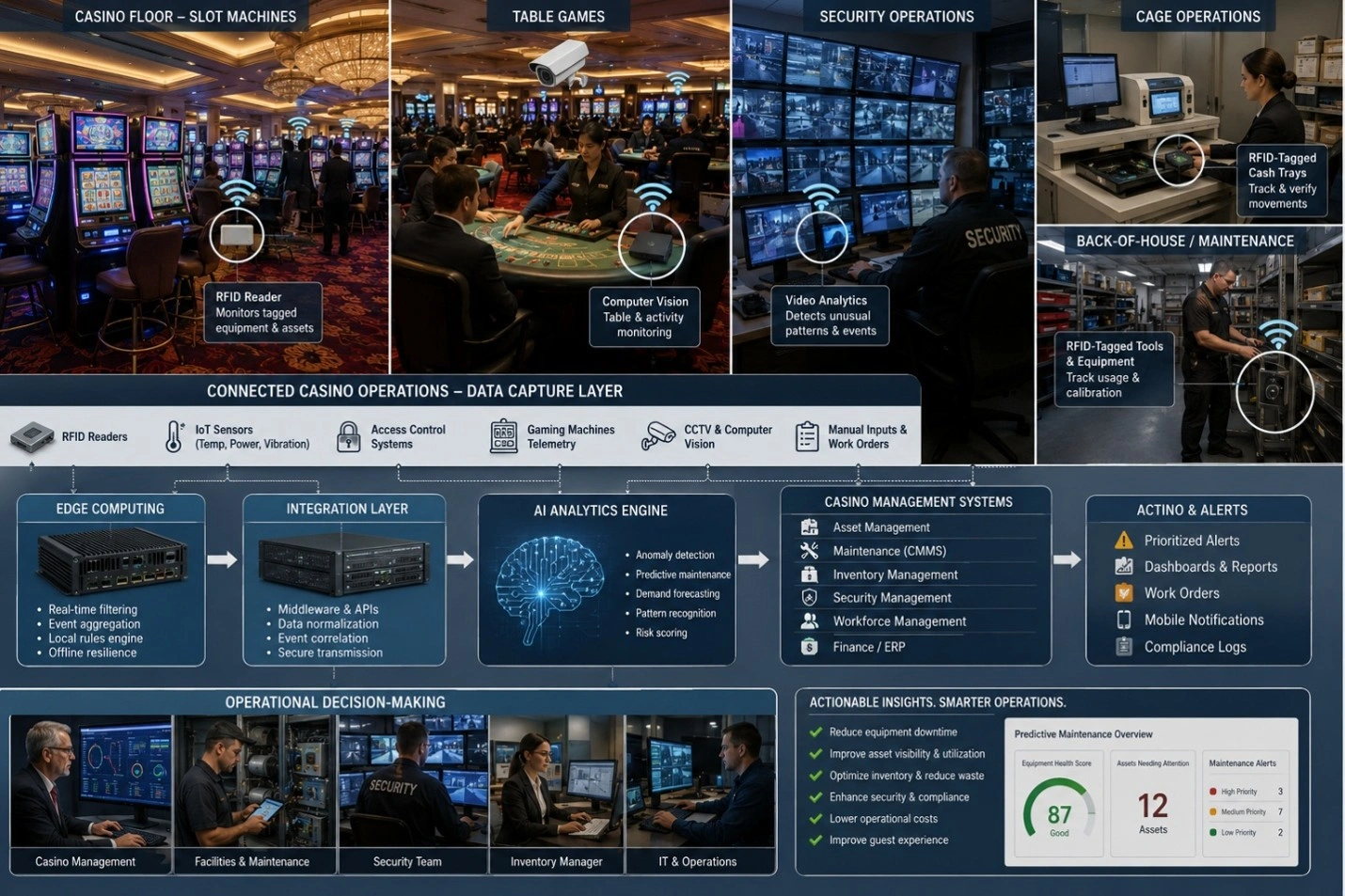
Why AI Matters in Modern Casino Management
Casino operations generate large volumes of physical and digital events. Slot machines change operational states, gaming tables require controlled equipment and inventory, chips and other gaming assets move between locations, maintenance teams service machines, cage personnel handle controlled assets, and security teams monitor activity across large facilities. Many of these activities occur simultaneously and involve different operational systems. AI can help transform this information into actionable casino intelligence. The most useful casino AI applications generally address a specific operational decision:
- Which gaming machines require maintenance before an equipment fault disrupts operations?
- Which tagged assets have moved outside an authorized area?
- Which casino equipment requires inspection, replacement, or replenishment?
- Which inventory items are approaching operational thresholds?
- Which movement or access event requires investigation?
- Which operational patterns differ significantly from established baselines?
- Which maintenance tasks should receive priority?
- Which areas require additional operational attention?
RFID can contribute reliable identity and event data to these decisions. A reader can detect a tagged object at a defined checkpoint, while a software system can associate the event with an asset record, employee workflow, location, timestamp, and operational status. AI can then evaluate that information alongside other data sources. This distinction is important. RFID does not independently determine whether an event is suspicious, whether equipment will fail, or whether a casino employee should intervene. It supplies identification and event information. AI models and business rules provide higher-level interpretation. For example, an RFID reader installed near a controlled equipment room may record that a tagged maintenance asset entered or exited the room. A casino software system can associate the event with the asset’s expected location and maintenance schedule. An AI model can identify abnormal movement patterns when combined with historical events, access records, maintenance work orders, and other operational information. A security or facilities employee can then review the resulting alert. This approach makes AI more useful because the model is connected to a defined business process rather than operating as an isolated analytics application.
Casino Applications for AI, RFID, and Connected Operations
Gaming Equipment and Asset Management
Casino properties contain large inventories of gaming equipment, electronic components, maintenance tools, spare parts, networking equipment, and other operational assets. Maintaining an accurate asset register can become difficult when equipment is moved between gaming floors, storage areas, maintenance workshops, and other controlled locations. RFID can provide automated identification at selected locations. AI can use the resulting historical information to identify asset movement patterns, utilization trends, maintenance requirements, and exceptions. Potential applications include:
- Automated asset identification at maintenance and storage checkpoints
- Tracking selected gaming equipment and high-value operational assets
- Monitoring movement between authorized casino zones
- Linking equipment identity with maintenance records
- Identifying assets with unusual movement histories
- Predicting maintenance requirements from asset and service data
- Improving spare-parts planning based on historical consumption
The engineering design should consider read-zone boundaries carefully. A reader installed near multiple adjacent assets can create unwanted reads if antenna placement, tag selection, power levels, shielding, and software filtering are not properly engineered.
Casino Inventory and Back-of-House Operations
Casino hospitality operations include food and beverage supplies, housekeeping materials, maintenance consumables, uniforms, technical components, and other inventory. AI-based inventory management can combine RFID events with inventory management software to improve visibility into stock movement. UHF RFID is particularly useful where items need to be identified without direct line-of-sight at controlled points. HF RFID can be appropriate for short-range interactions where a deliberate user action is desirable. LF RFID may be selected for specific low-frequency identification requirements where its characteristics fit the operating environment. AI can analyze consumption rates, replenishment patterns, stock movements, and operational schedules. Instead of relying solely on static inventory thresholds, casino managers can use historical demand patterns to prioritize replenishment and investigate unusual consumption.
Casino Security and Controlled Asset Movement
Security is a critical casino function, but RFID should not be treated as a replacement for established casino surveillance, access control, or security procedures. A more practical approach is to combine RFID events with existing security information. A tagged asset moving through a restricted checkpoint can create an event. Access-control information can establish whether the movement occurred under an authorized credential. Video surveillance can provide visual verification when an investigation is required. AI can help correlate these events and identify patterns that deserve human review. Potential applications include:
- Restricted-area asset movement monitoring
- Automated checkpoint event logging
- Correlation of RFID and access-control events
- Investigation support for unusual movement
- Asset location verification during security reviews
- Identification of repeated operational exceptions
Computer vision can provide additional context where appropriate. RFID identifies a tagged object, while video analytics can help determine what physically occurred around the event. Combining these sources can reduce dependence on any individual sensing method.
Predictive Maintenance for Casino Equipment
Gaming machines, HVAC equipment, power systems, networking equipment, security systems, and other casino infrastructure require continuous maintenance. An AI-based predictive maintenance system can combine equipment identifiers with telemetry, maintenance histories, work orders, operating conditions, and failure records. RFID can help establish which physical asset generated a particular maintenance event. This is particularly valuable in environments where equipment can be replaced, relocated, or serviced repeatedly. A practical workflow may connect:
- RFID-tagged equipment identity
- Equipment master records
- Maintenance work orders
- Technician inspections
- IoT sensor readings
- Historical failure records
- AI-based anomaly detection
- Maintenance scheduling software
AI models can then estimate maintenance priorities or identify abnormal operating patterns. The output should normally support technicians and maintenance managers rather than automatically initiating disruptive equipment actions without appropriate operational controls.
AI-Powered Casino Asset Management Workflow with RFID
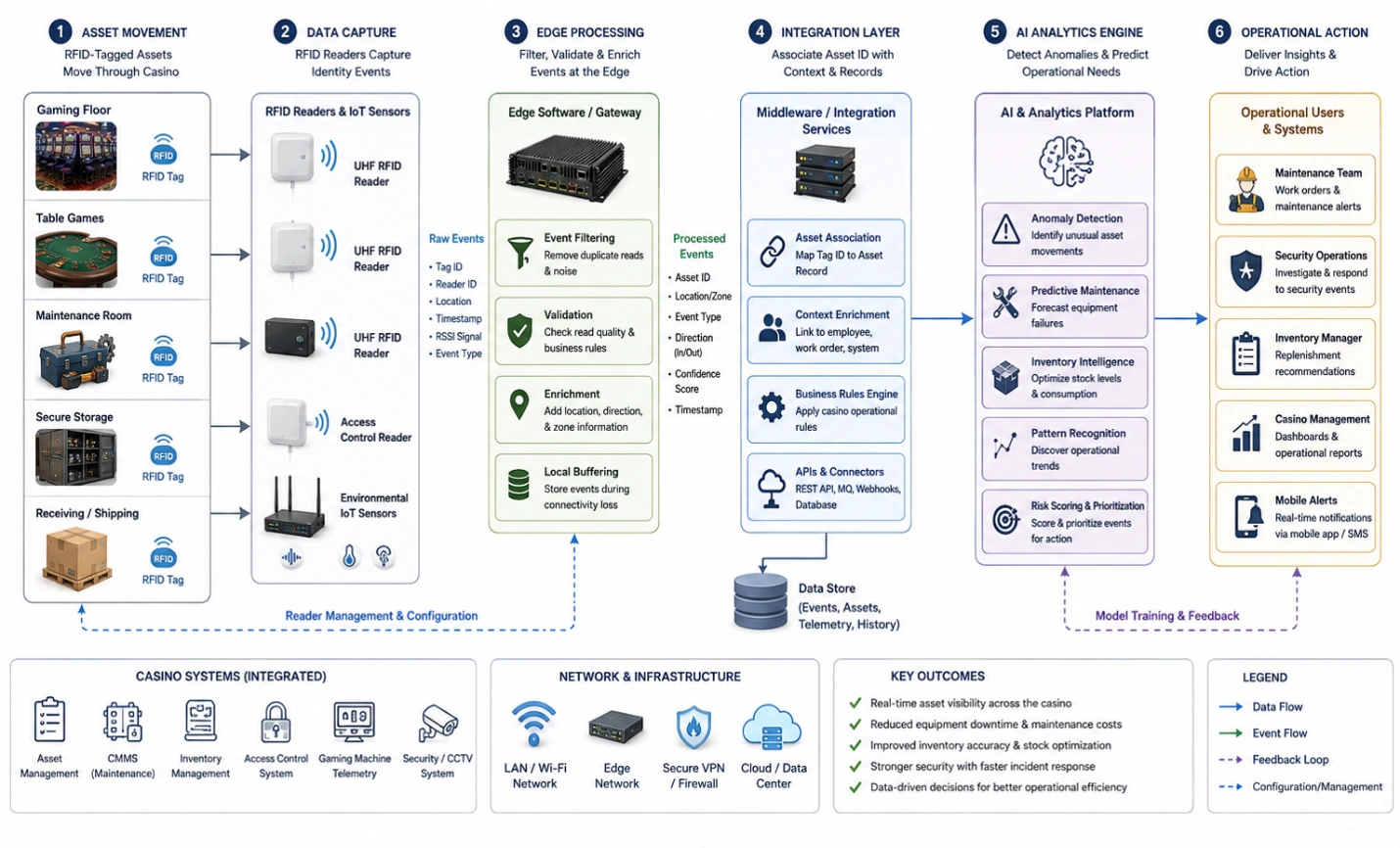
Casino Operational Workflow from RFID Events to AI Decisions
A casino AI solution should be designed around the complete data lifecycle rather than the RFID reader alone. A representative workflow begins with physical activity and ends with a business or operational action.
Data Acquisition
RFID readers, antennas, IoT sensors, access-control systems, gaming equipment, and other connected devices generate events. RFID tags provide an electronic identity that can be associated with equipment, inventory, or other selected physical objects. Reader placement is a major engineering consideration. Casino environments can contain metal structures, electrical equipment, dense electronics, furniture, and multiple adjacent operational zones. These conditions can affect RF behavior and create unintended reads. Site surveys, antenna orientation, tag selection, reader configuration, and read-zone testing should therefore precede production deployment.
Edge Processing and Event Filtering
Raw reader events are not necessarily business events. A reader may detect the same tag multiple times as an object remains within its field. Edge software can filter duplicate reads, apply timing rules, associate events with locations, and determine whether an object crossed a meaningful checkpoint. This reduces unnecessary data volume before information is forwarded to centralized software.
Middleware and Software Integration
Middleware can translate device events into standardized records and connect RFID systems with casino asset management, maintenance, inventory, security, access-control, or other software. Useful integration methods may include REST APIs, webhooks, message queues, databases, and other enterprise integration mechanisms, depending on the existing casino software environment. The integration layer should preserve essential event information such as:
- Asset or tag identifier
- Reader or checkpoint identifier
- Location
- Timestamp
- Event type
- Associated equipment record
- Authorization context where available
- Confidence or validation status where applicable
AI Analytics and Decision Support
AI can operate on both current and historical data. Machine learning models may detect anomalies, classify operational conditions, forecast demand, identify maintenance patterns, or prioritize events. The model should be evaluated against the actual casino process. A technically sophisticated model that produces excessive false alerts may create additional work rather than improve operations.
Operational Action
The final stage is human or system action. A maintenance supervisor may receive a prioritized work order. An inventory manager may receive a replenishment recommendation. A security employee may review a correlated event. A facilities team may investigate abnormal equipment behavior. This closed loop is essential because the value of AI is ultimately measured by improved operational outcomes, not simply by the quantity of data collected.
AI-Enabled RFID Asset Management Deployment in a Casino
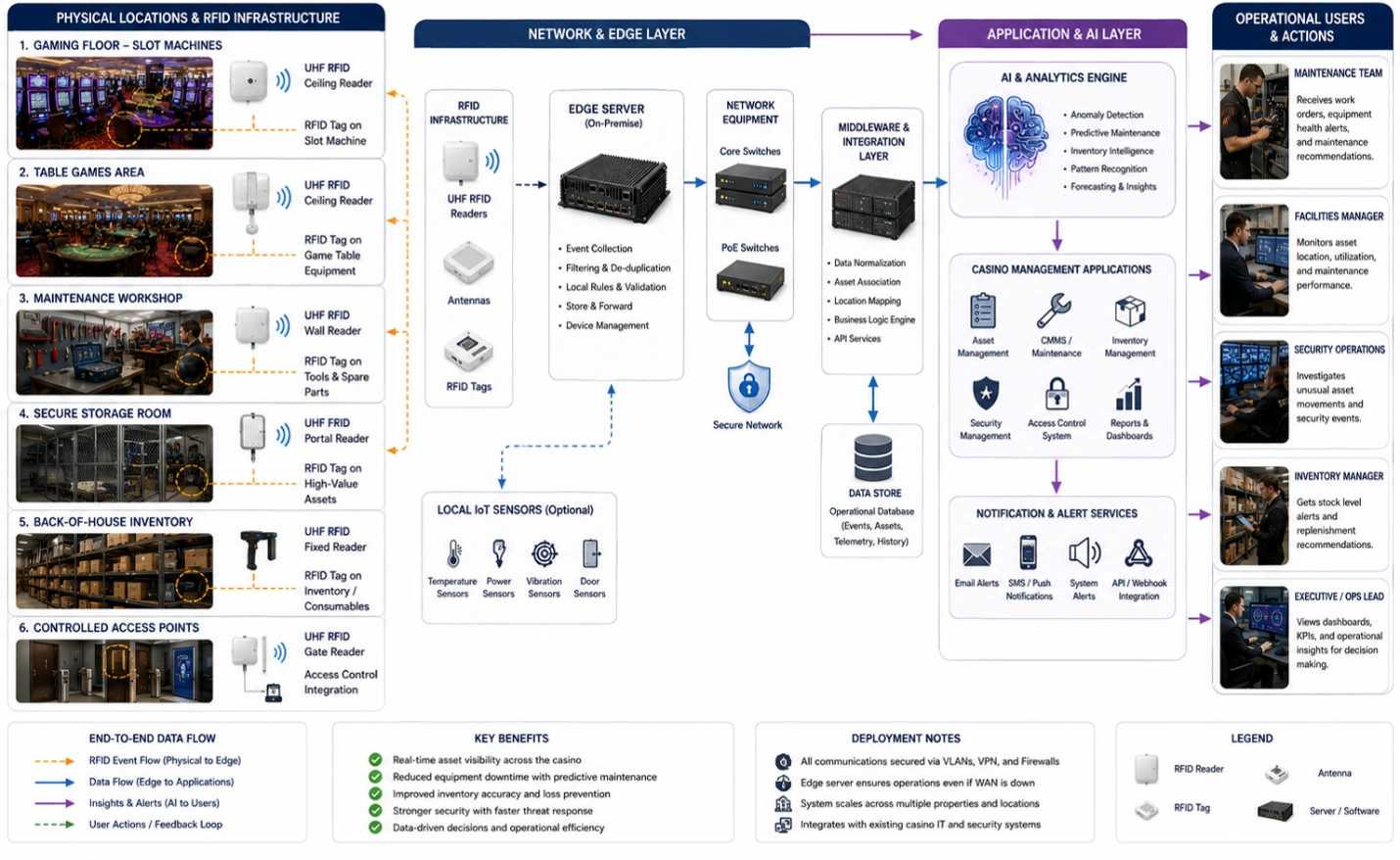
AI, RFID, and IoT Technologies for Casino Systems
A casino solution normally requires several complementary technologies rather than a single device or software component. The selection should reflect the physical environment, operational workflow, data requirements, cybersecurity controls, and integration requirements.
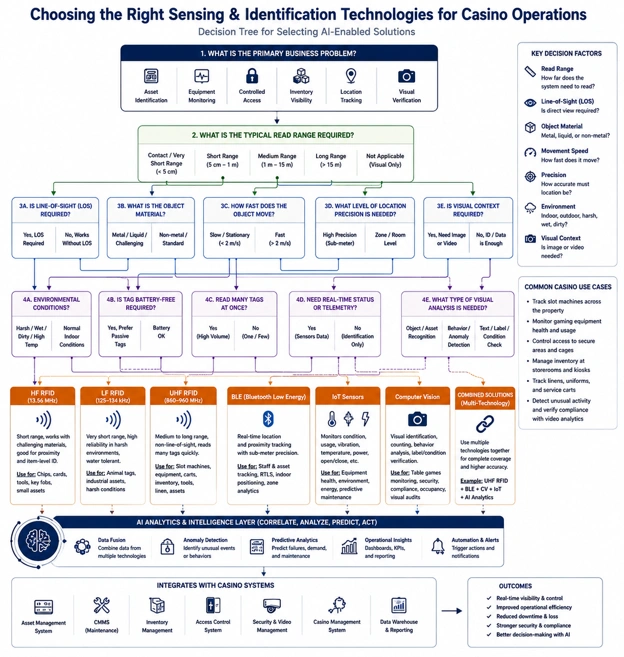
UHF RFID for Casino Asset Identification
UHF RFID is useful for applications requiring longer read ranges and automated identification of multiple tagged objects. Casino applications can include selected equipment, maintenance assets, inventory containers, spare parts, and controlled movement checkpoints. The implementation must account for metal surfaces, tag orientation, reader placement, antenna coverage, and neighboring read zones. Specialized on-metal RFID tags may be required for metallic equipment.
HF RFID for Controlled Interactions
HF RFID generally supports shorter-range identification and can be useful where deliberate proximity between a tag and reader is desirable. A casino workflow involving controlled asset confirmation, identification at a workstation, or specific staff interactions may benefit from this operating characteristic.
LF RFID for Specialized Identification
LF RFID can be considered when its lower-frequency characteristics and application-specific read behavior are appropriate. Its use should be determined from the physical and operational requirements rather than from a general assumption that one RFID frequency is universally preferable.
Edge Computing and AI
Edge computing can process casino data closer to the source. This can reduce unnecessary network traffic, provide faster event processing, and allow selected functions to continue operating when connectivity to a centralized service is interrupted. AI workloads can be divided between edge systems and centralized computing according to latency, processing requirements, data sensitivity, and operational resilience.
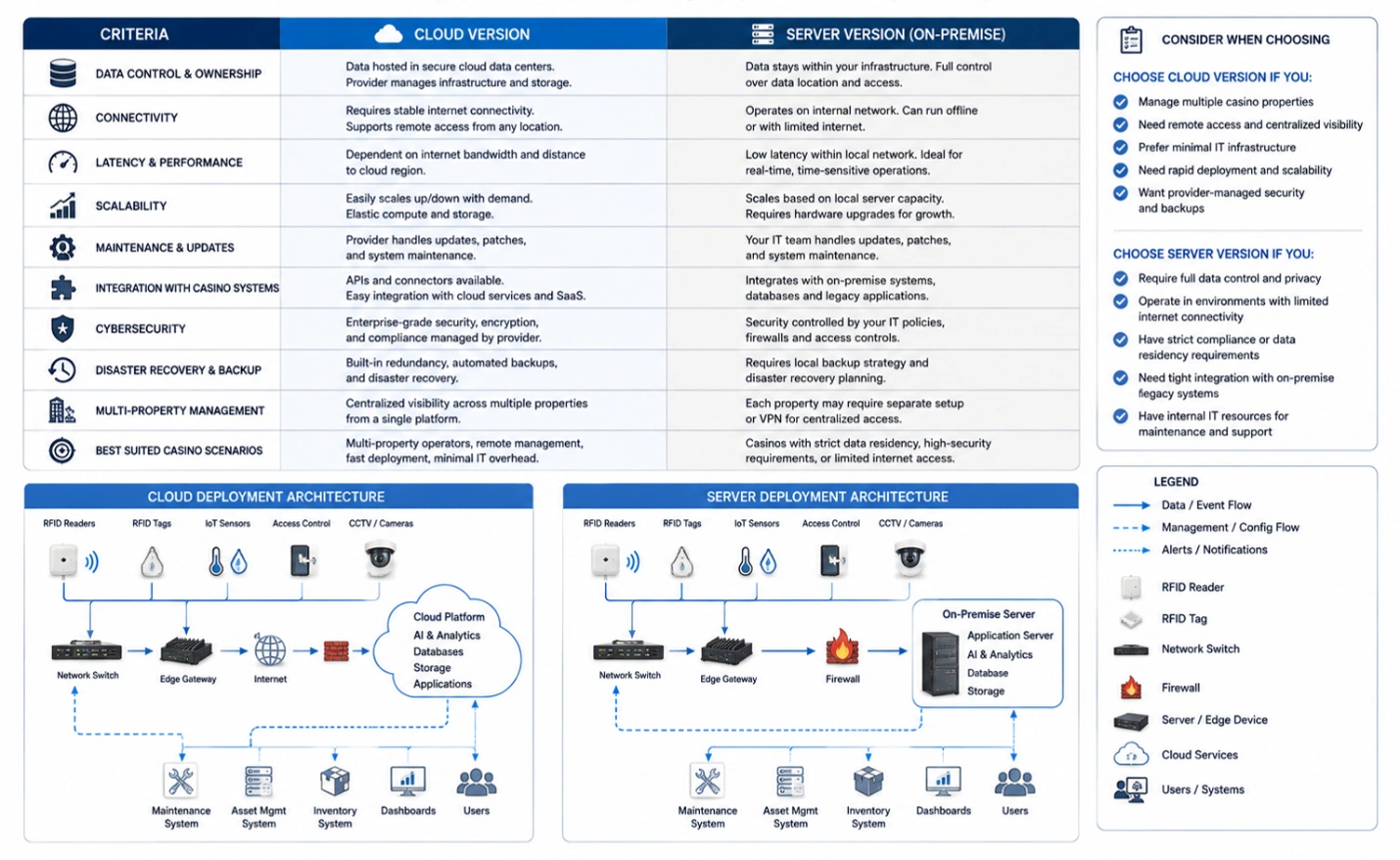
Cloud Version and Server Version
A Cloud Version can be appropriate when casino organizations want centrally hosted software, managed infrastructure, remote access, elastic computing resources, and easier deployment across geographically distributed properties. A Server Version can be deployed on customer-managed edge servers, private data centers, facility servers, or other privately hosted infrastructure. This approach may be preferable when casino operators require greater control over data location, network isolation, integration with private systems, or local operational processing. The decision should consider:
- Casino network design
- Data governance requirements
- Cybersecurity policies
- Connectivity reliability
- Integration with existing software
- Latency requirements
- Number of properties and locations
- IT support capabilities
- Disaster recovery requirements
GAO can support these deployments with RFID, BLE, and IoT hardware products and systems selected according to the operational requirements of the customer environment.
Cloud vs. Server Deployment for AI-Enabled Casino RFID Systems
Technical Capabilities and Operational Benefits for Casinos
Combining AI with RFID and other connected data sources can improve casino operations when each technology is assigned a clear operational role. RFID provides physical identification events, IoT devices provide equipment and environmental data, existing casino software supplies business context, and AI analyzes these inputs to support decisions.
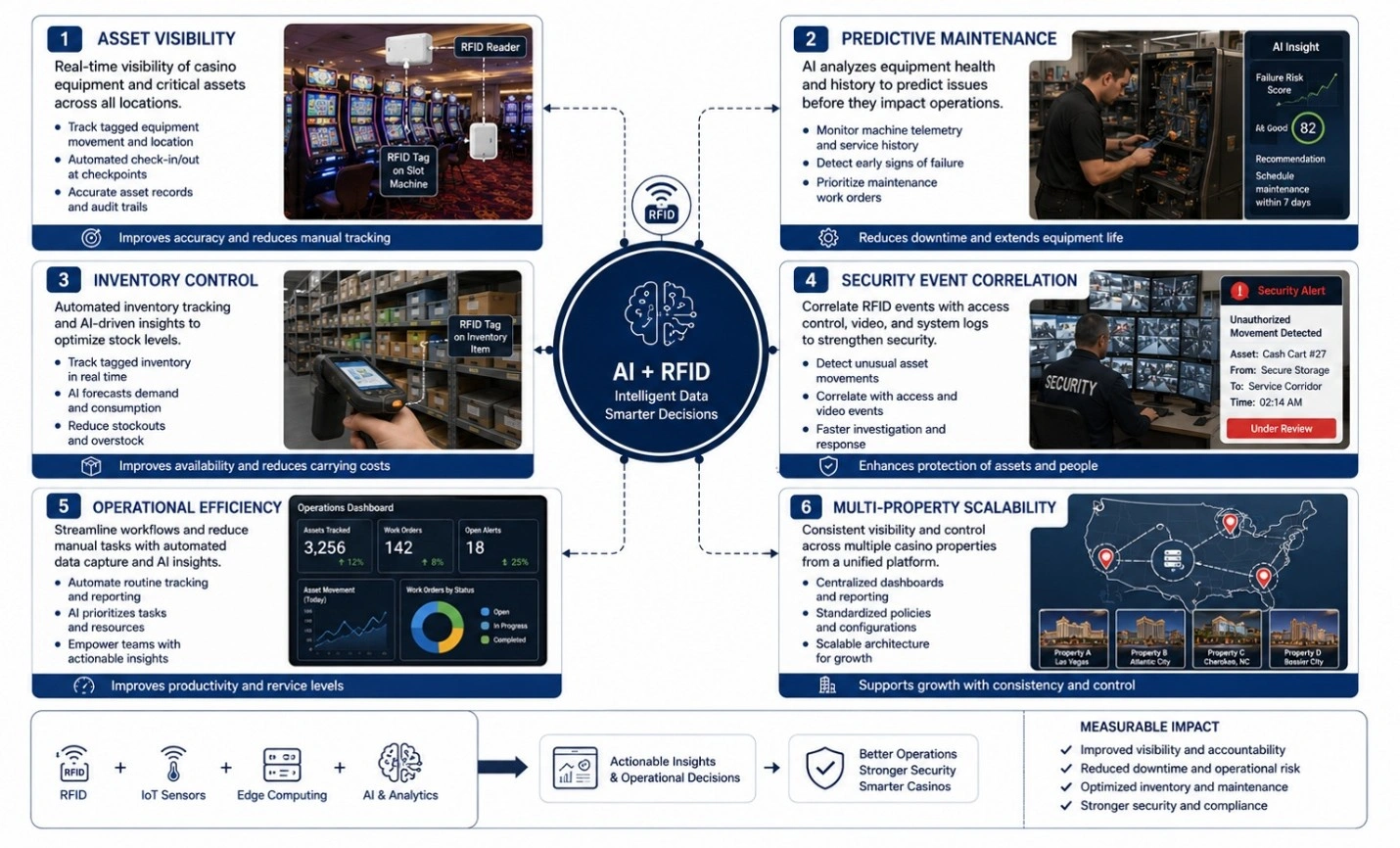
More Accurate Asset Visibility
Automated identification can reduce dependence on manual asset searches and spreadsheet-based updates. When RFID checkpoints are positioned at meaningful transition points, casino teams can establish a more consistent record of where selected equipment or inventory was last observed. This is particularly useful for assets that move between gaming floors, technical workshops, storage rooms, facilities areas, and other controlled locations. AI can further analyze historical movement records to identify:
- Unusual asset movement
- Repeated transfers between locations
- Assets that remain unused for extended periods
- Equipment frequently associated with maintenance activity
- Inventory consumption anomalies
- Operational processes that generate repeated exceptions
The resulting information can support facilities managers, gaming technology teams, inventory personnel, and casino operations managers.
Faster Maintenance Response
Casino equipment downtime can affect operations, maintenance schedules, and staff workload. AI-based maintenance analysis can prioritize equipment according to observed conditions, historical failures, service intervals, and operational importance. An RFID identifier helps ensure that maintenance information is associated with the correct physical asset. This becomes increasingly valuable when similar machines or components exist throughout a large gaming property. A technician can scan or encounter an RFID-tagged asset and retrieve its associated service history, while the maintenance system can record the resulting work order against the same asset identity.
Improved Inventory Control
AI-supported inventory management can help casino teams distinguish normal consumption from unusual patterns. RFID events can provide automated observations at receiving areas, storage locations, workrooms, or controlled issue points. The combined information can support:
- Reorder prioritization
- Stock-level monitoring
- Consumption forecasting
- Spare-parts planning
- Receiving verification
- Storage-location visibility
- Investigation of inventory discrepancies
The strongest results occur when RFID data is integrated with existing inventory records rather than maintained as an independent database.
Better Security Event Correlation
Casino security teams often work with multiple information sources. RFID can provide another event stream that can be correlated with access-control logs, video systems, maintenance records, and authorized movement records. AI can assist by identifying relationships across these datasets. For example, an asset movement event may be considered normal when it corresponds with an approved maintenance work order and authorized employee access. The same physical movement may warrant review when the supporting operational context is absent. This approach can reduce the burden of manually reviewing unrelated events while retaining human oversight for consequential security decisions.
Operational Scalability
A well-designed casino RFID system can expand from a limited number of checkpoints to additional departments or properties. However, scalability is not achieved simply by installing more readers. The software should maintain consistent device identifiers, location definitions, asset records, event schemas, user permissions, and integration interfaces. Multi-property casino groups should also consider whether operational policies are standardized across locations. A system that works for one property may require configuration changes when deployed across different building layouts, equipment inventories, network environments, and operating procedures.
6 Key Benefits of AI-Enabled RFID Operations for Casinos
Casino AI Performance Metrics and KPIs
Technology deployment should be evaluated using operational measurements rather than technology adoption alone. Casino management teams can establish a baseline before deployment and compare performance after implementation. Relevant KPIs may include:
- Asset location accuracy
- Asset search time
- RFID read accuracy at defined checkpoints
- False-read rate
- Inventory discrepancy rate
- Maintenance response time
- Mean time to repair
- Preventive maintenance compliance
- Equipment downtime
- Spare-parts availability
- Inventory turnover
- Replenishment cycle time
- Security investigation response time
- Number of unresolved asset exceptions
- Alert precision and false-positive rate
- System availability
- Reader and device uptime
- Integration transaction success rate
- AI model detection performance
- User response time to operational alerts
Not every KPI should be applied to every casino deployment. The selected measurements should correspond to the problem the solution was designed to address. For example, a maintenance deployment should emphasize equipment downtime, maintenance response, repair intervals, and predictive-alert performance. An inventory deployment should focus more heavily on stock accuracy, replenishment time, discrepancy rates, and item availability. AI performance also requires separate evaluation. A model that detects 95% of abnormal events may still be operationally unsuitable if it produces an excessive number of false alerts. Casino teams should therefore measure precision, recall where appropriate, alert volume, human review time, and the operational consequences of incorrect classifications.
Cybersecurity and Data Protection for Casino RFID Systems
Casino environments require strong controls around operational systems and sensitive information. RFID should therefore be deployed as part of the casino’s broader cybersecurity program. Security controls can include:
- Network segmentation for IoT and RFID devices
- Role-based access control
- Strong authentication
- Encrypted communications where supported
- Secure device configuration
- Firmware and software lifecycle management
- Centralized logging
- Security monitoring
- Vulnerability management
- Backup and recovery procedures
- Controlled administrative privileges
- API authentication and authorization
- Secure integration with casino software
RFID tag identifiers should not automatically be treated as sensitive merely because they originate from physical objects. Their sensitivity depends on what the identifier represents and what systems it can be correlated with. For example, an asset identifier associated with a maintenance record may expose operational information if improperly protected. Security requirements should therefore be determined through data classification and system-risk assessment. AI systems introduce additional considerations. Training data, operational records, model outputs, access permissions, and integration credentials should be protected according to their respective risk profiles. Human review is also important. Automated AI recommendations should not be allowed to create uncontrolled operational consequences simply because an algorithm produced a high-confidence result.
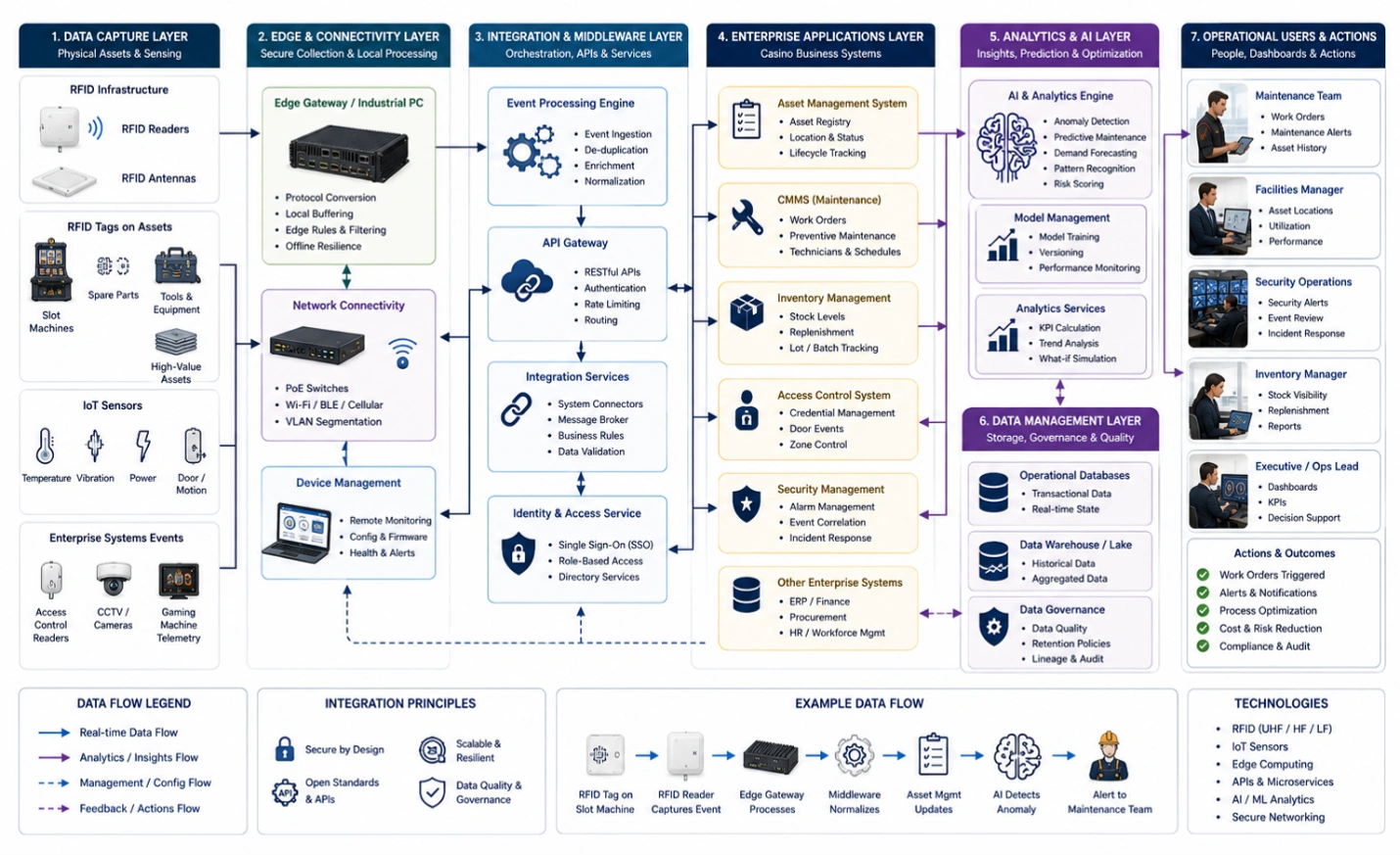
Integration with Casino Software and Existing Infrastructure
AI and RFID deployments rarely operate independently. The most practical implementations connect to software already used by casino organizations. Depending on the specific property, integration targets can include:
- Asset management systems
- Computerized maintenance management systems
- Inventory management software
- Facilities management software
- Access-control systems
- Security management software
- Building management systems
- Workforce management systems
- Procurement software
- Enterprise resource planning systems
- Data warehouses
- Business intelligence software
- Casino operational databases
Integration design should begin with data ownership and workflow requirements. Teams should determine which system remains the authoritative source for asset identity, location, maintenance status, inventory quantities, employee authorization, and other important records. A common mistake is creating a second operational database that duplicates information already maintained elsewhere. This can lead to conflicting asset records and inconsistent status information. A better approach is to define system responsibilities clearly and use integration interfaces to synchronize the required information.
API and Event-Based Integration
REST APIs can support request-based integration between RFID software and business applications. Event-based interfaces can be more appropriate when the system needs to communicate operational events as they occur. For example, an RFID checkpoint event can be transformed into an event containing the tag identifier, location, timestamp, and event type. Middleware can then route that event to an asset management or analytics application. Message queues can also help decouple RFID infrastructure from downstream applications. This can improve resilience when a receiving application becomes temporarily unavailable.
Database and Data Warehouse Integration
Historical RFID events can be stored for analytics when operational policies require long-term analysis. Data warehouses can combine these events with maintenance, inventory, facilities, and operational records. AI models can then analyze historical patterns without placing unnecessary processing loads on the operational RFID system. The data model should preserve event timestamps and location information accurately. Time synchronization across readers, edge servers, databases, and other devices is particularly important when multiple event streams must be correlated.
AI-Enabled RFID Integration with Casino Information Systems
Engineering Considerations for Casino RFID Deployment
Successful deployment requires more than choosing a reader and attaching tags to equipment. Casino environments create several engineering constraints.
RF Environment and Read-Zone Design
Gaming floors can contain dense electronic equipment, metal surfaces, furniture, partitions, and closely spaced operational areas. These conditions can influence RFID performance. Engineers should evaluate:
- Required read distance
- Tag orientation
- Material of the tagged object
- Metal and liquid exposure
- Antenna positioning
- Reader power configuration
- Adjacent reader interference
- Physical separation between read zones
- Unintended tag detection
- Required identification throughput
Testing should occur using representative equipment and operating conditions rather than relying only on laboratory specifications.
Tag Selection
Tag selection should be based on the object and workflow. An RFID tag intended for a metal equipment enclosure may require different characteristics from a tag attached to a plastic inventory container. Tags used near heat, moisture, cleaning chemicals, or mechanical abrasion may require additional environmental protection. The physical attachment method is also important. A technically suitable tag can become unreliable if it detaches during normal equipment movement or maintenance.
Location Modeling
A casino RFID system needs an accurate representation of physical locations. Reader identifiers should map consistently to meaningful locations such as a maintenance room, secure storage area, receiving checkpoint, or designated gaming-floor zone. Location granularity should match the operational decision. Creating extremely detailed zones can generate unnecessary complexity if the business only needs to know whether an asset is inside or outside a controlled area.
Commissioning and Validation
Before production operation, deployment teams should perform controlled tests covering normal and exceptional conditions. Testing can include:
- Tag readability
- Read-zone boundaries
- False-read behavior
- Multiple-tag detection
- Network communication
- Event filtering
- API integration
- Data synchronization
- User permissions
- Alert generation
- Recovery after connectivity interruption
- Reader restart behavior
- Software failure handling
Acceptance criteria should be defined before commissioning so that performance can be evaluated objectively.
Implementation Roadmap for Casino AI and RFID
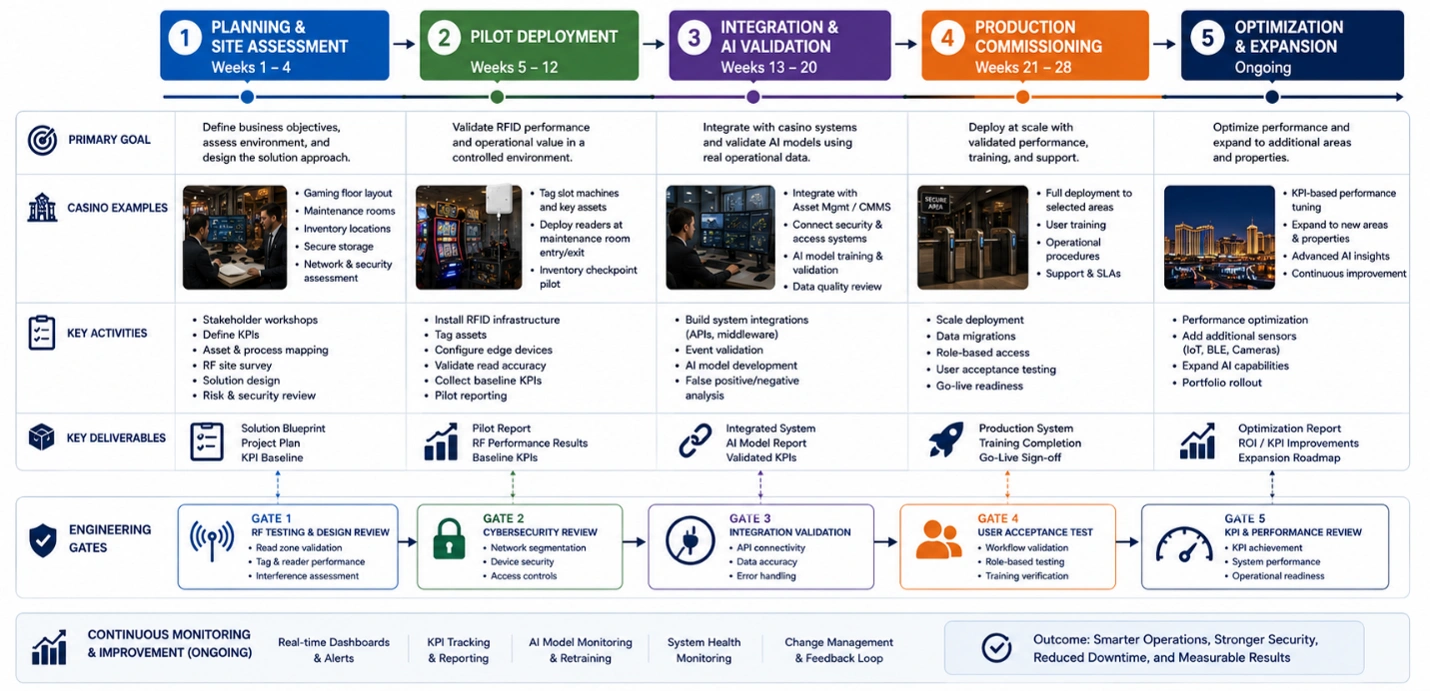
A phased deployment can reduce technical and operational risk.
Planning and Site Assessment
The first stage should identify the operational problem, affected assets, existing software, physical locations, network infrastructure, cybersecurity requirements, and expected KPIs. The team should also identify where RFID provides a meaningful advantage over barcode, BLE, manual workflows, computer vision, or other sensing methods.
Pilot Deployment
A pilot should focus on a contained workflow with measurable outcomes. A casino maintenance room, selected equipment group, inventory checkpoint, or controlled asset movement process can provide a manageable starting point. The pilot should use production-representative equipment and operating conditions.
Integration and AI Validation
Once RFID event quality is established, the next stage is integration with the relevant business software. AI models should be evaluated using actual casino operational data where appropriate. Model outputs should be reviewed by domain experts to identify false positives, missing events, and operationally irrelevant predictions.
Production Commissioning
Production deployment should include documented device configurations, network settings, software versions, tag inventories, location mappings, integration endpoints, user roles, backup procedures, and maintenance responsibilities. Training should focus on the operational workflow rather than the technology alone.
Optimization and Expansion
After deployment, teams can examine KPI performance and adjust reader locations, tag types, event-filtering rules, AI thresholds, dashboards, and workflow configurations. Expansion should follow demonstrated operational value rather than simply increasing the number of tagged assets.
5-Stage AI-Enabled RFID Casino Implementation Timeline
Practical Recommendations for Casino Operators
Casino organizations considering AI and RFID should begin with operational requirements rather than selecting hardware first. Key recommendations include:
- Define the specific casino workflow that needs improvement.
- Establish baseline KPIs before deployment.
- Identify authoritative systems for asset, inventory, maintenance, and access information.
- Conduct an RF site survey using representative casino equipment.
- Select RFID frequency and tag type according to the physical application.
- Design reader zones around operational decisions rather than maximum possible coverage.
- Filter duplicate and low-value RFID events at the edge where practical.
- Integrate RFID data with existing casino software instead of creating unnecessary parallel records.
- Evaluate AI models using operationally relevant performance metrics.
- Keep human review in workflows involving security or consequential operational decisions.
- Segment RFID and IoT devices appropriately within the casino network.
- Document device configurations, tag assignments, location mappings, and integration dependencies.
- Pilot the solution before extending it across a complete gaming property or multiple properties.
- Reassess performance periodically as casino layouts, equipment, software, and operational procedures change.
GAO’s experience supplying RFID, BLE, and IoT hardware products and systems can support organizations that require practical identification, sensing, and connected-device components for these workflows.
Building the Future of Casino AI and Connected IoT Operations
AI for casinos is most effective when it is connected to real operational data and clearly defined business decisions. RFID can provide reliable physical identification events for selected casino assets, inventory, equipment, and controlled workflows, while AI can turn those events into anomaly detection, predictive maintenance, inventory intelligence, and operational recommendations. The strongest implementations combine RFID with IoT sensors, computer vision where appropriate, edge computing, secure networking, integration middleware, existing casino software, and human operational expertise. GAO, headquartered in New York City and Toronto, Canada, is ranked among the top 10 leading B2B and B2G BLE and RFID suppliers globally. GAO and its sister companies, GAO Research Inc. and GAO Tek Inc., form GAO Group, serving customers across the United States and Canada, including Fortune 500 companies, leading R&D organizations, universities, and government agencies. GAO has invested substantially in product and system R&D and maintains stringent quality assurance processes, with technical support available remotely or onsite. For casino operators, technology selection should ultimately be driven by measurable operational requirements, environmental conditions, integration needs, cybersecurity controls, and long-term maintainability. Readers, tags, AI software, and connected sensors are components of a larger operational solution. Their value emerges when they reliably support the people and processes responsible for casino operations.
Decision Tree for Selecting Casino Sensing and Identification Technologies
Building the Future of Industrial AI and IoT with Aperture Venture Studio and GAO RFID Inc.
For more than three decades, GAO Group of Companies has invested heavily in R&D covering industrial RFID, BLE, and IoT technologies. As generative AI became increasingly useful for industrial applications, we expanded our work across AI and IoT technologies, including RFID and BLE, and founded Aperture Venture Studio to support the development and scaling of AI and IoT solutions relevant to industries such as casino operations, asset management, security, and connected facilities. Aperture has attracted AI and IoT technical experts, operational executives, investors, and leading companies. We have also developed the Aperture Ventures Summit and TekSummit to facilitate discussion of advanced AI and IoT topics. These efforts have contributed to broader technical communities around AI and IoT. We welcome participation as advisors, co-founders or employees, investors, or customers.