
Oil & Gas Monitoring Using AI and RFID for Upstream, Midstream, and Downstream Operations
AI and RFID Are Transforming Oil & Gas Monitoring Across the Entire Value Chain
Oil & Gas Monitoring Using AI and RFID combines intelligent data analytics with RFID-enabled identification and tracking to improve operational visibility across upstream, midstream, and downstream facilities. AI analyzes operational patterns, equipment conditions, personnel movement, inspection records, and production data, while RFID provides reliable identification of assets, tools, valves, pipes, drilling equipment, chemicals, safety equipment, and mobile resources throughout complex facilities.
Modern oil and gas operations generate enormous volumes of operational technology (OT) and industrial IoT data. AI enhances RFID by recognizing abnormal operating conditions, predicting equipment degradation, identifying operational risks, optimizing maintenance scheduling, and improving regulatory compliance. The result is improved production efficiency, stronger process safety, better environmental performance, and reduced operational downtime.
Organizations operating offshore facilities, refineries, LNG terminals, tank farms, compressor stations, well pads, gathering systems, and pipeline networks increasingly rely on AIoT solutions to improve operational awareness while supporting workforce safety and asset integrity. GAO has supported organizations across North America by supplying RFID hardware, industrial IoT products, and technical expertise for complex industrial monitoring environments.
Understanding AI and RFID in Oil & Gas Monitoring
What Is Oil & Gas Monitoring Using AI and RFID?
Oil & Gas Monitoring Using AI and RFID is an intelligent monitoring solution that combines automatic asset identification with machine learning to improve operational decision making across exploration, production, transportation, storage, and refining operations.
RFID uniquely identifies physical assets without requiring direct visual contact. AI converts the resulting operational data into actionable intelligence by detecting anomalies, forecasting failures, recommending maintenance actions, identifying operational bottlenecks, and optimizing workforce activities.
Unlike traditional inspection programs that depend heavily on manual reporting, AI + RFID continuously analyzes operational conditions, allowing maintenance engineers, production supervisors, reliability engineers, integrity managers, HSE professionals, and operations teams to make decisions based on real operational data.
Why AI Is Becoming Essential for RFID-Based Oil & Gas Operations
Oil and gas facilities operate under demanding environmental and operational conditions that include:
- High-pressure process systems
- Corrosive operating environments
- Hazardous classified areas
- Remote production sites
- Aging infrastructure
- Strict environmental regulations
- Continuous production requirements
- Complex maintenance schedules
- Large geographically distributed assets
Traditional RFID implementations primarily answer questions such as:
- Where is the asset?
- When was it inspected?
- Who performed the inspection?
- Which maintenance event occurred?
AI extends these capabilities by answering more advanced operational questions:
- Which pressure vessel is most likely to exceed inspection thresholds?
- Which rotating equipment is approaching bearing failure?
- Which maintenance activities should be prioritized?
- Which pipeline section presents elevated integrity risk?
- Which field assets require immediate inspection?
- Which contractor movements indicate safety concerns?
- Which inventory shortages may interrupt production?
This transition from historical tracking to predictive operational intelligence is driving rapid adoption of AI and RFID throughout the oil and gas industry.
GAO supplies RFID readers, RFID tags, industrial sensing technologies, and supporting IoT hardware that help organizations collect the operational data required for AI-driven monitoring solutions.
AI and RFID Oil & Gas Monitoring Across Upstream, Midstream, and Downstream Operations
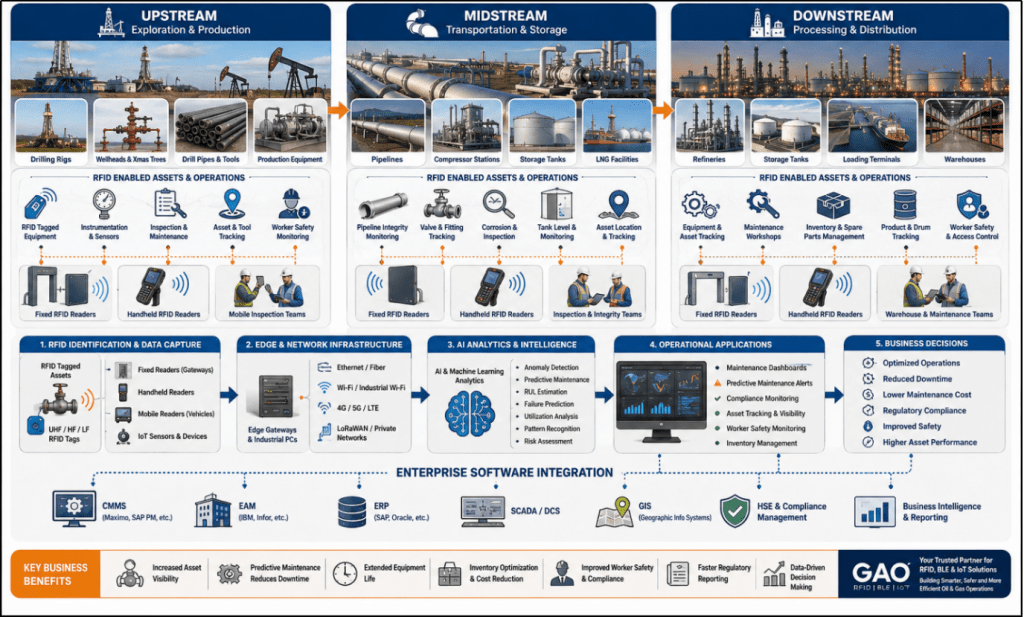
This infographic depicts how AI and RFID enable intelligent monitoring throughout the oil and gas value chain, from upstream exploration and production to midstream transportation and downstream refining. It illustrates RFID-enabled asset identification, Industrial IoT connectivity, AI-driven analytics, enterprise software integration, and automated operational decision-making. The key takeaway is that combining AI with RFID improves asset visibility, predictive maintenance, regulatory compliance, worker safety, inventory management, and overall operational efficiency across oil and gas operations.
Why AI and RFID Matter Across the Oil & Gas Industry
Oil and gas operations span multiple operational environments, each presenting unique monitoring requirements.
Upstream Exploration and Production
AI + RFID improves visibility across:
- Drilling rigs
- Blowout preventers (BOPs)
- Drill strings
- Mud pumps
- Casing equipment
- Wellheads
- Christmas trees
- Completion tools
- Pressure control equipment
- Offshore production systems
Operational objectives include:
- Asset traceability
- Equipment certification
- Inspection compliance
- Maintenance optimization
- Personnel accountability
- Production reliability
Midstream Transportation
Pipeline operators use AI and RFID to monitor:
- Pipeline valves
- Pigging equipment
- Compressor stations
- Pump stations
- Metering stations
- Storage terminals
- LNG transfer facilities
- Tank farms
- Mobile maintenance equipment
Operational priorities include:
- Pipeline integrity
- Leak prevention
- Inspection scheduling
- Regulatory reporting
- Spare parts availability
- Emergency response readiness
Downstream Refining and Petrochemical Operations
Refineries require continuous monitoring of thousands of critical assets, including:
- Heat exchangers
- Reactors
- Distillation columns
- Pressure vessels
- Compressors
- Pumps
- Control valves
- Instrumentation
- Safety equipment
- Turnaround maintenance assets
AI-assisted RFID monitoring helps optimize:
- Reliability-centered maintenance
- Asset lifecycle management
- Shutdown planning
- Turnaround execution
- Spare parts inventory
- Contractor coordination
- Equipment certification
- Hazardous material tracking
Core Technologies Supporting AI and RFID Oil & Gas Monitoring Systems
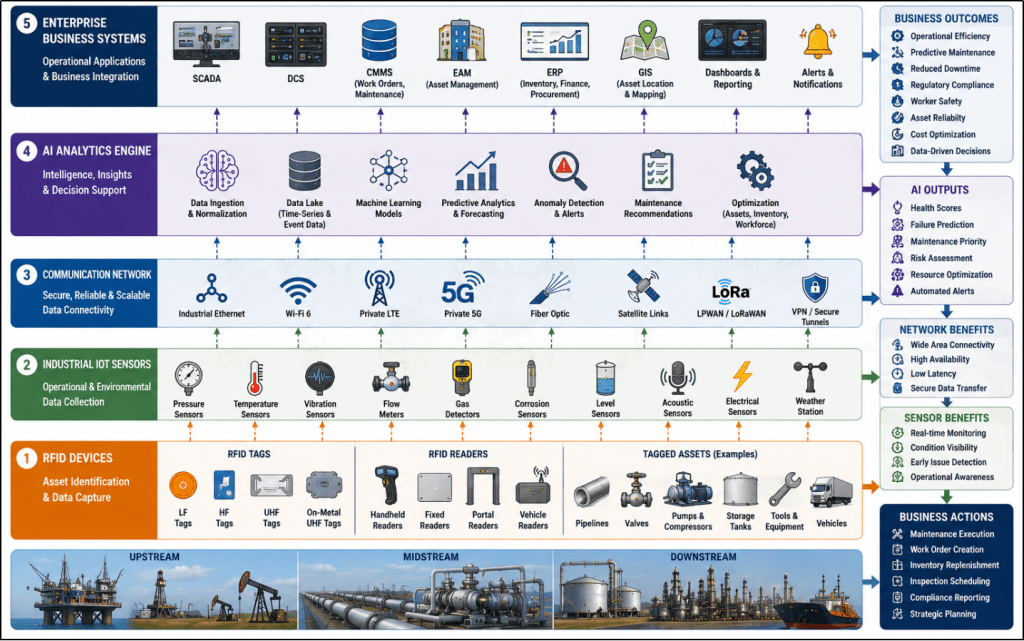
This multi-layer technical diagram illustrates how RFID devices, Industrial IoT sensors, communication networks, AI analytics, and enterprise business systems work together to support intelligent oil and gas monitoring. It demonstrates the flow of operational data from RFID-enabled assets through secure connectivity and AI-driven analysis to enterprise applications such as SCADA, DCS, ERP, CMMS, and GIS, enabling predictive maintenance, operational visibility, compliance, and data-driven decision-making.
Operational Workflow for AI and RFID Oil & Gas Monitoring
Oil and gas monitoring involves multiple operational layers that convert field observations into intelligent operational decisions.
RFID Data Acquisition
The process begins with RFID identification.
Common RFID-tagged assets include:
- Pressure vessels
- Valves
- Pumps
- Compressors
- Safety equipment
- Portable gas detectors
- Pipeline components
- Maintenance tools
- Chemical containers
- Drill pipe assemblies
- Mobile inspection devices
- Fire protection equipment
RFID readers collect:
- Asset identity
- Maintenance history
- Inspection status
- Certification records
- Calibration history
- Equipment location
- Personnel interactions
- Timestamped operational events
Depending on operational requirements, organizations deploy:
- UHF RFID readers for long-range industrial asset tracking
- HF RFID systems for maintenance documentation
- LF RFID systems for harsh industrial identification
Industrial Communication Infrastructure
After RFID events are captured, operational data enters industrial communication networks.
Supporting technologies often include:
- SCADA
- Distributed Control Systems (DCS)
- Industrial Ethernet
- OPC UA
- Modbus TCP
- MQTT
- ISA100 Wireless
- WirelessHART
- Private LTE
- 5G industrial networks
- Fiber optic backbone
- Edge gateways
Industrial communication infrastructure aggregates information from RFID devices together with:
- Vibration sensors
- Pressure transmitters
- Temperature sensors
- Flow meters
- Acoustic monitoring systems
- Corrosion monitoring devices
- Gas detection systems
- Tank level instrumentation
- Motor current monitoring
- Environmental monitoring stations
The combined operational dataset provides AI with significantly richer context than RFID events alone.
Edge Processing
Rather than transmitting every RFID event directly to centralized software, edge servers perform local processing by:
- Removing duplicate reads
- Filtering noisy data
- Validating tag identities
- Synchronizing timestamps
- Detecting communication failures
- Correlating RFID events with sensor measurements
- Compressing operational datasets
- Applying local AI inference for time-sensitive events
Edge processing is especially valuable for offshore facilities, remote well pads, compressor stations, and isolated pipeline segments where communications may be intermittent.
AI Analytics
Once operational data reaches AI software, multiple analytical models operate simultaneously.
Common AI techniques include:
- Predictive maintenance models
- Remaining useful life estimation
- Time-series forecasting
- Equipment anomaly detection
- Computer vision integration for inspection validation
- Asset utilization analysis
- Inventory optimization
- Maintenance prioritization
- Risk scoring
- Failure prediction
- Root cause analysis
- Workforce optimization
Rather than relying on fixed alarm thresholds, AI continuously learns from operational history, maintenance outcomes, environmental conditions, and production behavior to improve prediction accuracy.
Operational Workflow for AI and RFID Oil & Gas Monitoring
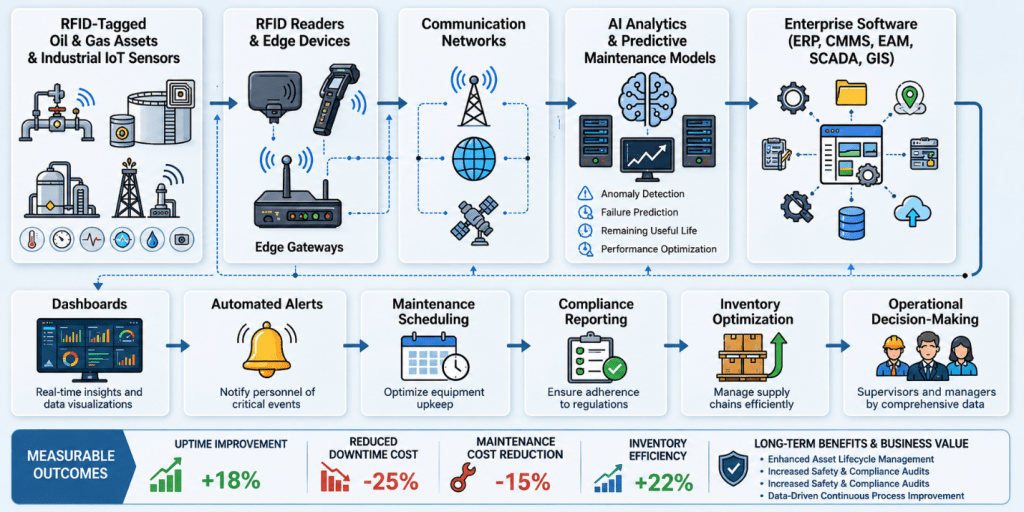
This workflow diagram for AI and RFID oil & gas monitoring, end-to-end operational process of AI and RFID monitoring in the oil and gas industry. It shows how RFID-tagged assets and Industrial IoT sensor data flow through RFID readers, edge gateways, communication networks, AI analytics, and enterprise software to enable predictive maintenance, compliance reporting, inventory optimization, automated alerts, and data-driven operational decision-making.
Technical Components Supporting AI and RFID Oil & Gas Monitoring
Successful AI and RFID deployments require tightly integrated hardware, industrial software, communication systems, cybersecurity controls, and enterprise business applications. Each component contributes to reliable monitoring, regulatory compliance, predictive maintenance, and operational resilience across upstream production facilities, pipeline networks, LNG terminals, storage operations, and refineries.
RFID Hardware
Typical RFID hardware includes:
- UHF fixed industrial RFID readers
- Handheld RFID readers
- Explosion-protected RFID readers for hazardous locations
- LF RFID readers for equipment identification
- HF RFID readers for maintenance records
- Rugged industrial RFID antennas
- Passive RFID tags
- High-temperature RFID tags
- Chemical-resistant RFID tags
- Metal-mount RFID tags
- Intrinsically safe handheld terminals
Hardware selection depends on hazardous area classification, read distance requirements, environmental exposure, asset materials, operating temperature, and maintenance accessibility.
GAO provides RFID hardware designed for demanding industrial environments, supported by engineering expertise developed through three decades of serving Fortune 500 companies, research organizations, universities, and government agencies across the United States and Canada.
Industrial Software Supporting AI and RFID Monitoring
Industrial software transforms RFID events and sensor measurements into operational intelligence that supports maintenance planning, production optimization, compliance reporting, and asset lifecycle management. Rather than functioning as isolated applications, these systems exchange information through standardized interfaces and industrial middleware to maintain consistent operational data across the organization.
Common software components include:
- RFID device management software
- RFID middleware for event filtering and device orchestration
- AI inference software
- Machine learning model management software
- Industrial historian databases
- Asset Performance Management (APM) software
- Computerized Maintenance Management Systems (CMMS)
- Enterprise Asset Management (EAM) software
- Enterprise Resource Planning (ERP) systems
- Geographic Information Systems (GIS)
- Laboratory Information Management Systems (LIMS)
- Manufacturing Execution Systems (MES) for refinery operations
- Operational dashboards
- Alarm management software
- Digital work instruction software
- Mobile maintenance applications
Oil and gas organizations frequently integrate AI and RFID monitoring with enterprise systems such as SAP S/4HANA, IBM Maximo Application Suite, Oracle Enterprise Asset Management, AVEVA PI System, Honeywell Experion, Emerson DeltaV, Siemens PCS 7, AspenTech solutions, Hexagon asset management software, and Microsoft Power BI. Integration enables inspection records, work orders, production history, and equipment status to remain synchronized across operational technology and business systems.
GAO has supplied RFID hardware and supporting IoT technologies that integrate with diverse industrial software environments, helping organizations improve interoperability while minimizing disruption to existing operational workflows.
AI Models Used in Oil & Gas Monitoring
Different operational objectives require specialized AI models. A single deployment typically combines multiple analytical methods to improve prediction accuracy and operational reliability.
| AI Model | Oil & Gas Monitoring Application |
| Time-series forecasting | Predict equipment degradation and production trends |
| Anomaly detection | Detect abnormal equipment behavior and process deviations |
| Remaining Useful Life (RUL) estimation | Forecast maintenance windows for rotating equipment |
| Classification models | Identify equipment operating states and inspection priorities |
| Regression models | Estimate corrosion rates, energy consumption, or production performance |
| Reinforcement learning | Optimize maintenance scheduling and operational strategies |
| Clustering | Group similar failure patterns across geographically distributed assets |
| Natural Language Processing (NLP) | Analyze maintenance logs, inspection reports, and incident documentation |
| Computer Vision | Validate inspections, detect leaks, identify corrosion, and monitor PPE compliance |
Rather than replacing engineers, these AI methods support reliability teams by prioritizing investigations, reducing manual analysis, and highlighting operational conditions that require expert review.
Communication Protocols and Supporting Infrastructure
Reliable communication is fundamental for AI and RFID monitoring because operational decisions depend on accurate and timely data exchange.
Common industrial communication technologies include:
- OPC UA
- MQTT
- Modbus TCP
- EtherNet/IP
- PROFINET
- DNP3
- IEC 61850 (where applicable)
- ISA100 Wireless
- WirelessHART
- BACnet for facility support systems
- HTTPS REST APIs
- AMQP
- SNMP for infrastructure monitoring
- NTP/PTP time synchronization
- Private LTE
- Industrial 5G
- Fiber optic Ethernet
- Wi-Fi 6 for maintenance applications
Communication redundancy is commonly implemented using redundant switches, ring topologies, dual network paths, redundant edge servers, and backup communication links to maintain operational continuity during equipment failures or network interruptions.
Communication Flow for AI and RFID Oil & Gas Monitoring Systems
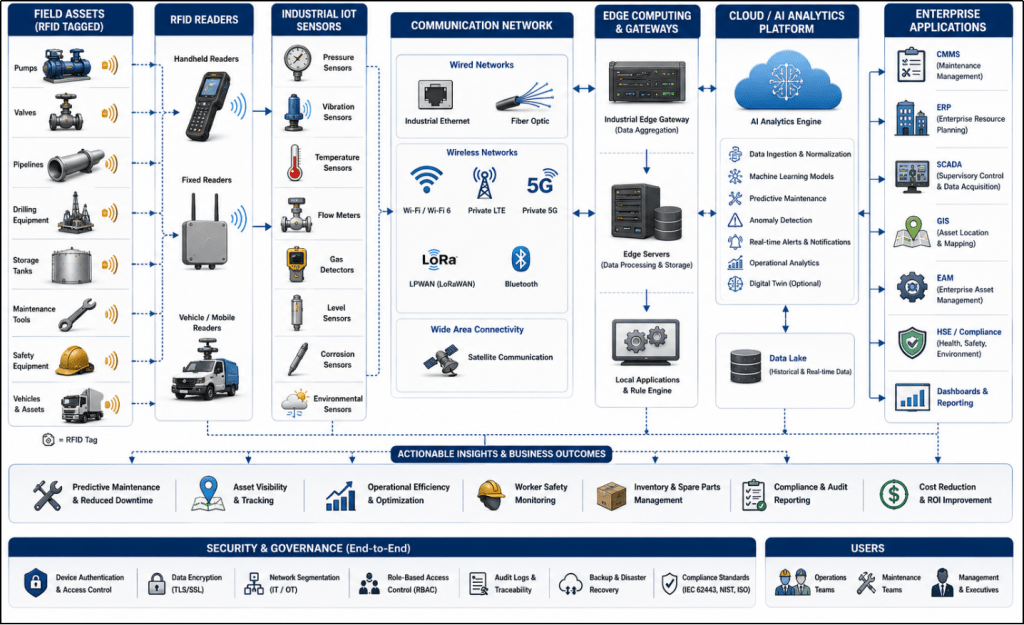
The network topology diagram shown in this schematic how RFID-tagged assets and Industrial IoT sensors exchange data through secure communication networks to edge servers and AI analytics software within an oil and gas monitoring system. It shows the integration of Industrial Ethernet, Wi-Fi, Private LTE, Private 5G, fiber optics, and satellite connectivity with enterprise applications such as CMMS, ERP, SCADA, GIS, and operational dashboards, enabling predictive maintenance, asset visibility, compliance monitoring, and data-driven operational decision-making.
Industry Standards and Regulatory Alignment
Oil and gas monitoring solutions should be designed to align with internationally recognized engineering standards, cybersecurity frameworks, and regulatory requirements.
Frequently referenced standards include:
- ISO 55000 Asset Management
- ISO 14224 Petroleum and Natural Gas Industries Collection and Exchange of Reliability and Maintenance Data
- ISO 17363 Supply Chain RFID Applications
- ISO 18000 RFID Air Interface Standards
- IEC 62443 Industrial Cybersecurity
- IEC 61511 Functional Safety
- IEC 60079 Explosive Atmospheres
- API RP 580 Risk-Based Inspection
- API RP 581 Risk-Based Inspection Methodology
- API 510 Pressure Vessel Inspection Code
- API 570 Piping Inspection Code
- API 653 Tank Inspection
- OSHA Process Safety Management (PSM)
- EPA environmental compliance requirements
- NIST Cybersecurity Framework
- ISA 95 Integration Standards
Compliance with these standards improves operational consistency while simplifying audits, regulatory reporting, and long-term asset management.
Cloud Version vs. Server Version for AI and RFID Oil & Gas Monitoring
Oil and gas organizations generally deploy AI and RFID monitoring software using either cloud-hosted infrastructure or privately managed server environments. The appropriate model depends on operational constraints, cybersecurity policies, data sovereignty, connectivity, and regulatory requirements.
| Comparison Factor | Cloud Version | Server Version |
| Software Hosting | Hosted in a cloud environment and managed within cloud infrastructure by the solution provider or cloud service provider. | Installed and managed on customer-owned edge servers, private data centers, refinery servers, or other enterprise-managed server infrastructure. |
| Infrastructure Ownership | Cloud infrastructure is owned and maintained by the cloud provider, while the organization manages its application data and configurations. | The organization owns or fully controls the server infrastructure, networking, storage, and application environment. |
| Deployment Speed | Faster deployment with minimal infrastructure preparation, enabling rapid rollout across multiple sites. | Longer deployment due to server procurement, software installation, configuration, and infrastructure validation. |
| Scalability | Compute resources, storage, and users can be expanded on demand with minimal operational disruption. | Scaling requires additional physical or virtual server resources, storage expansion, and IT planning. |
| Latency | Suitable for centralized monitoring, analytics, and reporting; latency depends on WAN or Internet connectivity. | Very low latency because processing occurs within the local operational network, making it suitable for real-time control environments. |
| Cybersecurity Control | Security is shared between the cloud provider and the organization, with centralized identity management, encryption, and continuous security updates. | Full control over cybersecurity policies, network segmentation, authentication, patch management, and access controls within the organization’s infrastructure. |
| Maintenance Responsibility | Infrastructure maintenance, backups, software updates, and availability are largely managed by the cloud provider. | Internal IT or operational technology teams are responsible for server maintenance, updates, backups, monitoring, and disaster recovery. |
| Offline Capability | Limited when Internet connectivity is unavailable, although edge buffering and synchronization can maintain temporary operation. | Can continue operating independently during WAN or Internet outages because processing and data storage remain local. |
| Integration Flexibility | Easily integrates with cloud-based ERP, CMMS, analytics software, mobile applications, and remote monitoring services through secure APIs. | Provides direct integration with local SCADA, DCS, PLCs, EAM, MES, and other operational technology systems using industrial communication protocols. |
| Remote Asset Support | Well suited for geographically distributed drilling sites, pipelines, terminals, offshore facilities, and multiple production facilities through centralized management. | Remote assets can be supported but typically require VPNs, private communication links, or dedicated connectivity for secure access. |
| Regulatory Suitability | Appropriate for organizations permitted to store operational data in cloud environments and requiring centralized reporting across multiple locations. | Preferred where strict data sovereignty, cybersecurity regulations, or operational policies require all data to remain within privately managed infrastructure. |
| Implementation Complexity | Lower implementation complexity because cloud infrastructure and core software services are preconfigured and centrally managed. | Higher implementation complexity due to server provisioning, network configuration, cybersecurity hardening, and ongoing infrastructure administration. |
| Ideal Deployment Scenarios | Multi-site oil and gas operators, geographically dispersed pipeline networks, distributed maintenance teams, fleet management, and organizations requiring centralized analytics and remote visibility. | Refineries, petrochemical plants, offshore facilities, compressor stations, critical infrastructure, isolated production facilities, and highly regulated environments requiring local processing and maximum operational control. |
Technical Capabilities and Business Value of AI and RFID Oil & Gas Monitoring
Combining AI with RFID provides measurable improvements across technical operations, maintenance, safety, compliance, and business performance.
Key technical capabilities include:
- Continuous asset identification without manual data entry
- Predictive maintenance driven by historical and real-time operational data
- Automated inspection verification
- Intelligent maintenance prioritization
- Real-time asset location awareness
- Workforce accountability and access validation
- Corrosion and integrity risk assessment
- Equipment utilization analysis
- Inventory optimization for critical spare parts
- Automated regulatory reporting
- Operational anomaly detection
- Failure pattern recognition
- AI-assisted turnaround planning
- Mobile inspection support
- Digital asset history management
These capabilities translate into practical operational improvements such as:
- Reduced unplanned shutdowns
- Improved equipment availability
- Higher production reliability
- Better turnaround execution
- Lower maintenance costs
- Reduced inspection effort
- Faster emergency response
- Increased worker safety
- Improved environmental compliance
- Better contractor management
- More accurate asset lifecycle planning
- Reduced inventory carrying costs
- Improved capital planning through predictive asset health insights
Engineering teams also benefit from AI-generated recommendations that prioritize work orders based on operational risk rather than fixed maintenance intervals, enabling more effective allocation of maintenance resources.
GAO helps organizations implement RFID-based monitoring solutions that support these outcomes by providing industrial-grade RFID readers, tags, accessories, and technical expertise tailored to demanding oil and gas environments.
Business and Benefits of AI and RFID Oil & Gas Monitoring
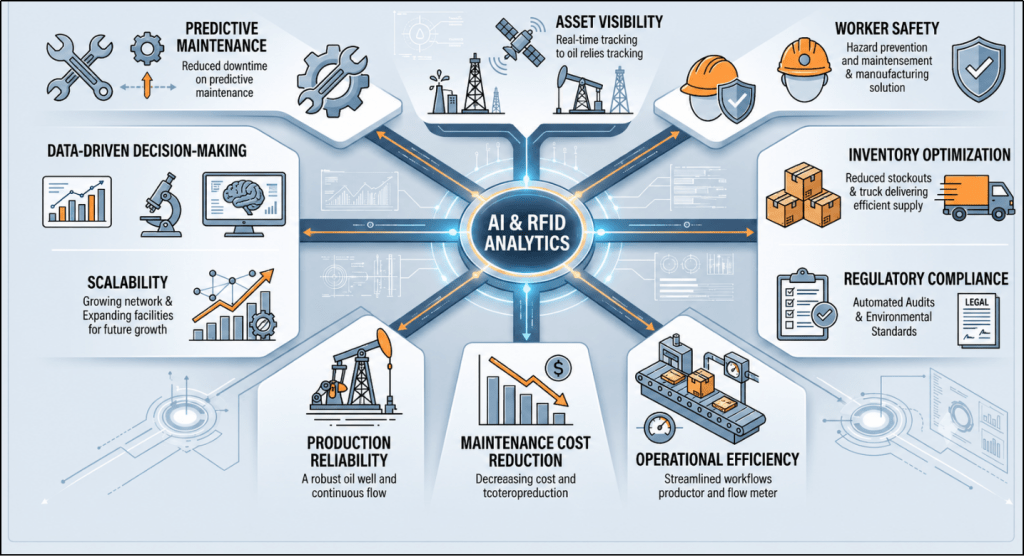
This infographic highlights the primary technical and business benefits of implementing AI and RFID for oil and gas monitoring. AI and RFID analytics serve as the central intelligence layer, connecting capabilities such as predictive maintenance, asset visibility, worker safety, inventory optimization, regulatory compliance, operational efficiency, production reliability, scalability, maintenance cost reduction, and data-driven decision-making to improve operational performance across the oil and gas value chain.
Engineering Best Practices for Successful Implementation
Successful AI and RFID deployments require careful planning beyond hardware installation.
Recommended engineering practices include:
- Conduct a comprehensive asset criticality assessment before RFID tagging.
- Select RFID tag types based on operating temperature, chemical exposure, vibration, and metal surfaces.
- Validate read performance under actual field conditions, including hazardous locations.
- Define data quality rules for RFID events before AI model development.
- Integrate operational technology and business systems through secure middleware.
- Apply edge processing where communication latency or intermittent connectivity exists.
- Establish AI model validation procedures using historical maintenance and failure records.
- Implement role-based access control and multi-factor authentication for operational software.
- Monitor AI model performance continuously and retrain models as equipment or operating conditions change.
- Develop cybersecurity policies aligned with IEC 62443 and the NIST Cybersecurity Framework.
- Perform periodic RFID infrastructure audits to verify reader coverage, tag integrity, and communication reliability.
- Plan for scalability to accommodate future facilities, production assets, and analytical workloads.
Advancing Oil & Gas Monitoring with AI and RFID
AI and RFID are redefining how oil and gas operators manage asset integrity, equipment reliability, regulatory compliance, and workforce safety. By combining automated identification with advanced analytics, organizations gain continuous visibility into critical assets across upstream production sites, midstream transportation networks, and downstream processing facilities. Well-designed solutions improve maintenance planning, reduce operational risk, strengthen environmental stewardship, and support data-driven decision-making throughout the asset lifecycle.
Successful implementation requires careful hardware selection, secure communication infrastructure, integration with operational and business software, robust cybersecurity practices, and ongoing AI model optimization. Drawing on decades of experience supplying RFID and industrial IoT technologies, GAO supports customers with reliable hardware products, engineering knowledge, stringent quality assurance processes, and expert remote and onsite technical support. Organizations seeking to modernize oil and gas monitoring can benefit from evaluating AI and RFID solutions as part of a broader digital transformation strategy.
Complete AI and RFID Oil & Gas Monitoring Solution for Intelligent Operations
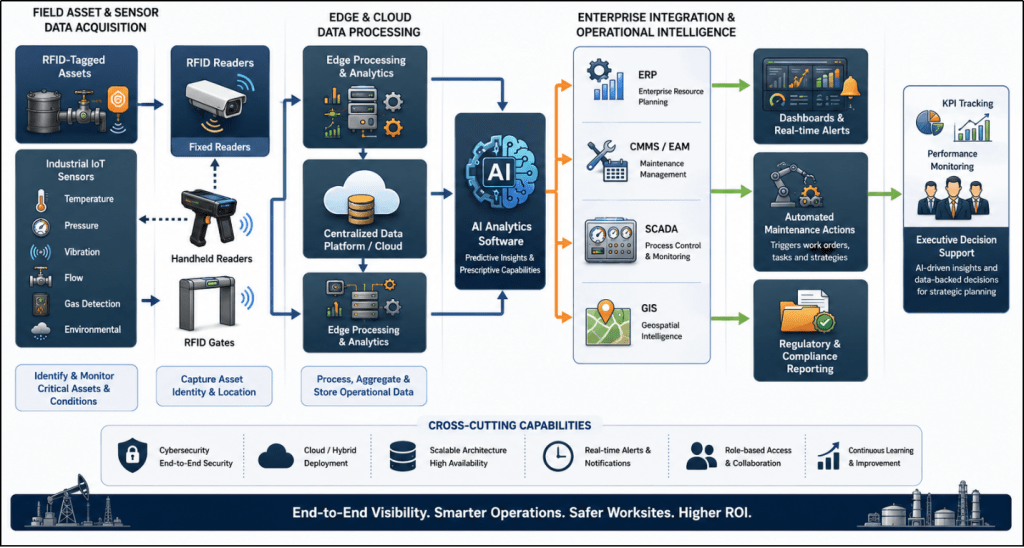
This solution block diagram provides a comprehensive overview of an AI and RFID monitoring system for the oil and gas industry. It illustrates how RFID-tagged assets, Industrial IoT sensors, communication networks, edge processing, AI analytics, and enterprise applications such as ERP, CMMS, EAM, SCADA, and GIS work together to deliver real-time dashboards, automated maintenance, regulatory compliance, and executive decision support for end-to-end operational intelligence.
Advisory Opportunity for Industrial AI + IoT Initiatives
For more than 30 years, GAO Group has advanced RFID, BLE, sensing technologies, edge computing, testing and measurement, and enterprise IoT solutions that support mission-critical operations. AI and IoT are transforming these proven technologies into intelligent systems that deliver greater visibility, automation, and operational insight. Building on this foundation, Aperture Venture Studio develops and scales specialized AI and IoT ventures by leveraging GAO Tek and GAO RFID’s engineering expertise and established technologies. We welcome customers, strategic partners, industry experts, advisors, and investors to explore collaboration opportunities. Contact us to learn more about our AI and RFID solutions or discuss partnership opportunities.