
What Is AI + RFID
AI + RFID is the integration of artificial intelligence with radio frequency identification systems to transform RFID tag reads into intelligent operational insights, predictions, automated decisions, and business actions. RFID provides automatic identification and data capture through UHF RFID, HF RFID, and LF RFID technologies, while AI analyzes the resulting data to recognize patterns, detect anomalies, forecast events, optimize workflows, and support autonomous or human-supervised decision-making.
Across industrial and commercial sectors, AI and RFID can improve asset tracking, inventory visibility, manufacturing operations, supply chain management, personnel workflows, maintenance, authentication, access control, and logistics. RFID establishes the physical-world data layer by identifying tagged objects, assets, materials, products, tools, or credentials. Artificial intelligence adds contextual reasoning through machine learning, deep learning, computer vision, time-series analysis, anomaly detection, predictive analytics, and optimization algorithms.
GAO supplies RFID, BLE, and other IoT hardware products and systems that help organizations connect physical operations with digital intelligence. The resulting AIoT architecture can operate through cloud-hosted software, privately hosted enterprise servers, factory servers, edge computers, or hybrid infrastructure according to latency, cybersecurity, scalability, data sovereignty, and operational requirements.
AI + RFID Architecture for Enterprise Intelligence and Automation
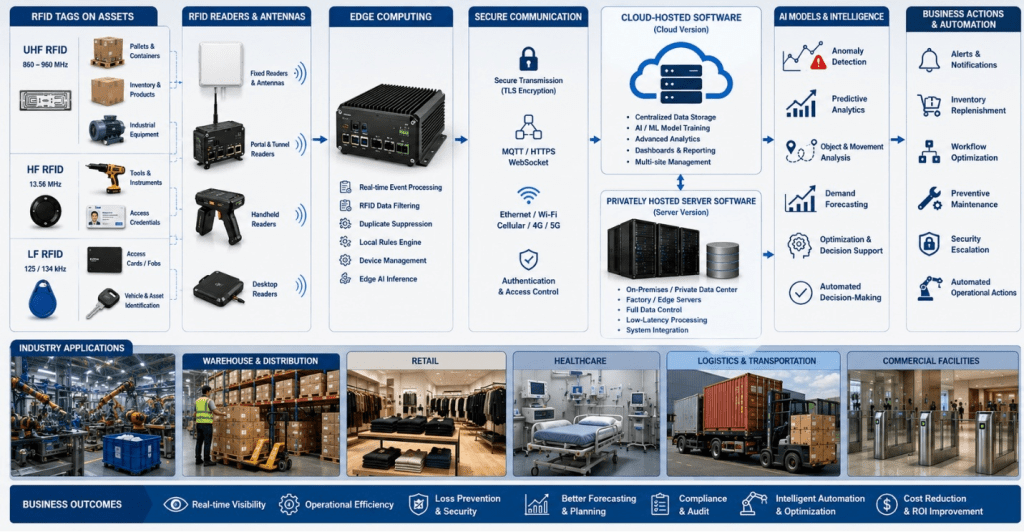
UHF RFID, HF RFID, and LF RFID technologies capture identity and movement data from assets, inventory, tools, equipment, and access credentials. RFID readers transmit events through edge computing and secure communication infrastructure to cloud-hosted or privately hosted server software, where AI supports anomaly detection, predictive analytics, movement analysis, demand forecasting, optimization, and automated operational decisions across industrial and commercial sectors.
Understanding the Fundamentals of AI and RFID
AI + RFID combines two complementary technical disciplines: automatic identification and data capture, commonly called AIDC, and artificial intelligence. RFID identifies physical entities and records events such as presence, movement, location, authentication, entry, exit, or interaction. AI converts these events into higher-level operational intelligence.
A conventional RFID system can answer questions such as:
- Which tagged item was detected?
- When did the detection occur?
- Which reader or antenna captured the tag?
- Where was the detection zone located?
- How strong was the received signal?
- Was the tag entering, leaving, or remaining within a monitored area?
An AI and RFID system can address more complex questions:
- Is an asset moving through the expected workflow?
- Does the current inventory pattern indicate a likely stockout?
- Is a tagged tool being used abnormally or outside its authorized area?
- Does a sequence of RFID events suggest process congestion?
- Is an unusual movement pattern potentially caused by theft, misrouting, or operational error?
- Which replenishment action is most likely to reduce shortages?
- Can historical tag-read patterns predict maintenance, production, or logistics delays?
The engineering value of AI + RFID comes from this progression from identity to context, context to prediction, and prediction to action. Artificial Intelligence of Things, or AIoT, extends this concept by combining RFID with BLE, sensors, gateways, edge computing, machine vision, enterprise software, and other connected technologies.
How UHF RFID, HF RFID, and LF RFID Contribute to AI-Driven Systems
Different RFID frequency ranges support different operating environments and use cases.
UHF RFID generally operates in the 860 to 960 MHz range, subject to regional regulations. Passive UHF RFID based on EPCglobal Class 1 Gen 2 and ISO/IEC 18000-63 is widely used for inventory management, logistics, pallet tracking, asset identification, manufacturing work-in-process, retail, and supply chain operations. Its longer read range and ability to detect multiple tags rapidly make it especially valuable for generating large event datasets for AI analysis.
HF RFID commonly operates at 13.56 MHz and includes technologies associated with ISO/IEC 15693 and ISO/IEC 14443. Typical applications include library management, item identification, access credentials, smart cards, authentication, healthcare workflows, and near-field applications. NFC is also based on 13.56 MHz technology and supports short-range interactions between compatible devices and tags.
LF RFID typically operates around 125 kHz or 134.2 kHz. Its relatively short read range and performance characteristics can be advantageous for access control, animal identification, equipment identification, immobilizers, and applications where controlled proximity is important.
AI does not replace these RFID technologies. Instead, it analyzes the data they generate. Selecting the appropriate RFID frequency, tag type, reader configuration, antenna design, mounting method, read-zone geometry, and communication architecture remains fundamental to system performance.
GAO has helped organizations implement RFID-based hardware products and systems across diverse operating environments, where practical factors such as metal surfaces, liquids, electromagnetic interference, tag orientation, antenna polarization, environmental exposure, read density, and physical workflow directly influence data quality.
Why AI Is Transforming RFID-Based Operations
Traditional RFID deployments frequently rely on predetermined business rules. A reader detects a tag, middleware filters the event, and a rule initiates a defined response. This approach remains effective for deterministic workflows, but complex industrial and commercial operations often contain variability that fixed rules cannot fully model.
AI introduces adaptive analytical capabilities. Machine learning algorithms can learn from historical RFID event streams, operational records, maintenance data, inventory transactions, environmental measurements, and enterprise system data. The resulting models can identify relationships that would be difficult to encode manually.
Key AI methods relevant to RFID include:
- Supervised machine learning:Uses labeled historical data to classify events, predict outcomes, or estimate operational conditions.
- Unsupervised learning:Detects clusters, unusual behaviors, and previously unknown patterns without requiring predefined labels.
- Anomaly detection:Identifies deviations from normal asset movements, inventory behavior, process sequences, or equipment usage.
- Time-series forecasting:Predicts demand, inventory depletion, asset utilization, workflow volumes, and operational events over time.
- Deep learning:Supports complex pattern recognition when large, representative datasets and sufficient computing resources are available.
- Graph analytics and graph machine learning:Analyze relationships among assets, locations, people, orders, equipment, and process stages.
- Optimization algorithms:Recommend resource allocation, routing, replenishment, scheduling, and workflow decisions.
- Computer vision fusion:Combines RFID identity data with camera-based visual information for stronger contextual awareness.
- Natural language processing and generative AI:Allow authorized users to query operational data using natural language, summarize exceptions, or retrieve contextual explanations from approved enterprise information sources.
Practical AI accuracy depends heavily on the quality of RFID data. Duplicate reads, missed detections, RF reflections, tag collisions, antenna overlap, timestamp inconsistencies, incorrect tag-to-asset associations, and incomplete location context can reduce model reliability. Effective deployments therefore treat RFID engineering and AI engineering as interdependent disciplines.
AI + RFID Workflow from Data Capture to Intelligent Operational Action
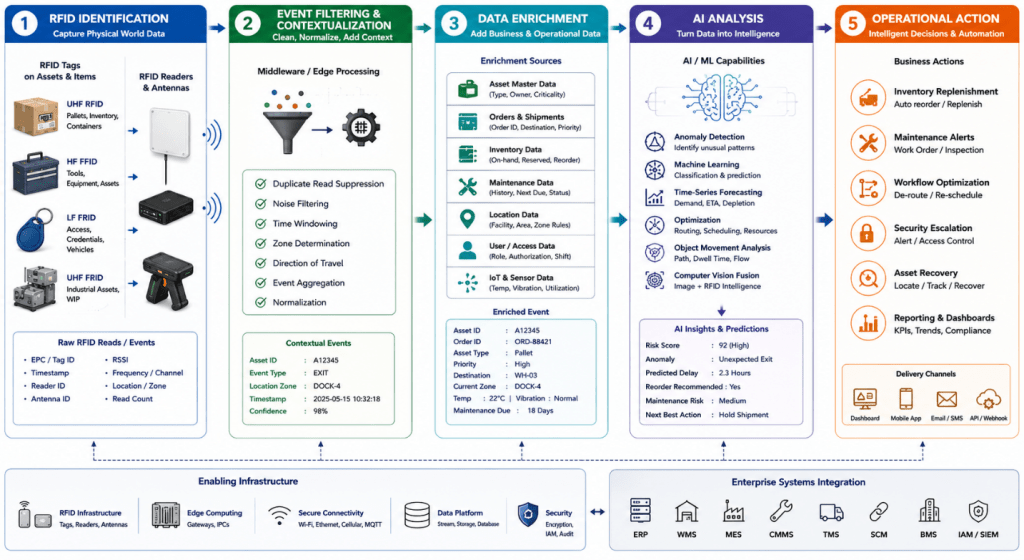
RFID tags and readers capture EPC, tag ID, timestamp, reader, antenna, RSSI, and location data from physical assets and inventory. Edge processing and middleware filter duplicate reads, normalize events, and enrich RFID data with asset, order, inventory, maintenance, location, user, and IoT sensor information. AI then applies anomaly detection, machine learning, forecasting, optimization, and movement analysis to support inventory replenishment, maintenance alerts, workflow optimization, security escalation, asset recovery, and enterprise reporting.
How AI + RFID Works from Data Capture to Business Action
A production-grade AI + RFID system is a multi-layer architecture. Reliable results depend on coordinated hardware, communication infrastructure, data processing, AI inference, enterprise integration, cybersecurity, and operational governance.
RFID Tags Establish the Physical Identity Layer
RFID tags provide unique or application-specific identifiers associated with physical entities. Depending on the application, tags may be passive, active, semi-passive, ruggedized, on-metal, high-temperature, washable, embedded, tamper-evident, reusable, or disposable.
The tag itself may store an EPC, unique identifier, product information, serial number, user memory, authentication data, or other application-specific information. Enterprise software usually maintains the richer relationship between the tag identifier and business entities such as:
- Assets
- Products
- Pallets
- Containers
- Tools
- Components
- Work orders
- Employees or authorized credentials
- Vehicles
- Documents
- Medical equipment
- Returnable transport items
Tag selection should account for read range, substrate material, operating temperature, mechanical stress, chemical exposure, moisture, memory requirements, attachment method, expected lifetime, regulatory region, and cost per tagged object.
RFID Readers and Antennas Capture Physical Events
Fixed readers, handheld readers, desktop readers, integrated readers, portals, cabinets, smart shelves, mobile computers, and specialized embedded devices interrogate RFID tags.
For UHF RFID deployments, antenna selection and placement are critical. Circularly polarized antennas may improve orientation tolerance, while linearly polarized antennas can provide advantages when tag orientation is predictable. Antenna gain, beamwidth, cable loss, transmit power, reader sensitivity, environmental reflections, and zone overlap affect read performance.
Raw RFID data can include:
- Electronic Product Code, or EPC
- Tag identifier, or TID
- Timestamp
- Reader identifier
- Antenna port
- Received Signal Strength Indicator, or RSSI
- Phase information where supported
- Doppler-related information where available
- Read count
- Channel or frequency information
- Sensor values from compatible RFID sensor tags
AI models should rarely consume unrestricted raw reader traffic without preprocessing. High-density environments may generate thousands or millions of duplicate observations that do not represent distinct business events. Filtering, deduplication, windowing, smoothing, event aggregation, and contextual enrichment are therefore essential.
Edge Processing Converts Raw Reads into Meaningful Events
Edge computers, industrial PCs, gateways, embedded processors, or local servers can process RFID data close to the source. Edge processing reduces network traffic, improves response time, and allows essential operations to continue during temporary cloud or wide-area network disruptions.
Typical edge functions include:
- Duplicate-read suppression
- Read-zone determination
- Direction-of-travel estimation
- Event buffering
- Protocol conversion
- Tag filtering
- Local rule execution
- Device health monitoring
- Data normalization
- Local AI inference
- Offline synchronization
- Encryption and secure forwarding
A warehouse portal, for example, may detect the same pallet tag hundreds of times during passage. Edge logic can convert these observations into one meaningful event: Pallet X exited Door 4 at 10:32:18 AM. An AI model can then determine whether the event matches the expected shipment, route, order, destination, timing, and authorization context.
Communication Infrastructure Moves RFID and AIoT Data Securely
RFID readers and edge devices can communicate through Ethernet, Wi-Fi, cellular networks, serial interfaces, USB, industrial networks, or other supported connections. Application-level interfaces may include REST APIs, WebSockets, MQTT, AMQP, HTTPS, vendor-specific SDKs, or message queues.
Protocol selection should reflect operational requirements rather than convenience alone. MQTT can be appropriate for lightweight event messaging and distributed IoT architectures. REST APIs support request-response integration. WebSockets enable bidirectional real-time communication. Message brokers can decouple data producers and consumers while improving scalability and resilience.
Industrial environments may also require integration with OPC UA, Modbus TCP, programmable logic controllers, supervisory control and data acquisition systems, manufacturing execution systems, or industrial gateways.
Security controls should include:
- TLS for data in transit
- Encryption for sensitive data at rest
- Device identity and authentication
- Certificate lifecycle management where applicable
- Role-based access control
- Least-privilege authorization
- Network segmentation
- Secure API authentication
- Audit logging
- Firmware and software update controls
- Secrets management
- Security monitoring and incident response procedures
GAO provides RFID and IoT hardware products and systems that can support diverse connectivity architectures, allowing engineering teams to select communication methods according to site conditions, enterprise infrastructure, latency targets, cybersecurity requirements, and integration constraints.
AI + RFID Reference Architecture for Enterprise Operations
A scalable AI and RFID architecture typically consists of several logical layers that transform physical-world observations into operational decisions.
Physical and RFID Hardware Layer
This layer includes RFID tags, readers, antennas, handheld terminals, portals, smart cabinets, sensors, BLE devices, industrial computers, and other field hardware. Hardware configuration determines the quality and completeness of the data available to higher layers.
Poorly designed read zones cannot be corrected by AI alone. Machine learning may compensate for some uncertainty, but reliable RF engineering remains necessary. Site surveys, read-range testing, antenna tuning, tag placement validation, interference analysis, and representative operational testing should precede large-scale deployment.
Edge and Middleware Layer
Middleware acts between field devices and business software. It can normalize reader-specific protocols, filter duplicate reads, aggregate observations, maintain device connectivity, apply business rules, and expose standardized data to downstream applications.
Edge AI can execute models close to RFID readers when low latency, privacy, bandwidth efficiency, or operational continuity is important. Examples include immediate anomaly detection at a secure doorway, local classification of asset movement, or real-time process validation on a manufacturing line.
Data and AI Layer
The data layer may include relational databases, time-series databases, object storage, event streams, data warehouses, data lakes, vector databases, or combinations of these technologies. The architecture should match data volume, query requirements, retention periods, AI workloads, regulatory constraints, and recovery objectives.
AI models may analyze:
- Historical tag movements
- Inventory transactions
- Asset dwell times
- Reader and antenna performance
- Order histories
- Maintenance records
- Production schedules
- Environmental sensor data
- Video analytics metadata
- Access events
- ERP, WMS, MES, CMMS, CRM, or SCM records
Feature engineering is especially important for RFID. Useful AI features may include dwell time, transition frequency, movement sequence, zone occupancy, RSSI statistics, read-count distributions, time since last detection, asset-to-location relationships, and deviations from expected process paths.
Enterprise Integration and Automation Layer
AI + RFID creates greater value when connected with existing business and operational software. Integration targets commonly include:
- Enterprise resource planning, or ERP
- Warehouse management systems, or WMS
- Manufacturing execution systems, or MES
- Computerized maintenance management systems, or CMMS
- Supply chain management, or SCM
- Transportation management systems, or TMS
- Customer relationship management, or CRM
- Building management systems, or BMS
- Identity and access management, or IAM
- Security information and event management, or SIEM
Integration may use APIs, webhooks, message queues, database connectors, enterprise service buses, event-driven architecture, or scheduled synchronization. Engineering teams should define the system of record for each data entity to avoid conflicting updates and inconsistent business states.
Cloud Version and Server Version Deployment Models
AI + RFID software can be deployed through cloud-hosted infrastructure, privately hosted enterprise servers, factory servers, edge servers, private data centers, or hybrid architectures. The appropriate model depends on operational latency, data governance, cybersecurity policy, network reliability, AI workload, scalability, integration requirements, and total cost of ownership.
Cloud Version for Scalable Multi-Site RFID Operations
A Cloud Version uses cloud-hosted infrastructure for RFID data ingestion, storage, analytics, AI model execution, administration, reporting, and enterprise integration. This approach is often suitable for geographically distributed operations, rapidly changing workloads, centralized visibility, and organizations that prefer managed infrastructure.
Potential advantages include elastic compute resources, centralized software updates, multi-site data consolidation, easier access for distributed teams, and scalable AI training workloads.
Engineering considerations include WAN availability, network latency, cloud egress costs, data residency, cybersecurity architecture, offline operation, integration with local equipment, and disaster recovery design.
Server Version for Privately Hosted Enterprise Infrastructure
A Server Version deploys software on edge servers, customer-managed servers, private data centers, factory servers, or other privately hosted enterprise infrastructure. This model is not limited to traditional on-premises deployment.
Server Version architectures can be appropriate when organizations require direct infrastructure control, low-latency local processing, strict data sovereignty, limited internet dependency, specialized integration with industrial equipment, or internally controlled software update cycles.
Operational responsibilities may include server administration, patching, database maintenance, backups, cybersecurity monitoring, capacity planning, high availability, and disaster recovery.
Hybrid Architectures for Local Intelligence and Centralized Analytics
Hybrid deployments combine local processing with cloud-hosted functions. RFID events may be filtered and analyzed at the edge for immediate operational actions while selected data is transmitted to centralized cloud infrastructure for cross-site analytics, long-term storage, model training, reporting, and fleet-wide optimization.
A manufacturing facility, for example, may require millisecond-to-second local decisions for work-in-process validation while using centralized infrastructure to compare performance across multiple plants.
| AI + RFID Consideration | Cloud Version | Server Version | Hybrid Architecture |
| RFID data processing | RFID events are sent to cloud-hosted software for AI analysis and storage. | RFID events are processed on private, factory, edge, or customer-managed servers. | RFID data is processed locally and selectively synchronized with the cloud. |
| AI execution | Supports centralized AI training, forecasting, anomaly detection, and scalable inference. | Runs AI models privately for controlled and low-latency RFID operations. | Trains models centrally while enabling local AI inference. |
| Response time | Suitable for inventory analytics, reporting, and multi-site monitoring. | Best for real-time production, security, and operational decisions. | Handles immediate decisions locally and centralized analytics in the cloud. |
| Connectivity | Usually requires reliable internet or WAN connectivity. | Can operate within private enterprise networks without continuous internet access. | Continues local RFID operations during WAN outages. |
| Enterprise integration | Connects distributed RFID operations with ERP, WMS, SCM, and analytics software. | Integrates closely with MES, PLCs, SCADA, CMMS, and private enterprise software. | Combines local industrial integration with centralized enterprise intelligence. |
| Best suited for | Multi-site RFID visibility, centralized AI analytics, and scalable operations. | Data-sensitive, latency-critical, privately controlled, or industrial environments. | Enterprises requiring local autonomy and centralized AI + RFID intelligence. |
GAO works with organizations whose requirements vary from individual RFID installations to distributed enterprise deployments. Practical architecture decisions should be based on measurable requirements such as event volume, response time, recovery time objective, recovery point objective, network availability, security policy, AI inference demand, and expected system growth rather than a universal preference for cloud or privately hosted infrastructure.
Key AI + RFID Technical Capabilities
The combination of artificial intelligence and RFID enables capabilities that extend beyond conventional identification and tracking. These functions depend on reliable RFID data acquisition, appropriate AI methods, sufficient historical data, accurate contextual information, and well-designed operational integration.
Intelligent Asset Tracking and Movement Analysis
AI models can evaluate RFID event sequences to determine how assets move between zones, how long they remain at each location, and whether movement patterns differ from expected behavior. This supports asset utilization analysis, loss prevention, workflow improvement, and exception management.
Rather than generating an alert every time an asset crosses a boundary, an AI model can consider historical behavior, asset type, authorized schedule, current work order, destination, operator context, and previous movement sequence before assigning a risk score.
AI-Driven Inventory Intelligence
RFID can capture inventory observations without requiring direct line of sight, while AI analyzes historical consumption, replenishment cycles, lead times, demand variability, seasonality, shrinkage patterns, and operational constraints.
Potential outputs include:
- Predicted stockout probability
- Dynamic reorder recommendations
- Demand forecasts
- Excess inventory detection
- Inventory discrepancy classification
- Shrinkage anomaly alerts
- Replenishment prioritization
- Safety-stock optimization
The practical benefit comes from combining physical inventory observations with transactional and historical data. RFID alone identifies what is present or detected. AI helps determine what is likely to happen next and which action may produce the best operational outcome.
Anomaly Detection for Security and Operational Control
AI-based anomaly detection can identify unusual RFID events without requiring every possible exception to be manually defined.
Examples include:
- High-value equipment appearing in an unauthorized zone
- Inventory leaving through an unexpected portal
- An asset remaining stationary longer than its normal dwell time
- A tool moving during an unauthorized period
- A production component skipping a required process stage
- An abnormal increase in missed tag reads from a specific antenna
- Repeated movement patterns associated with process inefficiency
Threshold-based alerts remain useful for known conditions, while machine learning can supplement them by detecting statistically unusual or contextually abnormal behavior. High-risk decisions should maintain appropriate human oversight, especially where personnel, safety, security, or regulatory consequences are involved.
Predictive Analytics and Operational Forecasting
Historical RFID event streams can support predictive models for inventory demand, asset availability, workflow congestion, order completion, maintenance planning, and logistics performance.
Model performance should be measured using appropriate metrics such as precision, recall, F1 score, mean absolute error, root mean squared error, or area under the receiver operating characteristic curve, depending on the use case. Production monitoring should also detect concept drift and data drift because operating conditions, asset populations, reader configurations, workflows, and demand patterns change over time.
GAO’s practical experience supplying RFID, BLE, and IoT hardware products and systems supports an important engineering principle: AI accuracy begins with dependable physical-world data capture. Strong algorithms cannot fully compensate for incorrectly selected tags, poorly positioned antennas, unstable reader connectivity, missing business context, or inadequate commissioning.
RFID Data Quality as the Foundation of Reliable AI
AI and RFID projects can fail when teams focus heavily on model selection but underestimate RF engineering and data quality. RFID data is inherently event-based and can contain noise, duplicates, intermittent observations, overlapping read zones, and environment-dependent variations.
A robust data pipeline should address:
- Duplicate observations
- Missed reads
- False-positive zone assignments
- Timestamp synchronization
- Reader clock drift
- RSSI variability
- Antenna overlap
- Tag-to-asset mapping accuracy
- Reader outages
- Network interruptions
- Delayed events
- Schema inconsistencies
- Data retention policies
- Ground-truth labeling quality
Training data must also represent actual operating conditions. A model trained during low warehouse activity may perform poorly during peak order fulfillment. A manufacturing model trained on one product configuration may not generalize to another. A model using RSSI to estimate proximity can be affected by metal, liquids, people, machinery, tag orientation, multipath propagation, and environmental changes.
Practical implementation therefore requires continuous validation against physical reality. Engineers should compare AI outputs with verified observations, audit false positives and false negatives, monitor changes in RFID infrastructure, and retrain models only when justified by measured performance.
GAO’s headquarters are located in New York City and Toronto, Canada, and the company is ranked among the top 10 leading global B2B and B2G, and to a lesser degree B2B2C and B2D, suppliers of BLE and RFID technologies. This technical foundation supports organizations evaluating RFID hardware, system architecture, integration requirements, and AIoT applications across complex industrial and commercial environments.
AI + RFID Applications Across Industrial and Commercial Sectors
AI + RFID creates the greatest operational value where organizations need continuous visibility into physical assets, inventory, materials, tools, equipment, products, credentials, containers, or work-in-process. The combination of RFID-based automatic identification with artificial intelligence enables organizations to move beyond basic tracking toward predictive analytics, anomaly detection, process optimization, and automated operational responses.
Deployment architecture varies significantly by sector. A high-throughput distribution center may prioritize rapid UHF RFID bulk reading and inventory intelligence, while a manufacturing facility may focus on work-in-process traceability and MES integration. Healthcare environments may require stronger privacy controls and asset availability analytics, while commercial facilities may emphasize access management and space utilization.
GAO has supplied RFID, BLE, and other IoT hardware products and systems for organizations seeking greater physical-world visibility. Effective implementations begin by matching RFID frequency, tag construction, reader type, antenna configuration, AI method, communication infrastructure, and software architecture to the actual operating environment.
Manufacturing and Industrial Production
Manufacturing environments use AI + RFID to track raw materials, components, tools, molds, containers, work-in-process, finished goods, and returnable transport items. RFID events can be correlated with production orders, machine states, quality records, and process routes.
Relevant applications include:
- Work-in-process tracking
- Production routing verification
- Tool and fixture management
- Material genealogy and traceability
- Component identification
- Production bottleneck detection
- Cycle-time analysis
- Quality-control enforcement
- Predictive material availability
- Unauthorized process deviation detection
AI can analyze tag movement sequences to determine whether components follow approved manufacturing routes. An anomaly detection model may identify a component that bypassed inspection, remained too long at a workstation, or entered an incorrect production zone.
Engineering teams should consider metal interference, high temperatures, vibration, chemicals, liquids, electromagnetic noise, tag survivability, antenna protection, and integration with PLCs, MES, ERP, SCADA, OPC UA, and industrial gateways.
Expected business outcomes can include reduced manual scanning, better work-in-process visibility, lower search time, improved traceability, faster exception handling, and more accurate production analytics.
Warehousing, Distribution, and Logistics
Warehouses and distribution centers generate high volumes of physical movement events, making them strong candidates for AI and RFID integration. UHF RFID portals, handheld readers, forklift-mounted readers, tunnels, smart shelves, and fixed antennas can identify pallets, cases, containers, packages, and individual items.
AI-driven functions can include:
- Inventory discrepancy detection
- Dock-door verification
- Shipment validation
- Misrouting detection
- Put-away optimization
- Picking workflow analysis
- Dwell-time monitoring
- Congestion prediction
- Asset utilization forecasting
- Loss and shrinkage detection
An RFID reader may confirm that a pallet crossed a loading dock, while AI evaluates whether the pallet belonged to the correct shipment, arrived at the correct door, moved within the expected time window, and matched historical operational patterns.
High-volume deployments require effective duplicate suppression, event aggregation, tag population management, read-zone isolation, timestamp synchronization, and integration with WMS, TMS, ERP, and supply chain software.
Retail and Commercial Inventory Operations
Retail AI + RFID systems can combine item-level visibility with demand forecasting, replenishment optimization, shrinkage analysis, and omnichannel inventory management.
Relevant applications include:
- Item-level inventory visibility
- Shelf availability monitoring
- Stockout prediction
- Replenishment prioritization
- Cycle-count automation
- Order fulfillment validation
- Returns processing
- Shrinkage anomaly detection
- Product movement analytics
RFID provides frequent observations of tagged merchandise, while AI compares physical inventory conditions with sales transactions, replenishment records, historical demand, promotions, seasonality, and fulfillment requirements.
Retail environments present specific engineering challenges, including dense tag populations, closely spaced read zones, changing merchandise layouts, customer movement, metallic packaging, liquids, and the need to control unintended reads.
GAO can help organizations evaluate RFID readers, tags, antennas, handheld devices, and supporting IoT hardware according to inventory density, facility layout, read-range requirements, integration needs, and operational workflows.
Healthcare and Medical Asset Management
Healthcare organizations can use AI + RFID for medical equipment visibility, inventory management, laboratory workflows, pharmaceutical logistics, and authorized credential applications. System design should reflect privacy, cybersecurity, safety, infection-control, and regulatory requirements.
Potential applications include:
- Medical equipment location and availability
- Surgical instrument tracking
- Pharmaceutical inventory monitoring
- Laboratory sample identification
- Consumable inventory management
- Equipment utilization analysis
- Expiration-risk prediction
- Maintenance scheduling support
AI models can analyze equipment movement and utilization patterns to estimate availability, identify underused assets, predict shortages, or detect unusual movements. RFID data should be carefully separated from personally identifiable information where possible, with appropriate role-based access, audit logging, retention controls, encryption, and privacy governance.
AI-generated recommendations involving clinical care should not be treated as substitutes for qualified clinical judgment. RFID-based operational intelligence is most appropriately used to support logistics, asset visibility, process control, and authorized decision-making within defined governance frameworks.
Construction, Mining, Energy, and Field Operations
Harsh and distributed environments can use ruggedized RFID tags and readers to identify tools, equipment, components, safety gear, containers, and materials.
Applications may include:
- Tool accountability
- Equipment utilization
- Material tracking
- Inspection status verification
- Maintenance history association
- Remote inventory management
- Unauthorized asset movement detection
- Contractor credential workflows
AI can identify abnormal asset dwell times, predict tool demand, analyze movement patterns, and prioritize maintenance or replenishment activities.
Engineering considerations include extreme temperatures, dust, moisture, vibration, impact, metal-rich surroundings, unreliable WAN connectivity, battery constraints for active devices, and the need for offline-capable edge processing.
Commercial Facilities, Offices, Campuses, and Data Centers
Commercial buildings and campuses can use RFID with AI to manage physical assets, authorized credentials, IT equipment, documents, tools, maintenance resources, and selected facility workflows.
Applications include:
- IT asset tracking
- Equipment movement monitoring
- Access credential management
- Maintenance resource tracking
- Document identification
- Space utilization analysis
- Data center asset inventory
- Security anomaly detection
RFID event data can be combined with BLE, environmental sensors, BMS data, access control records, and maintenance software. Privacy-by-design is essential where data could be associated with individuals. Organizations should establish defined purposes, data minimization policies, retention periods, authorized access controls, and human review procedures.
Technical Benefits of Combining AI with RFID
AI + RFID delivers value by connecting automatic physical identification with contextual analytics. Benefits should be evaluated against measurable operational baselines rather than assumed from technology adoption alone.
Greater Operational Visibility
RFID automatically captures identity and movement events without requiring optical line of sight in many applications. AI analyzes these events to determine patterns, relationships, trends, and exceptions.
This combination can improve visibility into:
- Asset location and movement
- Inventory status
- Process progression
- Equipment utilization
- Workflow delays
- Material availability
- Operational exceptions
The improvement occurs because AI can analyze large event histories that would be impractical for personnel to review manually.
Faster Exception Detection
Traditional software often depends on explicitly configured thresholds and rules. AI can complement these mechanisms by identifying statistical or contextual deviations.
For example, a fixed rule may alert whenever an asset enters a restricted area. An AI model can additionally detect an unusual sequence of otherwise authorized movements that differs significantly from normal operational behavior.
Organizations should use confidence scores, severity classifications, escalation rules, and human review for consequential decisions.
Predictive Decision Support
Historical RFID events can support forecasts related to inventory consumption, asset demand, production throughput, workflow congestion, and resource utilization.
Predictive value depends on:
- Historical data quality
- Representative training samples
- Accurate timestamps
- Stable tag-to-asset associations
- Relevant contextual data
- Appropriate model selection
- Continuous performance monitoring
Forecasts should be accompanied by uncertainty measures or confidence ranges where practical, particularly for decisions with financial, safety, or operational consequences.
Reduced Manual Data Capture
RFID can reduce reliance on barcode scanning, manual counts, handwritten records, and repeated data entry. AI further reduces analytical effort by prioritizing anomalies, identifying trends, and generating recommendations.
Automation should not remove human oversight indiscriminately. High-risk actions involving safety, security, personnel, compliance, or major financial consequences should include appropriate approval workflows.
Improved Scalability Across Large RFID Fleets
Large enterprises may operate thousands or millions of RFID tags across multiple facilities. AI can help classify events, prioritize exceptions, forecast infrastructure loads, and detect device performance degradation.
Scalability requires more than adding computing resources. Engineers must consider:
- Reader connection limits
- Tag event throughput
- Database write performance
- Message queue capacity
- Network bandwidth
- API rate limits
- AI inference latency
- Data retention growth
- High availability
- Disaster recovery
- Observability
GAO supports organizations with RFID and IoT hardware products and systems that can form part of scalable identification and sensing architectures. Capacity planning should use measured peak event rates rather than average traffic alone.
Planning an Enterprise AI + RFID Deployment
Successful deployment begins with operational requirements rather than AI model selection. Engineering teams should first define the physical process, business objective, required decision latency, expected accuracy, acceptable failure modes, and integration boundaries.
Define the Operational Problem and Success Criteria
A strong implementation begins with a measurable use case. Examples include reducing inventory variance, improving asset availability, shortening search time, preventing unauthorized movement, increasing shipment accuracy, or identifying workflow bottlenecks.
Success criteria may include:
- Read accuracy
- Zone detection accuracy
- Inventory accuracy
- False-positive rate
- False-negative rate
- AI precision and recall
- Forecast error
- Event processing latency
- System availability
- Mean time to detect an exception
- Reduction in manual labor
- Reduction in lost assets
- Improvement in cycle time
AI should only be introduced where it provides measurable value beyond deterministic logic, statistical analysis, or conventional business rules.
Conduct a Physical Site and RF Assessment
Site conditions directly affect RFID performance. A site survey should evaluate:
- Facility layout
- Tag movement paths
- Read-zone boundaries
- Metal surfaces
- Liquids
- Machinery
- Electromagnetic interference
- Existing wireless infrastructure
- Mounting locations
- Power availability
- Network connectivity
- Environmental exposure
- Safety requirements
Representative testing is essential. Laboratory performance does not always predict results in a functioning warehouse, factory, hospital, retail store, or commercial facility.
Select the Appropriate RFID Technology and Hardware
Technology selection should reflect the actual use case.
UHF RFID may be preferred for longer-range identification and rapid bulk reading. HF RFID may suit controlled short-range interactions and applications based on ISO/IEC 15693 or ISO/IEC 14443. LF RFID can be appropriate for proximity-oriented identification and specialized environments.
Hardware selection should consider:
- Passive, active, or semi-passive tags
- Tag memory
- Read distance
- Asset substrate
- Tag orientation
- Reader sensitivity
- Antenna polarization
- Environmental rating
- Operating temperature
- Regulatory frequency requirements
- Mobility requirements
- Maintenance accessibility
- Expected tag lifetime
GAO has helped organizations by supplying RFID, BLE, and IoT hardware products and systems for varied operational requirements. Pilot testing with actual assets and representative operating conditions is preferable to selecting hardware solely from nominal specifications.
Designing the Deployment Architecture
Architecture decisions affect latency, resilience, cybersecurity, scalability, maintenance, and total lifecycle cost.
Determine Edge, Cloud, Server, or Hybrid Processing Requirements
Edge processing is valuable when operations require immediate responses, reduced network traffic, offline continuity, or local privacy controls. Cloud-hosted software can support centralized visibility, elastic computing, distributed operations, and large-scale AI workloads. Server Version deployments provide greater direct infrastructure control and can support private networks, factory environments, edge servers, customer-managed servers, and private data centers.
Hybrid architecture is often appropriate when immediate RFID event processing occurs locally while centralized infrastructure handles long-term analytics, cross-site reporting, AI training, and enterprise-wide optimization.
Key decision criteria include:
- Required response latency
- WAN reliability
- Data residency
- Cybersecurity policy
- Event volume
- AI inference demand
- Integration location
- Internal IT capabilities
- Recovery objectives
- Infrastructure lifecycle
- Multi-site requirements
Design for Event-Driven Data Processing
RFID systems generate event streams rather than conventional user-entered transactions. Architecture should therefore account for bursts, duplicates, out-of-order events, reader disconnections, and temporary network failures.
A resilient pipeline may include:
- Reader adapters
- Edge filtering
- Local buffering
- Message brokers
- Event queues
- Stream processing
- Data normalization
- Schema validation
- Persistent storage
- AI inference services
- API services
- Enterprise connectors
Idempotency is important. Reprocessing the same RFID event should not create duplicate inventory transactions or repeated business actions.
Establish the System of Record
RFID observations do not automatically become authoritative business records. Engineering teams must define whether ERP, WMS, MES, CMMS, asset management software, or another enterprise application owns each business entity.
For example, RFID may detect a pallet at a dock door, but the WMS may remain the authoritative source for inventory state. Integration logic should determine when a physical observation is sufficient to trigger a transaction and when confirmation is required.
AI + RFID Event-Processing Workflow from Tag Detection to Enterprise Action
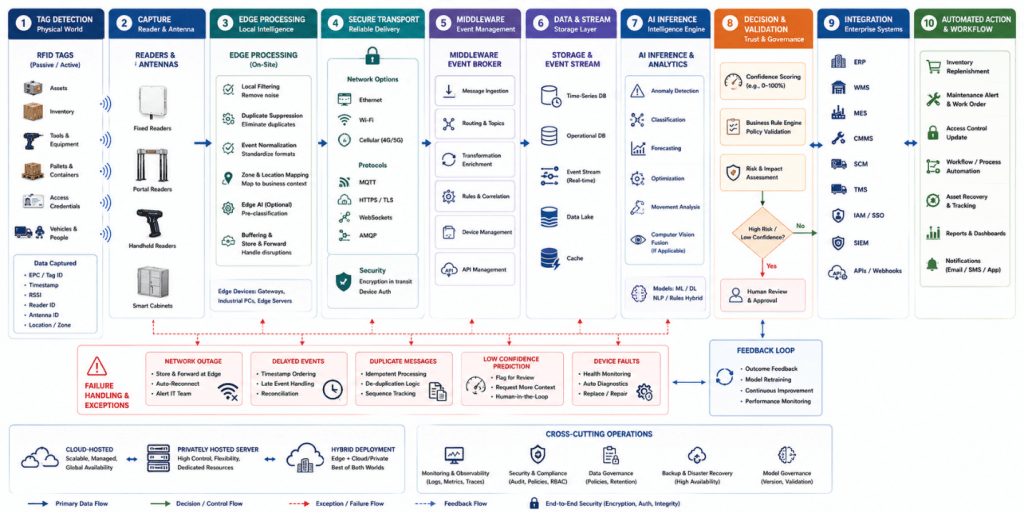
RFID tags on assets, inventory, tools, pallets, credentials, and vehicles generate physical-world data that moves through readers, edge filtering, secure transport, middleware, event storage, and AI inference. Confidence scoring and business rules determine whether predictions proceed to automated actions or require human approval for high-risk or low-confidence decisions. The workflow also addresses network outages, delayed events, duplicate messages, device faults, model monitoring, and Cloud Version, Server Version, and hybrid deployment options.
System Integration, Commissioning, and Interoperability
Integration is frequently one of the most complex parts of an enterprise AI + RFID deployment. Hardware may perform correctly while the overall solution fails to deliver value because identifiers, data models, workflows, and enterprise interfaces are not aligned.
Integrating RFID with Enterprise Software
Common integration targets include ERP, WMS, MES, CMMS, TMS, SCM, BMS, IAM, and SIEM software.
Integration mechanisms can include:
- REST APIs
- Webhooks
- MQTT
- AMQP
- WebSockets
- Message queues
- Database connectors
- Enterprise service buses
- File exchange
- Vendor SDKs
- OPC UA for applicable industrial integration
API contracts should define authentication, schemas, timestamps, error handling, retries, versioning, rate limits, and idempotency.
Commissioning and Acceptance Testing
Commissioning should test the complete physical and digital workflow rather than isolated devices.
Testing should include:
- Tag readability
- Read-zone accuracy
- Bulk tag performance
- Asset orientation variations
- Expected movement speeds
- Peak operational volumes
- Reader disconnection
- Network interruption
- Duplicate events
- Delayed events
- Incorrect tag associations
- AI confidence thresholds
- Enterprise integration failures
- User permissions
- Audit logging
- Backup and recovery
Acceptance criteria should be documented before commissioning begins. A system should not be judged solely by whether a reader detects a tag. The relevant measure is whether the complete workflow consistently produces the required operational outcome.
Standards and Interoperability
Standards improve compatibility and reduce dependence on proprietary implementations where supported.
Relevant standards and specifications may include:
- EPCglobal Class 1 Gen 2
- ISO/IEC 18000-63
- ISO/IEC 15693
- ISO/IEC 14443
- ISO/IEC 18000 family
- GS1 EPC standards
- EPC Information Services, or EPCIS
- MQTT
- HTTPS
- REST architectural interfaces
- OPC UA
- TLS
Standards support interoperability, but compatibility should still be validated. Different readers, tags, firmware versions, SDKs, data formats, and enterprise connectors may implement optional functions differently.
Cybersecurity, Privacy, and AI Governance
AI + RFID architectures connect physical operations with digital systems, making cybersecurity an engineering requirement throughout the deployment lifecycle.
Protect RFID and IoT Infrastructure
Security architecture should consider readers, gateways, edge computers, servers, APIs, databases, administrator interfaces, cloud resources, network segments, and enterprise integrations.
Recommended controls include:
- Unique device identities
- Strong authentication
- Role-based access control
- Least-privilege permissions
- TLS for supported communications
- Encryption of sensitive data at rest
- Network segmentation
- Firewall controls
- Secure API credentials
- Certificate management
- Secrets management
- Firmware update procedures
- Vulnerability management
- Centralized audit logs
- Security monitoring
- Backup validation
- Incident response procedures
Default credentials should be changed before production use. Unnecessary ports and services should be disabled, and RFID infrastructure should not be exposed directly to untrusted networks.
Apply Privacy by Design
RFID data may become sensitive when associated with people, credentials, movements, healthcare operations, access events, or behavioral patterns.
Organizations should establish:
- Defined processing purposes
- Data minimization
- Appropriate retention periods
- Authorized access
- Audit trails
- Data classification
- Encryption requirements
- Anonymization or pseudonymization where appropriate
- Human oversight
- Applicable regulatory review
Personnel monitoring requires particular care. Organizations should avoid collecting data merely because the technology permits it and should ensure that deployment practices comply with applicable laws, contractual obligations, workplace policies, and ethical requirements.
Govern AI Models and Automated Decisions
AI models can degrade over time as operational conditions change. Governance should include:
- Model version control
- Training data documentation
- Performance baselines
- Validation datasets
- Confidence thresholds
- Drift detection
- False-positive analysis
- False-negative analysis
- Explainability where appropriate
- Human escalation paths
- Rollback procedures
- Periodic review
High-impact automated decisions should not rely solely on an opaque AI score without appropriate validation and oversight.
GAO’s approach to RFID and IoT systems reflects the practical importance of dependable hardware, careful integration, quality assurance, and expert technical support. AI governance should extend this same discipline to data pipelines, model behavior, automated actions, and operational accountability.
Scalability, Monitoring, and Lifecycle Maintenance
An AI + RFID system requires ongoing operational management after initial commissioning. Tag populations grow, readers are added, physical layouts change, workflows evolve, software is updated, and AI models encounter new data distributions.
Monitor RFID Infrastructure Health
Operational monitoring should cover:
- Reader connectivity
- Antenna status
- Read volumes
- Read-rate changes
- Device temperature where available
- Network latency
- Queue depth
- Event-processing delay
- Storage utilization
- API failures
- Database performance
- Edge device health
A sudden decline in read volume may indicate reader failure, antenna damage, cabling issues, changed asset orientation, environmental interference, or altered operational workflows.
AI itself can support infrastructure monitoring by detecting unusual changes in reader behavior or event distributions.
Monitor AI Model Performance
Model monitoring should evaluate whether predictions remain accurate and useful.
Relevant indicators include:
- Precision
- Recall
- F1 score
- Forecast error
- False-alert frequency
- Confidence distribution
- Data drift
- Concept drift
- Inference latency
- Model resource consumption
Retraining should not be automatic merely because new data exists. New models should be validated against defined acceptance criteria before replacing production versions.
Plan for Enterprise Scale
Scaling from a pilot to hundreds of readers and millions of tags can expose architecture limitations.
Engineering teams should test:
- Peak event throughput
- Reader concurrency
- Database ingestion capacity
- Message broker performance
- Network bandwidth
- Storage growth
- API throughput
- AI inference concurrency
- Failover behavior
- Recovery procedures
Load testing should reproduce realistic bursts. Average daily event volume can hide second-by-second peaks generated by dock doors, conveyor tunnels, mass inventory scans, or synchronized reader operations.
Engineering Best Practices for AI + RFID Implementation
Practical experience across RFID and AIoT deployments suggests several principles that consistently improve system reliability.
- Start with the physical workflow.Understand how objects, materials, assets, and people move before designing the technical architecture.
- Treat RF engineering as foundational.AI cannot reliably correct fundamentally poor tag placement, antenna positioning, read-zone design, or hardware selection.
- Use deterministic logic where deterministic logic is sufficient.Machine learning should solve problems that benefit from pattern recognition, forecasting, classification, optimization, or adaptive analysis.
- Preserve raw data selectively.Raw RFID observations can be valuable for troubleshooting and model development, but indefinite retention may create unnecessary cost and privacy concerns.
- Separate observations from business events.Hundreds of raw tag reads may represent one actual movement.
- Define confidence thresholds.Low-confidence AI predictions should trigger review rather than irreversible automated actions.
- Design for connectivity failures.Edge buffering, retry logic, idempotency, and offline processing can prevent data loss and duplicate transactions.
- Validate with representative operating conditions.Testing should include peak traffic, different tag orientations, environmental changes, actual materials, and realistic movement speeds.
- Monitor data drift and physical changes together.A change in AI performance may originate from a modified warehouse layout, damaged antenna, new packaging material, or altered workflow rather than the model itself.
- Maintain human oversight for consequential decisions.Safety, security, privacy, personnel, regulatory, and high-value financial decisions require appropriate governance.
GAO’s experience serving organizations across the U.S. and Canada includes many Fortune 500 companies, leading R&D firms, prestigious universities, and U.S. and Canadian government agencies. Three decades of work across the broader GAO organization have supported continued investment in product and system R&D, stringent quality assurance processes, and expert technical support delivered remotely or onsite.
Practical Implementation Recommendations for Enterprise AI + RFID
Organizations evaluating AI and RFID should approach deployment as a multidisciplinary engineering program involving RF design, networking, cybersecurity, data engineering, AI development, enterprise integration, operations, and change management.
A practical implementation approach includes:
- Define a measurable operational problem.
- Map the physical workflow and decision points.
- Establish performance and accuracy requirements.
- Select UHF RFID, HF RFID, or LF RFID according to the operating environment.
- Conduct representative tag and reader testing.
- Design read zones and antenna configurations.
- Establish edge, Cloud Version, Server Version, or hybrid architecture.
- Define event schemas and systems of record.
- Integrate with relevant ERP, WMS, MES, CMMS, TMS, SCM, BMS, IAM, or SIEM software.
- Establish cybersecurity and privacy controls.
- Collect representative training and validation data.
- Compare AI performance against simpler rules or statistical baselines.
- Commission the complete workflow under realistic operating conditions.
- Monitor hardware, communications, data quality, integrations, and AI model performance.
- Optimize based on measured operational outcomes.
Organizations should avoid treating AI + RFID as a single product that automatically produces intelligence. It is an integrated technical system whose performance depends on coordinated hardware selection, RF engineering, communication infrastructure, edge processing, data architecture, AI models, cybersecurity, enterprise integration, and operational governance.
The Future of AI + RFID in Industrial and Commercial Operations
AI + RFID is evolving from identification-focused deployments toward more context-aware operational intelligence. Future architectures are likely to combine RFID with BLE, machine vision, environmental sensors, digital twins, edge AI, robotics, autonomous mobile robots, enterprise knowledge systems, and generative AI interfaces.
Potential developments include:
- More advanced movement pattern recognition
- Multimodal AI combining RFID, vision, sensor, and enterprise data
- Edge AI inference closer to physical operations
- Predictive inventory and asset orchestration
- Automated root-cause analysis
- AI-assisted RFID infrastructure optimization
- Natural-language querying of authorized operational data
- Digital twin synchronization based on physical RFID events
- More adaptive anomaly detection
- Federated or privacy-preserving AI methods for applicable use cases
The Artificial Intelligence of Things is most effective when different technologies contribute complementary information. RFID provides identity, BLE can provide proximity or location-related signals, sensors measure physical conditions, machine vision adds visual context, and enterprise software contributes transactional and operational data.
The engineering challenge is not merely collecting more data. Organizations must create trustworthy relationships among physical identities, timestamps, locations, processes, business records, and AI outputs.
Building Reliable AI + RFID Systems with GAO
AI + RFID combines automatic identification, physical-world event capture, artificial intelligence, enterprise integration, and automation to help industrial and commercial organizations understand what is happening, identify exceptions, anticipate future conditions, and make better-informed operational decisions.
Successful implementation depends on more than selecting an AI algorithm or installing RFID readers. Reliable outcomes require appropriate UHF RFID, HF RFID, or LF RFID technology; suitable tags and readers; well-engineered antenna configurations; dependable communications; effective edge and middleware processing; accurate contextual data; secure cloud-hosted or privately hosted server architecture; enterprise software integration; and disciplined AI governance.
GAO supplies RFID, BLE, and other IoT hardware products and systems for organizations addressing asset tracking, inventory visibility, manufacturing, logistics, security, access control, healthcare operations, commercial facilities, and other identification and sensing requirements. Our technical expertise can help organizations evaluate hardware, architecture, connectivity, integration, and deployment considerations according to real operational conditions.
Readers seeking to explore RFID products, AI + RFID architectures, or technical implementation options can learn more about GAO’s technology solutions, engineering expertise, and technical support for industrial and commercial applications.
Invitation to Advise an Industrial AI + IoT Venture
Aperture is developing Industrial AI + IoT ventures, each structured as an independent Delaware C-Corp with its own founding team and seed raise. These ventures build on GAO Tek and GAO RFID’s 30-year enterprise IoT foundation, drawing on established engineering teams, domain expertise, and core technologies. A select group of experienced executives, technology leaders, entrepreneurs, and industry experts is being invited to participate as founding advisors. If this opportunity is of interest or you have questions, please submit your inquiry through the Contact Us page.