
Blood Inventory Control RFID Systems Using RFID Technologies
Blood Inventory Control RFID Systems enable continuous visibility, traceability, and governance across blood banks, hospital transfusion services, mobile collection units, and regional distribution centers. These systems use RFID technologies to uniquely identify blood bags, components, and storage containers while maintaining verifiable records across collection, processing, storage, transport, and transfusion workflows.
Blood inventory environments demand strict control over expiration dates, storage conditions, chain-of-custody, and regulatory documentation. RFID-based blood inventory systems support these requirements by automating identification events, reducing manual scanning dependency, and improving reconciliation accuracy across storage locations and handling points. System architecture separates physical data capture from inventory governance, allowing organizations to operate under cloud-based or non-cloud deployments depending on regulatory mandates, infrastructure policies, and operational maturity. Deployment flexibility enables consistent inventory controls across centralized blood centers and decentralized hospital environments without altering core operational procedures.
Overview of GAO’s RFID-Based Blood Inventory Control RFID Systems
Blood Inventory Control RFID platforms focus on maintaining accuracy, availability, and compliance for blood products across highly regulated clinical environments. The system structure aligns asset identification, lifecycle state management, and reporting within a controlled governance framework. Inventory intelligence supports operational decisions such as allocation, redistribution, quarantine, and disposal while maintaining audit-ready records.
RFID technologies enable non-line-of-sight identification suitable for cold storage, constrained access areas, and high-throughput processing lines. Blood inventory platforms support multiple deployment models, including cloud-hosted environments for regional coordination and non-cloud configurations operating on handheld devices, PCs, local servers, or enterprise-controlled remote servers. This architectural flexibility allows hospitals, blood centers, and healthcare networks to adapt inventory controls to data residency requirements, latency sensitivity, and clinical risk tolerance while maintaining consistent operational logic.
Description, Purpose, Issues Addressed and Benefits of GAO’s RFID-Enabled Blood Inventory Control RFID System Description
System Purpose
Blood Inventory Control RFID Systems are designed to enforce traceability, inventory accuracy, and compliance across the entire blood lifecycle. The system maintains persistent identity for each blood unit and records all state transitions from collection through transfusion or disposal.
Primary system purposes include:
- Real-time inventory visibility across storage locations and facilities
- Enforcement of expiration, compatibility, and quarantine policies
- Reduction of manual data entry and reconciliation errors
- Generation of verifiable audit records for regulatory review
Issues Addressed in Blood Inventory Operations
Operational and compliance issues addressed include:
- Inventory discrepancies between physical stock and information systems
- Limited visibility into near-expiry or misallocated blood units
- Manual label scanning errors under time-critical conditions
- Fragmented documentation across collection, storage, and transfusion
- Regulatory exposure under FDA, AABB, Health Canada, and hospital accreditation standards
Operational and Clinical Benefits
Observed benefits include:
- Improved inventory accuracy and reconciliation rates
- Faster identification of expiring or recalled blood units
- Reduced waste from preventable expiration
- Strengthened chain-of-custody documentation
- Improved coordination between clinical, laboratory, and logistics teams
System Architecture of Blood Inventory Control RFID Using RFID Technologies
Cloud Architecture for Blood Inventory Control RFID
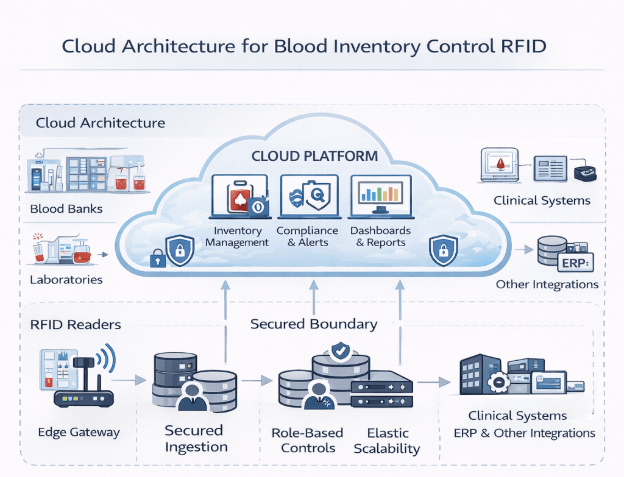
Cloud-based architecture centralizes inventory governance, policy enforcement, and reporting within controlled cloud environments. RFID events generated at blood banks, laboratories, storage refrigerators, and transfusion points are transmitted through secure gateways to centralized services responsible for inventory state management and analytics.
The overall structure combines distributed data capture with centralized configuration and reporting. Local clinical teams manage readers and capture points, while centralized IT or compliance teams oversee policies, dashboards, and system integrations. Security boundaries isolate device communications, tenant data, and administrative access through role-based controls and encrypted channels. Scalability is achieved through elastic processing capacity and standardized onboarding of new facilities.
Non-Cloud Architecture for Blood Inventory Control RFID
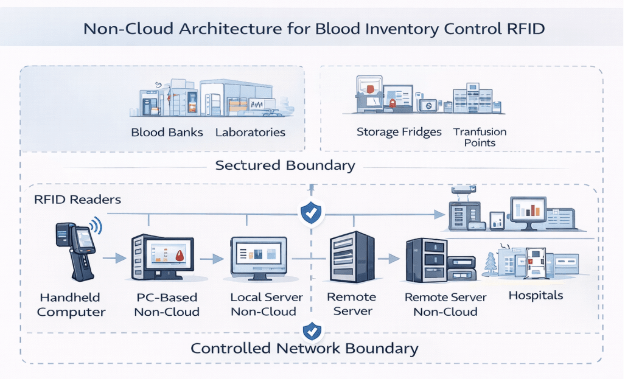
Non-cloud architecture supports environments requiring data sovereignty, offline operation, or infrastructure isolation. Blood Inventory Control RFID software may operate entirely on handheld computers, PCs, local servers, or enterprise-managed remote servers.
Data processing, inventory validation, and reporting occur within defined network boundaries. Operational responsibility shifts toward local IT and biomedical engineering teams for system maintenance, backups, and upgrades. Synchronization with external systems is optional and tightly controlled. Scalability depends on hardware provisioning and site-level configuration rather than elastic resources.
Cloud vs Non-Cloud Deployment Comparison for Blood Inventory Control RFID
| Dimension | Cloud Deployment | Non-Cloud Deployment |
| Governance Model | Centralized inventory policies | Localized control per facility |
| Connectivity Dependency | Requires reliable network access | Supports offline or intermittent operation |
| Regulatory Alignment | Suitable for multi-site coordination | Preferred for strict data residency |
| Scalability Approach | Elastic compute and storage | Hardware-based expansion |
| Operational Ownership | Shared IT and compliance oversight | Predominantly internal IT teams |
| Typical Use Scenarios | Regional blood networks | Hospital-centric deployments |
| Handheld Operation | Edge capture only | Full system execution |
| PC-Based Deployment | Administrative access | Department-level control |
| Local Server Deployment | Optional hybrid caching | Core processing and storage |
| Remote Server Deployment | Cloud-hosted services | Enterprise-controlled data centers |
Cloud Integration and Data Management for Blood Inventory Control RFID
Cloud integration focuses on inventory data lifecycle governance rather than device management. RFID event data is ingested through secure interfaces, normalized, and associated with blood unit records, processing stages, and compliance attributes. Processing engines apply inventory rules related to expiration thresholds, compatibility flags, and quarantine status.
Storage layers separate operational data from historical audit records to meet retention and regulatory requirements. Analytics services support inventory aging analysis, utilization patterns, and compliance monitoring. Integration interfaces enable controlled data exchange with laboratory information systems, hospital information systems, and enterprise resource planning platforms. Access governance enforces role-based permissions, audit logging, and encryption standards.
Major Components of Blood Inventory Control RFID Architecture
RFID Credentials and Labels
- Unique identifiers attached to blood units and containers
- Selection considerations include sterilization tolerance and memory capacity
RFID Readers
- Fixed and mobile readers deployed across storage and handling zones
- Constraints include interference control and read zone accuracy
Edge Devices and Gateways
- Aggregate reader data and apply preliminary validation
- Operate under clinical network constraints
Middleware and Processing Engines
- Correlate RFID events with inventory rules and workflows
- Support version control and validation logic
Cloud Platforms or Local Servers
- Host inventory engines, analytics, and reporting
- Selected based on governance and availability requirements
Databases and Storage Systems
- Maintain transactional and audit datasets
- Designed for traceability and compliance retention
Dashboards and Reporting Tools
- Provide role-specific visibility for clinical, operational, and compliance teams
RFID Technologies Used in Blood Inventory Control RFID
UHF RFID
- Longer read ranges and higher throughput
- Greater sensitivity to liquid proximity
HF RFID
- Short-range, stable coupling characteristics
- Predictable performance near fluids
NFC
- Very short-range interaction
- Device-mediated authentication
LF RFID
- Low-frequency propagation
- Limited data rates and range
RFID Technology Comparison for Blood Inventory Control RFID
| Technology | Operational Alignment | Environmental Behavior | Interaction Model | System Role |
| UHF | Bulk inventory movement | Moderate | Passive broadcast | Storage zone tracking |
| HF | Controlled identification | High | Inductive coupling | Processing verification |
| NFC | Manual confirmation | High | Device-initiated | Inspection checkpoints |
| LF | Specialized environments | Very high | Continuous field | Legacy integration |
Combining Multiple RFID Technologies in Blood Inventory Control RFID
Multi-technology architectures are appropriate when inventory workflows include both bulk movement and controlled verification points. Combining UHF RFID for storage-level visibility with HF or NFC RFID for validation checkpoints improves accuracy and governance. Architectural benefits include reduced ambiguity and improved reconciliation. Trade-offs include increased configuration complexity, reader coordination challenges, and higher system validation requirements.
Applications of Blood Inventory Control RFID Systems
- Regional blood bank inventory coordination
- Hospital transfusion service management
- Mobile blood collection unit tracking
- Plasma processing and fractionation facilities
- Emergency blood stock management
- Quarantine and recall handling workflows
- Surgical suite blood product staging
- Trauma center inventory readiness
- Research and clinical trial blood storage
- Inter-hospital blood redistribution programs
- Military and disaster response blood logistics
Deployment Options for Blood Inventory Control RFID
Cloud Deployment Use Cases and Advantages
- Multi-hospital networks requiring centralized inventory oversight
- Regional blood centers coordinating multiple facilities
- Organizations prioritizing standardized compliance reporting
Non-Cloud Deployment Use Cases and Advantages
- Hospitals with strict data residency requirements
- Facilities requiring offline operational continuity
- Environments with limited external connectivity
Non-cloud deployments support software execution on handheld computers for bedside verification, PCs for laboratory management, local servers for hospital-wide control, or remote servers managed within enterprise data centers.
Case Studies of Blood Inventory Control RFID Systems Using RFID Technologies
U.S. Case Studies
Blood Inventory Traceability Optimization in New York City, New York
- Problem
A multi-hospital healthcare network in New York City faced recurring discrepancies between recorded and physical blood inventory across centralized blood banks and hospital transfusion services. Manual barcode workflows caused delays in reconciliation, and expiration-related waste averaged 7 percent monthly. Regulatory audits required improved chain-of-custody documentation.
- Solution
GAO supported deployment of Blood Inventory Control RFID Systems using RFID technologies with a cloud-based architecture. UHF RFID was applied for cold storage inventory zones, while HF RFID supported controlled verification points. Edge gateways transmitted events to centralized inventory governance services, integrating with laboratory information systems.
- Result
Inventory accuracy improved to 99.2 percent, and blood unit expiration waste dropped by 38 percent within six months. Hospital Blood Bank Workflow Automation in Chicago, Illinois
- Problem
A large urban hospital blood bank in Chicago experienced bottlenecks during peak transfusion demand due to manual blood unit identification and documentation errors. Offline storage areas lacked reliable network access, creating data gaps.
- Solution
GAO implemented Blood Inventory Control RFID Systems using RFID technologies in a non-cloud configuration operating on a local server with handheld RFID-enabled computers. HF RFID supported close-range verification in preparation rooms, while UHF RFID enabled batch inventory checks.
- Result
Average blood unit processing time decreased by 27 percent, and documentation discrepancies fell below 1 percent per audit cycle. Regional Blood Distribution Coordination in Los Angeles, California
- Problem
A regional blood distribution organization serving multiple hospitals across Los Angeles lacked real-time visibility into inventory levels at satellite storage locations. Redistribution decisions were based on delayed reports, leading to preventable shortages.
- Solution
GAO supported a cloud-based Blood Inventory Control RFID System using RFID technologies with centralized dashboards. UHF RFID readers captured storage and outbound logistics events, while cloud analytics provided cross-facility inventory insights.
- Result
Inter-facility redistribution response times improved by 41 percent, and emergency stock shortages declined by 22 percent year over year. Trauma Center Blood Readiness Enhancement in Houston, Texas
- Problem
A trauma center in Houston required rapid verification of blood availability during emergency scenarios. Manual inventory checks delayed clinical decision-making during high-pressure events.
- Solution
GAO deployed a non-cloud Blood Inventory Control RFID System using RFID technologies on PCs and handheld devices. NFC and HF RFID supported rapid verification at transfusion points without reliance on continuous connectivity.
- Result
Emergency blood verification times were reduced from minutes to under 30 seconds per check.
University Medical Center Compliance Improvement in Boston, Massachusetts
- Problem
A university medical center in Boston faced audit findings related to incomplete documentation of blood handling events across teaching laboratories and clinical units.
- Solution
GAO assisted with a hybrid deployment of Blood Inventory Control RFID Systems using RFID technologies, combining cloud-based compliance reporting with on-premise processing nodes. HF RFID supported laboratory handling checkpoints.
- Result
Regulatory audit exceptions related to blood inventory documentation dropped to zero in the subsequent review cycle.
Mobile Blood Collection Oversight in Atlanta, Georgia
- Problem
Mobile blood collection units operating across Atlanta struggled to synchronize collection data with central inventory systems, resulting in delayed availability of collected units.
- Solution
GAO enabled non-cloud Blood Inventory Control RFID Systems using RFID technologies running on handheld computers with periodic synchronization to a remote server. HF RFID supported unit identification during collection.
- Result
Data synchronization delays were reduced by 56 percent, improving processing turnaround times.
Blood Component Processing Facility in Phoenix, Arizona
- Problem
A blood component processing facility experienced misalignment between processing stages and inventory records, increasing rework and compliance risk.
- Solution
GAO supported deployment of Blood Inventory Control RFID Systems using RFID technologies on a local server architecture. UHF RFID enabled tracking across processing zones.
- Result
Processing-stage reconciliation errors declined by 33 percent within the first quarter.
Rural Hospital Network Inventory Control in Montana
- Problem
A rural hospital network in Montana required reliable blood inventory control with limited network connectivity and minimal IT staffing.
- Solution
GAO implemented a non-cloud Blood Inventory Control RFID System using RFID technologies operating on PCs with optional remote server synchronization. HF RFID supported controlled handling environments.
- Result
Inventory accuracy improved from 92 percent to 98 percent across participating facilities.
Pediatric Hospital Blood Safety Program in Seattle, Washington
- Problem
A pediatric hospital required enhanced safeguards to prevent transfusion errors related to blood unit misidentification.
- Solution
GAO supported Blood Inventory Control RFID Systems using RFID technologies with NFC-enabled verification points integrated into clinical workflows.
- Result
Reported near-miss identification incidents decreased by 45 percent.
Military Medical Facility Inventory Control in San Diego, California
- Problem
A military medical facility required isolated infrastructure for blood inventory systems due to security constraints.
- Solution
GAO supported a non-cloud Blood Inventory Control RFID System using RFID technologies deployed on a secure local server environment.
- Result
Inventory audit reconciliation achieved 100 percent alignment during internal inspections.
Emergency Response Blood Stock Management in Miami, Florida
- Problem
Emergency response centers in Miami lacked real-time awareness of blood stock levels during disaster response operations.
- Solution
GAO enabled a cloud-based Blood Inventory Control RFID System using RFID technologies with centralized dashboards accessible to authorized response coordinators.
- Result
Stock deployment decisions accelerated by 34 percent during emergency drills.
Research Hospital Blood Storage Monitoring in San Francisco, California
- Problem
A research hospital required precise tracking of blood units allocated to clinical trials.
- Solution
GAO supported Blood Inventory Control RFID Systems using RFID technologies on a remote server managed within enterprise infrastructure.
- Result
Trial-related inventory discrepancies were eliminated across reporting cycles.
Multi-Campus Healthcare System in Ohio
- Problem
A multi-campus healthcare system experienced inconsistent blood inventory practices across facilities.
- Solution
GAO assisted with cloud-based Blood Inventory Control RFID Systems using RFID technologies to standardize policies across sites.
- Result
Policy adherence consistency increased by 29 percent system-wide.
Specialty Surgical Center in Denver, Colorado
- Problem
A specialty surgical center required precise blood inventory staging for scheduled procedures.
- Solution
GAO supported a non-cloud Blood Inventory Control RFID System using RFID technologies on a PC-based deployment.
- Result
Procedure-related inventory shortages declined by 21 percent.
Canadian Case Studies
Provincial Blood Services Coordination in Toronto, Ontario
- Problem
Blood services across Toronto required coordinated inventory visibility across hospitals and distribution centers.
- Solution
GAO supported a cloud-based Blood Inventory Control RFID System using RFID technologies with centralized reporting.
- Result
Inter-facility stock balancing improved by 37 percent.
Hospital Blood Bank Operations in Vancouver, British Columbia
- Problem
A hospital blood bank in Vancouver experienced documentation delays during peak demand.
- Solution
GAO implemented a non-cloud Blood Inventory Control RFID System using RFID technologies on handheld computers.
- Result
Documentation turnaround improved by 31 percent.
Regional Healthcare Network in Calgary, Alberta
- Problem
A regional network required consistent blood inventory oversight across multiple sites.
- Solution
GAO supported Blood Inventory Control RFID Systems using RFID technologies deployed on a remote server within enterprise infrastructure.
- Result
Inventory variance across sites decreased by 26 percent.
Teaching Hospital Compliance Program in Montreal, Quebec
- Problem
A teaching hospital faced compliance challenges related to blood handling documentation.
- Solution
GAO assisted with hybrid deployment of Blood Inventory Control RFID Systems using RFID technologies combining local servers and centralized reporting.
- Result
Audit findings related to blood inventory handling were reduced by 44 percent.
Rural Healthcare Facility in Northern Ontario
- Problem
A rural healthcare facility required resilient blood inventory tracking with limited connectivity.
- Solution
GAO supported a non-cloud Blood Inventory Control RFID System using RFID technologies operating on PCs with periodic synchronization.
- Result
Inventory reporting accuracy improved to 97 percent.
Our products and systems have been developed and deployed for a wide range of industrial applications. They are available off-the-shelf or can be customized to meet your needs. If you have any questions, our technical experts can help you.
For any further information on GAO’s products and systems, to request evaluation kits, free samples, recorded video demos, or explore partnership opportunities, please fill out this form or email us.