
Border Control Systems Using RFID Technologies Overview
Border Control Systems Using RFID technologies enable automated identification, monitoring, and governance of cross-border movements involving people, vehicles, cargo units, and regulated assets. These systems replace manual inspection workflows with machine-readable identification layers integrated into controlled access zones, inspection lanes, checkpoints, and secure perimeters. RFID-based border systems support continuous state awareness, controlled policy enforcement, and structured auditability across high-volume and high-risk environments.
Operational models vary depending on regulatory mandates, data residency requirements, and infrastructure maturity. Border Control Systems Using RFID technologies support both cloud-based deployments and non-cloud configurations operating on handheld computers, PCs, local servers, or enterprise-managed remote servers. This flexibility allows border authorities to balance centralized oversight with localized operational autonomy.
RFID technologies applied within border control environments include UHF, HF, NFC, and LF, selected based on read range requirements, interference tolerance, credential form factors, and inspection workflows. These systems are designed to integrate with identity management platforms, customs systems, inspection databases, and national security infrastructure while maintaining strict separation between operational domains and administrative access layers.
Overview of GAO’s RFID- Based Border Control Systems
Border Control Systems Using RFID technologies provide structured visibility into border operations by combining automated identification, rule-based decision logic, and auditable reporting. These systems are architected to support large-scale deployments across land borders, seaports, airports, and controlled transit corridors.
Core system functions include credential verification, asset tracking, movement validation, and compliance enforcement. Border Control Systems Using RFID technologies reduce reliance on manual inspection while increasing throughput consistency and data accuracy. System structures emphasize modularity, allowing phased deployment across inspection points, lanes, and zones without disrupting ongoing operations.
Deployment flexibility remains a central design principle. Cloud-based architectures support centralized policy management, analytics, and reporting across multiple border facilities. Non-cloud deployments enable localized control in environments with strict sovereignty mandates, limited connectivity, or classified operational constraints. GAO supports both deployment models, enabling border agencies to adapt system architectures to evolving operational and regulatory conditions.
Description, Purpose, Issues Addressed and Benefits of GAO’s RFID-Enabled Border Control Systems Using RFID Technologies
System Description
- Border Control Systems Using RFID technologies consist of identification credentials, sensing infrastructure, processing layers, and governance mechanisms designed to validate, record, and control cross-border interactions. These systems operate across heterogeneous environments involving vehicles, cargo containers, inspection staff, travelers, and secure facilities.
System Purposes
- Automate credential verification at border checkpoints
- Enforce access and movement policies across controlled zones
- Maintain traceable audit records for regulatory review
- Support risk-based inspection workflows
- Enable controlled data sharing with upstream and downstream systems
Issues Addressed
- Manual inspection bottlenecks and inconsistent enforcement
- Limited visibility across distributed border facilities
- Data silos between inspection, customs, and security systems
- Regulatory pressure for traceability and accountability
- Operational challenges in high-volume traffic scenarios
System Benefits
- Increased inspection throughput with reduced human error
- Consistent policy enforcement across sites
- Improved data integrity and audit readiness
- Flexible deployment aligned with sovereignty requirements
- Scalable architecture supporting phased expansion
System Architecture of Border Control Systems Using RFID Technologies
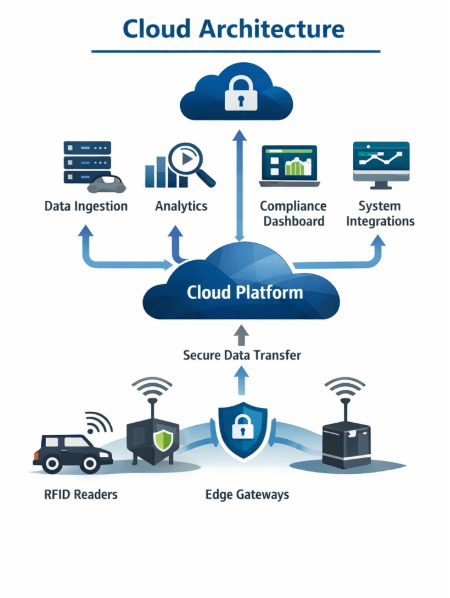
Cloud Architecture Overview
Cloud-based Border Control Systems Using RFID technologies centralize governance, policy enforcement, and analytics within controlled cloud environments. RFID events generated at inspection lanes, access gates, cargo yards, and transit corridors are transmitted through secure edge gateways to centralized ingestion services.
The architecture separates edge capture responsibilities from centralized oversight. Field operations teams manage readers, antennas, and capture points, while centralized IT and compliance teams oversee configuration, reporting, and integrations. Security boundaries isolate device communications, tenant datasets, and administrative access using encrypted channels and role-based controls. Scalability is achieved through elastic processing capacity and standardized onboarding of additional border facilities.
Non-Cloud Architecture Overview
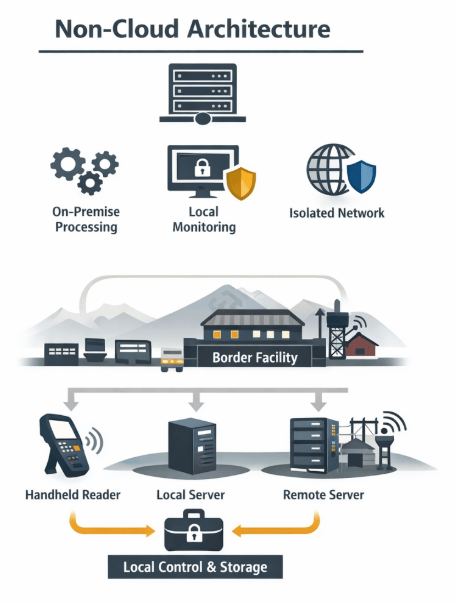
Non-cloud Border Control Systems Using RFID technologies support environments requiring infrastructure isolation, offline operation, or strict data residency. System software operates on handheld computers, PCs, local servers, or enterprise-managed remote servers under agency control.
Data processing, validation, and reporting occur within defined network boundaries. Operational responsibility shifts toward local IT and security teams for system maintenance, backups, and updates. Synchronization with external systems remains optional and tightly governed. Scalability depends on hardware provisioning, system partitioning, and site-level configuration rather than elastic services.
Cloud vs Non-Cloud RFID Border Control Systems Comparison
| Aspect | Cloud Deployment | Non-Cloud Deployment |
| Governance Model | Centralized | Localized |
| Data Residency | Configurable | Fixed |
| Scalability | Elastic | Hardware-driven |
| Connectivity Dependency | Moderate | Low |
| IT Responsibility | Central teams | Local teams |
| Typical Use | Multi-site national borders | Sovereign or classified sites |
Cloud Integration and Data Management for RFID Border Control Systems
Cloud-based Border Control Systems Using RFID technologies manage data across a defined lifecycle. Event data is ingested through secure gateways, normalized, and processed using rule-based validation engines. Storage layers enforce retention policies aligned with regulatory requirements. Analytics services support operational monitoring, compliance reporting, and anomaly detection.
System integrations enable controlled data exchange with customs platforms, identity management systems, inspection databases, and national security infrastructure. Security controls include encryption, role-based access governance, tenant isolation, and audit logging. GAO designs these data governance frameworks to align with cross-border regulatory mandates and agency oversight requirements.
Major Components of RFID Border Control Systems Architecture
- RFID Credentials
Function as machine-readable identifiers tied to individuals, vehicles, or assets. Selection depends on durability, security features, and regulatory acceptance.
- RFID Readers
Capture credential interactions within defined zones. Constraints include environmental exposure, interference, and throughput requirements.
- Edge Devices
Aggregate and preprocess event data close to capture points. Responsible for buffering, validation, and secure transmission.
- Middleware
Enforces business rules, policy logic, and data normalization between capture layers and processing systems.
- Cloud Platforms
Provide centralized governance, analytics, and reporting where permitted by regulation.
- Local Servers
Support isolated processing environments with fixed infrastructure control.
- Databases
Store credential states, event histories, and compliance records with defined retention policies.
- Dashboards and Reporting Tools
Present operational metrics, audit trails, and exception alerts to authorized stakeholders.
RFID Technologies Used in Border Control Systems
- UHF RFID
Supports long-range, high-throughput identification with sensitivity to environmental interference.
- HF RFID
Operates at shorter ranges with stable performance near liquids and metals.
- NFC
Enables proximity-based interactions with strong user authentication characteristics.
- LF RFID
Offers reliable performance in harsh environments with limited read range.
RFID Technologies Comparison for RFID Border Control Systems
| Technology | Read Range | Data Rate | Environmental Tolerance | Integration Complexity |
| UHF | Long | High | Moderate | High |
| HF | Medium | Medium | High | Medium |
| NFC | Short | Medium | High | Medium |
| LF | Very Short | Low | Very High | Low |
Combining Multiple RFID Technologies in Border Control Systems
Combining multiple RFID technologies is appropriate when border operations involve heterogeneous workflows. Architectural benefits include optimized performance across inspection zones and credential types. Trade-offs include increased system complexity, integration overhead, and governance challenges. GAO applies multi-technology designs only when operational requirements justify the added complexity.
Applications of Border Control Systems Using RFID Technologies
- Vehicle lane access validation supporting automated checkpoint throughput
- Cargo container movement verification across bonded zones
- Staff credential enforcement within restricted border facilities
- Inspection queue management for regulated goods
- Temporary permit validation for cross-border workers
- Transit corridor monitoring for high-risk cargo
- Secure access control for customs warehouses
- Inspection bay occupancy tracking
- Audit trail generation for compliance reviews
- Emergency access override monitoring
Deployment Options for RFID Border Control Systems
Cloud Deployment Use Cases and Advantages
- National or multi-site border agencies
- Centralized compliance oversight
- Cross-facility analytics and reporting
- Reduced local infrastructure burden
Non-Cloud Deployment Use Cases and Advantages
- Sovereign or classified environments
- Offline or limited connectivity sites
- Strict data residency mandates
- Local operational autonomy
Case Studies of Border Control Systems Using RFID Technologies
United States Deployments
Border Vehicle Processing Optimization in San Diego, California
- Problem
A high-traffic land border checkpoint experienced vehicle congestion during peak hours due to manual credential verification and fragmented inspection records across inspection lanes. Limited connectivity and mixed vehicle types created inconsistent processing times and audit gaps.
- Solution
Border Control Systems Using RFID technologies were deployed with UHF RFID credentials embedded in vehicle permits and HF RFID for officer identification. A hybrid architecture combined local servers at inspection lanes with cloud-based policy management supported by GAO. Edge processing validated credentials locally while synchronizing records to centralized systems when connectivity allowed.
- Result
Average vehicle processing time was reduced by 37 percent, with credential verification accuracy exceeding 99 percent. A key trade-off involved maintaining local server redundancy to ensure continued operation during network interruptions.
Cargo Lane Compliance Monitoring in Laredo, Texas
- Problem
A commercial cargo border facility lacked real-time visibility into container movements across bonded and inspection zones, increasing the risk of compliance violations and delayed audits.
- Solution
Border Control Systems Using RFID technologies were implemented using UHF RFID tags on containers and fixed readers along lane entry and exit points. The system operated on a cloud deployment managed by GAO, enabling centralized compliance reporting and integration with customs databases.
- Result
Unauthorized container movements declined by 42 percent within six months. The primary trade-off involved increased reliance on network availability, mitigated through buffered edge data capture.
Secure Staff Access Control at a Border Facility in Nogales, Arizona
- Problem
A border operations site required improved enforcement of staff access policies across restricted inspection zones without disrupting daily workflows.
- Solution
HF RFID credentials were issued to personnel, supported by Border Control Systems Using RFID technologies running on a local server. Access decisions were enforced locally, with periodic synchronization to a remote server for audit review. GAO provided system architecture design aligned with agency security policies.
- Result
Unauthorized access incidents dropped to zero during the first audit cycle. A trade-off included limited real-time cross-site analytics due to the non-cloud deployment.
Temporary Permit Validation in El Paso, Texas
- Problem
Manual verification of temporary cross-border work permits led to inconsistent enforcement and delayed processing during shift changes.
- Solution
NFC-based RFID technologies were deployed for permit validation using handheld computers operated by inspection officers. The non-cloud system processed validations locally while storing encrypted logs on PCs within the facility network, supported by GAO.
- Result
Permit validation time decreased by 29 percent. A noted limitation was the requirement for disciplined device management to prevent data loss.
Multi-Site Border Oversight in Detroit, Michigan
- Problem
Multiple border crossings operated independently, creating inconsistent enforcement policies and fragmented reporting across sites.
- Solution
Border Control Systems Using RFID technologies were centralized through a cloud deployment managed by GAO. UHF RFID supported vehicle identification, while LF RFID was used for specialized equipment tracking in high-interference zones.
- Result
Policy enforcement consistency improved across all sites, and compliance reporting preparation time was reduced by 45 percent. The trade-off involved initial integration effort across legacy systems.
Port Entry Monitoring in Los Angeles, California
- Problem
A port-of-entry facility faced challenges correlating vehicle, driver, and cargo identities during inspection handoffs.
- Solution
A multi-technology RFID Border Control System combined UHF RFID for vehicles and HF RFID for personnel credentials. The system operated on a remote server architecture to balance centralized oversight with local operational control, supported by GAO.
- Result
Inspection handoff errors were reduced by 33 percent. System complexity increased due to multi-technology coordination, requiring stricter configuration governance.
Inspection Zone Audit Readiness in Buffalo, New York
- Problem
Audit preparation required manual consolidation of inspection logs from multiple checkpoints, increasing labor effort and error risk.
- Solution
Border Control Systems Using RFID technologies were implemented using a cloud-based reporting layer and local edge processing. GAO configured automated audit trail generation aligned with regulatory review standards.
- Result
Audit preparation time was reduced by 52 percent. Dependence on standardized data schemas required retraining of inspection staff.
Remote Border Facility Operations in Tucson, Arizona
- Problem
A remote border site operated with intermittent connectivity and limited IT support, constraining deployment options.
- Solution
A non-cloud RFID Border Control System using RFID technologies was deployed on a local server with UHF RFID for vehicle tracking. GAO designed the system for offline-first operation with scheduled data exports.
- Result
Operational continuity was maintained during connectivity outages, with inspection throughput increasing by 21 percent. Limited real-time analytics remained a constraint.
Airport Border Checkpoint Optimization in Miami, Florida
- Problem
High passenger volumes during international arrivals strained manual identity verification processes.
- Solution
NFC-based RFID credentials were integrated into Border Control Systems Using RFID technologies, supported by cloud-based analytics for passenger flow monitoring. GAO assisted with system integration planning.
- Result
Passenger processing efficiency improved by 34 percent. Privacy governance required stricter access controls within analytics dashboards.
Hazardous Cargo Monitoring in Houston, Texas
- Problem
Tracking regulated hazardous cargo through border inspection zones required higher assurance and traceability.
- Solution
LF RFID tags were used for container identification within shielded environments, supported by Border Control Systems Using RFID technologies operating on a local server. GAO aligned system constraints with safety regulations.
- Result
Traceability compliance reached 100 percent during inspections. Limited read range required careful reader placement.
Cross-Border Rail Inspection in Chicago, Illinois
- Problem
Rail-based cargo inspections suffered from inconsistent identification due to environmental interference.
- Solution
UHF RFID was combined with HF RFID for redundancy within Border Control Systems Using RFID technologies. A hybrid cloud and local server deployment supported resilience, designed by GAO.
- Result
Identification reliability improved by 41 percent. System calibration effort increased during initial rollout.
Secondary Inspection Workflow Control in Brownsville, Texas
- Problem
Secondary inspection areas lacked structured tracking of vehicle dwell times and outcomes.
- Solution
Border Control Systems Using RFID technologies were deployed with UHF RFID and cloud-based analytics. GAO configured dwell-time monitoring and exception alerts.
- Result
Average secondary inspection duration decreased by 26 percent. Alert tuning required iterative adjustment to avoid false positives.
Mobile Inspection Unit Support in Yuma, Arizona
- Problem
Mobile inspection teams required rapid deployment capabilities without fixed infrastructure.
- Solution
Handheld computers running non-cloud Border Control Systems Using RFID technologies supported NFC and HF RFID credential checks. GAO provided deployment guidance.
- Result
Inspection setup time was reduced by 40 percent. Limited historical data access constrained trend analysis.
Northern Border Vehicle Control in Pembina, North Dakota
- Problem
Seasonal traffic spikes created processing variability across inspection lanes.
- Solution
Cloud-managed Border Control Systems Using RFID technologies leveraged UHF RFID for vehicles and centralized policy updates. GAO supported scalability planning.
- Result
Lane throughput variability decreased by 31 percent. Seasonal hardware scaling required advance procurement planning.
Canadian Deployments
Canadian Land Border Access Governance in Windsor, Ontario
- Problem
Cross-border staff access policies required tighter enforcement across shared facilities.
- Solution
HF RFID-based Border Control Systems Using RFID technologies operated on a local server deployment. GAO aligned system controls with Canadian regulatory requirements.
- Result
Access violations were eliminated during the first compliance review. Cross-site reporting remained limited.
Cargo Corridor Tracking in Surrey, British Columbia
- Problem
Cargo movements between inspection zones lacked synchronized tracking.
- Solution
UHF RFID-supported Border Control Systems Using RFID technologies were deployed with a remote server architecture. GAO enabled controlled data sharing across sites.
- Result
Cargo reconciliation discrepancies declined by 38 percent. Network latency required buffering strategies.
Airport Service Personnel Control in Toronto, Ontario
- Problem
Managing access for contracted service personnel across secure airport zones proved complex.
- Solution
NFC-based Border Control Systems Using RFID technologies operated on PCs within the airport network. GAO supported system configuration and role-based access policies.
- Result
Unauthorized access attempts dropped by 47 percent. Credential lifecycle management required stricter administrative processes. Remote Northern Border Operations in Manitoba
- Problem
Extreme environmental conditions and limited connectivity constrained system options.
- Solution
LF RFID was selected for durability within Border Control Systems Using RFID technologies deployed on local servers. GAO designed the system for environmental resilience.
- Result
System uptime exceeded 99 percent during winter operations. Limited data granularity was accepted as a trade-off.
Multi-Agency Border Coordination in Montreal, Quebec
- Problem
Multiple agencies operated overlapping inspection responsibilities with limited data coordination.
- Solution
Cloud-based Border Control Systems Using RFID technologies enabled controlled data segmentation and reporting. GAO supported integration planning across agency boundaries.
- Result
Inter-agency reporting conflicts decreased by 35 percent. Governance alignment required formal data-sharing agreements.
Our products and systems have been developed and deployed for a wide range of industrial applications. They are available off-the-shelf or can be customized to meet your needs. If you have any questions, our technical experts can help you.
For any further information on GAO’s products and systems, to request evaluation kits, free samples, recorded video demos, or explore partnership opportunities, please fill out this form or email us.