
Dorm Access Systems using RFID Technologies
Secure, Scalable, and Auditable Dormitory Access Control Using RFID Technologies
Dorm Access Systems using RFID technologies are designed to manage, monitor, and control physical access to student housing, residence halls, and campus accommodations. These systems replace mechanical keys and manual logs with digital credentials, automated authentication, and auditable access records. Access decisions are enforced at entry points such as dorm entrances, floor doors, shared facilities, and restricted service areas.
System architectures support centralized and distributed operating models, allowing institutions to deploy cloud-based platforms or non-cloud implementations depending on policy, budget, and regulatory constraints. Credential issuance, access authorization, and event logging operate consistently across deployment models. RFID Dorm Access Systems align with campus security frameworks, student lifecycle management, and residential operations, while supporting integration with identity management, incident response workflows, and compliance reporting.
Multiple deployment options including cloud-hosted and non-cloud configurations provide flexibility for universities, colleges, and private housing operators managing diverse infrastructure environments and data governance requirements.
Overview of GAO’s RFID- Based RFID Dorm Access Systems in Campus Environments
Dorm Access Systems using RFID technologies provide structured access governance across residential facilities with varying security postures. Entry points authenticate residents, staff, and authorized visitors using RFID credentials mapped to predefined access policies. System logic enforces time-based rules, zone restrictions, and role-based permissions while capturing detailed access telemetry.
Dormitory access platforms support daily residential operations such as student move-ins, room changes, guest access management, maintenance scheduling, and emergency lockdown procedures. Administrative workflows enable housing officers, campus security teams, and IT administrators to coordinate credential lifecycle management without disrupting occupancy operations.
Deployment flexibility allows institutions to centralize access management across campuses or operate systems locally within individual housing complexes. These systems support both cloud and non-cloud deployments to accommodate institutional risk tolerance, data residency requirements, and network reliability considerations.
Description, Purpose, Issues Addressed and Benefits of GAO’s RFID-Enabled Dorm Access Systems using RFID Technologies
System Description
RFID Dorm Access Systems integrate RFID credentials, access readers, control software, and reporting tools to regulate physical entry into residential facilities. Systems enforce authentication, authorization, and logging processes aligned with institutional housing policies. Access logic accommodates resident status changes, academic calendars, and emergency procedures.
System Purposes
- Enforce controlled access to dormitories and residential zones
- Reduce unauthorized entry and tailgating incidents
- Maintain auditable access logs for compliance and investigations
- Support resident lifecycle transitions without mechanical rekeying
- Enable coordinated response during security or safety events
Issues Addressed
- Lost or duplicated mechanical keys
- Manual access recordkeeping errors
- Delayed credential revocation for withdrawn residents
- Limited visibility into after-hours access activity
- Inconsistent enforcement across multiple housing facilities
System Benefits
- Improved access accountability and traceability
- Faster credential provisioning and deactivation
- Reduced operational overhead for housing staff
- Enhanced coordination between IT, security, and housing operations
- Scalable access governance across growing residential portfolios
RFID Dorm Access System Architecture Using RFID Technologies
Cloud Architecture for RFID Dorm Access Systems
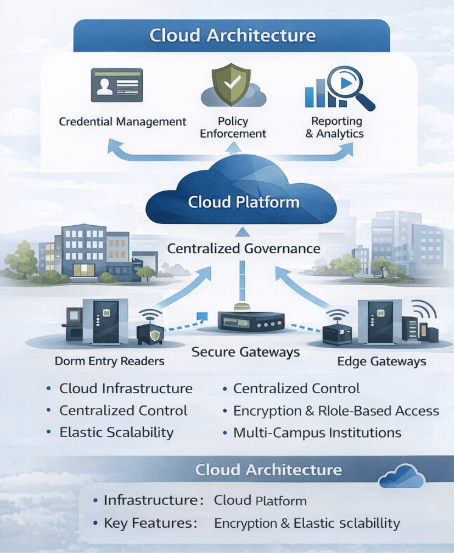
Cloud-based architectures centralize policy enforcement, credential management, and analytics within managed cloud environments. RFID access events generated at dorm entrances and common areas are transmitted via secure gateways to centralized ingestion services. Campus housing teams manage physical access points, while centralized IT and compliance teams oversee policies, reporting, and integrations.
Security boundaries segment device communications, resident datasets, and administrative access using encryption and role-based controls. Scalability is achieved through elastic processing and standardized onboarding of additional dormitories or campuses.
Non-Cloud Architecture for RFID Dorm Access Systems
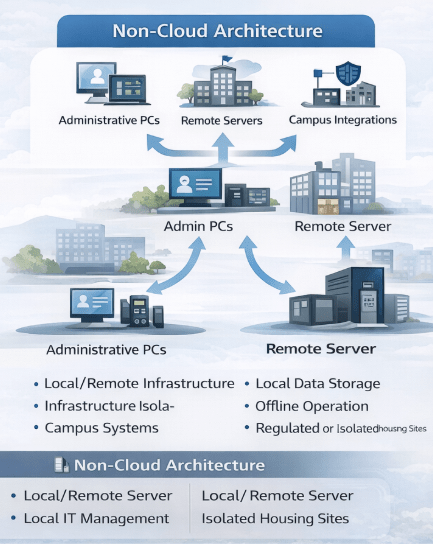
Non-cloud architectures operate within institution-controlled infrastructure environments. Software executes on handheld administrators’ devices, PCs, local servers within housing offices, or enterprise-managed remote servers. Access decisions, data validation, and reporting occur inside defined network boundaries.
Operational responsibility shifts to local IT and security teams for updates, backups, and system hardening. Synchronization with external campus systems remains optional and tightly governed. Scalability depends on hardware capacity, site-level configuration, and planned system expansion.
Cloud vs Non-Cloud RFID Dorm Access Systems Comparison
| Evaluation Area | Cloud-Based Deployment | Non-Cloud Deployment |
| Governance Model | Centralized housing and IT oversight | Decentralized or site-controlled |
| Data Residency | Managed through regional cloud controls | Fully institution-controlled |
| Scalability | Elastic capacity for new dorms | Hardware-based scaling |
| IT Responsibility | Shared with cloud provider | Fully local IT-managed |
| Offline Operation | Limited without local buffering | Fully supported |
| Typical Use | Multi-campus institutions | Isolated or regulated housing sites |
| Deployment Variants | Central cloud platform | Handheld, PC, local server, remote server |
Cloud Integration and Data Management for RFID Dorm Access Systems
Cloud integration focuses on structured data lifecycle management. Access events are ingested through secure APIs, normalized, and processed against policy engines. Data storage follows defined retention schedules aligned with housing regulations and privacy frameworks.
Analytics engines generate occupancy insights, access anomalies, and compliance reports. Integration interfaces connect with student information systems, identity platforms, and campus security tools. Security controls enforce encryption, audit logging, and access governance across administrative roles and tenant environments.
Major Components of RFID Dorm Access System Architecture
- RFID Credentials
Credentials store unique identifiers mapped to resident or staff records. Selection considers durability, lifecycle cost, and credential revocation requirements.
- Access Readers
Readers authenticate credentials and enforce access decisions. Selection depends on environmental conditions, mounting constraints, and integration compatibility.
- Edge Devices
Edge controllers manage local authentication logic and buffering. Constraints include processing capacity and network dependency.
- Middleware
Middleware coordinates policy enforcement, data normalization, and system integrations. Selection balances configurability and operational complexity.
- Cloud Platforms
Cloud platforms host centralized access logic, analytics, and reporting. Considerations include compliance certifications and regional availability.
- Local Servers
Local servers support isolated or offline operations. Constraints include maintenance overhead and scalability limits.
- Databases
Databases store access events, credential mappings, and audit logs. Selection considers performance, retention policies, and backup strategies.
- Dashboards and Reporting Tools
Dashboards provide operational visibility for housing and security teams. Reporting tools support compliance reviews and incident investigations.
RFID Technologies Used in RFID Dorm Access Systems
- UHF RFID
Supports long read ranges with higher sensitivity to environmental interference. Performance depends on antenna configuration and shielding.
- HF RFID
Operates at moderate ranges with stable performance near liquids and human bodies. Supports secure data exchange protocols.
- NFC
Short-range operation with strong user intent verification. Performance optimized for controlled proximity interactions.
- LF RFID
Low-frequency operation with minimal interference sensitivity. Supports simple authentication with limited data throughput.
RFID Technology Comparison for RFID Dorm Access Systems
| Technology | Read Range Profile | Data Throughput | Environmental Sensitivity | Typical Dorm Context |
| UHF | Long-range | High | Higher sensitivity | Perimeter monitoring |
| HF | Medium-range | Moderate | Stable | Door access points |
| NFC | Very short-range | Moderate | Very stable | Resident authentication |
| LF | Short-range | Low | Very stable | Legacy systems |
Combining Multiple RFID Technologies in Dorm Access Architectures
Multi-technology architectures are appropriate when dorm environments require layered access controls. Combining NFC for resident authentication with HF or UHF for monitoring shared spaces can improve operational coverage. Architectural benefits include flexibility and redundancy. Trade-offs include increased system complexity, integration overhead, and higher maintenance requirements. Institutions should assess staffing capabilities and long-term support implications before deploying hybrid environments.
Applications of Dorm Access Systems using RFID Technologies
- Student Room Access Management
Manages resident entry permissions tied to room assignments, housing contracts, and academic status with automated credential updates.
- Dormitory Main Entrance Control
Enforces access rules at building entrances using role-based authorization and time schedules managed by housing administrators.
- Floor and Zone Segmentation
Controls access to specific floors or wings based on residency, gender-specific housing policies, or security classifications.
- Guest Access Administration
Supports temporary credential issuance with expiration controls and audit tracking managed by residence staff.
- Maintenance Staff Access Control
Grants time-bound access to authorized service personnel with traceable activity logs for accountability.
- Emergency Lockdown Procedures
Enables centralized or local lockdown actions across dormitories during safety incidents or drills.
- Incident Investigation Support
Provides detailed access logs correlated with security events for compliance and disciplinary reviews.
- Residential Compliance Auditing
Supports housing policy enforcement through historical access reporting and anomaly detection.
Deployment Options for RFID Dorm Access Systems
Cloud Deployment Use Cases and Advantages
Cloud deployments suit institutions managing multiple campuses or housing portfolios. Centralized oversight, consistent policy enforcement, and simplified expansion support long-term growth and cross-site reporting.
Non-Cloud Deployment Use Cases and Advantages
Non-cloud deployments align with institutions requiring infrastructure isolation, offline operation, or strict data residency. Handheld, PC-based, local server, and remote server options provide operational autonomy and predictable performance under constrained networks.
Case Studies of Dorm Access Systems using RFID Technologies
United States Deployments
Cloud-Managed RFID Dorm Access System for Urban University Housing
New York City, NY
- Problem
Large residential buildings experienced unauthorized access and delayed credential revocation due to fragmented key-based systems and disconnected logs.
- Solution
Dorm Access Systems using RFID technologies were deployed with cloud-based governance. HF and NFC credentials controlled building and floor access. Centralized dashboards supported policy enforcement and audit reporting, with GAO supporting system configuration and documentation alignment.
- Result
Unauthorized entry incidents declined by 42 percent. Reliance on network availability required defined fallback access policies.
Non-Cloud RFID Dormitory Access Control for Research Campus Housing
Cambridge, MA
- Problem
Strict internal data residency rules prohibited cloud-based access systems, limiting modernization options.
- Solution
Dorm Access Systems using RFID technologies operated on local servers and PC-based administration software. HF credentials enforced access rules within campus-controlled networks. GAO assisted with architecture validation and operational workflows.
- Result
Access audit accuracy improved by 35 percent. Increased responsibility shifted to local IT teams.
Hybrid RFID Dorm Access System for Multi-Campus Housing
Los Angeles, CA
- Problem
Multiple residential campuses required standardized access policies while retaining site-level operational flexibility.
- Solution
Cloud-based governance managed credential lifecycle and reporting, while local edge controllers enforced access during connectivity disruptions. NFC credentials were issued across dormitories. GAO supported hybrid architecture design.
- Result
Policy exceptions were reduced by 28 percent. Hybrid complexity required disciplined change control.
Handheld-Managed RFID Dorm Access System for Community College Housing
San Diego, CA
- Problem
Limited IT staffing and budget constraints prevented centralized system deployment.
- Solution
Dorm Access Systems using RFID technologies operated on handheld computers for credential management. HF readers controlled entry points. GAO supported deployment and staff training.
- Result
Guest access violations declined by 31 percent. Long-term scalability remained constrained.
Cloud RFID Dorm Access System for Private Student Housing
Austin, TX
- Problem
High tenant turnover caused delays in access revocation.
- Solution
Cloud-managed Dorm Access Systems using RFID technologies centralized credential provisioning and deactivation. NFC credentials were integrated with property workflows. GAO supported integration planning.
- Result
Credential revocation times dropped from days to minutes. Cloud dependency required contingency procedures.
Local Server RFID Dorm Access System for Rural Campus Housing
Lubbock, TX
- Problem
Unreliable connectivity made cloud systems impractical.
- Solution
Dorm Access Systems using RFID technologies operated on local servers with HF credentials enforcing access independently of internet availability. GAO assisted with redundancy planning.
- Result
Access uptime exceeded 99.5 percent. Hardware expansion required advance planning.
RFID Dorm Access Control for Medical Student Housing
Baltimore, MD
- Problem
Irregular schedules and sensitive facilities required granular access segmentation.
- Solution
Cloud-managed Dorm Access Systems using RFID technologies applied role-based access policies. NFC credentials supported rapid authentication. GAO assisted with compliance documentation.
- Result
After-hours access violations declined by 37 percent. Policy configuration complexity increased oversight effort.
Remote Server RFID Dorm Access System for Distributed Housing
Phoenix, AZ
- Problem
Centralized control was required without maintaining local data centers.
- Solution
Dorm Access Systems using RFID technologies operated on enterprise-managed remote servers. HF credentials controlled access across sites. GAO supported remote administration models.
- Result
Access-related service tickets dropped by 24 percent. Latency tuning was required.
Cloud RFID Dorm Access System Supporting Emergency Response
Denver, CO
- Problem
Emergency lockdown coordination across dormitories was manual and slow.
- Solution
Cloud-based Dorm Access Systems using RFID technologies enabled centralized emergency access controls and dashboards. GAO supported testing and validation.
- Result
Emergency response execution time improved by 46 percent. Role governance became critical.
RFID Dorm Access System for Historic Campus Housing
Boston, MA
- Problem
Building preservation requirements limited infrastructure changes.
- Solution
Compact HF RFID readers and local server management minimized structural impact. GAO assisted with constrained system design.
- Result
Modern access control was deployed with minimal building alteration. Reader placement options were limited.
Large-Scale RFID Dorm Access System for Public University Housing
Columbus, OH
- Problem
Frequent room reassignments created administrative delays.
- Solution
Cloud-managed Dorm Access Systems using RFID technologies centralized credential updates. NFC credentials were issued at scale. GAO supported phased rollout.
- Result
Reassignment processing time fell by 33 percent. Initial onboarding required coordination.
RFID Dorm Access Control for Boarding School Residences
Princeton, NJ
- Problem
Stricter supervision and auditability were required for underage residents.
- Solution
Non-cloud PC-based Dorm Access Systems using RFID technologies enforced time-based access policies. GAO supported compliance documentation.
- Result
Policy violations dropped by 29 percent. Manual reporting remained necessary.
RFID Dorm Access System for Mixed-Use Housing
Chicago, IL
- Problem
Shared facilities required differentiated access privileges.
- Solution
Cloud-managed Dorm Access Systems using RFID technologies implemented role segmentation and analytics. GAO supported role modeling.
- Result
Unauthorized cross-access declined by 34 percent. Role definition required careful governance.
Cloud RFID Dorm Access System for Satellite Housing
Seattle, WA
- Problem
Remote sites lacked onsite IT staff.
- Solution
Centralized cloud administration with local edge enforcement supported distributed housing. GAO provided remote onboarding support.
- Result
Administrative labor hours decreased by 27 percent. Network resilience planning was required.
Canadian Deployments
Non-Cloud RFID Dorm Access System for University Housing
Toronto, ON
- Problem
Institutional data governance policies restricted cloud usage.
- Solution
Dorm Access Systems using RFID technologies operated on local servers within campus networks. HF credentials controlled access. GAO supported validation and training.
- Result
Access-related audit findings decreased by 31 percent. Scaling required hardware planning.
Cloud RFID Dorm Access System for Polytechnic Housing
Vancouver, BC
- Problem
Centralized reporting across diverse residential buildings was required.
- Solution
Cloud-managed Dorm Access Systems using RFID technologies centralized analytics and credential lifecycle management. GAO supported deployment planning.
- Result
Reporting cycle time improved by 38 percent. Cross-department coordination increased.
RFID Dorm Access System for Francophone Campus Housing
Montreal, QC
- Problem
Bilingual policy documentation increased administrative errors.
- Solution
PC-based non-cloud Dorm Access Systems using RFID technologies supported localized configurations. GAO assisted with customization.
- Result
Documentation errors declined by 26 percent. Manual updates increased workload.
RFID Dorm Access Control for Remote Campus Housing
Saskatoon, SK
- Problem
Connectivity constraints and limited IT staffing reduced system options.
- Solution
Local-server Dorm Access Systems using RFID technologies enforced access offline. GAO assisted with resilient design.
- Result
System availability exceeded 99 percent during outages. Expansion flexibility was limited.
RFID Dorm Access System for Government-Affiliated Training Housing
Ottawa, ON
- Problem
Facilities required alignment with government security controls.
- Solution
Dorm Access Systems using RFID technologies deployed on enterprise-managed remote servers with segmented access policies. GAO supported audit alignment.
- Result
Security remediation actions declined by 41 percent. Governance processes added overhead.
Our products and systems have been developed and deployed for a wide range of industrial applications. They are available off-the-shelf or can be customized to meet your needs. If you have any questions, our technical experts can help you.
For any further information on GAO’s products and systems, to request evaluation kits, free samples, recorded video demos, or explore partnership opportunities, please fill out this form or email us.