
Overview of GAO’s RFID –Based High-Value Asset Protection RFID Systems
High-value asset protection RFID systems are designed to safeguard critical physical assets across enterprise environments where loss, theft, misplacement, or unauthorized usage can create financial, operational, or compliance exposure. These systems combine structured identification, automated detection, and controlled data management to provide continuous asset visibility without relying on manual reconciliation or periodic audits.
High-value asset protection platforms use RFID technologies to associate physical items with digital identities, enabling automated verification at access points, storage zones, transport handoffs, and operational workstations. System logic enforces accountability by linking assets to personnel, locations, work orders, and custody states throughout their lifecycle.
Deployment flexibility supports both cloud and non-cloud implementations to accommodate enterprise security policies, latency requirements, regulatory constraints, and infrastructure maturity. Non-cloud deployments may operate entirely on handheld computers, PCs, local servers, or remote servers, while cloud deployments centralize governance and analytics across distributed sites.
GAO designs these asset protection systems to support controlled scalability, defined security boundaries, and integration with existing enterprise asset management, inventory control, and compliance workflows.
Description, Purpose, Issues Addressed and Benefits of GAO’s RFID-Enabled High-Value Asset Protection RFID Systems
System Description and Purpose
High-value asset protection RFID systems provide structured control over physical assets such as industrial tools, medical equipment, IT hardware, laboratory instruments, defense materials, and regulated inventory. The system assigns RFID credentials to assets and captures movement, status changes, and custody transitions through controlled reading points and operational workflows.
Asset records synchronize with enterprise systems to maintain authoritative asset registers, audit trails, and accountability mappings. Operational logic supports asset issuance, returns, storage validation, exception handling, and loss prevention without increasing manual administrative overhead.
Operational and Organizational Issues Addressed
- Unauthorized asset removal from controlled areas
- Asset misplacement during interdepartmental transfers
- Shrinkage caused by inadequate tracking discipline
- Incomplete audit trails for regulated equipment
- Delays caused by manual asset reconciliation
- Inconsistent asset custody documentation
- Limited visibility across multi-site operations
Enterprise Benefits
- Continuous asset traceability aligned with operational workflows
- Reduced losses through automated detection and exception alerts
- Improved audit readiness and regulatory reporting accuracy
- Faster asset retrieval and availability verification
- Reduced labor associated with manual inventory checks
- Clear separation of operational responsibility and accountability
System Architecture Overview for High-Value Asset Protection RFID Systems
Cloud-Based Architecture Overview
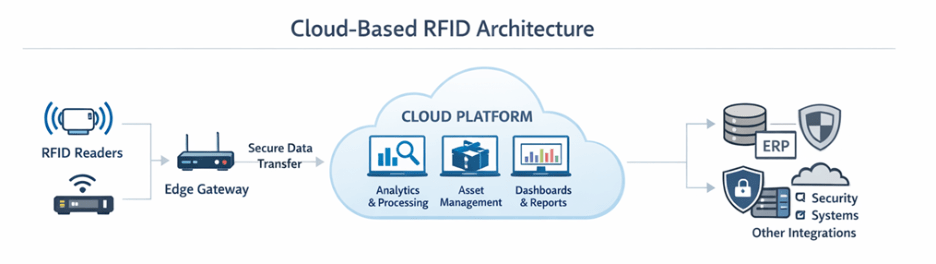
Cloud-based architecture centralizes asset intelligence, policy enforcement, and reporting within a controlled cloud environment. RFID events generated at field locations are transmitted through secure gateways to centralized services responsible for asset state management, analytics, and enterprise integrations.
Operational responsibilities are divided between edge data capture and centralized governance. Security boundaries isolate device communication, tenant data, and administrative access. Scalability is achieved through elastic processing capacity, centralized configuration management, and standardized onboarding of new facilities.
Non-Cloud Architecture Overview
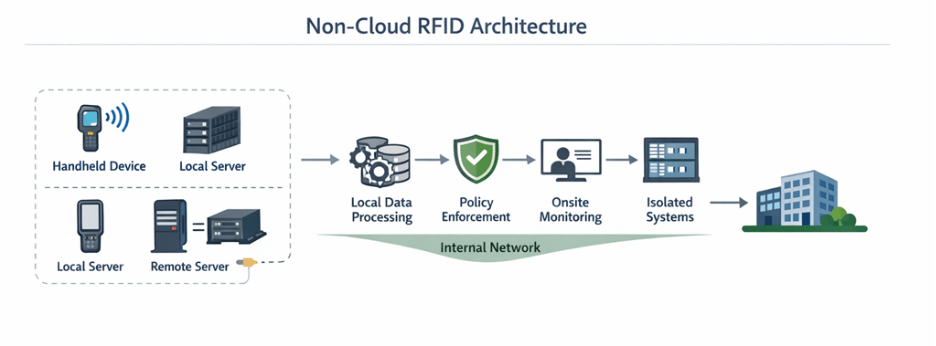
Non-cloud architecture supports deployments where data sovereignty, offline operation, or infrastructure isolation is required. Asset protection software may operate entirely on handheld computers, PCs, local servers, or remote servers under enterprise control.
Data processing, policy enforcement, and reporting occur within defined network boundaries. Operational responsibility shifts toward local IT teams, with controlled synchronization where permitted. Scalability is driven by hardware provisioning and system partitioning rather than elastic services.
Cloud vs Non-Cloud Deployment Comparison for High-Value Asset Protection RFID Systems
| Deployment Model | Typical Usage Context | Operational Characteristics | Appropriate Scenarios |
| Cloud-Based | Multi-site enterprises with centralized governance | Centralized analytics, remote administration, unified reporting | Distributed facilities, contract manufacturers, regulated supply chains |
| Handheld-Based Non-Cloud | Mobile operations and field environments | Standalone asset verification and offline operation | Field service teams, temporary sites, inspection workflows |
| PC-Based Non-Cloud | Small facilities or controlled environments | Local asset control with minimal infrastructure | Workshops, labs, secure rooms |
| Local Server Non-Cloud | Facilities with internal IT control | On-premises governance and data ownership | Defense, healthcare, regulated manufacturing |
| Remote Server Non-Cloud | Centrally managed private infrastructure | Controlled multi-site access without public cloud | Enterprises with private data centers |
Cloud Integration and Data Management for High-Value Asset Protection RFID Systems
Cloud integration manages the entire data lifecycle from ingestion to archival while maintaining strict governance controls. RFID event data enters the platform through authenticated endpoints and is normalized into structured asset records.
Processing logic correlates events with asset states, personnel associations, and location hierarchies. Storage tiers separate operational data, historical records, and audit logs based on retention policies. Analytics services support anomaly detection, usage pattern analysis, and compliance reporting.
System integrations synchronize asset data with ERP, CMMS, IAM, and security platforms through controlled APIs. Access governance enforces role-based permissions, approval workflows, and audit logging to maintain accountability across departments.
Security controls include encrypted data transmission, tenant isolation, access monitoring, and configurable retention policies aligned with enterprise compliance requirements.
Core Components of High-Value Asset Protection RFID Systems
- RFID Credentials
RFID credentials provide unique digital identifiers for physical assets. Selection depends on durability, read range, environmental tolerance, and asset lifecycle. Constraints include material interference, attachment method, and regulatory standards.
- RFID Readers and Antennas
Readers capture credential data at defined control points. Placement and configuration affect read reliability, zone control, and exception detection. Operational roles include access validation and movement confirmation.
- Edge Devices
Edge devices aggregate RFID data and enforce local logic. Selection considerations include processing capacity, offline operation, and security hardening.
- Middleware
Middleware manages event filtering, rule execution, and system interoperability. Constraints include latency tolerance and integration complexity.
- Cloud Platforms or Local Servers
Processing platforms host asset intelligence, policy logic, and reporting services. Selection depends on governance requirements, scalability needs, and infrastructure strategy.
- Databases
Databases store asset states, transaction histories, and audit records. Considerations include consistency models, retention policies, and query performance.
- Dashboards and Reporting Tools
Dashboards provide operational visibility and compliance insights. Reporting tools support audits, investigations, and performance analysis.
RFID Technology Characteristics for High-Value Asset Protection Systems
- UHF RFID
UHF RFID supports long read ranges and rapid bulk detection. Operational characteristics include sensitivity to environmental interference and directional tuning requirements.
- HF RFID
HF RFID operates at shorter ranges with stable performance near liquids and metals. Operational characteristics include controlled interaction zones and moderate data rates.
- NFC
NFC enables intentional, proximity-based interactions. Operational characteristics include user-initiated reads and high control over access events.
- LF RFID
LF RFID offers reliable performance in harsh environments. Operational characteristics include limited data rates and very short read ranges.
RFID Technology Comparison for High-Value Asset Protection RFID Systems
| RFID Technology | Role in Asset Protection Systems | Selection Considerations | Typical Deployment Context |
| UHF | Zone monitoring and bulk asset detection | Range, interference control | Warehouses, secure exits |
| HF | Controlled asset verification | Material compatibility | Labs, healthcare |
| NFC | Manual custody confirmation | User interaction | Issuance desks |
| LF | Harsh environment tracking | Environmental resilience | Industrial sites |
Combining Multiple RFID Technologies in High-Value Asset Protection Systems
Combining RFID technologies is appropriate when asset protection workflows require layered verification, environmental adaptation, or role-based interactions. Architectural benefits include improved reliability, reduced false events, and flexible enforcement models.
Trade-offs include increased system complexity, integration overhead, and operational training requirements. Complexity risks must be mitigated through clear system boundaries, unified data models, and disciplined configuration management.
Applications of High-Value Asset Protection RFID Systems
- Medical equipment custody control in hospitals managing infusion pumps, imaging devices, and surgical tools across departments and storage zones
- IT asset protection for data centers tracking servers, network appliances, and removable media through controlled access points
- Laboratory instrument governance supporting calibration tracking, usage accountability, and compliance documentation
- Defense and aerospace tool control ensuring secure issuance, return validation, and chain-of-custody records
- Manufacturing mold and die tracking across production cells and maintenance workshops
- Energy sector equipment monitoring for portable testing instruments and safety-critical devices
- Construction asset tracking for high-value tools across job sites and storage containers
- Research facility asset control for sensitive experimental equipment and prototypes
- Airport ground support equipment monitoring to prevent unauthorized relocation
- Mining operations tracking specialized machinery and inspection tools
Deployment Options for High-Value Asset Protection RFID Systems
Cloud Deployment Use Cases and Advantages
Cloud deployment supports centralized governance across geographically distributed facilities. Advantages include unified policy enforcement, consolidated reporting, and scalable analytics aligned with enterprise growth strategies.
Non-Cloud Deployment Use Cases and Advantages
Non-cloud deployment supports environments with strict data residency, offline operation, or isolated networks. Handheld deployments serve mobile teams, PC deployments support small facilities, local servers enable full on-premises control, and remote servers centralize governance within private infrastructure.
Organizational decision factors include regulatory obligations, latency sensitivity, IT maturity, and operational autonomy requirements.
Case Studies of High-Value Asset Protection RFID Systems using RFID Technologies
United States Case Studies
High-Value Asset Protection RFID Systems using RFID Technologies
New York City, New York
- Problem
A financial services operations center experienced repeated losses of high-value IT hardware during internal relocations and technology refresh cycles. Manual asset sign-out logs and spreadsheet tracking created custody gaps and audit inconsistencies.
- Solution
GAO implemented High-Value Asset Protection RFID Systems using RFID technologies with UHF credentials on servers and network devices. Fixed readers were installed at controlled exits. A non-cloud deployment running on a local server met internal data governance requirements, while handheld devices supported verification workflows.
- Result
Unauthorized asset removal incidents declined by 62 percent within six months. Audit reconciliation time was reduced to under four hours. Read zone calibration was identified as critical operational consideration.
San Jose, California
- Problem
A semiconductor research facility struggled to locate high-value test instruments shared across multiple laboratories, resulting in increased downtime and redundant procurement.
- Solution
GAO deployed High-Value Asset Protection RFID Systems using RFID technologies combining HF RFID for lab-level verification and NFC for controlled issuance. A cloud deployment enabled centralized visibility, supported by PC-based non-cloud operation during scheduled maintenance.
- Result
Instrument availability improved by 38 percent. Redundant equipment purchases declined. Managing multiple credential types introduced additional configuration complexity.
Chicago, Illinois
- Problem
A teaching hospital lacked reliable custody records for mobile diagnostic equipment, creating regulatory documentation risks.
- Solution
GAO implemented High-Value Asset Protection RFID Systems using RFID technologies with UHF RFID for corridor monitoring and HF RFID in storage areas. Cloud-based reporting supported compliance, while handheld non-cloud tools enabled offline audits.
- Result
Equipment loss incidents decreased by 47 percent. Compliance preparation time was reduced by more than half. Staff training influenced read accuracy.
Dallas, Texas
- Problem
An aerospace manufacturing facility experienced frequent production delays caused by missing calibrated tools.
- Solution
GAO deployed High-Value Asset Protection RFID Systems using RFID technologies with LF RFID selected for harsh industrial conditions. A local server deployment ensured low-latency enforcement of issuance controls.
- Result
Tool loss incidents declined by 71 percent within the first year. Tag durability validation required additional upfront testing.
Boston, Massachusetts
- Problem
A biomedical research organization encountered audit discrepancies involving grant-funded laboratory equipment.
- Solution
GAO implemented High-Value Asset Protection RFID Systems using RFID technologies with HF RFID integrated into lab access workflows. Cloud-based reporting supported grant compliance, with a remote server non-cloud option for isolated networks.
- Result
Audit discrepancies dropped by 55 percent. Asset metadata alignment was essential for reporting accuracy.
Seattle, Washington
- Problem
A logistics technology company reported recurring loss of prototype hardware during interoffice transfers.
- Solution
GAO deployed High-Value Asset Protection RFID Systems using RFID technologies using NFC-based custody confirmation and UHF RFID exit monitoring. Cloud deployment provided cross-site visibility, supported by handheld non-cloud tools.
- Result
Prototype loss incidents declined by 60 percent. Manual confirmation discipline remained a key operational dependency.
Phoenix, Arizona
- Problem
A utility services provider struggled to track high-value field testing equipment across remote service territories.
- Solution
GAO implemented High-Value Asset Protection RFID Systems using RFID technologies with handheld-based non-cloud software and LF RFID for environmental reliability.
- Result
Asset recovery rates improved by 44 percent. Offline operation limited real-time oversight.
Atlanta, Georgia
- Problem
A regional data center operator faced compliance exposure related to removable media tracking.
- Solution
GAO deployed High-Value Asset Protection RFID Systems using RFID technologies with UHF RFID at access points and a local server non-cloud deployment.
- Result
Unauthorized media movement incidents declined by 68 percent. Antenna tuning was required to prevent over-reading.
Denver, Colorado
- Problem
A mining equipment maintenance facility lacked accountability for specialized diagnostic tools across shifts.
- Solution
GAO implemented High-Value Asset Protection RFID Systems using RFID technologies with LF RFID and PC-based non-cloud software.
- Result
Tool availability improved by 33 percent. Manual synchronization between systems remained necessary.
Raleigh, North Carolina
- Problem
A pharmaceutical packaging site reported recurring internal audit discrepancies.
- Solution
GAO deployed High-Value Asset Protection RFID Systems using RFID technologies with HF RFID and cloud-based audit reporting.
- Result
Audit variance declined by 58 percent. Change control governance influenced system accuracy.
Minneapolis, Minnesota
- Problem
A medical device manufacturer struggled to locate validation equipment within cleanroom environments.
- Solution
GAO implemented High-Value Asset Protection RFID Systems using RFID technologies with HF RFID and a local server non-cloud deployment.
- Result
Validation delays decreased by 41 percent. Cleanroom certification requirements affected tag selection.
Los Angeles, California
- Problem
A media post-production facility experienced loss of specialized editing hardware.
- Solution
GAO deployed High-Value Asset Protection RFID Systems using RFID technologies with NFC-based check-in workflows and cloud reporting.
- Result
Asset loss declined by 52 percent. User compliance influenced system effectiveness.
St. Louis, Missouri
- Problem
A defense contractor required complete custody documentation for classified tools.
- Solution
GAO implemented High-Value Asset Protection RFID Systems using RFID technologies with LF RFID and an isolated local server deployment.
- Result
Custody documentation completeness reached 99 percent. Network isolation increased system complexity.
Tampa, Florida
- Problem
A maritime services organization reported loss of portable inspection equipment across dock facilities.
- Solution
GAO deployed High-Value Asset Protection RFID Systems using RFID technologies with UHF RFID and handheld non-cloud verification.
- Result
Equipment recovery improved by 46 percent. Environmental exposure increased maintenance demands.
Canada Case Studies
High-Value Asset Protection RFID Systems using RFID Technologies
Toronto, Ontario
- Problem
A research hospital faced compliance risks due to incomplete tracking of imaging accessories.
- Solution
GAO implemented High-Value Asset Protection RFID Systems using RFID technologies with HF RFID and cloud-based compliance reporting.
- Result
Audit exceptions declined by 61 percent. Coordination with infection control teams was required.
Mississauga, Ontario
- Problem
A logistics hub managing high-value automation components reported inventory mismatches.
- Solution
GAO deployed High-Value Asset Protection RFID Systems using RFID technologies with UHF RFID and a remote server non-cloud deployment.
- Result
Inventory accuracy exceeded 98 percent. Network latency planning influenced architecture decisions.
Vancouver, British Columbia
- Problem
A clean energy research facility experienced delays locating shared measurement instruments.
- Solution
GAO implemented High-Value Asset Protection RFID Systems using RFID technologies with NFC-enabled checkout workflows and PC-based non-cloud software.
- Result
Equipment search time declined by 35 percent. User adherence affected data accuracy.
Calgary, Alberta
- Problem
An energy services provider lacked visibility into specialized tools across multiple field depots.
- Solution
GAO deployed High-Value Asset Protection RFID Systems using RFID technologies with handheld non-cloud deployments and LF RFID.
- Result
Asset utilization improved by 29 percent. Offline operation proved operationally necessary.
Montreal, Quebec
- Problem
A university-affiliated laboratory network faced inconsistent asset reporting across departments.
- Solution
GAO implemented High-Value Asset Protection RFID Systems using RFID technologies with HF RFID and cloud-based centralized governance.
- Result
Reporting consistency improved across departments. Data normalization required upfront coordination.
GAO supports these deployments through long-standing engineering expertise, disciplined system architecture, and flexible deployment models aligned with enterprise operational realities across the United States and Canada.
Our products and systems have been developed and deployed for a wide range of industrial applications. They are available off-the-shelf or can be customized to meet your needs. If you have any questions, our technical experts can help you.
For any further information on GAO’s products and systems, to request evaluation kits, free samples, recorded video demos, or explore partnership opportunities, please fill out this form or email us.