
Cloud and Non-Cloud Deployment Models for Enterprise Security Operations
Overview of the GAO RFID Security Pack
The RFID Security Pack is an integrated security and identification system designed to protect physical assets, controlled areas, tools, and personnel workflows through RFID technologies. Built as a modular security platform rather than a single-purpose application, the solution combines credential management, event validation, and audit-grade traceability into a unified control framework.
The system is architected to operate across diverse IT environments, supporting cloud-hosted deployments as well as non-cloud configurations where software runs on handheld computers, industrial PCs, local servers, or remotely managed private servers. This flexibility allows organizations to align security operations with regulatory constraints, latency requirements, and data sovereignty policies.
RFID technologies such as UHF, HF, NFC, and LF are applied selectively based on operational needs, read range, and interference tolerance. Within the RFID Security Pack, these technologies serve as identity carriers rather than standalone components, enabling enforcement of security policies, automated access decisions, and verifiable security logs across facilities, worksites, and controlled assets.
GAO RFID Security Pack Overview with Emphasis on System Capabilities
Security-Centric System Design for Complex Environments
The RFID Security Pack functions as a security orchestration layer that governs how identities, assets, and access events are created, validated, logged, and reviewed. Core design principles focus on deterministic behavior, offline survivability, and policy-driven enforcement rather than consumer-style convenience.
Operationally, the system integrates RFID credentials with readers, edge logic, and backend security services to enforce rules such as authorized entry, asset movement restrictions, tool custody verification, and zone-based access control. Security rules are configurable to match enterprise policies, regulatory mandates, or contractual obligations.
Deployment flexibility is a defining attribute. Cloud-based implementations support centralized governance, multi-site visibility, and analytics-driven risk monitoring. Non-cloud implementations address environments with air-gapped networks, limited connectivity, or strict data residency requirements. Hybrid models are supported when certain sites require local enforcement while corporate security teams retain centralized oversight.
The RFID Security Pack is frequently positioned as a foundational security subsystem that integrates with identity management platforms, building management systems, maintenance software, and compliance reporting tools.
Detailed Description, Purposes, Issues Addressed, and Benefits
System Description
The RFID Security Pack is a layered security system composed of credential definition, event capture, rule execution, and audit validation. It treats every RFID interaction as a security event, associating it with a subject, object, location, timestamp, and policy outcome.
Security operators configure access rules, escalation thresholds, and exception handling procedures through administrative interfaces. The system records both successful and denied actions to support forensic investigations and compliance audits.
Purposes
- Enforce physical access control without reliance on manual supervision
- Establish chain-of-custody records for high-value or regulated assets
- Reduce insider risk through deterministic access validation
- Enable security operations in offline or constrained network conditions
- Provide audit-ready security logs for regulatory and contractual reviews
Issues Addressed
- Manual badge checks prone to human error
- Inconsistent access enforcement across multiple sites
- Lack of verifiable evidence during security incidents
- Network dependency in remote or industrial locations
- Fragmented security data across disparate systems
Benefits
- Policy-driven security enforcement aligned with enterprise governance
- Deterministic behavior under offline or degraded network conditions
- Reduced operational overhead for security personnel
- Improved audit posture through immutable event logs
- Scalable architecture adaptable to facility growth or restructuring
RFID Security Pack System Architecture
Cloud and Non-Cloud Architectural Models
Cloud Architecture Overview
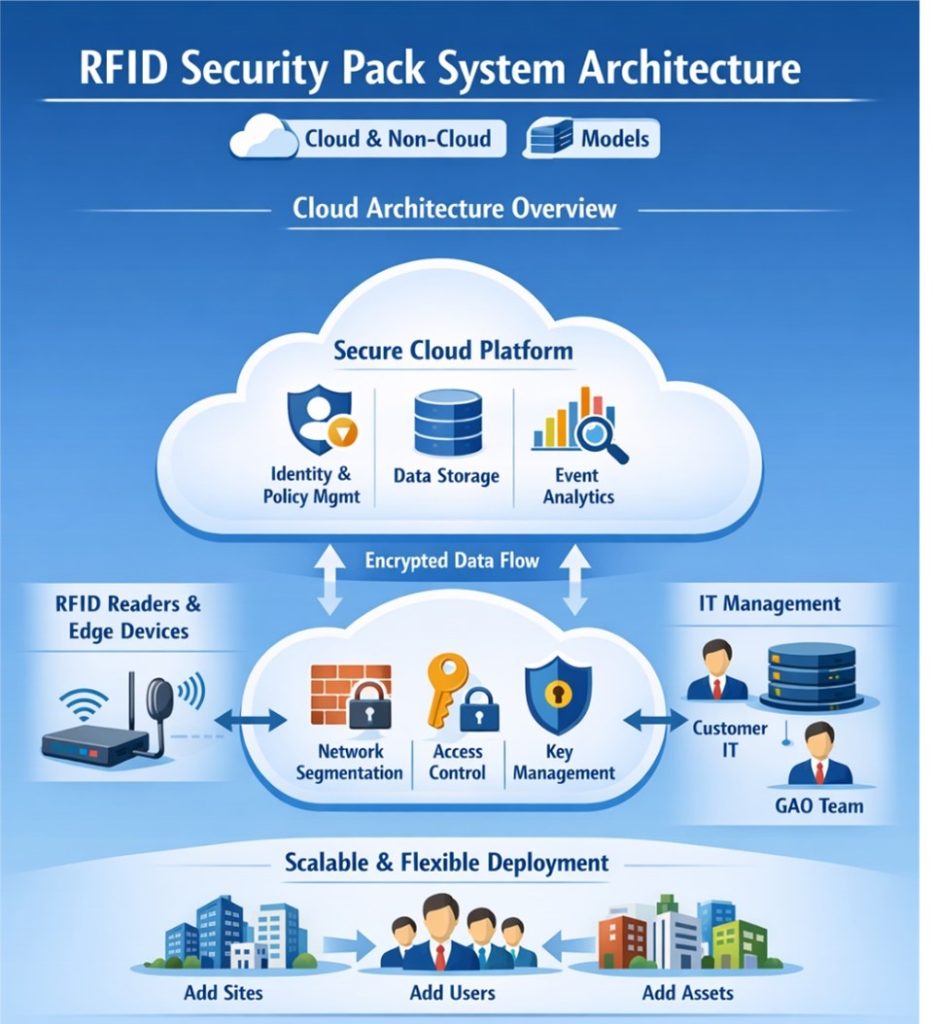
Cloud deployment centralizes identity management, policy definition, and event analytics within a secure cloud environment. RFID readers and edge devices transmit validated events to cloud services through encrypted channels. Central services perform correlation, long-term storage, and cross-site analytics.
Operational responsibility for infrastructure, scalability, and system availability is shared between GAO and customer IT teams based on service agreements. Security boundaries are enforced through network segmentation, role-based access control, and cryptographic key management.
Scalability is horizontal, allowing additional sites, users, or assets to be onboarded without redesigning local infrastructure.
Non-Cloud Architecture Overview
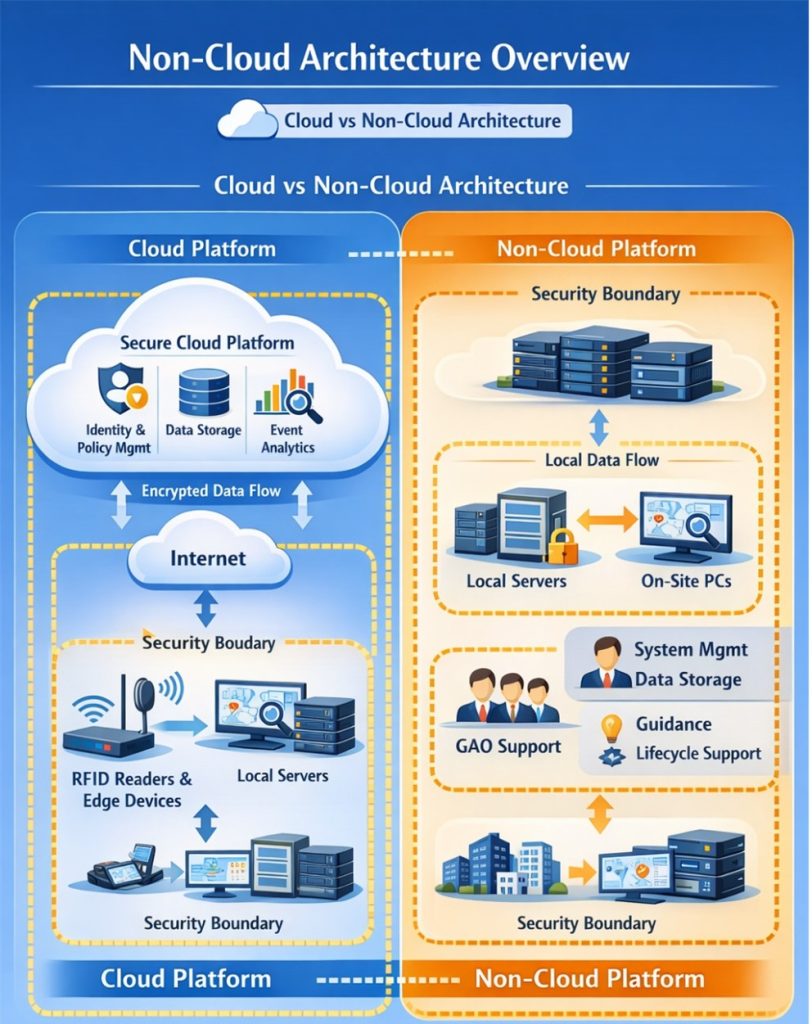
Non-cloud deployment places system intelligence closer to the point of operation. Software may run directly on handheld computers for mobile inspections, on PCs for single-site control rooms, on local servers for facility-wide enforcement, or on remote private servers managed by the customer.
Data flow remains local, with RFID events processed and stored within controlled network boundaries. Security responsibilities fall primarily on internal IT and security teams, while GAO provides system configuration guidance and lifecycle support.
This model minimizes latency, supports air-gapped operations, and simplifies compliance with strict data residency rules.
Suggested diagram placement: High-level architecture diagram showing cloud vs non-cloud data flow and security boundaries.
Cloud vs Non-Cloud RFID Security Pack Comparison
| Aspect | Cloud Deployment | Non-Cloud Deployment |
| Control Model | Centralized policy governance | Site-local or facility-based control |
| Connectivity Dependency | Requires reliable WAN connectivity | Operates offline or within LAN |
| Data Residency | Cloud-region dependent | Fully customer-controlled |
| Typical Environments | Multi-site enterprises, corporate campuses | Industrial plants, defense facilities |
| Scalability Approach | Elastic resource allocation | Hardware-bound scaling |
| Administration | Central security operations teams | Local IT or security administrators |
| Typical Selection Criteria | Analytics, cross-site visibility | Compliance, latency, isolation |
Handheld-based non-cloud configurations are selected for mobile security inspections or temporary sites. PC-based deployments suit single-entry-point facilities. Local servers support multi-reader environments with strict latency needs. Remote private servers balance centralized control with non-public infrastructure.
Cloud Integration and Data Management
Data Lifecycle and Governance within the RFID Security Pack
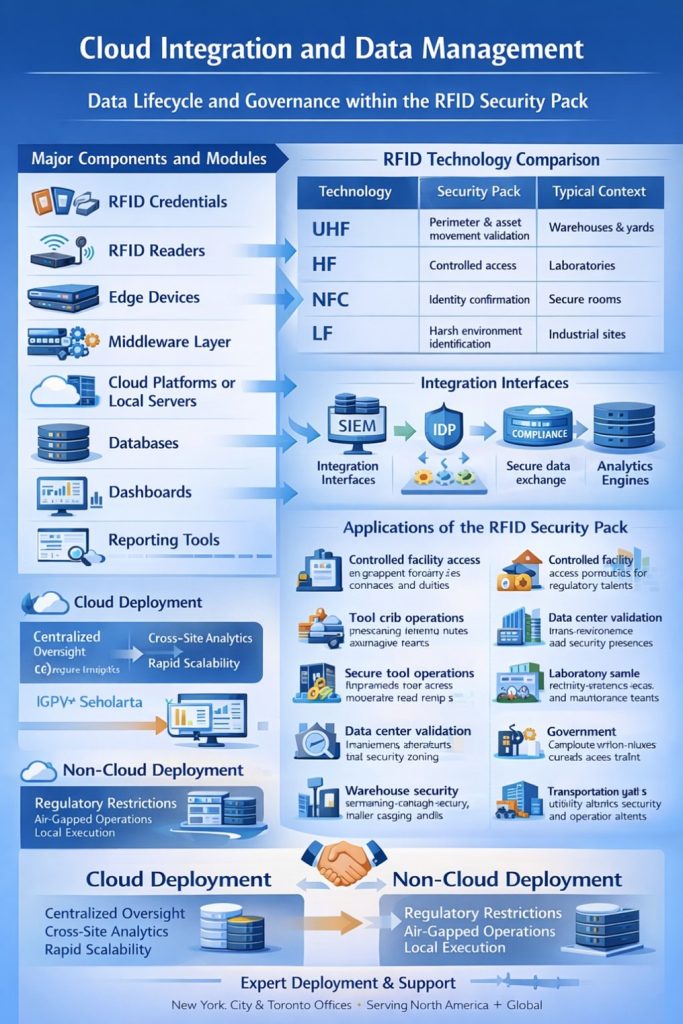
RFID event data enters the system through authenticated ingestion pipelines where integrity checks and schema validation occur. Processing layers normalize events, apply policy outcomes, and enrich records with contextual metadata such as zone identifiers or asset classifications.
Storage tiers separate operational logs from long-term compliance archives. Retention policies align with regulatory mandates, contractual requirements, or internal governance standards.
Analytics engines support incident investigation, anomaly detection, and trend analysis without exposing raw credential data unnecessarily. Integration interfaces allow secure data exchange with SIEM platforms, identity providers, and compliance management systems.
Access governance is enforced through role-based permissions, segregation of duties, and audit trails. Encryption is applied at rest and in transit, and key management practices align with enterprise security frameworks.
Major Components and Modules of the RFID Security Pack
- RFID Credentials
Serve as identity carriers for personnel, assets, or tools. Selection depends on durability, memory structure, and lifecycle management requirements.
- RFID Readers
Capture credential interactions and enforce physical read constraints. Placement and configuration influence detection reliability and security zoning.
- Edge Devices
Execute local validation logic, buffer events during connectivity loss, and enforce immediate security actions.
- Middleware Layer
Normalizes reader data, applies filtering rules, and interfaces with backend systems.
- Cloud Platforms or Local Servers
Host policy engines, databases, and administrative interfaces depending on deployment choice.
- Databases
Store configuration data, operational events, and audit records with integrity controls.
- Dashboards
Provide security operators with real-time visibility into access events and system health.
- Reporting Tools
Generate compliance reports, incident summaries, and operational metrics for stakeholders.
RFID Technologies Used in the RFID Security Pack
- UHF RFID
Optimized for long read ranges and high tag density. Performance can be affected by metal-rich environments and RF noise.
- HF RFID
Offers stable performance in controlled environments with moderate read ranges. Tolerant to interference compared to UHF.
- NFC
Designed for very short-range interactions with strong user intent validation. Dependent on close proximity.
- LF RFID
Operates reliably in harsh environments with low interference susceptibility. Limited data rates and read distances.
RFID Technology Comparison for the RFID Security Pack
| Technology | Security Pack Role | Selection Rationale | Typical Context |
| UHF | Perimeter and asset movement validation | Multi-tag detection capability | Warehouses, yards |
| HF | Controlled access points | Predictable read zones | Laboratories |
| NFC | Identity confirmation | Intentional interaction | Secure rooms |
| LF | Harsh environment identification | Interference tolerance | Industrial sites |
Combining Multiple RFID Technologies
Architectural Considerations
Combining RFID technologies is appropriate when security zones have distinct operational constraints. Multi-technology architectures allow perimeter detection with UHF while enforcing intentional access validation using HF or NFC at entry points.
Benefits include layered security enforcement and reduced false positives. Trade-offs involve increased system complexity, higher integration effort, and more demanding maintenance procedures. Governance models must clearly define which technology governs each decision point to avoid policy ambiguity.
Applications of the RFID Security Pack
- Controlled facility access management for engineers, contractors, and visitors with role-based authorization
- Secure tool crib operations tracking custody of calibrated instruments and specialty equipment
- Asset movement control across production lines, staging areas, and restricted zones
- Data center access validation for racks, cages, and authorized personnel
- Laboratory sample security ensuring chain-of-custody for regulated materials
- Healthcare equipment access governance across clinical and maintenance teams
- Utility infrastructure security protecting substations, cabinets, and field assets
- Transportation yard security managing vehicle entry, trailer staging, and operator authorization
- Government facility access enforcement aligned with clearance levels
- Campus security integration across buildings, labs, and shared resources
- Manufacturing workcell access ensuring certified operator presence
- Aviation ground operations securing tools and maintenance zones
- Construction site security for temporary facilities and mobile assets
- Warehouse security controlling high-value inventory zones
- Energy sector access governance for hazardous environments
Each application leverages policy-driven enforcement rather than manual supervision, enabling consistent security outcomes.
Deployment Options and Decision Factors
Cloud Deployment Use Cases and Advantages
Cloud deployments suit organizations requiring centralized oversight, cross-site analytics, and rapid scalability. Regulatory frameworks that permit external hosting and environments with stable connectivity align well with this model. Corporate security teams benefit from unified policy control and consolidated reporting.
Non-Cloud Deployment Use Cases and Advantages
Non-cloud deployments address regulatory restrictions, ultra-low latency needs, and operational isolation. Facilities with air-gapped networks, defense-related operations, or remote industrial sites often select local execution. Handheld and PC-based options support mobile or small-scale environments without dedicated servers.
GAO supports organizations through deployment planning, architecture validation, and long-term system optimization. Headquartered in New York City and Toronto, GAO draws on decades of experience serving enterprises, government agencies, and research institutions across the U.S., Canada, and globally, providing expert support both remotely and onsite.
Case Studies of Security Pack Using RFID Technologies
U.S. Case Studies
Manufacturing Facility Access Control Using RFID Security Pack in Detroit, Michigan
- Problem
A large automotive manufacturing facility in Detroit faced inconsistent enforcement of operator access rules across multiple production cells. Badge-based checks relied on manual oversight, leading to unauthorized tool usage and incomplete audit records during safety reviews.
- Solution
GAO supported deployment of the RFID Security Pack using HF and UHF RFID technologies. HF credentials controlled workcell entry points, while UHF tracked tool movement. The system operated on a local server to meet latency and plant network isolation requirements.
- Result
Unauthorized access incidents dropped by 68 percent within six months.
- Lesson
Local server deployments reduced latency but required disciplined patch management by plant IT staff.
Data Center Cage Security Using RFID Technologies in Ashburn, Virginia
- Problem
A multi-tenant data center required verifiable access logs for compliance audits while maintaining strict tenant isolation. Existing PIN-based controls lacked reliable attribution.
- Solution
RFID Security Pack was implemented with NFC credentials for intentional access validation. A cloud deployment enabled centralized policy management across multiple halls while preserving tenant-level data separation.
- Result
Audit preparation time was reduced by 42 percent year over year.
- Lesson
Cloud governance simplified oversight but required formal role-based access modeling upfront.
Utility Substation Access Governance in Phoenix, Arizona
- Problem
Field technicians accessed substations without real-time authorization verification due to intermittent connectivity and harsh environmental conditions.
- Solution
GAO configured the RFID Security Pack using LF RFID credentials with software running on rugged handheld computers. Policies were enforced locally with delayed synchronization to a remote private server.
- Result
Unauthorized entry events declined by 55 percent over nine months.
- Lesson
Offline-first designs improved resilience but limited real-time central visibility.
Hospital Equipment Security Using RFID Technologies in Boston, Massachusetts
- Problem
Biomedical devices moved across departments without proper custody records, complicating incident investigations and compliance reviews.
- Solution
The RFID Security Pack leveraged UHF RFID for equipment tracking and HF credentials for staff authorization. A cloud-based backend supported analytics and reporting.
- Result
Lost equipment incidents decreased by 37 percent within the first year.
- Lesson
RF signal tuning was required to manage dense clinical environments.
Warehouse Restricted Zone Control in Dallas, Texas
- Problem
High-value inventory zones experienced shrinkage due to insufficient access enforcement during peak shifts.
- Solution
GAO deployed the RFID Security Pack using UHF RFID and PC-based non-cloud software for zone-level enforcement without WAN dependency.
- Result
Shrinkage rates fell by 24 percent in two quarters.
- Lesson
PC-based systems worked well for single-site operations but lacked cross-site analytics.
Aerospace Tool Control System in Seattle, Washington
- Problem
Aerospace maintenance teams needed tool accountability aligned with FAA audit requirements.
- Solution
RFID Security Pack integrated UHF RFID for tool tracking and NFC for technician authentication. A local server hosted the system to meet regulatory documentation controls.
- Result
Tool reconciliation time improved by 61 percent.
- Lesson
Combining RFID technologies increased system complexity but improved accountability.
University Research Lab Access Security in Palo Alto, California
- Problem
Sensitive research labs required granular access controls tied to project-level authorization.
- Solution
GAO implemented the RFID Security Pack using HF RFID credentials with cloud-based policy administration integrated with campus identity systems.
- Result
Access violations dropped by 47 percent in one academic year.
- Lesson
Identity integration reduced duplication but required coordination with university IT.
Oil and Gas Facility Safety Enforcement in Midland, Texas
- Problem
Hazardous zones required verification of certified personnel presence before equipment activation.
- Solution
RFID Security Pack used LF RFID for personnel identification and ran on a local server to ensure deterministic enforcement.
- Result
Safety non-compliance events decreased by 52 percent.
- Lesson
LF RFID improved reliability but limited read range required careful reader placement.
Logistics Yard Vehicle Authorization in Memphis, Tennessee
- Problem
Unauthorized trailers entered staging areas, disrupting outbound scheduling.
- Solution
GAO supported a UHF RFID-based RFID Security Pack deployment with cloud analytics for yard-wide visibility.
- Result
Unauthorized yard entries were reduced by 33 percent.
- Lesson
Environmental RF noise required iterative calibration.
Pharmaceutical Facility Access Audit in Newark, New Jersey
- Problem
Regulatory inspections highlighted insufficient evidence of controlled area access enforcement.
- Solution
RFID Security Pack used HF RFID credentials with software hosted on a remote private server to meet data residency policies.
- Result
Audit findings related to access control were eliminated in the next inspection cycle.
- Lesson
Remote servers balanced central oversight with compliance constraints.
Construction Site Security Management in Denver, Colorado
- Problem
Temporary construction sites lacked consistent access monitoring for subcontractors.
- Solution
GAO deployed RFID Security Pack on handheld computers using NFC credentials for daily access validation.
- Result
Unauthorized site access incidents declined by 41 percent.
- Lesson
Handheld deployments required disciplined device lifecycle management.
Food Processing Plant Hygiene Zone Control in Fresno, California
- Problem
Hygiene compliance zones required verification of trained personnel entry.
- Solution
HF RFID credentials integrated with the RFID Security Pack running on a local PC enforced zone rules.
- Result
Non-compliance incidents dropped by 29 percent.
- Lesson
PC-based deployments were cost-effective but limited redundancy.
Government Records Facility Security in Baltimore, Maryland
- Problem
Restricted archives required verifiable access logs without external connectivity.
- Solution
GAO configured RFID Security Pack on an air-gapped local server using NFC credentials.
- Result
Manual logbook usage was eliminated entirely.
- Lesson
Air-gapped systems increased operational independence but limited analytics.
Energy Control Room Access Management in San Jose, California
- Problem
Control room access needed strict segregation between operators and maintenance staff.
- Solution
RFID Security Pack used HF RFID credentials with centralized cloud reporting.
- Result
Access policy violations reduced by 46 percent.
- Lesson
Policy granularity required ongoing governance reviews.
Canadian Case Studies
Transit Maintenance Facility Security in Toronto, Ontario
- Problem
Maintenance bays required controlled access to certified technicians only.
- Solution
GAO deployed the RFID Security Pack using HF RFID credentials with software hosted on a local server.
- Result
Unauthorized bay access decreased by 58 percent.
- Lesson
Local hosting simplified compliance with municipal IT policies.
Mining Operations Access Control in Sudbury, Ontario
- Problem
Remote mining sites faced connectivity constraints and harsh RF conditions.
- Solution
LF RFID credentials integrated with RFID Security Pack on handheld devices enabled offline enforcement.
- Result
Safety violations related to access dropped by 49 percent.
- Lesson
Offline enforcement reduced central visibility but improved resilience.
Healthcare Research Facility Security in Montreal, Quebec
- Problem
Controlled laboratories required audit-grade access traceability.
- Solution
RFID Security Pack leveraged NFC and HF RFID with cloud-based data management.
- Result
Audit preparation effort was reduced by 35 percent.
- Lesson
Cloud adoption required alignment with provincial data governance.
Port Authority Restricted Area Control in Vancouver, British Columbia
- Problem
Restricted maritime zones experienced inconsistent credential checks.
- Solution
GAO supported UHF RFID deployment with RFID Security Pack hosted on a remote private server.
- Result
Unauthorized entries fell by 31 percent.
- Lesson
Wide-area UHF coverage required environmental modeling.
University Engineering Facility Access in Waterloo, Ontario
- Problem
Shared engineering labs required time-bound access enforcement.
- Solution
RFID Security Pack used HF RFID credentials with PC-based non-cloud deployment.
- Result
After-hours access violations declined by 44 percent.
- Lesson
PC-based systems suited departmental control but required manual backup planning.
GAO draws on decades of experience supporting enterprises, public institutions, and regulated industries across the U.S. and Canada, combining RFID Security Pack architecture expertise with deployment flexibility to address real-world operational constraints.
Our products and systems have been developed and deployed for a wide range of industrial applications. They are available off-the-shelf or can be customized to meet your needs. If you have any questions, our technical experts can help you.
For any further information on GAO’s products and systems, to request evaluation kits, free samples, recorded video demos, or explore partnership opportunities, please fill out this form or email us.