
Overview of GAO’s RFID-Based Street Furniture Tracking Systems
Street furniture tracking systems enable municipalities, utilities, transportation authorities, and contractors to digitally manage distributed public assets such as streetlights, benches, bollards, traffic signs, bus shelters, waste receptacles, and smart city fixtures. Using RFID technologies, each asset is uniquely identified, monitored, and associated with lifecycle data across installation, inspection, maintenance, relocation, and retirement.
RFID-enabled street furniture management platforms provide a structured asset registry, verifiable field data capture, and auditable maintenance records across large geographic footprints. Data collected from RFID-tagged street assets is processed through configurable software that supports both cloud and non-cloud deployment models, allowing organizations to align with internal IT policies, data sovereignty rules, and operational constraints.
Street infrastructure environments are characterized by outdoor exposure, multi-vendor assets, contractor-based workflows, and regulatory oversight. RFID-based tracking systems address these challenges by improving asset traceability, standardizing field operations, and enabling centralized or localized governance. GAO supports these systems with flexible architectures that scale from handheld-only field solutions to enterprise-grade cloud platforms serving multi-agency deployments.
Street Furniture Tracking Systems Using GAO’s RFID: System Description, Purpose Issues Addressed, and Benefits Addressed
System Description
Street furniture tracking systems using RFID technologies are integrated asset management solutions designed to monitor and govern public infrastructure deployed across urban and suburban environments. The system associates physical street assets with digital identities through RFID credentials, enabling real-time or event-based data capture by field personnel, inspection teams, and maintenance contractors.
The system operates across heterogeneous environments including sidewalks, roadways, transit corridors, parks, and commercial districts. Software components orchestrate asset identification, condition logging, service history tracking, compliance documentation, and reporting workflows. Deployment options include cloud-based platforms as well as non-cloud configurations operating on handheld computers, PCs, local servers, or remote servers.
System Purposes
- Establish a single source of truth for distributed street furniture inventories
- Enable verifiable inspection and maintenance workflows for public assets
- Support contractor accountability and service-level agreement enforcement
- Improve lifecycle planning for repair, refurbishment, and asset replacement
- Provide auditable records for regulatory compliance and public safety reviews
Issues Addressed by the System
- Incomplete or outdated asset registries maintained through manual surveys
- Limited visibility into field maintenance activities and contractor performance
- Asset loss, unauthorized relocation, or undocumented replacements
- Difficulty correlating inspection findings with specific physical assets
- Fragmented data across departments, vendors, and legacy systems
Benefits to Organizations
- Improved operational governance across public works and transportation teams
- Reduced manual reconciliation between field reports and asset databases
- Faster fault identification and targeted maintenance interventions
- Enhanced transparency for compliance officers and municipal auditors
- Scalable architecture supporting city-wide and multi-jurisdiction deployments
System Architecture of Street Furniture Tracking Systems Using RFID
Cloud Architecture Overview
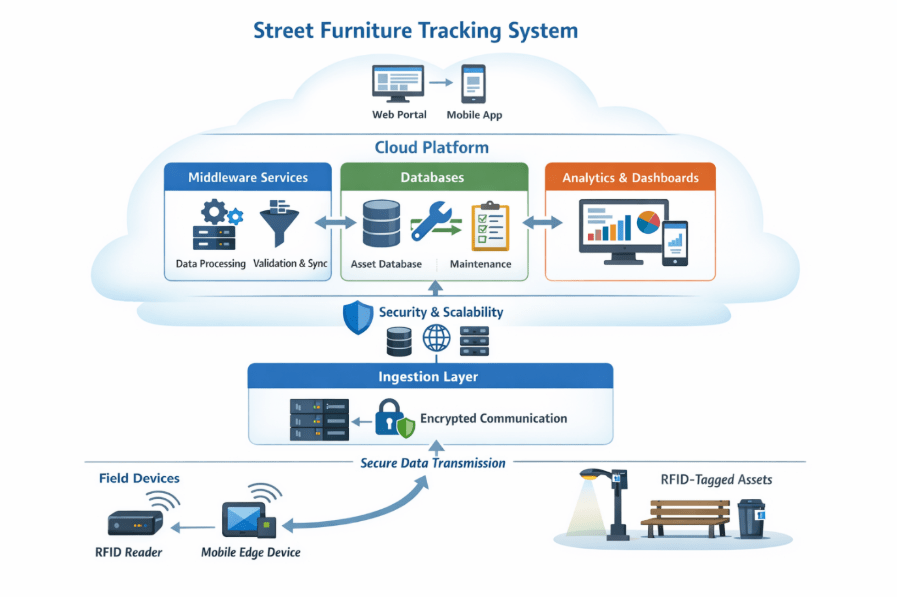
Cloud-based street furniture tracking systems centralize asset data management, analytics, and governance within a secured cloud environment. RFID readers and mobile edge devices capture asset identification and condition events in the field and transmit structured data to cloud ingestion services over encrypted communication channels.
Middleware services normalize incoming events, enforce validation rules, and synchronize asset records across modules such as inventory management, maintenance scheduling, compliance reporting, and analytics dashboards. Cloud platforms handle operational responsibilities including software lifecycle management, elastic scaling, backup, disaster recovery, and role-based access control.
Security boundaries are defined through identity management frameworks, network segmentation, and data encryption policies. Scalability considerations include geographic expansion, integration with smart city platforms, and support for multiple municipal departments operating under shared governance models.
Non-Cloud Architecture Overview
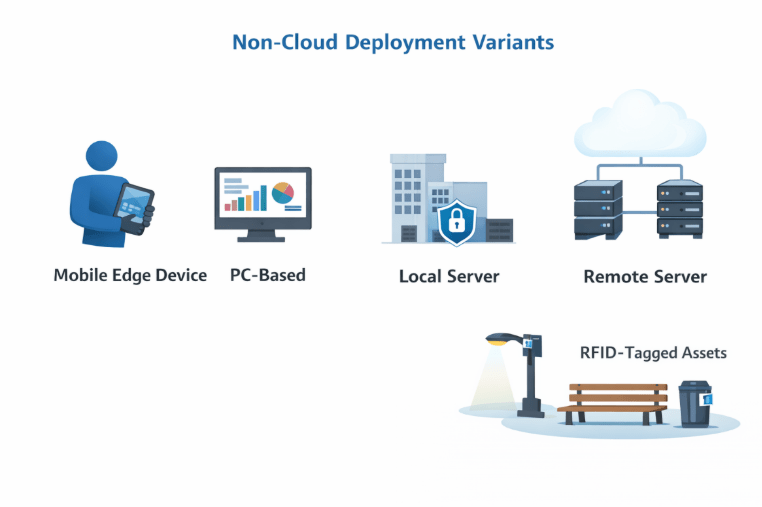
Non-cloud street furniture tracking systems are designed for environments with strict data residency requirements, limited connectivity, or decentralized operational models. Software can operate directly on handheld computers for offline field inspections, on PCs for departmental use, on local servers within municipal data centers, or on remote servers hosted by third-party infrastructure providers.
Data flows are typically event-driven and batch-synchronized, with asset records stored locally and synchronized periodically when connectivity permits. Operational responsibilities such as system updates, backups, and security controls are managed internally by IT teams or designated system integrators.
Security boundaries are enforced at the device, network, and application layers, often relying on internal authentication systems and segmented networks. Scalability is bounded by local infrastructure capacity, making architecture planning critical for city-wide rollouts.
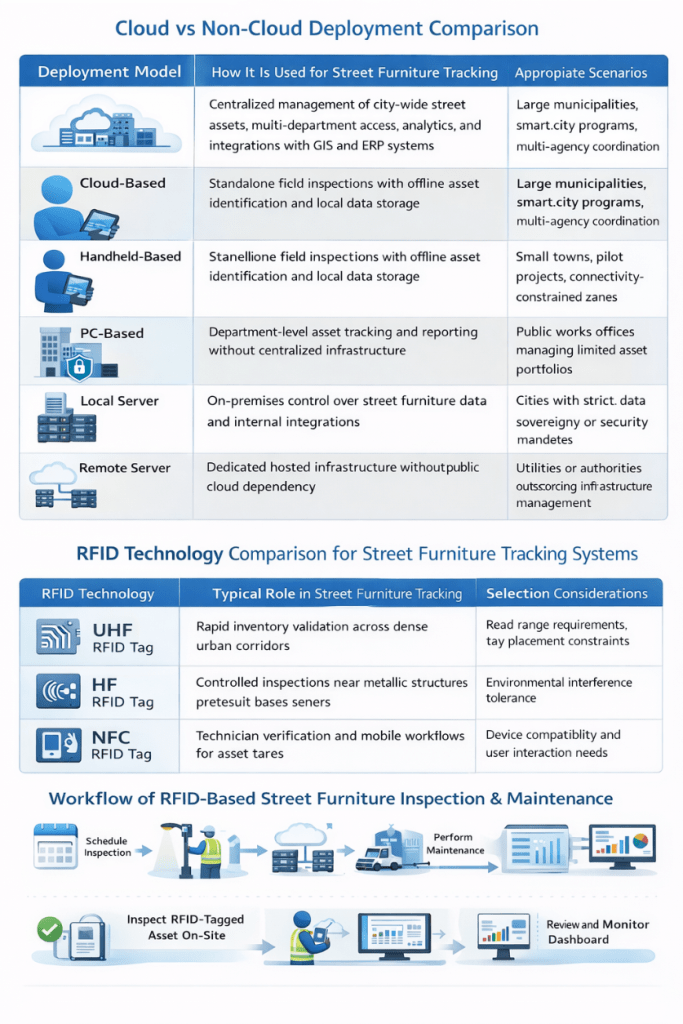
Cloud vs Non-Cloud Deployment Comparison for Street Furniture Tracking Systems
| Deployment Model | How It Is Used for Street Furniture Tracking | Appropriate Scenarios |
| Cloud-Based | Centralized management of city-wide street assets, multi-department access, analytics, and integrations with GIS and ERP systems | Large municipalities, smart city programs, multi-agency coordination |
| Handheld-Based | Standalone field inspections with offline asset identification and local data storage | Small towns, pilot projects, connectivity-constrained zones |
| PC-Based | Department-level asset tracking and reporting without centralized infrastructure | Public works offices managing limited asset portfolios |
| Local Server | On-premises control over street furniture data and internal integrations | Cities with strict data sovereignty or security mandates |
| Remote Server | Dedicated hosted infrastructure without public cloud dependency | Utilities or authorities outsourcing infrastructure management |
Cloud Integration and Data Management for Street Furniture Tracking Systems
Cloud-based street furniture tracking platforms manage the full data lifecycle from ingestion through archival. Field-generated RFID events are ingested through secure APIs, message queues, or file-based uploads depending on device capabilities and connectivity conditions.
Data processing layers perform validation, deduplication, temporal alignment, and enrichment using asset master data. Processed data is persisted in structured databases supporting transactional queries, historical analysis, and regulatory audits.
Analytics services enable condition trend analysis, maintenance forecasting, and contractor performance evaluation. Integration interfaces support data exchange with GIS systems, work order management platforms, financial systems, and urban analytics tools.
Security controls include encryption at rest and in transit, identity federation, role-based access governance, audit logging, and configurable data retention policies aligned with municipal regulations and public records requirements.
Major Components of Street Furniture Tracking System Architecture
- RFID Credentials
Physical identifiers attached to street furniture assets, selected based on environmental exposure, installation constraints, and asset lifespan requirements.
- RFID Readers
Fixed or mobile readers used by inspection teams and contractors to capture asset identification events in outdoor environments with variable interference conditions.
- Edge Devices
Handheld computers or vehicle-mounted systems that manage local data capture, validation, and temporary storage during field operations.
- Middleware
Software layer responsible for event normalization, business rule enforcement, asset state management, and system interoperability.
- Cloud Platforms
Centralized environments hosting databases, analytics, dashboards, and integration services for large-scale deployments.
- Local or Remote Servers
Non-cloud infrastructure hosting core applications and databases under organizational control.
- Databases
Structured repositories supporting asset master data, inspection logs, maintenance history, and compliance documentation.
- Dashboards and Reporting Tools
User interfaces enabling operations managers, compliance officers, and executives to monitor asset status and performance indicators.
RFID Technologies Used in Street Furniture Tracking Systems
- UHF RFID
Supports long read ranges and rapid identification of multiple street assets in drive-by or walk-by inspection scenarios.
- HF RFID
Provides moderate read ranges and improved performance near metal or urban interference sources.
- NFC
Enables close-range interactions using smartphones or tablets for targeted inspections and citizen engagement workflows.
- LF RFID
Offers reliable performance in challenging environments with high moisture or metal density, albeit with short read ranges.
RFID Technology Comparison for Street Furniture Tracking Systems
| RFID Technology | Typical Role in Street Furniture Tracking | Selection Considerations |
| UHF | Rapid inventory validation across dense urban corridors | Read range requirements, tag placement constraints |
| HF | Controlled inspections near metallic structures | Environmental interference tolerance |
| NFC | Technician verification and mobile workflows | Device compatibility and user interaction needs |
| LF | Harsh environment asset identification | Reliability over range and data density |
Combining Multiple RFID Technologies in Street Furniture Tracking Systems
Combining multiple RFID technologies is appropriate when street furniture portfolios span diverse environments and operational workflows. Hybrid architectures allow long-range UHF identification for inventory sweeps while leveraging NFC or HF for close-proximity inspections, commissioning, or contractor sign-offs.
Architectural benefits include improved data granularity and workflow alignment. Trade-offs involve increased system complexity, tag management overhead, and integration testing requirements. Governance frameworks must address technology selection standards and lifecycle management to avoid fragmentation risks.
Applications of RFID-Based Street Furniture Tracking Systems
- Streetlight asset inventory management supporting pole-level identification and maintenance attribution
- Traffic sign inspection workflows enabling condition scoring and compliance documentation
- Bus shelter maintenance tracking coordinating contractors, cleaning schedules, and structural inspections
- Bollard and barrier monitoring supporting urban safety and access control programs
- Waste receptacle servicing verification for sanitation departments and outsourced providers
- Public bench lifecycle tracking for refurbishment and replacement planning
- Smart city sensor asset association with physical street furniture infrastructure
- Pedestrian wayfinding signage governance across tourism and transit zones
- Parking meter asset tracking integrated with revenue and enforcement systems
- Utility cabinet and roadside enclosure identification for cross-agency coordination
Deployment Options for Street Furniture Tracking Systems
Cloud Deployment Use Cases and Advantages
- Multi-department municipal environments requiring centralized governance
- Smart city initiatives integrating street furniture data with analytics platforms
- Organizations prioritizing scalability, disaster recovery, and system interoperability
Non-Cloud Deployment Use Cases and Advantages
- Jurisdictions with strict data residency or cybersecurity regulations
- Field operations in low-connectivity or offline environments
- Departments requiring localized control over IT infrastructure and data access
GAO supports all deployment models with configurable architectures, implementation guidance, and long-term system support. Headquartered in New York City and Toronto, GAO has spent decades supporting public sector and enterprise customers across the U.S., Canada, and global markets, combining engineering depth with practical deployment experience.
Case Studies of Street Furniture Tracking Systems Using RFID Technologies
U.S. Case Studies
Urban Streetlight Asset Governance in New York City Using RFID-Based Street Furniture Tracking Systems
- Problem
A dense metropolitan borough in New York City managed over 120,000 streetlights across multiple agencies. Asset records were fragmented across spreadsheets and legacy databases, leading to inconsistent maintenance histories and delayed fault resolution. Connectivity varied significantly across inspection zones.
- Solution
Street Furniture Tracking Systems using RFID technologies were deployed using UHF RFID tags on poles and cabinets. Field teams used handheld computers operating non-cloud software for offline inspections, with periodic synchronization to a cloud platform managed by GAO. Middleware normalized inspection events and enforced asset identity consistency.
- Result
Verified asset records increased from approximately 78 percent to 99.4 percent within nine months.
- Lesson
Offline-first workflows reduced dependency on cellular coverage but required disciplined synchronization procedures.
Traffic Sign Compliance Tracking in Los Angeles Using RFID Technologies
- Problem
A municipal transportation department in Los Angeles faced audit findings related to undocumented traffic sign inspections and unclear responsibility between internal crews and contractors.
- Solution
HF RFID tags were affixed to traffic signs and poles. Inspectors used PC-based non-cloud software at district offices, while supervisory staff accessed a centralized cloud dashboard. GAO supported system configuration aligned with inspection ordinances and retention requirements.
- Result
Inspection documentation completeness improved by 41 percent year over year.
- Lesson
Hybrid cloud and PC-based deployments balanced compliance oversight with district autonomy.
Bus Shelter Maintenance Oversight in Chicago Using RFID-Based Street Asset Systems
- Problem
Over 4,000 bus shelters across Chicago were serviced by multiple vendors with limited verification of cleaning and structural inspections.
- Solution
Street Furniture Tracking Systems using RFID technologies leveraged UHF tags and vehicle-mounted readers. Data was ingested into a cloud deployment with contractor-specific access controls. GAO assisted with data governance design and SLA reporting logic.
- Result
Disputed maintenance claims were reduced by 36 percent within the first operating year.
Lesson
Clear access governance was essential to prevent cross-vendor data visibility issues.
Bollard and Barrier Inventory Management in Houston Using RFID Technologies
- Problem
Public safety departments struggled to maintain an accurate inventory of removable bollards deployed across event corridors and flood zones.
- Solution
LF RFID tags were selected due to environmental exposure and proximity to metal. Non-cloud software running on handheld computers enabled field crews to validate deployments without network access. Periodic uploads synchronized data to a remote server managed by GAO.
- Result
Asset loss incidents declined by 28 percent over twelve months.
- Lesson
Short read ranges improved accuracy but increased inspection time per asset.
Parking Meter Lifecycle Tracking in San Francisco Using RFID-Based Systems
- Problem
Parking authorities faced difficulty correlating physical parking meters with revenue and maintenance systems due to undocumented replacements.
- Solution
NFC-enabled RFID tags supported close-range verification by technicians using mobile devices. A cloud-based Street Furniture Tracking System integrated asset identity with financial systems. GAO provided integration advisory support.
- Result
Unattributed maintenance events dropped by 52 percent within six months.
- Lesson
Close-range interaction reduced errors but required staff training on verification procedures.
Waste Receptacle Servicing Verification in Phoenix Using RFID Technologies
- Problem
Sanitation departments lacked verifiable proof of service completion across public waste receptacles in parks and transit zones.
- Solution
UHF RFID tags enabled rapid identification during servicing rounds. Non-cloud PC-based software aggregated route data locally before upload to a central system. GAO assisted with deployment validation.
- Result
Missed service incidents decreased by 34 percent.
- Lesson
Batch synchronization delayed analytics visibility but reduced field device complexity.
Pedestrian Wayfinding Asset Control in Seattle Using RFID-Based Tracking
- Problem
Tourism and transit agencies could not reliably track condition and placement of pedestrian wayfinding signage.
- Solution
HF RFID tags supported controlled inspections near metallic structures. A local server deployment was selected due to municipal IT policies. GAO provided system hardening guidance.
- Result
Unscheduled sign replacements declined by 22 percent annually.
- Lesson
Local servers simplified compliance audits but required internal IT resources.
Utility Cabinet Tracking in Dallas Using RFID Technologies
- Problem
Multiple agencies accessed roadside utility cabinets without a unified asset registry, creating coordination issues.
- Solution
Street Furniture Tracking Systems using RFID technologies employed UHF tags and cloud-based identity management. GAO supported multi-agency role definitions.
- Result
Unauthorized access incidents fell by 19 percent.
- Lesson
Cross-agency governance required formal data ownership agreements.
Smart City Sensor Association in Boston Using RFID-Based Street Furniture Systems
- Problem
Smart sensors were deployed on existing street furniture without consistent linkage to physical assets.
- Solution
NFC and UHF RFID technologies were combined to associate sensors with poles and enclosures. A cloud deployment supported analytics integration. GAO advised on hybrid architecture trade-offs.
- Result
Sensor-to-asset mapping accuracy reached 98.7 percent.
- Lesson
Multi-technology designs increased integration testing effort.
Public Bench Asset Renewal Planning in Denver Using RFID Technologies
- Problem
Parks departments lacked reliable lifecycle data for benches exposed to weather and vandalism.
- Solution
LF RFID tags were embedded during refurbishment. Non-cloud software running on PCs supported condition scoring. GAO assisted with lifecycle data modeling.
- Result
Planned replacements increased by 31 percent relative to reactive repairs.
- Lesson
Embedded tags limited post-installation replacement flexibility.
Transit Corridor Signage Management in Atlanta Using RFID-Based Systems
- Problem
Transit corridors experienced frequent signage relocation without documentation.
- Solution
UHF RFID-enabled Street Furniture Tracking Systems provided rapid inventory sweeps. Cloud analytics highlighted discrepancies. GAO supported deployment scaling.
- Result
Unrecorded relocations dropped by 44 percent.
- Lesson
Drive-by reads required careful antenna calibration.
Snow Route Marker Tracking in Minneapolis Using RFID Technologies
- Problem
Seasonal snow route markers were deployed and removed without reliable tracking.
- Solution
HF RFID tags supported short-range verification. Handheld-based non-cloud software operated in extreme weather. GAO provided ruggedization recommendations.
- Result
Marker recovery rates improved from 83 percent to 97 percent.
- Lesson
Cold weather reduced battery performance in some handheld devices.
Event Infrastructure Asset Control in Las Vegas Using RFID-Based Tracking
- Problem
Temporary street furniture deployed for events lacked consistent accountability.
- Solution
UHF RFID tags and cloud-based Street Furniture Tracking Systems enabled rapid deployment audits. GAO supported temporary asset workflows.
- Result
Post-event asset reconciliation time decreased by 48 percent.
- Lesson
Temporary assets required flexible data retention policies.
Cross-District Street Asset Standardization in San Diego Using RFID Technologies
- Problem
District-level asset standards varied, complicating city-wide reporting.
- Solution
GAO supported a cloud-based Street Furniture Tracking System with standardized asset schemas and RFID identification.
- Result
Inter-district data consistency improved by 39 percent.
- Lesson
Standardization required change management across departments.
Canadian Case Studies
Municipal Streetlight Inspection Optimization in Toronto Using RFID Technologies
- Problem
A large Canadian city managed aging streetlight infrastructure with limited inspection traceability.
- Solution
UHF RFID-enabled Street Furniture Tracking Systems were deployed with cloud analytics. GAO provided configuration and support from its Toronto operations.
- Result
Inspection cycle times were reduced by 27 percent.
- Lesson
Legacy data migration required additional validation effort.
Bus Stop Asset Governance in Vancouver Using RFID-Based Systems
- Problem
Transit authorities faced inconsistent asset records for bus stops across municipalities.
- Solution
HF RFID tags and a remote server deployment supported shared governance. GAO assisted with inter-agency access controls.
- Result
Duplicate asset records were reduced by 33 percent.
- Lesson
Shared systems required clear jurisdictional boundaries.
Winter-Resilient Street Furniture Tracking in Calgary Using RFID Technologies
- Problem
Extreme weather affected asset identification reliability.
- Solution
LF RFID tags were selected for resilience. Non-cloud handheld software supported offline operations. GAO advised on technology selection.
- Result
Read reliability exceeded 96 percent during winter operations.
- Lesson
Short read ranges increased inspection dwell time.
Downtown Wayfinding Asset Control in Montreal Using RFID-Based Tracking
- Problem
Bilingual wayfinding signage required consistent condition tracking.
- Solution
NFC-enabled RFID supported close-range inspections using mobile devices. Cloud deployment enabled reporting. GAO provided integration support.
- Result
Inspection discrepancies declined by 29 percent.
- Lesson
Mobile device compatibility testing was essential.
Regional Street Asset Consolidation in Ottawa Using RFID Technologies
- Problem
Multiple agencies managed overlapping street furniture inventories.
- Solution
Street Furniture Tracking Systems using RFID technologies were deployed on a local server to meet federal data policies. GAO supported system validation.
- Result
Asset reconciliation effort was reduced by 35 percent.
- Lesson
Local infrastructure required dedicated operational ownership.
Our products and systems have been developed and deployed for a wide range of industrial applications. They are available off-the-shelf or can be customized to meet your needs. If you have any questions, our technical experts can help you.
For any further information on GAO’s products and systems, to request evaluation kits, free samples, recorded video demos, or explore partnership opportunities, please fill out this form or email us.