
Overview of Vehicle-Mounted Reader Systems Using RFID Technologies
Vehicle-Mounted Reader Systems are mobile RFID-enabled platforms designed to capture identification and status data while mounted on forklifts, yard trucks, reach stackers, automated guided vehicles, and other industrial vehicles. These systems integrate RFID technologies with onboard computing and connectivity to enable continuous data collection while assets are in motion across operational environments.
RFID-enabled vehicle readers typically operate as edge capture points within logistics, manufacturing, warehousing, ports, and large outdoor facilities. The structure combines ruggedized RFID readers, antennas, vehicle power interfaces, onboard processors, and back-end software to ensure reliable identification of tagged items, pallets, containers, or infrastructure markers.
Support for both cloud and non-cloud deployment models allows organizations to align system behavior with latency tolerance, cybersecurity posture, regulatory compliance, and IT maturity. Cloud-based deployments emphasize centralized visibility and cross-site coordination, while non-cloud configurations enable autonomous operations on vehicles, PCs, or localized servers in disconnected or controlled environments.
Functional Overview and Operational Value of RFID-Based Vehicle-Mounted Reader Systems
Vehicle-mounted RFID reader platforms function as mobile sensing layers within enterprise operational ecosystems. The system architecture enables real-time or near-real-time identification events to be generated as vehicles traverse predefined paths, storage zones, yards, or production areas.
Key structural elements include vehicle-mounted RFID reader assemblies, antenna arrays optimized for directional capture, onboard edge computing modules, middleware services, and data synchronization mechanisms. Together, these components support deterministic read performance under vibration, temperature variation, electromagnetic interference, and variable vehicle speeds.
Operational benefits focus on reducing manual scanning, eliminating fixed choke points, improving spatial coverage, and enabling continuous inventory awareness. Applications span automated confirmation of pallet movement, yard inventory validation, production line feeding verification, container tracking, and mobile asset reconciliation.
Multiple deployment options ensure suitability across regulated environments, bandwidth-constrained facilities, and geographically distributed enterprises without forcing uniform infrastructure assumptions.
Purposes, Operational Challenges Addressed, and Benefits
Purposes of Vehicle-Mounted Reader Systems
- Enable automated RFID data capture without stopping vehicles or operators
- Extend RFID coverage across large or dynamic operational areas
- Support real-time asset state awareness during vehicle movement
- Reduce dependency on fixed readers and manual scanning workflows
- Provide mobile validation of asset location, identity, and movement
Operational Issues Addressed
- Inventory inaccuracies caused by missed scans at static portals
- Labor inefficiencies from handheld scanning or paperwork
- Blind spots in yards, warehouses, and production staging zones
- Latency between asset movement and system record updates
- Inconsistent data capture due to operator variability
Benefits to Enterprise Operations
- Continuous mobile visibility of tagged assets
- Higher read consistency under industrial conditions
- Reduced infrastructure footprint compared to fixed portals
- Improved traceability for compliance and audit readiness
- Scalable expansion across fleets without redesigning layouts
System Architecture for Cloud and Non-Cloud Deployments
Cloud-Based Architecture Overview
Cloud-based Vehicle-Mounted Reader Systems centralize data processing, storage, analytics, and integration logic in a cloud platform. Vehicle-mounted readers act as edge data producers, transmitting RFID events through secure network connections.
The architecture typically includes mobile RFID readers, edge processors, secure communication gateways, cloud-hosted middleware, centralized databases, analytics engines, and web-based dashboards. Data flows from vehicle readers to cloud ingestion services where it is normalized, validated, enriched, and stored.
Operational responsibility for system updates, scaling, analytics, and cross-site visibility resides primarily in the cloud layer. Security boundaries are enforced using encryption, identity-based access controls, and network segmentation. Scalability is achieved through elastic cloud resources supporting fleet expansion and multi-site operations.
A system architecture diagram should appear here illustrating vehicle readers communicating with cloud services, analytics layers, and enterprise integrations.
Non-Cloud Architecture Overview
Non-cloud Vehicle-Mounted Reader Systems prioritize localized control, deterministic latency, and operational independence from internet connectivity. Software execution occurs closer to the operational environment.
Supported non-cloud configurations include:
- Software running directly on a vehicle-mounted computer or handheld terminal
- Software hosted on an industrial PC within the facility
- Software deployed on a local on-premises server
- Software hosted on a privately managed remote server
Data flows remain within defined network boundaries, often confined to plant networks or isolated operational zones. Operational responsibility includes local system administration, updates, backups, and security enforcement.
Security boundaries are tightly controlled through physical access, network isolation, and internal authentication mechanisms. Scalability depends on hardware capacity planning rather than elastic cloud provisioning.
A non-cloud architecture diagram should appear here showing vehicle readers communicating with local systems and servers.
Cloud vs Non-Cloud Vehicle-Mounted Reader Systems Comparison
| Aspect | Cloud-Based Systems | Non-Cloud Systems |
| Deployment Scope | Multi-site, geographically distributed fleets | Single-site or controlled environments |
| Connectivity Dependency | Requires reliable network connectivity | Operates with limited or no internet |
| Latency Control | Network-dependent response times | Deterministic local processing |
| Data Governance | Centralized policies and auditing | Site-specific governance controls |
| IT Maintenance | Managed platform services | Local IT ownership |
| Scalability Model | Elastic, demand-based | Hardware capacity-driven |
| Typical Scenarios | Enterprise logistics, global manufacturing | Defense facilities, regulated plants, remote sites |
Cloud Integration and Data Management Strategy
Cloud integration for Vehicle-Mounted Reader Systems focuses on disciplined data lifecycle management rather than hardware orchestration. RFID event data is ingested through secure APIs or message brokers, where it undergoes validation, timestamp normalization, and contextual enrichment.
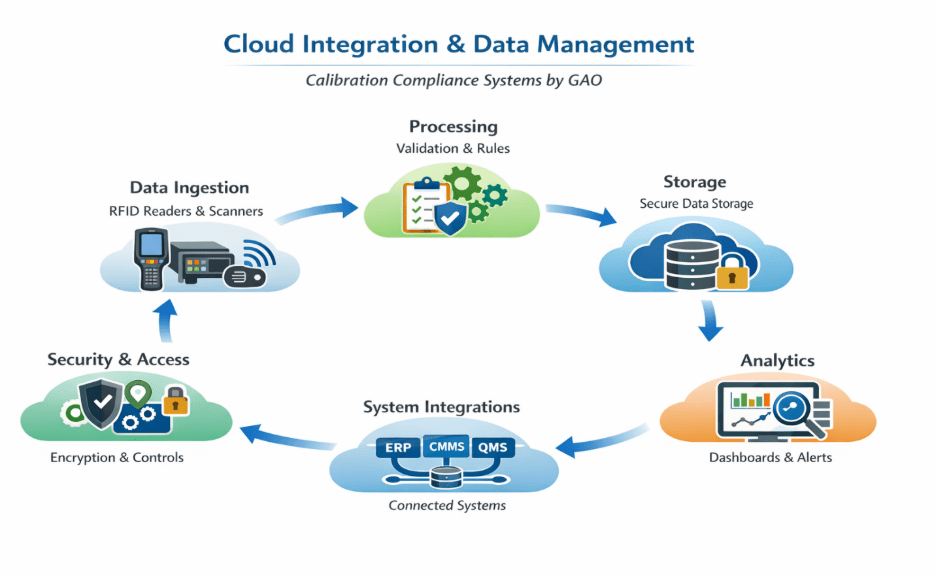
Processing pipelines apply business rules, filtering logic, and correlation algorithms to convert raw read events into operational records. Storage strategies typically include transactional databases for real-time operations and historical data repositories for analytics and audit trails.
Analytics services support trend analysis, exception detection, utilization reporting, and operational performance metrics. Integration frameworks enable bidirectional data exchange with ERP, WMS, MES, TMS, and compliance systems.
Security controls include encryption at rest and in transit, role-based access governance, audit logging, and policy-driven data retention. Access governance ensures users and systems interact only with authorized datasets throughout the data lifecycle.
Major System Components and Functional Roles
- RFID Credentials
RFID tags or transponders store unique identifiers and optional data payloads. Selection considerations include durability, memory requirements, mounting constraints, and environmental exposure.
- Vehicle-Mounted Readers
Readers execute tag interrogation, signal processing, and read event generation. Constraints include power availability, vibration tolerance, antenna port configuration, and environmental sealing.
- Edge Devices
Onboard processors handle buffering, local logic execution, and communication management. Selection focuses on compute capacity, operating system compatibility, and thermal performance.
- Middleware Platforms
Middleware orchestrates data normalization, filtering, device management, and business rule execution. Operational roles include system coordination and fault handling.
- Cloud Platforms
Cloud services provide centralized analytics, storage, access control, and integration interfaces. Selection depends on compliance alignment and scalability requirements.
- Local Servers
Local servers support non-cloud deployments requiring deterministic processing and localized data control.
- Databases
Databases store operational and historical RFID data with defined retention and access policies.
- Dashboards and Reporting Tools
Visualization layers provide operational monitoring, audit reporting, and performance insights tailored to operational roles.
RFID Technologies Used in Vehicle-Mounted Reader Systems
- UHF RFID
Supports long read ranges and high tag population handling. Performance depends on antenna placement, tag orientation, and environmental interference.
- HF RFID
Operates at shorter ranges with improved tolerance to liquids and metals. Suitable for controlled read zones.
- NFC
Very short-range communication optimized for deliberate interactions and credential verification.
- LF RFID
Low-frequency operation provides stable reads in challenging electromagnetic environments with limited read range.
RFID Technology Comparison for Vehicle-Mounted Reader Systems
| RFID Technology | Read Range | Environmental Sensitivity | Data Rate | Integration Role |
| UHF | Long | Sensitive to metals and liquids | High | Wide-area mobile identification |
| HF | Medium | Moderate tolerance | Moderate | Controlled mobile zones |
| NFC | Very short | High tolerance | Low | Intentional close-range interaction |
| LF | Short | High tolerance | Low | Harsh industrial environments |
Combining Multiple RFID Technologies
Multi-technology deployments become appropriate when operational zones exhibit diverse physical constraints or data interaction models. Combining UHF with HF or LF allows systems to balance wide-area coverage with localized precision.
Architectural benefits include flexible read zone design and redundancy. Trade-offs involve increased system complexity, integration effort, and reader coordination logic. Complexity risks include interference management, data reconciliation, and higher operational overhead.
Technology combinations should be justified through site surveys and operational requirements rather than generalized assumptions.
Applications of Vehicle-Mounted Reader Systems Using RFID Technologies
- Warehouse pallet movement validation ensuring accurate location updates during forklift operations
- Yard inventory reconciliation tracking containers and trailers across outdoor storage zones
- Production line feeding verification confirming material delivery timing and sequence
- Cold storage logistics monitoring tagged assets across temperature-controlled environments
- Port terminal container tracking across stacking yards and transfer lanes
- Airport ground support equipment identification during ramp operations
- Mining operations asset tracking across haul routes and staging areas
- Construction site material movement monitoring across dynamic layouts
- Automotive assembly logistics verifying kit delivery to workstations
- Defense logistics ensuring controlled movement of sensitive equipment
Deployment Options and Organizational Decision Factors
Cloud Deployment Use Cases and Advantages
- Enterprises requiring centralized visibility across regions
- Organizations prioritizing analytics and reporting consolidation
- IT teams seeking scalable infrastructure with managed services
- Operations with reliable connectivity and standardized governance
Non-Cloud Deployment Use Cases and Advantages
- Facilities operating in disconnected or restricted networks
- Environments with strict data residency requirements
- Operations requiring deterministic latency and local autonomy
- Sites with established on-premises IT governance models
Experience, Expertise, and Support from GAO
GAO designs and delivers Vehicle-Mounted Reader Systems using RFID technologies with deployment flexibility tailored to real-world operational constraints. With engineering teams based in New York City and Toronto, GAO supports customers across the United States, Canada, and global markets.
Four decades of experience serving Fortune 500 enterprises, research institutions, and government agencies inform system architecture decisions grounded in operational reality. Investments in R&D, quality assurance, and expert technical support enable GAO to assist from evaluation through deployment and long-term operation.
Recommendations for architecture diagrams, data flow charts, and deployment comparison tables should be incorporated throughout this webpage to support technical evaluation and procurement decision-making.
Case Studies of Vehicle-Mounted Reader Systems Using RFID Technologies
The following U.S. and Canadian case studies illustrate how GAO-supported Vehicle-Mounted Reader Systems using RFID technologies have been deployed across diverse operational environments. Each snapshot follows a Problem–Solution–Result structure and reflects real-world architectural, operational, and governance considerations across cloud and non-cloud deployments.
U.S. Case Studies
Vehicle-Mounted RFID Readers for Warehouse Forklift Operations in Chicago, Illinois
- Problem
A multi-building distribution center in Chicago faced recurring inventory discrepancies caused by missed scans at fixed dock doors and inconsistent handheld usage by forklift operators. Manual reconciliation cycles exceeded acceptable operational windows and impacted order accuracy.
- Solution
GAO supported the deployment of Vehicle-Mounted Reader Systems using UHF RFID technologies installed on forklifts. Readers interfaced with onboard computers and synchronized data to a cloud-based system for centralized inventory validation. Antenna placement was optimized for pallet-level reads during movement.
- Result
Inventory record accuracy improved from 91 percent to 99.2 percent within eight weeks.
Lesson or Trade-Off
Cloud dependency required additional network redundancy planning in high-traffic zones.
Yard Vehicle RFID Tracking for Container Logistics in Los Angeles, California
- Problem
A large intermodal yard in Los Angeles lacked continuous visibility of container movements between storage lanes and transfer points, leading to frequent rehandling and location disputes.
- Solution
Vehicle-Mounted Reader Systems using UHF RFID technologies were installed on yard tractors. A non-cloud deployment using a local server ensured low-latency updates and compliance with internal data governance policies.
- Result
Container search time decreased by 38 percent across daily operations.
Lesson or Trade-Off
Local server capacity planning required periodic upgrades during seasonal volume spikes.
Manufacturing Plant Material Flow Control in Detroit, Michigan
- Problem
An automotive manufacturing facility experienced line stoppages due to misrouted material carts and delayed confirmations of material delivery.
- Solution
GAO-assisted Vehicle-Mounted Reader Systems using HF RFID technologies were mounted on tugger vehicles. Software ran on industrial PCs connected to a local server to support deterministic response times near production lines.
- Result
Line stoppages related to material delivery dropped by 22 percent.
Lesson or Trade-Off
HF read range required tighter antenna alignment during vehicle maintenance cycles.
Cold Storage Fleet Visibility in Minneapolis, Minnesota
- Problem
A temperature-controlled logistics operator struggled to maintain accurate pallet counts as forklifts moved rapidly between freezer zones.
- Solution
Vehicle-Mounted Reader Systems using UHF RFID technologies were deployed on forklifts with ruggedized edge devices. Data synchronized to a cloud platform for cross-facility reporting.
- Result
Daily cycle count variance was reduced by 44 percent.
Lesson or Trade-Off
RFID tag selection had to be adjusted to withstand condensation exposure.
Airport Ground Support Equipment Tracking in Dallas, Texas
- Problem
An airport operations team lacked real-time visibility of ground support equipment movement across aprons and maintenance areas.
- Solution
GAO supported Vehicle-Mounted Reader Systems using LF RFID technologies mounted on service vehicles. A non-cloud configuration with software running on vehicle-mounted computers ensured offline operation during network outages.
- Result
Equipment utilization reporting accuracy increased to 96 percent.
Lesson or Trade-Off
LF technology limited read distance, requiring denser tag placement.
Port Terminal Yard Operations in Savannah, Georgia
- Problem
Port operators encountered delays reconciling container positions after peak unloading shifts.
- Solution
Vehicle-Mounted Reader Systems using UHF RFID technologies were installed on reach stackers. Data ingestion occurred through a cloud deployment supporting centralized analytics across terminals.
- Result
Container misplacement incidents declined by 31 percent.
Lesson or Trade-Off
Reader calibration required adjustment to mitigate metal interference near stacks.
Construction Equipment Tracking in Phoenix, Arizona
- Problem
A large construction site experienced frequent equipment misallocation across work zones.
- Solution
GAO-enabled Vehicle-Mounted Reader Systems using UHF RFID technologies were mounted on site vehicles, with software operating on handheld computers for non-cloud processing.
- Result
Equipment retrieval time decreased by 27 percent.
Lesson or Trade-Off
Handheld device battery management became a critical operational factor.
Food Distribution Fleet Monitoring in Fresno, California
- Problem
A food distribution center faced audit challenges due to incomplete movement records of palletized goods.
- Solution
Vehicle-Mounted Reader Systems using UHF RFID technologies were deployed on forklifts with cloud-based reporting for audit traceability.
- Result
Audit reconciliation time was reduced by 35 percent.
Lesson or Trade-Off
Cloud reporting required role-based access adjustments for compliance teams.
Defense Logistics Vehicle Operations in Huntsville, Alabama
- Problem
A defense logistics facility required controlled tracking of asset movements with strict data residency requirements.
- Solution
GAO supported Vehicle-Mounted Reader Systems using HF and LF RFID technologies in a hybrid non-cloud architecture running on a secure local server.
- Result
Asset movement verification accuracy exceeded 98 percent.
Lesson or Trade-Off
Multi-technology coordination increased system configuration complexity.
Mining Site Vehicle Asset Tracking in Reno, Nevada
- Problem
A mining operation lacked visibility into equipment movement across remote haul routes.
- Solution
Vehicle-Mounted Reader Systems using LF RFID technologies were mounted on haul trucks, with software hosted on a remote private server.
- Result
Unaccounted equipment movement incidents dropped by 41 percent.
Lesson or Trade-Off
Remote server connectivity required satellite network optimization.
Retail Distribution Center Operations in Columbus, Ohio
- Problem
High-volume retail distribution operations experienced delays during peak replenishment cycles.
- Solution
GAO-assisted Vehicle-Mounted Reader Systems using UHF RFID technologies were installed on forklifts with cloud integration for enterprise planning systems.
- Result
Dock-to-stock cycle time improved by 19 percent.
Lesson or Trade-Off
Integration testing with legacy systems required additional validation cycles.
Waste Management Fleet Tracking in Tampa, Florida
- Problem
Municipal waste operations struggled to verify vehicle servicing sequences across routes.
- Solution
Vehicle-Mounted Reader Systems using NFC and HF RFID technologies were deployed, with software running on vehicle-mounted tablets in a non-cloud setup.
- Result
Service verification discrepancies decreased by 33 percent.
Lesson or Trade-Off
NFC required operator proximity for certain verification events.
Pharmaceutical Distribution Compliance in New Brunswick, New Jersey
- Problem
A pharmaceutical distributor required precise movement records for regulatory audits.
- Solution
GAO supported Vehicle-Mounted Reader Systems using UHF RFID technologies with cloud-based data governance controls.
- Result
Regulatory audit findings related to traceability were eliminated.
Lesson or Trade-Off
Cloud retention policies required alignment with internal compliance frameworks.
Heavy Equipment Manufacturing Yard in Peoria, Illinois
- Problem
Manufacturing yard supervisors lacked reliable visibility of partially assembled units.
- Solution
Vehicle-Mounted Reader Systems using UHF RFID technologies were installed on yard vehicles with local server processing.
- Result
Work-in-progress location accuracy improved by 29 percent.
Lesson or Trade-Off
Local server maintenance required dedicated IT resources.
Canadian Case Studies
Distribution Center Forklift Tracking in Brampton, Ontario
- Problem
A regional distribution hub faced inventory drift caused by rapid forklift movement across multiple zones.
- Solution
GAO-supported Vehicle-Mounted Reader Systems using UHF RFID technologies were deployed with cloud-based inventory reconciliation.
- Result
Inventory adjustment entries declined by 36 percent.
Lesson or Trade-Off
Wireless coverage expansion was required in older facility sections.
Port Logistics Operations in Vancouver, British Columbia
- Problem
Port operators lacked consistent container movement records across shifts.
- Solution
Vehicle-Mounted Reader Systems using UHF RFID technologies were mounted on terminal vehicles with non-cloud software hosted on a local server.
- Result
Shift handover discrepancies dropped by 28 percent.
Lesson or Trade-Off
Local analytics capabilities were more limited than cloud alternatives.
Mining Equipment Tracking in Sudbury, Ontario
- Problem
Underground mining vehicles required reliable asset identification in high-interference environments.
- Solution
GAO-assisted Vehicle-Mounted Reader Systems using LF RFID technologies were deployed with software running on vehicle-mounted computers.
- Result
Equipment identification failure rates fell below 2 percent.
Lesson or Trade-Off
LF technology constrained simultaneous multi-asset reads.
Aerospace Manufacturing Logistics in Montreal, Quebec
- Problem
Aerospace assembly operations required precise tracking of component carts.
- Solution
Vehicle-Mounted Reader Systems using HF RFID technologies were integrated with a cloud-based manufacturing execution environment.
- Result
Material delivery timing deviations decreased by 21 percent.
Lesson or Trade-Off
HF tags required careful placement near composite materials.
Cold Chain Distribution Operations in Winnipeg, Manitoba
- Problem
Cold chain operators experienced incomplete movement logs during freezer transitions.
- Solution
GAO supported Vehicle-Mounted Reader Systems using UHF RFID technologies with software deployed on industrial PCs and synchronized to a remote server.
- Result
Missing movement records were reduced by 39 percent.
Lesson or Trade-Off
- Remote server synchronization intervals required tuning to balance latency and bandwidth.
These case studies reflect GAO’s experience supporting Vehicle-Mounted Reader Systems using RFID technologies across cloud and non-cloud architectures in the United States and Canada, grounded in operational constraints, compliance realities, and measurable outcomes.
Our products and systems have been developed and deployed for a wide range of industrial applications. They are available off-the-shelf or can be customized to meet your needs. If you have any questions, our technical experts can help you.
For any further information on GAO’s products and systems, to request evaluation kits, free samples, recorded video demos, or explore partnership opportunities, please fill out this form or email us.