
Overview of Automated Inventory Drone Systems Using GAO’S RFID Technologies
Automated Inventory Drone Systems using RFID technologies are designed to autonomously perform inventory verification, asset visibility, and stock reconciliation across complex physical environments. These aerial inventory platforms integrate unmanned aerial vehicles, RFID sensing payloads, and inventory intelligence software to reduce manual counting, eliminate blind spots, and enforce operational discipline in high-volume facilities.
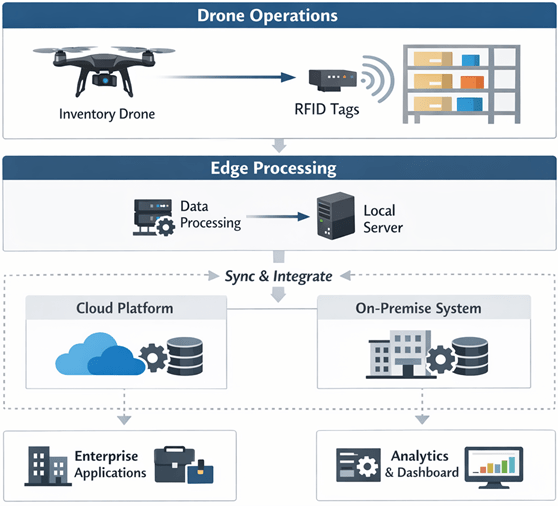
System design emphasizes repeatability, deterministic scanning paths, and structured data capture rather than ad-hoc observation. Inventory drones navigate warehouses, production floors, yards, or storage aisles while collecting RFID reads that are normalized, validated, and correlated against enterprise inventory records. The architecture supports distributed execution models, allowing analytics and control logic to operate in cloud platforms or in non-cloud environments such as handheld controllers, engineering PCs, local servers, or private remote servers.
Operational value centers on inventory accuracy, labor displacement, audit readiness, and improved asset accountability. These systems are commonly deployed in logistics hubs, manufacturing plants, regulated storage facilities, and large institutional environments where continuous inventory awareness directly impacts throughput, compliance, and working capital management.
Automated Inventory Drone Systems: Purpose, Operational Scope, and Value
System Description and Operational Intent
Automated Inventory Drone Systems represent a convergence of autonomous flight control, RFID-based identification, and inventory intelligence software. The system replaces or supplements manual cycle counts by executing pre-defined flight missions that systematically scan tagged inventory, tooling, containers, or fixed assets.
Operational scope typically includes:
- Mission planning and scheduling by operations managers or inventory control teams
- Autonomous drone navigation within mapped environments
- RFID data acquisition synchronized with positional telemetry
- Validation of reads against master data and location rules
- Exception reporting for missing, misplaced, or unauthorized assets
System design assumes industrial operating conditions, including high rack density, RF interference, controlled airspace, and safety governance requirements.
Problems and Constraints Addressed
Automated Inventory Drone Systems address several systemic challenges:
- Labor-intensive cycle counting consuming skilled warehouse staff
- Inventory inaccuracies caused by missed scans or human error
- Inaccessible storage locations requiring lifts or shutdowns
- Audit pressure in regulated industries requiring defensible records
- Limited inventory visibility between scheduled physical counts
Constraints include airspace safety policies, RFID read reliability in dense environments, integration with existing warehouse management systems, and organizational readiness for autonomous operations.
Business and Operational Benefits
Benefits achieved through structured deployment include:
- Increased inventory accuracy without operational downtime
- Reduced exposure to safety incidents related to manual counts
- Higher inventory turnover through timely discrepancy detection
- Improved audit confidence via traceable scan records
- Scalable inventory operations across multiple facilities
System Architecture for Automated Inventory Drone Systems Using RFID
Architectural Overview
Automated Inventory Drone Systems follow a layered architecture that separates aerial execution, RFID data capture, processing logic, and enterprise integration. The architecture adapts to cloud and non-cloud deployments without altering flight operations or data semantics.
Cloud Architecture Model
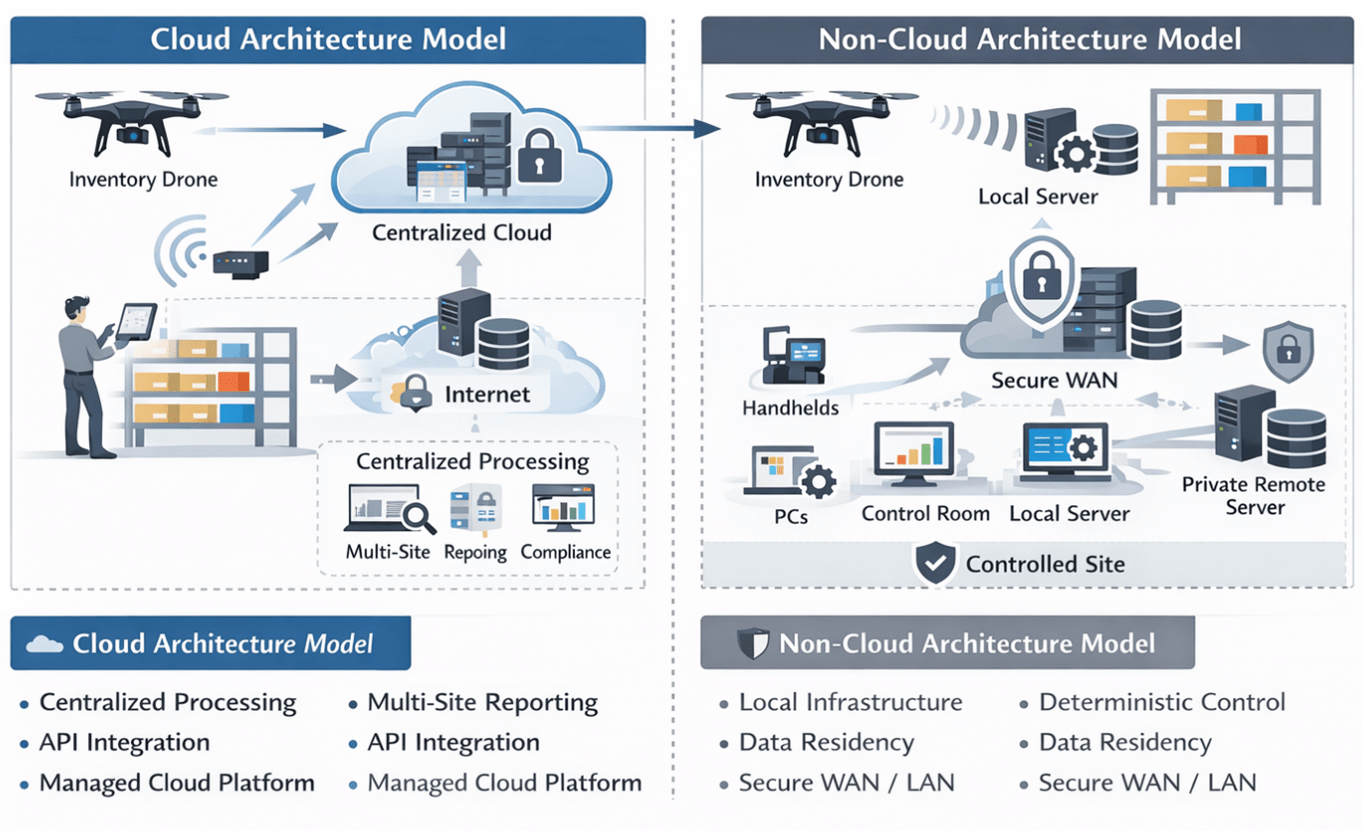
Cloud-based architectures centralize mission orchestration, inventory analytics, and cross-site reporting within managed cloud platforms.
Structural characteristics include:
- Drones operating as edge data collectors
- Secure uplink of RFID reads and telemetry to cloud endpoints
- Centralized processing, normalization, and inventory reconciliation
- Multi-site dashboards for operations, finance, and compliance teams
- API-driven integration with ERP, WMS, and asset management systems
Security boundaries are enforced through encrypted data transmission, identity-based access control, and tenant isolation. Scalability is achieved by elastic processing capacity supporting fleet expansion and increased scan frequency.
Operational responsibility shifts toward centralized IT and operations teams, reducing local infrastructure overhead while increasing dependency on network availability.
Non-Cloud Architecture Model
Non-cloud architectures prioritize control, determinism, and data residency. Inventory intelligence software executes within controlled environments based on operational and regulatory needs.
Deployment variants include:
- Handheld computers used by technicians for localized drone control and diagnostics
- PCs supporting engineering workstations or control rooms
- Local servers providing facility-wide coordination and data storage
- Private remote servers operating over secure WANs for centralized but non-public hosting
Data flow remains local, with RFID reads processed and stored within the organization’s infrastructure. Security boundaries are physically and logically enforced, and scalability depends on internal capacity planning.
Cloud vs Non-Cloud Automated Inventory Drone Systems Comparison
| Dimension | Cloud Deployment | Non-Cloud Deployment |
| Control Model | Centralized fleet orchestration | Site-specific operational control |
| Data Residency | Managed cloud regions | Fully local or privately hosted |
| Latency Sensitivity | Network-dependent | Deterministic execution |
| Regulatory Alignment | Suitable for multi-jurisdiction operations | Preferred for strict data sovereignty |
| IT Responsibility | Reduced internal infrastructure | Higher internal operational ownership |
| Typical Scenarios | Multi-site enterprises, distributed logistics | Secure facilities, isolated plants |
| Inventory Drone Coordination | Global mission policies | Local mission enforcement |
| Software Hosting | Public or private cloud | Handheld, PC, local or remote server |
Handheld deployments are typically selected for commissioning, testing, or temporary facilities. PC-based deployments suit engineering oversight. Local servers support continuous operations within a single site. Remote servers enable private centralization without public cloud exposure.
Cloud Integration and Data Management for Automated Inventory Drone Systems
Cloud integration focuses on disciplined data lifecycle governance rather than hardware control. RFID scan events are ingested through authenticated APIs, enriched with contextual metadata such as drone ID, mission ID, operator authorization, and asset classification.
Processing layers perform:
- Read de-duplication and confidence scoring
- Location correlation against facility maps
- Inventory state reconciliation against master records
- Exception flagging for anomalies and policy violations
Data is stored in structured repositories with retention policies aligned to audit and compliance requirements. Analytics services support trend analysis, inventory accuracy metrics, and operational KPIs.
Access governance enforces role-based permissions across operations, finance, compliance, and procurement teams. Security controls include encryption at rest, key management, audit logging, and segregation of duties.
Integration endpoints support ERP, WMS, EAM, and reporting platforms, enabling automated downstream workflows without manual intervention.
Major Components of Automated Inventory Drone System Architecture
- RFID Credentials
RFID credentials represent tagged inventory units, containers, tools, or fixed assets. Selection considerations include memory structure, durability, and compatibility with drone-mounted readers. Operational constraints involve tag orientation, environmental exposure, and lifecycle management.
- RFID Readers
Readers mounted on drones are optimized for weight, power consumption, and read stability. Configuration focuses on antenna patterns, duty cycles, and interference mitigation rather than raw read range.
- Edge Devices
Edge controllers manage flight execution, sensor synchronization, and immediate validation. Constraints include onboard compute capacity, thermal limits, and fail-safe behavior.
- Middleware Platforms
Middleware coordinates data normalization, mission logic, and policy enforcement. Selection criteria include extensibility, integration capability, and deterministic behavior under load.
- Cloud Platforms
Cloud platforms provide centralized analytics, fleet oversight, and cross-site visibility. Operational roles involve IT governance, security administration, and lifecycle management.
- Local and Remote Servers
Servers support non-cloud execution models, providing persistent storage, processing, and reporting within controlled environments.
- Databases
Databases store inventory state, scan history, and audit records. Constraints include consistency guarantees, retention policies, and recovery mechanisms.
- Dashboards and Reporting Tools
Dashboards present operational insights to different stakeholders. Design considerations include role-based views, data latency tolerance, and export capabilities.
RFID Technologies Used in Automated Inventory Drone Systems
- Ultra High Frequency RFID
UHF RFID operates in the 860 to 960 MHz range, offering extended read distances and high read rates. Performance is sensitive to RF interference, tag orientation, and environmental reflections, requiring careful antenna design and calibration.
- High Frequency RFID
HF RFID operates at 13.56 MHz and provides stable performance in environments with liquids or metals. Read ranges are shorter, but signal behavior is more predictable in dense storage scenarios.
- Near Field Communication
NFC operates at very short ranges and emphasizes secure, intentional interactions. Performance characteristics prioritize precision over coverage, making it suitable for controlled verification points.
- Low Frequency RFID
LF RFID operates below 135 kHz and offers strong penetration through challenging materials. Read speeds and data rates are limited, but reliability is high in harsh industrial conditions.
RFID Technology Comparison for Automated Inventory Drone Systems
| Technology | Read Range Profile | Environmental Tolerance | Inventory Density Handling | Integration Complexity |
| UHF RFID | Long-range aerial scanning | Moderate sensitivity | High throughput | Moderate |
| HF RFID | Short to mid-range | High stability | Medium density | Low |
| NFC | Very short-range | Controlled environments | Point verification | Low |
| LF RFID | Short-range | Very high tolerance | Sparse inventory | Moderate |
Combining Multiple RFID Technologies in Drone-Based Inventory Systems
Combining RFID technologies is appropriate when inventory environments exhibit heterogeneous physical characteristics or governance requirements. Architectural benefits include improved read reliability across asset classes and reduced false negatives.
Trade-offs involve increased system complexity, reader payload constraints, and more sophisticated middleware logic. Complexity risks arise from RF coexistence, mission planning overhead, and higher validation requirements. GAO typically recommends multi-technology designs only when operational conditions justify the added burden.
Applications of Automated Inventory Drone Systems Using RFID
- Warehouse cycle counting for high-bay storage environments, supporting inventory control teams with automated scans across pallet racks, mezzanines, and overflow zones without operational shutdowns.
- Manufacturing work-in-process tracking, enabling production supervisors to verify component availability, tooling presence, and buffer stock alignment across assembly lines and staging areas.
- Cold storage inventory verification, allowing drones to operate in temperature-controlled environments while RFID data supports compliance documentation and spoilage reduction.
- Pharmaceutical inventory audits, supporting quality assurance personnel with traceable inventory validation aligned to GMP and controlled substance handling procedures.
- Aerospace parts management, enabling MRO teams to verify serialized components, rotable assets, and calibrated tools within hangars and bonded storage areas.
- Retail distribution center reconciliation, supporting loss prevention teams and procurement planners with frequent, non-disruptive inventory assessments.
- Defense and government asset accountability, enabling controlled inventory verification within secure facilities without exposing data to public networks.
- Utility spare parts tracking, supporting maintenance crews by validating availability of critical components stored across yards and depots.
- University research asset management, allowing laboratory administrators to maintain visibility over tagged equipment across campuses and shared facilities.
Deployment Options for Automated Inventory Drone Systems
Cloud Deployment Use Cases and Advantages
Cloud deployments are selected by organizations managing multiple facilities, distributed inventory, or centralized analytics teams. Advantages include centralized governance, simplified updates, and scalable analytics capacity. Regulatory acceptance depends on jurisdiction and data classification.
Non-Cloud Deployment Use Cases and Advantages
Non-cloud deployments are favored in regulated, secure, or latency-sensitive environments. Handheld and PC deployments support commissioning and engineering control. Local servers provide facility autonomy, while private remote servers balance centralization with data sovereignty.
GAO’s Role in Automated Inventory Drone Systems Using RFID
GAO supports Automated Inventory Drone Systems through architecture design, RFID technology selection, and deployment flexibility. With operations headquartered in New York City and Toronto, GAO has decades of experience supporting enterprise and government customers across North America. Investments in R&D, quality assurance, and expert support enable GAO to address complex operational constraints while aligning systems with real-world governance, security, and compliance expectations.
Case Studies of Automated Inventory Drone Systems using RFID Technologies
U.S. Case Studies
High-Bay Warehouse Inventory Validation in Chicago, Illinois
Problem
- Recurring inventory discrepancies exceeding acceptable tolerance during quarterly cycle counts.
- Manual counts required scissor lifts, aisle closures, and overtime labor.
- Operational disruptions and safety exposures from high-bay pallet racking.
Solution
- Deployed Automated Inventory Drone System using UHF RFID for scheduled aerial scans.
- Inventory intelligence software on local server to meet data residency policies.
- GAO supported RF planning and middleware for dense tag populations.
Result
- Inventory accuracy improved from 96.1% to 99.4% within two audit cycles.
- Cycle count labor hours reduced by 62%.
Lesson
- Dense UHF environments required antenna polarization tuning.
- Mitigated multipath interference effectively.
Pharmaceutical Cold Storage Audit Support in Indianapolis, Indiana
Problem
- Struggled with compliant inventory audits in cold environments.
- Staff exposed to extended cold without full coverage.
- Existing handheld RFID audits incomplete and time-constrained.
Solution
- Introduced inventory drones with HF RFID for short-range, high-reliability scans.
- Processing software on hardened PC in quality control office.
- GAO provided validation documentation support.
Result
- Audit completion time decreased by 48%.
- Audit exception rates dropped below 0.5%.
Lesson
- Shorter read ranges improved confidence.
- Increased flight path density was necessary.
Manufacturing Work-in-Process Tracking in Dayton, Ohio
Problem
- Lacked real-time visibility into work-in-process containers.
- Multiple assembly cells caused line stoppages.
- Resulted in expediting costs.
Solution
- Integrated UHF RFID Automated Inventory Drone System with production controls.
- Used private remote server; selective cloud analytics for reporting.
- GAO assisted with system integration design.
Result
- Line stoppages from missing WIP containers declined by 37% over six months.
Lesson
- Hybrid cloud/non-cloud models needed disciplined interface version control.
Defense Logistics Asset Accountability in Huntsville, Alabama
Problem
- Required frequent asset verification in secure facility.
- Avoided external network dependencies and manual teams.
Solution
- Deployed LF RFID drones for metal-dense storage.
- All processing on local server in isolated network enclave.
- GAO advised on security boundary design.
Result
- Asset reconciliation cycles shortened from 10 days to 4 days.
- Zero data egress incidents.
Lesson
- Lower LF data rates required extended flight durations.
Retail Distribution Center Reconciliation in Dallas, Texas
Problem
- High-throughput center experienced shrinkage.
- Delayed inventory detection between monthly counts.
Solution
- Deployed UHF RFID drones with cloud-hosted analytics.
- Non-cloud edge processing for network outage resilience.
- GAO supported fleet scalability planning.
Result
- Shrinkage from inventory inaccuracy decreased by 22% year over year.
Lesson
- Network latency planning essential for peak reporting windows.
Aerospace Tool Control in Wichita, Kansas
Problem
- Verified calibrated tooling across large hangars.
- Impacted maintenance schedules.
Solution
- HF and NFC RFID drones for close-range flights.
- Software on engineering workstation PC.
- GAO provided multi-technology architecture guidance.
Result
- Tool availability verification time reduced by 55%.
Lesson
- Multi-technology payloads increased drone weight.
- Imposed battery constraints.
Utility Spare Parts Yard Management in Phoenix, Arizona
Problem
- Outdoor spare parts yards had limited visibility.
- High search times during outage response.
Solution
- UHF RFID drones with private remote server over secure WAN.
- GAO supported environmental hardening.
Result
- Average part retrieval time improved by 41% in emergencies.
Lesson
- Outdoor RF variability required periodic recalibration.
Food Processing Facility Compliance in Fresno, California
Problem
- Needed frequent verification for quality and traceability.
- Without interrupting production.
Solution
- HF RFID drones with local server for food safety audits.
- GAO assisted with compliance mapping.
Result
- Audit nonconformities dropped from 14 to 2 per quarter.
Lesson
- Cleaning schedules aligned with drone operations.
Automotive Parts Sequencing in Toledo, Ohio
Problem
- Sequencing errors from inaccurate buffer inventory.
- Near assembly lines.
Solution
- UHF RFID drones integrated with MES via cloud analytics.
- Edge processing for low-latency alerts.
- GAO supported data model alignment.
Result
- Sequencing delays reduced by 29%.
Lesson
- Exception thresholds tuned to avoid alert fatigue.
Chemical Warehouse Safety Audits in Baton Rouge, Louisiana
Problem
- Safety risks in manual inspections of hazardous zones.
Solution
- LF RFID drones under non-cloud architecture on hardened server.
- GAO advised on intrinsically safe procedures.
Result
- Manual inspection exposure hours declined by 68%.
Lesson
- Flight scheduling coordinated with safety permitting.
E-Commerce Fulfillment Accuracy in Columbus, Ohio
Problem
- Increasing order inaccuracies in peak seasons.
- Due to outdated inventory records.
Solution
- UHF RFID drones for nightly scans with cloud reconciliation.
- GAO supported peak volume scalability testing.
Result
- Order accuracy improved from 97.3% to 99.1%.
Lesson
- Night operations needed lighting and obstacle mapping.
University Research Asset Tracking in Boston, Massachusetts
Problem
- Inaccurate records of lab equipment across buildings.
Solution
- NFC/HF RFID drones for close-range verification.
- Software on central facilities PC.
- GAO supported governance design.
Result
- Asset location accuracy reached 98.6%.
Lesson
- Indoor navigation required frequent map updates.
Port Logistics Container Audits in Savannah, Georgia
Problem
- Lacked timely visibility in container staging.
- Affected throughput planning.
Solution
- UHF RFID drones with cloud analytics and edge failover.
- GAO assisted RF zoning.
Result
- Misplacement incidents declined by 34%.
Lesson
- Weather affected flight scheduling consistency.
Healthcare Supply Chain Inventory in Minneapolis, Minnesota
Problem
- Frequent validation for hospital replenishment.
- Without increasing labor costs.
Solution
- HF RFID drones with local server for data governance.
- GAO provided validation support.
Result
- Verification cycles shortened by 46%.
Lesson
- RF shielding from medical equipment needed mitigation.
Canadian Case Studies
National Retail Distribution in Brampton, Ontario
Problem
- Inconsistent accuracy across seasonal storage zones.
Solution
- UHF RFID drones with cloud analytics and edge processing.
- GAO supported inventory platform integration.
Result
- Inventory variance reduced by 31% year over year.
Lesson
- Seasonal layout changes required rapid re-mapping.
Mining Equipment Stores in Sudbury, Ontario
Problem
- Delays locating parts in metal-dense environments.
Solution
- LF RFID drones with remote private server.
- GAO advised on tag selection and RF isolation.
Result
- Maintenance delays from missing parts declined by 39%.
Lesson
- LF reliability traded for slower scan cycles.
Aerospace MRO Facility in Montreal, Quebec
Problem
- Precise verification of serialized components.
- Without disrupting work zones.
Solution
- HF RFID drones on engineering PC (non-cloud).
- GAO supported certification documentation.
Result
- Verification time decreased by 52%.
Lesson
- Flight paths coordinated with maintenance crews.
Cold Chain Logistics in Winnipeg, Manitoba
Problem
- Labor constraints in frozen inventory checks.
Solution
- HF RFID drones with local server.
- GAO assisted environmental qualification.
Result
- Labor exposure in cold storage reduced by 61%.
Lesson
- Batteries needed cold-rated specifications.
Government Records Storage in Gatineau, Quebec
Problem
- Accurate verification with data sovereignty controls.
Solution
- NFC/HF RFID drones on secured local server (non-cloud).
- GAO provided architecture advisory.
Result
- Reconciliation accuracy exceeded 99% in audits.
Lesson
- Short-range tech required denser flight coverage.
These case studies reflect GAO’s experience supporting Automated Inventory Drone Systems using RFID technologies across diverse operational environments in the United States and Canada, with emphasis on architectural trade-offs, deployment flexibility, and measurable outcomes.
Our products and systems have been developed and deployed for a wide range of industrial applications. They are available off-the-shelf or can be customized to meet your needs. If you have any questions, our technical experts can help you.
For any further information on GAO’s products and systems, to request evaluation kits, free samples, recorded video demos, or explore partnership opportunities, please fill out this form or email us.