
Cold Storage Monitoring RFID Systems Using RFID Technologies
Cold Storage Monitoring RFID systems enable continuous visibility, compliance tracking, and operational control across refrigerated and frozen environments handling temperature-sensitive goods. These systems use RFID technologies to identify, track, and monitor assets such as pallets, containers, totes, racks, and individual product units throughout cold chain operations. Data captured at storage zones, loading docks, and transport interfaces supports real-time status awareness and historical traceability.
Cold Storage Monitoring RFID platforms are structured to support diverse enterprise environments, including large distribution centers, pharmaceutical cold rooms, food processing plants, and logistics hubs. System intelligence correlates asset identity with temperature exposure, dwell time, location history, and handling events to support audit readiness and process optimization. Deployment flexibility allows organizations to operate the system in cloud-based or non-cloud configurations depending on regulatory constraints, connectivity conditions, and internal IT policies. RFID-enabled cold chain monitoring strengthens operational discipline while reducing manual inspection overhead and data integrity risks.
Overview of GAO’s RFID- Based Cold Storage Monitoring RFID Solutions
Cold Storage Monitoring RFID focuses on preserving product integrity and regulatory compliance across controlled-temperature environments. The system architecture integrates asset identification, event capture, data governance, and reporting workflows to maintain verifiable records across storage and handling stages. Core benefits include improved chain-of-custody documentation, reduction of temperature excursion risks, faster root-cause analysis, and higher confidence during audits and recalls.
The system structure separates physical data capture from policy enforcement and reporting logic. RFID technologies provide non-line-of-sight identification suitable for cold, humid, and low-visibility environments. Centralized or localized processing engines enforce operational rules such as exposure thresholds, quarantine triggers, and escalation workflows. Cold Storage Monitoring RFID platforms support multiple deployment models, including cloud-hosted environments and non-cloud configurations operating on handheld devices, PCs, local servers, or enterprise-controlled remote servers. This flexibility allows organizations to align system behavior with compliance, sovereignty, and uptime requirements without redesigning core processes.
Description, Purpose, Issues Addressed and Benefits of GAO’s RFID-Enabled Cold Storage Monitoring RFID Systems
System Purpose and Operational Scope
Cold Storage Monitoring RFID systems are designed to maintain traceability and compliance across refrigerated supply chains. The system aligns asset identification, environmental monitoring correlation, and operational reporting within a single governance framework.
Key objectives include:
- Continuous visibility of cold storage assets across zones, facilities, and transit interfaces
- Enforcement of handling policies tied to temperature exposure and dwell time
- Creation of tamper-resistant audit trails for regulatory and customer review
- Reduction of manual inspections and spreadsheet-driven tracking
Issues Addressed in Cold Storage Operations
Operational challenges commonly addressed include:
- Incomplete documentation of temperature exposure history
- Manual data capture errors during receiving and dispatch
- Limited visibility into asset dwell time and staging bottlenecks
- Difficulty correlating environmental deviations with specific assets
- Compliance risk under FDA, USDA, Health Canada, and GxP frameworks
Business and Operational Benefits
Measured benefits observed in enterprise deployments include:
- Improved recall precision through asset-level traceability
- Faster deviation investigation and corrective action workflows
- Reduced product loss from undetected temperature excursions
- Lower audit preparation effort and documentation gaps
- Improved coordination between operations, quality, and compliance teams
System Architecture of Cold Storage Monitoring RFID Using RFID Technologies
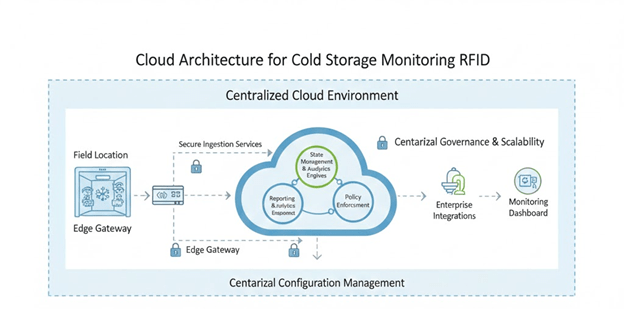
Cloud Architecture for Cold Storage Monitoring RFID
Cloud-based architecture centralizes policy enforcement, asset intelligence, and reporting within controlled cloud environments. RFID events generated at cold rooms, freezers, and loading docks are transmitted via secure gateways to centralized services responsible for state management and analytics.
Overall structure includes distributed edge capture paired with centralized governance. Operational responsibility is split between local teams managing readers and gateways, and centralized teams overseeing policies, dashboards, and integrations. Security boundaries isolate device communication, tenant data, and administrative access using role-based controls and encrypted channels. Scalability is achieved through elastic processing capacity, centralized configuration management, and standardized onboarding of additional facilities.
Recommended diagram placement:
- Cloud architecture diagram illustrating RFID readers, edge gateways, secure ingestion services, analytics engines, dashboards, and enterprise integrations
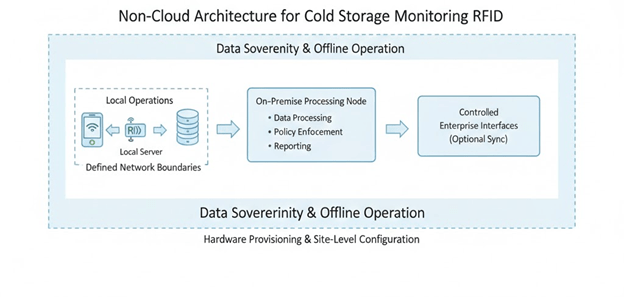
Non-Cloud Architecture for Cold Storage Monitoring RFID
Non-cloud architecture supports deployments requiring data sovereignty, offline operation, or infrastructure isolation. Cold Storage Monitoring RFID software may operate directly on handheld computers, PCs, local servers, or enterprise-managed remote servers.
Data processing, reporting, and policy enforcement occur within defined network boundaries. Operational responsibility shifts toward local IT teams, including system updates, backups, and capacity planning. Synchronization with upstream systems is controlled and optional. Scalability depends on hardware provisioning, system partitioning, and site-level configuration rather than elastic services.
Recommended diagram placement:
- Non-cloud architecture diagram showing handheld devices, local readers, on-premise processing nodes, and controlled enterprise interfaces
 Cloud vs Non-Cloud Deployment Comparison for Cold Storage Monitoring RFID
| Dimension | Cloud Deployment | Non-Cloud Deployment |
| Data Governance | Centralized policy control across facilities | Localized control per site or enterprise domain |
| Connectivity Dependence | Requires reliable network connectivity | Supports offline or intermittent operation |
| Compliance Alignment | Suitable for multi-site standardized compliance | Preferred for strict sovereignty or isolation |
| Scalability Model | Elastic compute and storage allocation | Hardware-driven expansion |
| Operational Ownership | Shared responsibility between IT and provider | Predominantly internal IT responsibility |
| Typical Selection Scenarios | Distributed cold chains, rapid expansion | Regulated facilities, isolated infrastructure |
| Handheld-Based Use | Limited to capture and edge processing | Full system operation possible |
| PC-Based Use | Administrative access and monitoring | Standalone or departmental deployments |
| Local Server Use | Optional for caching or hybrid models | Core processing and storage |
| Remote Server Use | Managed cloud services | Enterprise-controlled data centers |
Cloud Integration and Data Management for Cold Storage Monitoring RFID
Cloud integration for Cold Storage Monitoring RFID focuses on data lifecycle governance rather than hardware control. RFID event data is ingested through secure interfaces, normalized, and associated with asset records and environmental metadata. Processing engines apply business rules related to exposure thresholds, dwell limits, and exception handling.
Data storage strategies separate operational data from historical records to support retention policies and compliance audits. Analytics services support trend analysis, deviation clustering, and operational benchmarking across facilities. Integration interfaces enable controlled data exchange with warehouse management systems, quality systems, and enterprise resource planning platforms. Security controls enforce identity-based access, tenant isolation, encryption at rest and in transit, and auditable administrative actions.
Major Components of Cold Storage Monitoring RFID Architecture
RFID Credentials and Tags
- Asset identifiers bound to pallets, containers, or units
- Selection considerations include form factor, temperature tolerance, and memory requirements
RFID Readers
- Fixed or mobile devices capturing tag events within cold environments
- Constraints include condensation exposure, mounting geometry, and read zone control
Edge Devices and Gateways
- Aggregate reader data and enforce preliminary filtering
- Operate under constrained connectivity and environmental conditions
Middleware and Processing Engines
- Correlate identity events with operational rules
- Support configuration versioning and fault tolerance
Cloud Platforms or Local Servers
- Host policy enforcement, analytics, and reporting services
- Selection depends on governance and availability requirements
Databases and Storage Systems
- Maintain transactional and historical datasets
- Designed for auditability and controlled retention
Dashboards and Reporting Tools
- Provide operational visibility and compliance evidence
- Role-based views for operations, quality, and management
RFID Technologies Used in Cold Storage Monitoring RFID
UHF RFID
- Long read range and high throughput
- Sensitive to metal and liquid interactions
HF RFID
- Shorter range with stable coupling characteristics
- Predictable behavior in dense environments
NFC
- Very short-range interaction model
- Device-mediated read mechanisms
LF RFID
- Low-frequency propagation with minimal interference
- Limited data rates and read distance
RFID Technology Comparison for Cold Storage Monitoring RFID
| Technology | Operational Fit | Environmental Tolerance | Data Interaction Model | System Role |
| UHF | Bulk asset movement | Moderate | Passive broadcast | Dock and zone tracking |
| HF | Controlled identification | High | Inductive coupling | Workstation verification |
| NFC | Manual confirmation | High | Device-initiated | Inspection and audit |
| LF | Harsh environments | Very high | Continuous field | Legacy or specialized assets |
Combining Multiple RFID Technologies in Cold Storage Monitoring RFID
Multi-technology architectures are appropriate when operational zones impose different physical or procedural constraints. Combining UHF for bulk movement with HF or NFC for verification checkpoints can improve data integrity. Architectural benefits include improved accuracy and workflow alignment. Trade-offs include increased system complexity, reader coordination challenges, and higher configuration overhead. Governance models must clearly define technology boundaries to avoid ambiguity in asset state interpretation.
Applications of Cold Storage Monitoring RFID Systems
- Pharmaceutical cold rooms managing batch-level compliance
- Vaccine storage facilities enforcing exposure thresholds
- Frozen food distribution centers tracking pallet dwell time
- Meat processing plants monitoring staging zones
- Seafood export hubs documenting chain-of-custody
- Dairy logistics operations managing shelf-life exposure
- Clinical trial material storage environments
- Hospital pharmacy cold storage rooms
- Biotech reagent inventory control
- Airport cold cargo handling facilities
- Cross-docking refrigerated warehouses
- Cold chain contract logistics providers
Deployment Options for Cold Storage Monitoring RFID
Cloud Deployment Use Cases and Advantages
- Multi-site cold chains requiring centralized oversight
- Organizations with distributed compliance teams
- Environments prioritizing rapid scaling and standardization
Non-Cloud Deployment Use Cases and Advantages
- Facilities with strict data residency mandates
- Remote locations with unreliable connectivity
- Enterprises requiring full infrastructure control
Non-cloud software may operate on handheld computers for field-centric workflows, PCs for departmental oversight, local servers for facility-wide control, or remote servers within enterprise-controlled data centers.
Case Studies of Cold Storage Monitoring RFID Using RFID Technologies
United States Case Studies
Cold Storage Compliance Tracking in Chicago Using Cold Storage Monitoring RFID
- Problem
A multi-zone refrigerated warehouse in Chicago struggled to maintain verifiable temperature exposure records across inbound pallets and outbound shipments. Manual logs and siloed systems created audit gaps during FDA inspections, especially during peak seasonal throughput.
- Solution
GAO supported deployment of a Cold Storage Monitoring RFID system using UHF RFID technologies integrated with a cloud-based governance platform. Fixed readers at dock doors and storage aisles captured asset movement, while centralized policy engines correlated RFID events with temperature data streams. Configuration management and reporting were handled centrally, with local teams responsible for reader upkeep.
- Result
Audit preparation time was reduced by 42 percent.
Pharmaceutical Cold Room Monitoring in New Jersey Using Cold Storage Monitoring RFID
- Problem
A pharmaceutical distribution facility in Newark lacked asset-level traceability for temperature-sensitive batches stored across multiple cold rooms, increasing recall investigation time.
- Solution
GAO enabled a non-cloud Cold Storage Monitoring RFID deployment using HF RFID technologies operating on a local server. Asset identity and exposure records were processed entirely within the facility network to meet internal compliance mandates.
- Result
Deviation investigation cycles shortened by 37 percent.
Frozen Food Pallet Tracking in Minneapolis Using Cold Storage Monitoring RFID
- Problem
A frozen food processor experienced frequent pallet misplacement within freezer zones, leading to extended dwell times and inventory aging risks.
- Solution
GAO implemented UHF RFID-based Cold Storage Monitoring RFID using a hybrid architecture. Edge gateways captured pallet movement while cloud analytics identified dwell anomalies and congestion points.
- Result
Average pallet dwell time decreased by 29 percent.
Vaccine Storage Monitoring in Boston Using Cold Storage Monitoring RFID
- Problem
A biomedical storage site in Boston required immutable temperature exposure histories to support regulatory submissions and third-party audits.
- Solution
GAO supported a non-cloud deployment with RFID software operating on secure PCs within a controlled network. NFC RFID technologies enabled authenticated verification during inspections.
- Result
Inspection documentation errors dropped by 51 percent.
Cold Cargo Handling at Los Angeles Airport Using Cold Storage Monitoring RFID
- Problem
Airport cold cargo handlers faced limited visibility into pallet staging durations during customs clearance, increasing spoilage risk.
- Solution
GAO deployed a cloud-based Cold Storage Monitoring RFID platform using UHF RFID technologies integrated with enterprise logistics systems.
- Result
Temperature excursion incidents declined by 33 percent.
Meat Processing Cold Storage in Omaha Using Cold Storage Monitoring RFID
- Problem
A meat processing plant encountered inconsistent documentation of cold room transfers during shift changes.
- Solution
GAO implemented a non-cloud RFID system operating on handheld computers using HF RFID technologies to log transfers at control points.
- Result
Transfer documentation completeness increased to 98 percent.
Biotech Reagent Storage in San Diego Using Cold Storage Monitoring RFID
- Problem
A research-grade cold storage facility needed batch-level traceability for reagents under varying temperature tolerances.
- Solution
GAO enabled a cloud-based Cold Storage Monitoring RFID architecture using a combination of UHF and NFC RFID technologies for movement tracking and verification.
- Result
Batch traceability resolution improved by 46 percent.
Dairy Distribution Cold Chain in Madison Using Cold Storage Monitoring RFID
- Problem
A dairy distributor lacked reliable historical exposure data during customer quality disputes.
- Solution
GAO supported a non-cloud deployment using a remote enterprise server and UHF RFID technologies to centralize records under corporate IT control.
- Result
Dispute resolution time reduced by 34 percent.
Hospital Pharmacy Cold Storage in Houston Using Cold Storage Monitoring RFID
- Problem
Hospital pharmacies struggled with documenting cold storage compliance across decentralized storage rooms.
- Solution
GAO implemented HF RFID-based Cold Storage Monitoring RFID running on local PCs with centralized reporting exports.
- Result
Internal compliance audit findings dropped by 41 percent.
Seafood Export Cold Storage in Seattle Using Cold Storage Monitoring RFID
- Problem
Exporters faced difficulty correlating freezer dwell time with shipment delays during port congestion.
- Solution
GAO deployed cloud-hosted Cold Storage Monitoring RFID using UHF RFID technologies with analytics focused on dwell-time thresholds.
- Result
Spoilage-related write-offs decreased by 28 percent.
Clinical Trial Material Storage in Raleigh Using Cold Storage Monitoring RFID
- Problem
Trial material storage required strict chain-of-custody documentation for regulatory submissions.
- Solution
GAO enabled a non-cloud deployment using RFID software on local servers and NFC RFID technologies for controlled verification events.
- Result
Documentation reconciliation time reduced by 39 percent.
Cold Chain Contract Logistics in Dallas Using Cold Storage Monitoring RFID
- Problem
A third-party logistics provider struggled to provide standardized compliance reports across client accounts.
- Solution
GAO supported a cloud-based Cold Storage Monitoring RFID deployment using UHF RFID technologies with tenant-isolated reporting.
- Result
Client compliance reporting turnaround improved by 44 percent.
Frozen Ingredient Storage in Boise Using Cold Storage Monitoring RFID
- Problem
Ingredient storage operations lacked visibility into freezer congestion during peak production cycles.
- Solution
GAO deployed a non-cloud system operating on local servers using UHF RFID technologies to monitor zone occupancy.
- Result
Freezer congestion events declined by 31 percent.
Cold Storage Compliance in Phoenix Using Cold Storage Monitoring RFID
- Problem
A regional cold storage operator faced inconsistent compliance evidence across multiple facilities.
- Solution
GAO implemented a cloud-based Cold Storage Monitoring RFID architecture with centralized configuration and reporting.
- Result
Compliance variance across sites decreased by 36 percent.
Canadian Case Studies
Pharmaceutical Cold Storage in Toronto Using Cold Storage Monitoring RFID
- Problem
A pharmaceutical storage facility in Toronto required localized data control while maintaining audit readiness.
- Solution
GAO supported a non-cloud Cold Storage Monitoring RFID deployment using HF RFID technologies operating on a local server.
- Result
Audit nonconformities reduced by 38 percent.
Frozen Food Distribution in Mississauga Using Cold Storage Monitoring RFID
- Problem
Distribution centers experienced limited traceability during cross-dock transfers.
- Solution
GAO deployed cloud-based Cold Storage Monitoring RFID using UHF RFID technologies with centralized analytics.
- Result
Cross-dock processing delays dropped by 27 percent.
Vaccine Storage Facilities in Montreal Using Cold Storage Monitoring RFID
- Problem
Public health storage sites needed verified exposure histories under strict provincial regulations.
- Solution
GAO enabled a non-cloud deployment using PC-based RFID software and NFC RFID technologies.
- Result
Exposure documentation completeness reached 99 percent.
Seafood Cold Chain Operations in Vancouver Using Cold Storage Monitoring RFID
- Problem
Exporters lacked visibility into cold storage dwell time during maritime delays.
- Solution
GAO supported a cloud-based Cold Storage Monitoring RFID system using UHF RFID technologies integrated with logistics platforms.
- Result
Delay-related spoilage losses reduced by 32 percent.
Biotech Research Storage in Waterloo Using Cold Storage Monitoring RFID
- Problem
Research facilities required precise tracking of reagent exposure under varying protocols.
- Solution
GAO implemented a non-cloud RFID system operating on handheld computers using HF RFID technologies.
- Result
Protocol deviation incidents declined by 35 percent.
GAO supports Cold Storage Monitoring RFID deployments across the U.S. and Canada, drawing on decades of experience serving regulated industries, government agencies, and research institutions through rigorous system design, quality assurance, and expert support.
Our products and systems have been developed and deployed for a wide range of industrial applications. They are available off-the-shelf or can be customized to meet your needs. If you have any questions, our technical experts can help you.
For any further information on GAO’s products and systems, to request evaluation kits, free samples, recorded video demos, or explore partnership opportunities, please fill out this form or email us.