
Overview of Library Book Management RFID Systems Using RFID Technologies
Library Book Management RFID Systems apply RFID technologies to automate identification, circulation, inventory control, and lifecycle governance of physical library collections. These systems replace manual barcode workflows with contactless asset recognition, enabling high-volume book handling, near real-time inventory visibility, and enforceable circulation policies across academic, public, and special libraries. A typical solution integrates tagged books, RFID-enabled workstations, mobile inventory devices, middleware, and centralized management software that governs lending rules, audit trails, and reporting.
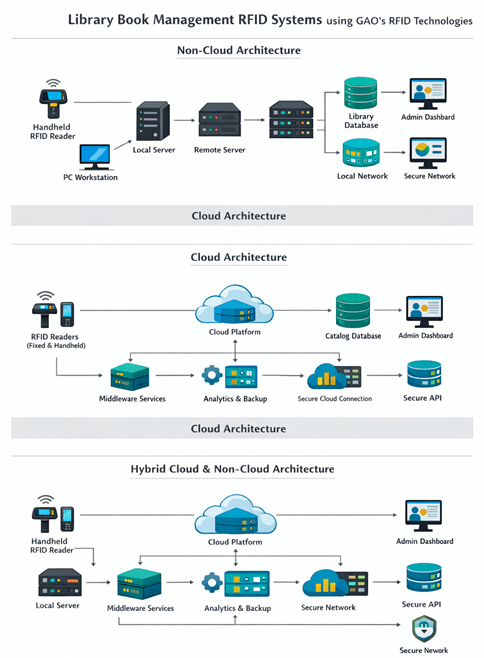
Operational value is delivered through faster check-in and check-out, reduced mis-shelving, improved collection accuracy, and stronger loss prevention. The system structure supports modular expansion for self-service kiosks, automated return conveyors, and security gates. Deployment flexibility is central to system design, with support for both cloud-based and non-cloud implementations, including software running on handheld computers, PCs, local servers, or remote servers. This flexibility allows libraries to align governance, compliance, latency, and cost controls with institutional IT policies while maintaining consistent catalog integrity and circulation performance.
Library Book Management RFID System Using GAO’s RFID Technologies: System Description, Purpose Issues Addressed, and Benefits Addressed
System Description
Library Book Management RFID Systems consist of an integrated stack combining physical identification, operational software, and governance controls. Each book is assigned a unique RFID credential linked to bibliographic and circulation records. Fixed and mobile readers capture transactions during lending, returns, shelving, and audits. Middleware orchestrates event validation, policy enforcement, and synchronization with library management systems. Administrative dashboards provide visibility into collection status, patron activity, and compliance metrics.
The system supports multi-branch environments, interlibrary loans, and differentiated access rights for librarians, circulation staff, auditors, and IT administrators. Design assumptions include high transaction volumes, mixed media formats, and coexistence with legacy integrated library systems.
Purposes of Implementing Library Book Management RFID Systems
- Automate circulation workflows while enforcing lending policies and patron entitlements
- Maintain accurate, continuously reconciled inventory records across stacks and branches
- Enable rapid audits, shelf verification, and exception management
- Support self-service operations without compromising security or data integrity
- Provide operational transparency for management, compliance, and procurement planning
Issues Addressed by RFID-Based Library Book Management
- Manual handling bottlenecks during peak circulation periods
- Inventory inaccuracies caused by mis-shelving, shrinkage, or delayed reconciliation
- Limited auditability of book movement and custody history
- High labor costs associated with repetitive circulation tasks
- Difficulty scaling services across distributed library networks
Benefits Delivered to Library Operations and Governance
- Accelerated circulation throughput with reduced staff intervention
- Improved collection accuracy and discoverability
- Stronger loss prevention through automated security enforcement
- Actionable analytics for acquisition planning and collection optimization
- Measurable reductions in operational overhead and error rates
System Architecture of Library Book Management RFID Systems Using RFID Technologies
Cloud Architecture Overview
Cloud-based Library Book Management RFID Systems centralize data processing, policy management, and analytics within a secured cloud environment. Field devices transmit encrypted transaction events to cloud ingestion services. Middleware layers normalize data, enforce validation rules, and synchronize records with catalog and patron databases. Cloud platforms handle scalability, redundancy, backup, and cross-branch coordination.
Security boundaries are defined through role-based access control, tenant isolation, and encrypted data storage. Operational responsibilities such as software updates, system monitoring, and disaster recovery are largely managed at the platform level. This architecture supports elastic scaling during peak academic terms and simplifies multi-location governance.
Non-Cloud Architecture Overview
Non-cloud Library Book Management RFID Systems deploy the same functional stack within controlled on-premises or privately hosted environments. Software may run directly on handheld computers for small collections, on PCs for circulation desks, on local servers for branch-level autonomy, or on remote servers hosted in private data centers. Data flow remains localized, with optional synchronization to external systems.
Operational responsibility for patching, backups, and capacity planning resides with the library or its system integrator. Security boundaries are enforced through network segmentation, local authentication services, and physical access controls. Non-cloud architectures address regulatory, latency, or institutional policy constraints while preserving RFID-driven automation.
Cloud vs Non-Cloud Comparison for Library Book Management RFID Systems
| Aspect | Cloud Deployment | Non-Cloud Deployment |
| Governance Model | Centralized policy and data governance | Localized or institution-controlled governance |
| Scalability | Elastic scaling across branches | Capacity defined by local infrastructure |
| IT Responsibility | Platform-managed updates and backups | Library-managed maintenance and recovery |
| Latency Control | Dependent on network connectivity | Deterministic local performance |
| Typical Scenarios | Multi-branch academic or public libraries | Archives, government libraries, restricted networks |
| Deployment Variants | Public or private cloud | Handheld, PC, local server, remote server |
Cloud Integration and Data Management
Cloud integration focuses on end-to-end data lifecycle governance rather than device operation. Transaction events are ingested through secured APIs, validated against circulation rules, and processed into normalized records. Data storage layers separate transactional logs, master catalog data, and analytical aggregates.
Analytics engines support trend analysis, utilization metrics, and anomaly detection. Integration interfaces synchronize data with external library management systems, ERP platforms, and reporting tools. Security controls include encryption at rest and in transit, audit logging, and access governance aligned with institutional compliance frameworks. Data retention and deletion policies are configurable to meet regulatory and archival requirements.
Major Components and Modules of the System Architecture
- RFID Credentials
RFID credentials embedded in books store unique identifiers linked to catalog records. Selection considerations include durability, memory capacity, and compatibility with existing workflows. Operational roles focus on lifecycle tracking rather than data storage.
- RFID Readers and Edge Devices
Readers capture identification events at circulation desks, self-service kiosks, and inventory points. Edge devices aggregate reads, perform preliminary validation, and buffer transactions during network interruptions.
- Middleware Services
Middleware enforces business logic, validates transactions, and mediates between readers and management systems. Constraints include throughput capacity and integration compatibility.
- Cloud Platforms and Local Servers
Platforms host application logic, databases, and analytics services. Selection depends on governance, scalability, and compliance requirements.
- Databases, Dashboards, and Reporting Tools
Databases maintain authoritative records, while dashboards provide operational visibility. Reporting tools support audits, procurement analysis, and compliance reviews.
RFID Technologies Used in Library Book Management Systems
- UHF RFID
UHF operates with longer read ranges and higher read rates. Operational characteristics include sensitivity to environmental factors and suitability for bulk scanning.
- HF RFID
HF provides moderate read ranges with stable performance around liquids and paper media. It supports reliable desk-based operations.
- NFC
NFC enables very short-range interactions, optimized for secure, intentional transactions. It aligns with user-facing interfaces.
- LF RFID
LF offers low read ranges with high tolerance to interference. It supports niche identification requirements.
Comparison of RFID Technologies for Library Book Management RFID Systems
| Technology | Typical Role in Library Systems | Selection Rationale |
| UHF | Rapid inventory and shelf scanning | High throughput requirements |
| HF | Circulation desks and staff workstations | Balanced performance and reliability |
| NFC | Patron-facing self-service points | Controlled, secure interactions |
| LF | Specialized collections | Environmental resilience |
Combining Multiple RFID Technologies
Combining RFID technologies is appropriate when operational zones have distinct performance requirements. Hybrid architectures allow UHF for inventory audits, HF for circulation control, and NFC for patron interfaces. Benefits include optimized performance per workflow and reduced bottlenecks. Trade-offs involve increased system complexity, integration overhead, and higher governance requirements. Careful architectural partitioning and middleware abstraction mitigate complexity risks.
Applications of Library Book Management RFID Systems
- Circulation desk automation supporting high-volume lending and returns with policy enforcement
- Self-service kiosks enabling patron-driven transactions under controlled authorization
- Mobile inventory audits conducted by librarians using handheld readers
- Shelf management workflows identifying mis-shelved or missing items
- Interlibrary loan tracking across distributed branches
- Automated return and sorting systems integrated with conveyor infrastructure
- Collection analytics supporting acquisition and deaccession decisions
- Security gate integration for loss prevention and alarm management
- Special collections handling with restricted access controls
- Compliance reporting for institutional audits and accreditation
Deployment Options and Organizational Considerations
Cloud Deployment Use Cases and Advantages
Cloud deployment suits organizations requiring centralized governance, rapid scaling, and cross-branch coordination. Advantages include reduced internal IT burden, standardized policy enforcement, and integrated analytics across locations.
Non-Cloud Deployment Use Cases and Advantages
Non-cloud deployment aligns with institutions facing regulatory restrictions, limited connectivity, or strict data residency requirements. Handheld and PC-based systems support small libraries, while local and remote servers address larger controlled environments.
GAO’s Role in Supporting Library Book Management RFID Systems
GAO supports Library Book Management RFID Systems through flexible architectures, deployment advisory, and long-term system support. With operations anchored in New York City and Toronto, GAO brings decades of experience serving universities, government agencies, and enterprise institutions across the U.S. and Canada. Investments in R&D, stringent quality assurance, and expert support enable libraries to deploy systems aligned with operational realities, compliance obligations, and long-term scalability requirements.
Case Studies of Cloud and Non-Cloud-Based Library Book Management RFID Systems Using RFID Technologies
United States Library Deployments
Academic Research Library Modernization in Boston, Massachusetts
- Problem
A large academic research library managing multi-million-volume collections faced recurring inventory drift, delayed circulation reconciliation, and audit challenges tied to grant-funded materials. Barcode-based processes created manual bottlenecks during semester transitions and limited visibility into real-time collection status.
- Solution
Cloud and Non-Cloud-Based Library Book Management RFID Systems using RFID technologies were deployed using HF RFID for circulation desks and UHF RFID for mobile inventory validation. Transaction processing software operated on a local server, while selected analytics synchronized to a cloud environment. GAO supported system architecture design, data governance alignment, and catalog integration.
- Result
Inventory accuracy increased from approximately 93 percent to 99.4 percent within six months.
- Lesson
Hybrid deployments improved audit performance but required formalized staff change control.
Citywide Public Library Network in Phoenix, Arizona
- Problem
A municipal library system with multiple branches experienced long queues, mis-shelved items, and rising labor costs during peak public usage periods. Branch-level IT resources were limited.
- Solution
The system was implemented in a cloud deployment using HF RFID at circulation counters and NFC-enabled self-service stations. Centralized policy management reduced local configuration overhead. GAO provided deployment planning and remote operational support.
- Result
Average check-out and check-in processing time decreased by 42 percent.
- Lesson
Network availability became a critical dependency for daily operations.
Government Records Library in Washington, District of Columbia
- Problem
A government records library required strict data residency, offline operation, and complete audit trails for sensitive materials. External cloud dependency was restricted by policy.
- Solution
A non-cloud deployment was implemented with software running on hardened PCs and a local server. HF RFID supported circulation control, while LF RFID was applied to archival items with environmental constraints. GAO assisted with security boundary definition and compliance validation.
- Result
Unauthorized material movement incidents were reduced to zero over a twelve-month period.
- Lesson
Local control improved compliance but increased internal maintenance responsibility.
University Medical Library in Cleveland, Ohio
- Problem
Clinical users required rapid access to reference materials, but circulation congestion and manual audits disrupted daily workflows.
- Solution
A hybrid architecture combined cloud-based analytics with non-cloud transaction processing on circulation PCs. HF RFID handled high-frequency desk activity, while UHF RFID enabled after-hours inventory scans. GAO advised on workflow optimization.
- Result
Peak-hour circulation throughput increased by 37 percent.
- Lesson
Separating analytics from transactions reduced latency during clinical peak usage.
Community College Library in Fresno, California
- Problem
A small IT team managed a growing collection with limited budget and inconsistent annual inventory reporting.
- Solution
Non-cloud software running on handheld computers was paired with HF RFID tagging. Data synchronization occurred periodically via secure exports. GAO supported future scalability planning.
- Result
Annual inventory audit time was reduced by 55 percent.
- Lesson
Handheld-only deployments limited real-time oversight but simplified operations.
Legal Reference Library in Chicago, Illinois
- Problem
High-value legal volumes required precise custody records and traceable circulation histories for compliance purposes.
- Solution
HF RFID circulation was deployed with management software hosted on a remote private server. Cloud synchronization was disabled. GAO supported audit configuration and access control design.
- Result
Chain-of-custody documentation reached 100 percent completeness.
- Lesson
Remote servers balanced control with centralized management complexity.
State University Main Library in Austin, Texas
- Problem
Frequent mis-shelving across open stacks reduced item availability and increased staff workload.
- Solution
UHF RFID inventory scanning was combined with cloud-managed analytics, while circulation remained on local PCs. GAO assisted with tag placement standards.
- Result
Mis-shelving incidents declined by 61 percent.
- Lesson
Inventory efficiency depended on disciplined tagging practices.
Urban Public Library in New York City, New York
- Problem
High daily circulation volumes caused staff fatigue and service delays during peak hours.
- Solution
Cloud-based Library Book Management RFID Systems using RFID technologies integrated HF RFID desks with NFC self-service kiosks. GAO supported performance benchmarking and rollout.
- Result
Self-service transactions accounted for 48 percent of total circulation activity.
- Lesson
Patron education directly influenced kiosk adoption rates.
Private University Archive in Palo Alto, California
- Problem
Restricted archival collections required minimal RF interference and detailed access logging.
- Solution
LF RFID was deployed with non-cloud software hosted on a local server. GAO supported compliance documentation and access governance.
- Result
Access audit discrepancies were eliminated.
- Lesson
Lower-frequency systems traded speed for environmental stability.
Regional Library Consortium in Denver, Colorado
- Problem
Interlibrary loan delays resulted from inconsistent tracking standards across member libraries.
- Solution
Cloud-coordinated RFID management standardized HF RFID circulation policies across institutions. GAO assisted with integration governance.
- Result
Interlibrary transfer cycle time improved by 33 percent.
- Lesson
Operational standardization was required before technical integration.
Technical Institute Library in Raleigh, North Carolina
- Problem
Engineering and lab-use collections experienced frequent inventory mismatches.
- Solution
Hybrid deployment used HF RFID circulation and UHF RFID handheld audits with software on a local server. GAO supported configuration and training.
- Result
Inventory discrepancies declined by 58 percent.
- Lesson
Staff training consistency affected data quality outcomes.
Corporate Research Library in San Jose, California
- Problem
Restricted-access research materials required rapid audits without external data exposure.
- Solution
Non-cloud deployment on a remote server combined with UHF RFID audits met internal security policies. GAO supported system hardening.
- Result
Audit completion time decreased by 46 percent.
- Lesson
Remote hosting required robust secure connectivity planning.
Law School Library in Philadelphia, Pennsylvania
- Problem
Manual circulation reporting conflicted with accreditation audit requirements.
- Solution
Cloud analytics were combined with HF RFID circulation on PCs. GAO assisted with report alignment.
- Result
Accreditation audit preparation time was reduced by 40 percent.
- Lesson
Analytics alignment outweighed raw transaction volume.
Historical Society Library in Savannah, Georgia
- Problem
Fragile historical collections required low-handling inventory processes.
- Solution
HF RFID with handheld non-cloud software enabled non-intrusive audits. GAO supported process design.
- Result
Physical handling incidents decreased by 52 percent.
- Lesson
Operational discipline proved more critical than system complexity.
Canadian Library Deployments
Provincial University Library in Toronto, Ontario
- Problem
Distributed faculties applied inconsistent circulation policies and reporting standards.
- Solution
Cloud-managed Library Book Management RFID Systems using RFID technologies unified HF RFID circulation governance. GAO supported policy harmonization.
- Result
Cross-faculty reporting accuracy reached 99 percent.
- Lesson
Policy alignment preceded technical success.
Municipal Library System in Vancouver, British Columbia
- Problem
High visitor volumes strained circulation staffing capacity.
- Solution
NFC self-service was integrated with HF RFID desks under a cloud deployment. GAO supported load testing.
- Result
Staff-assisted transactions declined by 35 percent.
- Lesson
User interface design influenced adoption rates.
Research Institute Library in Montreal, Quebec
- Problem
Bilingual reporting requirements complicated inventory governance.
- Solution
Cloud analytics were paired with PC-based non-cloud circulation software. GAO supported configuration management.
- Result
Language-based reporting discrepancies were eliminated.
- Lesson
Configuration flexibility outweighed feature breadth.
Government Training Library in Ottawa, Ontario
- Problem
Security policies restricted external data transmission.
- Solution
Non-cloud deployment on a local server with HF RFID circulation met compliance requirements. GAO supported security validation.
- Result
Data handling compliance exceptions were reduced to zero.
- Lesson
Local control increased operational accountability.
Polytechnic Institute Library in Calgary, Alberta
- Problem
Rapid collection growth outpaced manual inventory processes.
- Solution
Hybrid deployment combined UHF RFID inventory audits with cloud-based analytics and local circulation PCs. GAO supported scaling strategy.
- Result
Annual inventory cycle time improved by 49 percent.
- Lesson
Early growth planning reduced future integration complexity.
Our products and systems have been developed and deployed for a wide range of industrial applications. They are available off-the-shelf or can be customized to meet your needs. If you have any questions, our technical experts can help you.
For any further information on GAO’s products and systems, to request evaluation kits, free samples, recorded video demos, or explore partnership opportunities, please fill out this form or email us.