
Overview of GAO’s Cycle Counting Systems Using RFID Technologies
RFID cycle counting systems enable continuous, automated inventory verification across warehouses, manufacturing floors, distribution centers, and regulated facilities. These systems use RFID technologies to capture item-level identification data without line-of-sight scanning, supporting frequent counts without disrupting operational workflows. Cycle counting platforms replace manual inventory audits with structured, repeatable processes that improve data accuracy, shrinkage control, and reconciliation discipline across physical and digital records.
RFID-based cycle counting solutions are architected to support diverse enterprise environments, ranging from cloud-connected multi-site operations to fully isolated non-cloud deployments. System logic can operate on handheld computers, industrial PCs, local servers, or remote private servers depending on governance, latency, and compliance requirements. Data collected through RFID readers is normalized, validated, and reconciled against inventory systems, ERP platforms, or warehouse management systems. The system structure supports role-based workflows for operators, supervisors, auditors, and compliance teams while maintaining traceability and audit readiness. Multiple deployment models allow organizations to balance scalability, data sovereignty, and operational autonomy without compromising count integrity.
What System, Purposes Addressed, Benefits Delivered To RFID Cycle Counting Systems Are Designed to Do
System Description
RFID cycle counting systems are structured inventory verification platforms designed to perform partial, high-frequency inventory counts across defined asset segments. The system orchestrates RFID readers, edge processing logic, inventory rules engines, and reporting layers to ensure continuous alignment between physical stock and system records. The solution supports serialized items, lot-controlled materials, returnable transport items, and fixed assets across operational zones.
The system operates within active work environments such as warehouses, production cells, tool cribs, retail backrooms, cold storage facilities, and secured government facilities. Operators interact with the system through handheld terminals or workstations while supervisors monitor variance trends, exception queues, and reconciliation status through dashboards. Procurement and finance teams rely on system outputs to validate stock positions and valuation accuracy.
Purposes Addressed by the System
RFID cycle counting systems are implemented to address structural inventory challenges including:
- Inventory record inaccuracy caused by manual scanning delays and missed transactions
- Labor-intensive annual or quarterly physical counts disrupting operations
- Shrinkage, misplacement, and unauthorized material movement
- Lack of audit traceability for regulated industries
- Delayed discrepancy resolution between ERP and physical stock
Benefits Delivered to Enterprise Operations
Key operational and governance benefits include:
- Continuous inventory accuracy without operational shutdowns
- Reduced dependency on full physical inventory counts
- Faster variance identification and root cause analysis
- Improved compliance posture for internal and external audits
- Predictable labor utilization for inventory control teams
System Architecture of Cycle Counting Systems Using RFID Technologies
Cloud-Based Architecture
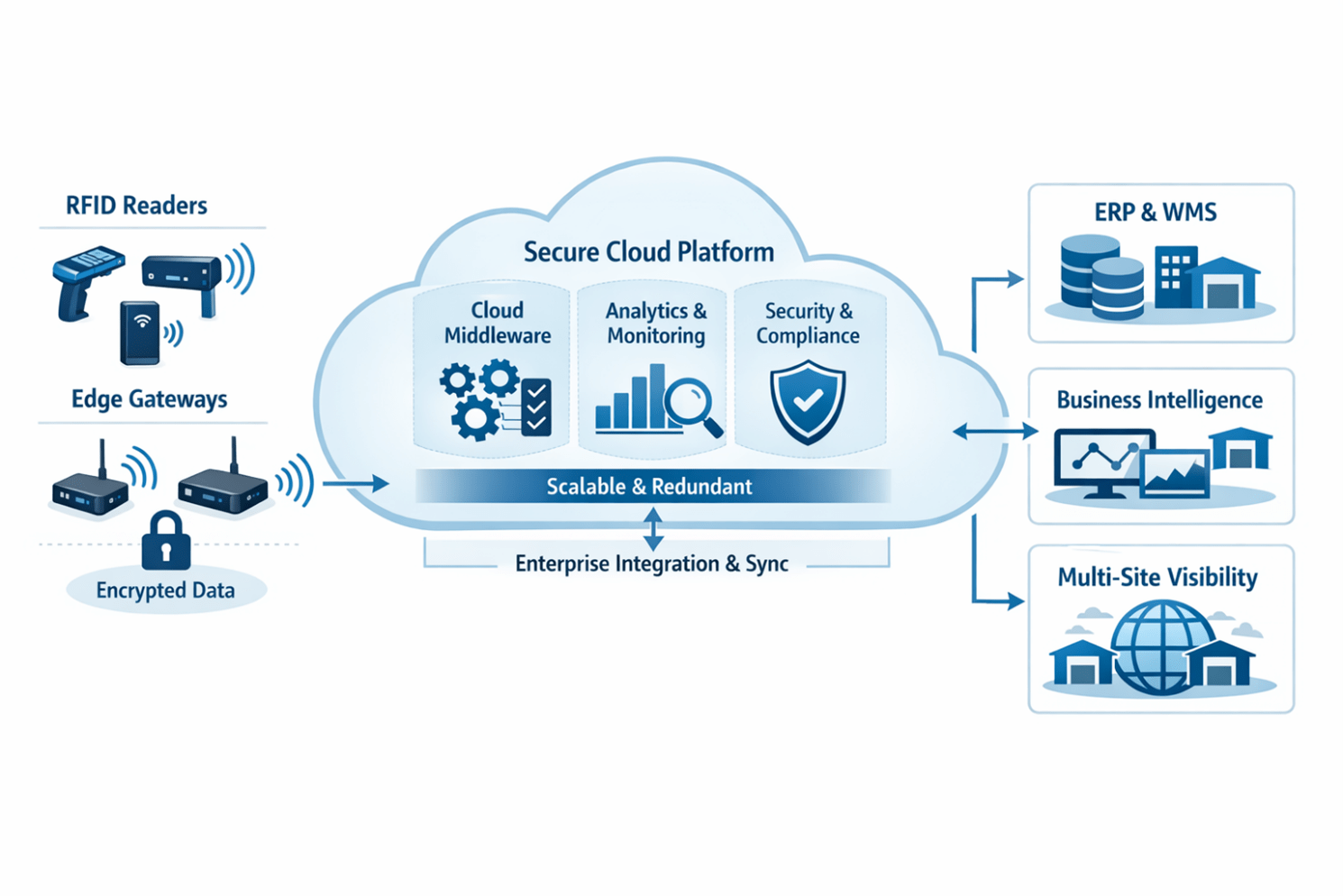
Cloud-based RFID cycle counting architectures centralize inventory logic, analytics, and governance layers in a secure cloud environment. RFID readers and edge devices transmit validated read events to cloud services through encrypted channels. Cloud-hosted middleware processes event streams, applies business rules, and synchronizes inventory states with enterprise systems.
Operational responsibilities such as system updates, scaling, redundancy, and analytics processing are centralized. Security boundaries are defined through identity federation, role-based access control, and network segmentation. Cloud architectures support multi-site visibility, cross-facility benchmarking, and centralized compliance oversight. Elastic scalability allows expansion across warehouses or regions without local infrastructure growth.
Non-Cloud Architecture
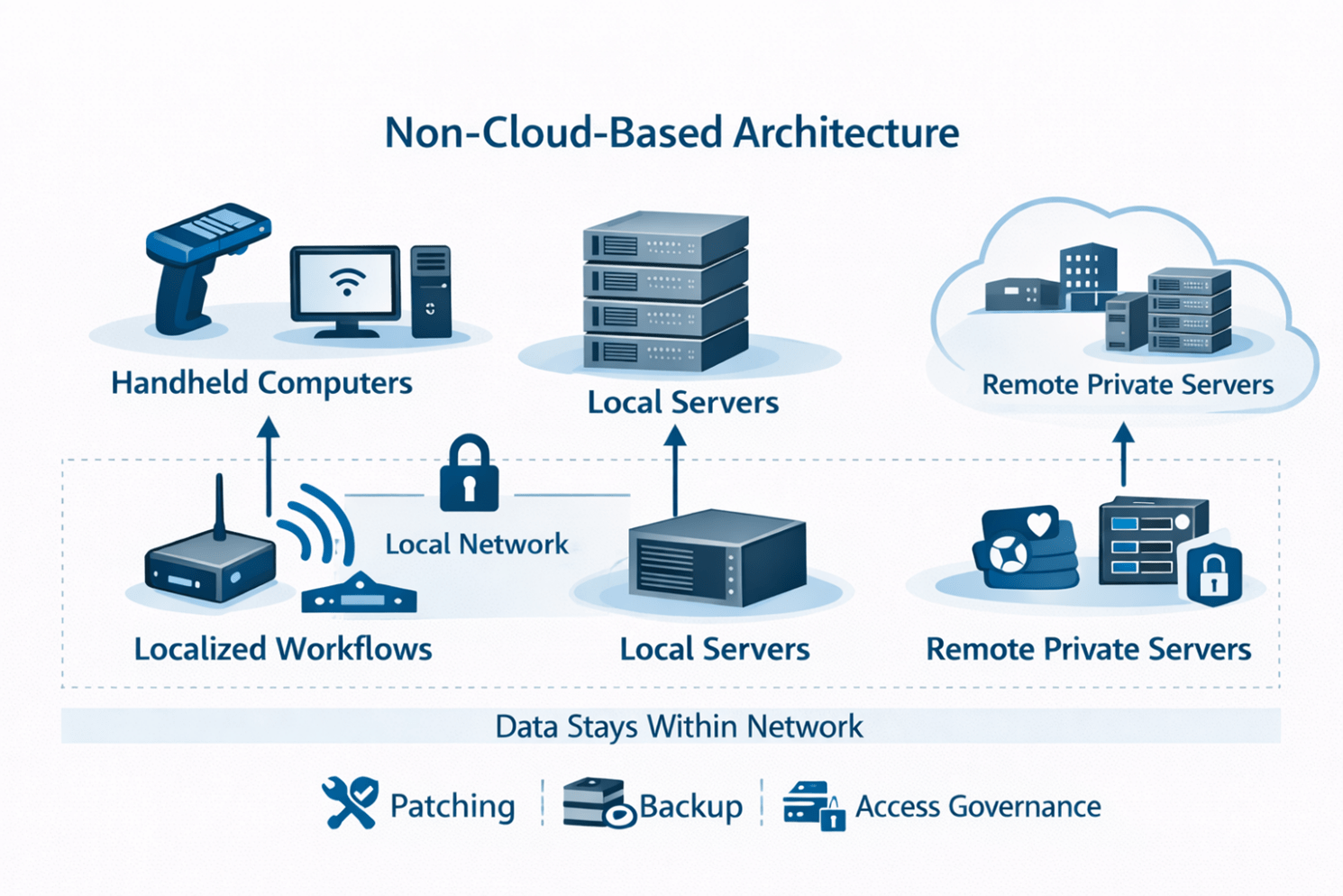
Non-cloud RFID cycle counting architectures are deployed where data sovereignty, latency control, or operational independence is required. Software can run directly on handheld computers for localized counting workflows, on PCs for departmental inventory control, on local servers for facility-wide operations, or on remote private servers managed by the organization.
Data flow remains within defined network boundaries, reducing external exposure. Security responsibilities shift to internal IT teams, including patching, backup, and access governance. Scalability depends on local compute capacity and network design. These architectures are commonly used in defense facilities, regulated manufacturing, or sites with intermittent connectivity.
Cloud vs Non-Cloud RFID Cycle Counting System Comparison
| Decision Dimension | Cloud-Based RFID Cycle Counting Systems | Non-Cloud RFID Cycle Counting Systems |
| Deployment Scope | Multi-site, distributed operations | Single site or tightly controlled environments |
| Infrastructure Ownership | Cloud-managed platforms | Enterprise-managed hardware and software |
| Data Governance | Centralized policies and monitoring | Localized control and isolated data domains |
| Scalability Model | Elastic scaling across facilities | Capacity planning per site or server |
| Typical Use Scenarios | Retail chains, logistics networks, global manufacturers | Defense sites, regulated plants, offline operations |
| Handheld-Based Use | Used as edge data collection devices | Can operate as primary system logic |
| Local Server Use | Optional caching or gateway role | Core processing and storage platform |
| Remote Server Use | Cloud-hosted | Private data center or co-location facility |
Cloud Integration and Data Management for RFID Cycle Counting Systems
Cloud integration within RFID cycle counting systems focuses on structured data lifecycle governance rather than hardware orchestration. RFID read events are ingested through secure APIs or message brokers and normalized into inventory transaction records. Data processing layers apply validation rules, duplicate suppression, and temporal correlation to ensure transactional accuracy.
Storage layers maintain historical inventory snapshots, variance logs, and audit trails aligned with retention policies. Analytics engines generate reconciliation metrics, count accuracy trends, and exception alerts for operational teams. Integration services synchronize inventory states with ERP, WMS, and financial systems using standardized interfaces.
Security controls include encryption at rest and in transit, identity-based access, segregation of duties, and compliance logging. Access governance ensures that operators, auditors, and administrators view only authorized data sets, supporting regulatory and internal audit requirements.
Major Components of RFID Cycle Counting System Architecture
- RFID Credentials
RFID credentials represent the tagged identifiers associated with inventory items, containers, or assets. Selection depends on memory structure, encoding standards, environmental durability, and lifecycle requirements. Credentials must support reliable read consistency across repeated count cycles.
- RFID Readers
Readers capture tag data during count activities. Fixed, handheld, or vehicle-mounted readers are selected based on coverage requirements, read density, and operational constraints. Reader configuration impacts read accuracy, collision handling, and data volume.
- Edge Devices
Edge devices aggregate read events, apply preliminary filtering, and manage connectivity to backend systems. Constraints include processing capacity, power availability, and network reliability. Edge logic reduces unnecessary data transmission and improves response time.
- Middleware Layer
Middleware coordinates reader management, event processing, rule execution, and system integration. Selection considerations include protocol support, extensibility, and operational transparency for IT teams.
- Cloud Platforms or Local Servers
These platforms host inventory logic, data repositories, and analytics engines. Selection depends on governance, scalability, and operational autonomy requirements.
- Databases
Databases store inventory states, transaction logs, and audit records. Design considerations include consistency models, retention policies, and reporting workloads.
- Dashboards and Reporting Tools
These interfaces provide operational visibility for supervisors, auditors, and executives. Reporting tools must support drill-down analysis, export controls, and role-based access.
RFID Technologies Used in RFID Cycle Counting Systems
- UHF RFID
UHF RFID operates at longer read ranges and supports high tag population environments. Performance characteristics include rapid read rates, sensitivity to environmental interference, and directional antenna requirements.
- HF RFID
HF RFID operates at shorter ranges with predictable coupling behavior. Operational characteristics include stable performance near liquids and metals with controlled read zones.
- NFC
NFC operates at very short ranges and supports intentional, user-initiated interactions. Characteristics include secure peer-to-peer communication and low read ambiguity.
- LF RFID
LF RFID offers low sensitivity to environmental interference with limited data rates. Operational characteristics include stable performance in harsh industrial environments with constrained read distances.
RFID Technology Comparison for RFID Cycle Counting Systems
| RFID Technology | Role in RFID Cycle Counting Systems | Selection Considerations |
| UHF | High-volume inventory sweeps | Facility size, tag density, RF environment |
| HF | Controlled count zones | Precision requirements, interference tolerance |
| NFC | Operator-verified counts | User interaction, security validation |
| LF | Harsh industrial counts | Environmental stability, read consistency |
Combining Multiple RFID Technologies in One System
Combining multiple RFID technologies within a single cycle counting system is appropriate when operational zones exhibit distinct environmental and control requirements. Architectural benefits include optimized read reliability across varied assets and workflows. Trade-offs include increased integration complexity, tag management overhead, and system configuration effort. Governance models must address data normalization across heterogeneous read sources to avoid reconciliation conflicts.
Applications of Cycle Counting Systems Using RFID Technologies
- Manufacturing Work-in-Process Inventory
Cycle counting across production lines tracks component consumption, buffer stock levels, and line-side material availability without halting assembly operations.
- Warehouse Pallet and Case Inventory
Routine counts of palletized and case-level inventory improve slotting accuracy and outbound fulfillment readiness.
- Tool Crib Asset Control
Serialized tool tracking ensures availability, calibration compliance, and loss prevention within maintenance environments.
- Retail Backroom Inventory
Frequent cycle counts support replenishment accuracy and reduce shelf stockouts without disrupting store operations.
- Cold Chain Storage Facilities
Inventory verification in temperature-controlled zones supports compliance documentation and spoilage prevention.
- Government Asset Accountability
Secure facilities use cycle counting to maintain chain-of-custody and audit traceability for controlled assets.
- Healthcare Supply Rooms
Automated counts of medical supplies support restocking discipline and usage tracking under regulatory oversight.
- Data Center Equipment Tracking
Cycle counting validates server, network, and spare part inventories across racks and cages.
- Construction Material Staging Areas
Material verification reduces project delays caused by misplaced or unaccounted inventory.
- Aerospace Component Management
Serialized part tracking ensures configuration control and regulatory compliance throughout maintenance cycles.
Deployment Options for RFID Cycle Counting Systems
- Cloud Deployment Use Cases and Advantages
Cloud deployments are selected by organizations seeking centralized visibility, rapid scalability, and simplified system governance. Enterprises with multiple facilities benefit from unified inventory oversight and standardized counting policies. Regulatory environments permitting external data processing enable cloud adoption.
- Non-Cloud Deployment Use Cases and Advantages
Non-cloud deployments are chosen when regulatory mandates require data isolation or when operational continuity must be maintained without external connectivity. Handheld-based deployments suit mobile teams, PC-based systems support departmental control, local servers enable site autonomy, and remote private servers balance control with centralized management.
Case Studies of Cycle Counting Systems Using RFID Technologies
U.S. Case Studies
Distribution Center Inventory Reconciliation in Chicago, Illinois
- Problem
A regional distribution center experienced recurring inventory variances between its warehouse management system and physical stock. Manual cycle counts were limited to quarterly schedules, causing delayed discrepancy detection and audit pressure during peak seasons.
- Solution
GAO supported deployment of Cycle Counting Systems Using RFID technologies with UHF tags and fixed readers. A cloud-based deployment centralized inventory intelligence across shifts, while handheld computers running non-cloud software were used for targeted exception counts in dense racking zones.
- Result
Inventory record accuracy improved from 92 percent to 99.3 percent within six months.
Lesson or Trade-off
Higher read density required RF power calibration to avoid duplicate reads in narrow aisles.
Manufacturing Work-in-Process Tracking in Detroit, Michigan
- Problem
An automotive component manufacturer struggled to maintain accurate work-in-process inventory across multiple production cells. Barcode-based scans were often skipped during shift transitions.
- Solution
Cycle Counting Systems Using RFID technologies were implemented using HF tags on bins and handheld readers. A non-cloud architecture running on a local server ensured low latency and compliance with internal IT controls. GAO assisted with workflow validation.
- Result
Unaccounted WIP inventory was reduced by 37 percent over two quarters.
Lesson or Trade-off
Local processing improved responsiveness, though expansion to additional plants required server replication.
Retail Backroom Stock Control in Phoenix, Arizona
- Problem
Retail operations faced mismatches between point-of-sale inventory data and actual backroom stock, leading to replenishment errors.
- Solution
GAO helped deploy Cycle Counting Systems Using RFID technologies with UHF tagging and handheld readers. A cloud deployment aggregated inventory data across locations, while handheld devices operated offline when connectivity was unavailable.
- Result
Stock availability accuracy increased by 28 percent across participating stores.
Lesson or Trade-off
Operational consistency depended on disciplined handheld scanning routines.
Pharmaceutical Warehouse Compliance in New Brunswick, New Jersey
- Problem
Regulated pharmaceutical storage required frequent inventory verification with documented audit trails. Manual processes created compliance exposure.
- Solution
Cycle Counting Systems Using RFID technologies were deployed using HF tags and fixed readers. A remote private server hosted the non-cloud software to align with validation and data retention requirements. GAO supported audit reporting setup.
- Result
Audit preparation time was reduced by 45 percent year over year.
Lesson or Trade-off
Compliance was strengthened, though analytics expansion required additional compute planning.
Aerospace Parts Inventory in Seattle, Washington
- Problem
Serialized aerospace components stored across secured zones were difficult to reconcile due to limited visibility and access controls.
- Solution
GAO supported Cycle Counting Systems Using RFID technologies combining UHF for bulk storage and NFC at controlled issue points. A hybrid model used cloud analytics with localized edge processing.
- Result
Inventory reconciliation discrepancies declined by 31 percent within one fiscal year.
Lesson or Trade-off
Multi-technology architecture improved control but increased configuration complexity.
Tool Crib Asset Management in Houston, Texas
- Problem
Maintenance teams experienced frequent tool shortages despite system records showing adequate inventory.
- Solution
Cycle Counting Systems Using RFID technologies were deployed using LF tags for metal tools and handheld readers. Non-cloud software operated directly on handheld computers due to site network restrictions.
- Result
Tool loss incidents dropped by 42 percent over nine months.
Lesson or Trade-off
Handheld-only deployment simplified governance but limited long-term analytics.
Food Distribution Cold Storage in Minneapolis, Minnesota
- Problem
Inventory counts in temperature-controlled storage were inconsistent due to harsh environmental conditions affecting manual scans.
- Solution
GAO assisted with Cycle Counting Systems Using RFID technologies using cold-rated UHF tags. Cloud deployment centralized reporting, while local PCs handled on-site validation tasks.
- Result
Inventory count accuracy improved by 34 percent during seasonal peaks.
Lesson or Trade-off
Environmental qualification increased upfront testing requirements.
Government Asset Accountability in Arlington, Virginia
- Problem
Controlled assets required verifiable accountability within a restricted connectivity environment.
- Solution
Cycle Counting Systems Using RFID technologies were deployed with HF tags and readers. A non-cloud architecture running on a local server ensured data isolation. GAO provided system hardening guidance.
- Result
Inventory-related audit findings decreased by 52 percent.
Lesson or Trade-off
Data isolation improved security, though centralized analytics were limited.
Electronics Manufacturing Inventory in San Jose, California
- Problem
Rapid component turnover created frequent mismatches between ERP inventory and physical stock.
- Solution
GAO supported Cycle Counting Systems Using RFID technologies with UHF tags and fixed readers. A cloud-based deployment enabled near real-time synchronization with production systems.
- Result
Inventory adjustment transactions were reduced by 39 percent.
Lesson or Trade-off
API governance was required to maintain data integrity across systems.
Construction Material Staging in Denver, Colorado
- Problem
Materials staged across temporary yards were frequently misplaced, impacting project timelines.
- Solution
Cycle Counting Systems Using RFID technologies were implemented using UHF tags and handheld readers. Non-cloud software ran on PCs at site offices to support intermittent connectivity.
- Result
Material availability delays decreased by 26 percent per project cycle.
Lesson or Trade-off
Offline operation improved resilience but required scheduled data synchronization.
Healthcare Supply Room Management in Boston, Massachusetts
- Problem
Clinical teams reported inconsistent availability of essential supplies despite replenishment schedules.
- Solution
GAO assisted with Cycle Counting Systems Using RFID technologies using HF tags and handheld scanners. A cloud deployment supported centralized oversight across departments.
- Result
Stockout incidents declined by 33 percent within eight months.
Lesson or Trade-off
Role-based access design was critical to maintain data privacy.
Data Center Equipment Inventory in Ashburn, Virginia
- Problem
Frequent hardware relocations caused incomplete asset records across multiple data halls.
- Solution
Cycle Counting Systems Using RFID technologies were deployed using UHF tags and fixed readers. A remote server hosted non-cloud software aligned with internal security policies.
- Result
Unverified equipment records were reduced by 41 percent annually.
Lesson or Trade-off
Remote hosting balanced control and oversight but required network monitoring.
Apparel Distribution Facility in Los Angeles, California
- Problem
High SKU volumes caused cycle counts to lag behind inventory turnover.
- Solution
GAO supported Cycle Counting Systems Using RFID technologies with UHF tagging and cloud-based analytics. Handheld readers were used for targeted exception counts.
- Result
Cycle count completion rates increased by 48 percent.
Lesson or Trade-off
Zone configuration discipline was necessary to maintain accuracy.
Energy Sector Spare Parts Inventory in Tulsa, Oklahoma
- Problem
Spare parts distributed across depots were difficult to reconcile, affecting maintenance schedules.
- Solution
Cycle Counting Systems Using RFID technologies were deployed using LF tags and handheld devices. Non-cloud software operated on local servers due to regulatory constraints.
- Result
Maintenance delays related to inventory issues declined by 29 percent.
Lesson or Trade-off
LF stability improved reliability, though read range limited count speed.
Canadian Case Studies for RFID Cycle Counting System Using RFID Technologies
Manufacturing Inventory Control in Toronto, Ontario
- Problem
A multi-line manufacturing facility experienced recurring discrepancies in component inventory affecting production planning.
- Solution
GAO supported Cycle Counting Systems Using RFID technologies with UHF tags and cloud-based analytics. Edge devices handled on-site validation to reduce network dependency.
- Result
Inventory accuracy improved by 35 percent within two quarters.
Lesson or Trade-off
Network redundancy planning was required to support cloud connectivity.
Logistics Hub Operations in Mississauga, Ontario
- Problem
High-throughput logistics operations struggled to maintain accurate pallet counts during peak shipping windows.
- Solution
Cycle Counting Systems Using RFID technologies were deployed using UHF readers and handheld devices. Non-cloud software operated on local servers for consistent performance.
- Result
Pallet count discrepancies were reduced by 31 percent year over year.
Lesson or Trade-off
Local processing reduced latency but limited cross-site benchmarking.
Government Facility Asset Tracking in Ottawa, Ontario
- Problem
Strict data residency requirements restricted use of externally hosted systems.
- Solution
GAO assisted with Cycle Counting Systems Using RFID technologies using HF tags and a fully non-cloud architecture hosted on a remote private server.
- Result
Audit reconciliation effort decreased by 44 percent.
Lesson or Trade-off
Compliance was achieved, though analytics customization required internal IT effort.
Cold Storage Distribution in Winnipeg, Manitoba
- Problem
Seasonal inventory fluctuations challenged accurate cycle counting in cold environments.
- Solution
Cycle Counting Systems Using RFID technologies were deployed with UHF tags rated for low temperatures. Cloud analytics supported trend analysis, while PCs managed on-site operations.
- Result
Seasonal inventory variance dropped by 27 percent.
Lesson or Trade-off
Extended qualification testing increased deployment timelines.
University Research Asset Management in Vancouver, British Columbia
- Problem
Shared research equipment lacked consistent inventory verification across laboratories.
- Solution
GAO supported Cycle Counting Systems Using RFID technologies using NFC and HF tags. Software operated on PCs with scheduled cloud synchronization for reporting.
- Result
Untracked asset incidents declined by 38 percent within one academic year.
Lesson or Trade-off
Hybrid synchronization required governance to avoid data latency issues.
Our products and systems have been developed and deployed for a wide range of industrial applications. They are available off-the-shelf or can be customized to meet your needs. If you have any questions, our technical experts can help you.
For any further information on GAO’s products and systems, to request evaluation kits, free samples, recorded video demos, or explore partnership opportunities, please fill out this form or email us.