
Overview of GAO’s RFID- Based RFID Duty-Free Inventory Systems
RFID Duty-Free Inventory systems are purpose-built inventory control and asset visibility platforms designed to address the regulatory, operational, and shrinkage risks inherent in duty-free retail environments. These inventory management systems rely on RFID technologies to establish item-level traceability, automated reconciliation, and controlled stock movement across bonded warehouses, airport retail zones, and point-of-sale handoff locations.
The RFID Duty-Free Inventory structure integrates identification layers, data capture infrastructure, and inventory intelligence software to maintain continuous inventory awareness under customs supervision. Support for both cloud and non-cloud deployment models allows organizations to align the system with regulatory jurisdictions, latency constraints, and data residency requirements. Non-cloud implementations can operate fully offline on handheld computers, PCs, or servers located within secure airport or customs-controlled facilities, while cloud-enabled versions provide centralized oversight across multiple international locations.
RFID-based duty-free inventory control improves inventory accuracy, reduces manual audits, and enforces chain-of-custody controls without introducing operational friction for warehouse staff, store associates, or compliance teams.
Description, Purpose, Issues Addressed and Benefits of GAO’s RFID-Enabled RFID Duty-Free Inventory System
System Description
RFID Duty-Free Inventory is a controlled inventory management and compliance system engineered for bonded retail operations operating under customs and excise regulations. The system applies RFID technologies to uniquely identify, track, and reconcile duty-free merchandise throughout inbound receipt, bonded storage, retail display, and final sale or export release.
The system architecture supports multiple operating environments including airside retail, bonded warehouses, free trade zones, cruise terminals, and cross-border duty-free outlets. Inventory data is continuously validated against regulatory constraints, authorized movement rules, and transactional records generated by POS and customs declaration systems.
Operational and Regulatory Challenges Addressed
- Manual inventory counts introducing compliance exposure
- Shrinkage and diversion risk in bonded inventory zones
- Limited real-time visibility across distributed duty-free locations
- Audit complexity under customs and excise authorities
- Inventory reconciliation gaps between warehouse, store, and POS systems
- Restricted IT environments requiring offline or air-gapped operation
Business and Technical Benefits
- Near real-time item-level inventory accuracy
- Reduced compliance audit effort and reporting latency
- Controlled chain-of-custody across bonded movements
- Faster cycle counts with minimal staff disruption
- Deployment flexibility aligned with customs, airport, and enterprise IT policies
System Architecture Overview for RFID Duty-Free Inventory
Recommended Diagram Placement
System-level architecture diagram showing RFID capture layer, edge processing, inventory logic, and data governance boundaries.
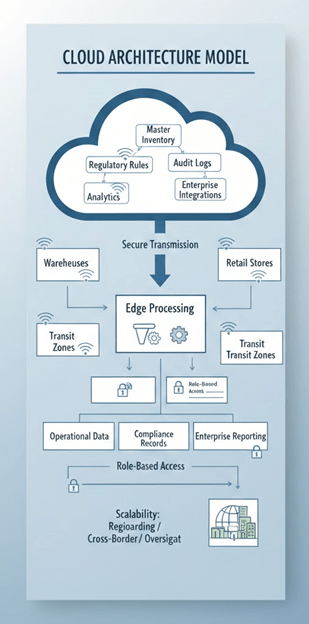
Cloud Architecture Model
The cloud-based RFID Duty-Free Inventory architecture centralizes inventory intelligence and governance across multiple locations. RFID events generated at warehouses, retail stores, and transit zones are filtered and normalized at the edge before secure transmission to centralized cloud services.
The cloud layer manages master inventory records, regulatory rule enforcement, historical audit logs, analytics engines, and enterprise integrations. Data ownership boundaries are clearly segmented between operational inventory data, compliance records, and enterprise reporting datasets. Role-based access controls restrict visibility across operational teams, compliance officers, and procurement stakeholders.
Scalability is managed through logical partitioning by region, customs authority, or operating entity. Cloud deployment supports rapid onboarding of new duty-free locations and cross-border inventory oversight.
Non-Cloud Architecture Models
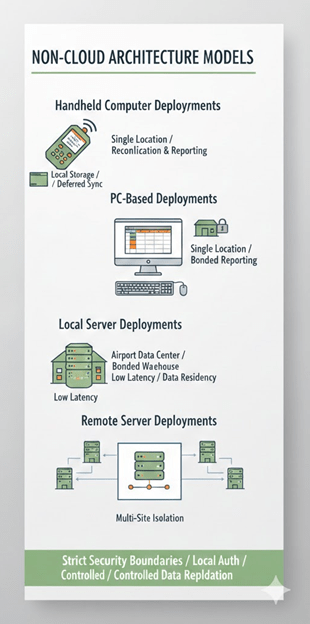
Non-cloud RFID Duty-Free Inventory deployments operate entirely within controlled environments where connectivity, sovereignty, or regulatory mandates restrict cloud usage.
Handheld computer deployments support mobile inventory operations such as cycle counting, spot audits, and inbound receipt verification with local storage and deferred synchronization.
PC-based deployments support single-location duty-free stores requiring workstation-based inventory reconciliation and reporting.
Local server deployments centralize inventory processing within airport data centers or bonded warehouse facilities, maintaining low latency and direct control over data residency.
Remote server deployments support centralized non-cloud operations across multiple sites while maintaining isolation from public cloud infrastructure.
Each non-cloud model defines strict security boundaries, local authentication controls, and controlled data replication policies.
Cloud vs Non-Cloud Deployment Comparison for RFID Duty-Free Inventory
| Decision Criteria | Cloud-Based RFID Duty-Free Inventory | Non-Cloud RFID Duty-Free Inventory |
| Regulatory Flexibility | Supports multi-jurisdiction oversight | Aligned with strict local customs mandates |
| Connectivity Dependency | Requires reliable secure connectivity | Operates fully offline or air-gapped |
| Multi-Site Operations | Centralized global inventory visibility | Site-specific or regionally centralized |
| IT Governance | Shared responsibility model | Full internal control |
| Typical Use Scenarios | International airport groups, cruise operators | Single airports, high-security zones |
| Platform Footprint | Cloud platforms managed by GAO | Handheld, PC, local or remote servers |
Cloud Integration and Data Management for RFID Duty-Free Inventory
RFID Duty-Free Inventory cloud integration focuses on controlled data lifecycle management rather than hardware interaction. Inventory events are ingested through secured APIs or message queues after edge validation. Processing layers apply business rules, customs constraints, and inventory state transitions.
Data storage is segmented into operational databases, immutable audit repositories, and analytical datasets. Retention policies align with customs audit requirements and corporate compliance standards. Encryption at rest and in transit protects sensitive inventory and transaction records.
Analytics services generate inventory accuracy metrics, shrinkage indicators, and compliance readiness dashboards. Integration endpoints support ERP, POS, customs declaration, and financial systems under strict access governance models. Identity and access management enforces least-privilege principles across internal teams, regulators, and auditors.
Major Components of RFID Duty-Free Inventory Architecture
- RFID Credentials
Encodes unique item identity and compliance attributes. Selection considers memory structure, tamper resistance, and lifecycle durability.
- RFID Readers
Capture inventory movement events. Constraints include read accuracy, environmental interference tolerance, and regulatory frequency compliance.
- Edge Devices
Aggregate and filter RFID events. Responsible for local validation, buffering, and rule enforcement under constrained connectivity.
- Middleware
Translates raw RFID reads into inventory transactions. Selection emphasizes extensibility, exception handling, and system interoperability.
- Cloud Platforms
Host centralized inventory intelligence, compliance logic, and analytics. Considerations include data sovereignty, scalability, and access control.
- Local and Remote Servers
Provide non-cloud processing and storage. Focus areas include uptime, physical security, and disaster recovery.
- Databases
Store inventory states, transaction histories, and audit logs. Selection prioritizes consistency, traceability, and retention management.
- Dashboards and Reporting Tools
Present inventory status, compliance indicators, and operational KPIs. Constraints include role-based visibility and regulatory reporting formats.
RFID Technology Characteristics Relevant to Duty-Free Inventory
- UHF RFID
Supports long read ranges and high tag density. Sensitive to environmental conditions and requires careful tuning in metallic retail environments.
- HF RFID
Operates at shorter ranges with improved performance near liquids. Offers predictable read zones suitable for controlled handover points.
- NFC
Enables very short-range interactions. Provides deterministic reads and supports secure operator-driven verification workflows.
- LF RFID
Offers minimal interference susceptibility. Limited data rates and read distances restrict throughput in high-volume environments.
RFID Technology Comparison for RFID Duty-Free Inventory
| Technology | Role within RFID Duty-Free Inventory | Decision Considerations |
| UHF | Bulk inventory capture | Throughput vs interference tolerance |
| HF | Controlled zone verification | Read predictability |
| NFC | Manual validation checkpoints | Operator interaction requirements |
| LF | Specialized constrained environments | Reliability vs scalability |
Combining Multiple RFID Technologies in Duty-Free Inventory Systems
Multi-technology RFID Duty-Free Inventory architectures are appropriate when operational zones present conflicting physical or regulatory constraints. Combining technologies allows optimization across bulk storage, controlled transfer points, and human-verified checkpoints.
Architectural benefits include improved read reliability and process segmentation. Trade-offs include increased system complexity, higher integration overhead, and expanded testing requirements. Governance models must clearly define which technology governs each inventory state transition to avoid reconciliation conflicts.
Applications of RFID Duty-Free Inventory Systems
- Bonded warehouse inventory reconciliation
Manages pallet-level and item-level reconciliation using automated capture workflows aligned with customs inspection schedules.
- Airside retail stock visibility
Maintains real-time awareness of shelf and backroom inventory under restricted access conditions.
- Customs audit preparation
Generates traceable inventory histories and movement logs for regulatory inspections.
- Inbound goods verification
Validates supplier shipments against bonded documentation at receipt points.
- Inter-store transfer control
Tracks authorized movement between duty-free outlets within airport groups.
- POS inventory synchronization
Ensures inventory decrementation aligns with duty-free sale events.
- Shrinkage investigation
Supports forensic analysis of inventory discrepancies.
- Expiry and recall management
Identifies affected inventory across bonded locations.
- Cruise terminal duty-free tracking
Manages inventory movement between port facilities and vessels.
- Free trade zone inventory oversight
Maintains compliance within multi-tenant bonded facilities.
Deployment Options for RFID Duty-Free Inventory Systems
Cloud Deployment Considerations
Cloud deployment aligns with organizations managing multiple international duty-free operations requiring centralized governance. Advantages include scalability, cross-site analytics, and standardized compliance enforcement. Regulatory approvals and data residency constraints must be evaluated during planning.
Non-Cloud Deployment Considerations
Non-cloud deployment suits environments with strict customs mandates, limited connectivity, or air-gapped security requirements. Handheld and PC deployments support localized operations, while server-based implementations provide centralized control without public cloud exposure. Latency, sovereignty, and operational autonomy drive these decisions.
GAO’s Role in RFID Duty-Free Inventory Implementations
GAO supports RFID Duty-Free Inventory projects through architecture design, deployment flexibility, and long-term operational support. Headquartered in New York City and Toronto, GAO delivers RFID systems trusted by enterprise operators, government agencies, and regulated industries across North America and globally. Decades of R&D investment, rigorous quality assurance, and expert technical support enable GAO to help duty-free operators align inventory control with regulatory and operational realities.
Case Studies of RFID Duty-Free Inventory Using RFID Technologies
Case Study: RFID Duty-Free Inventory Control in Miami, Florida
Problem
A duty-free retailer operating within Miami International Airport faced discrepancies between bonded warehouse stock and point-of-sale records. Manual barcode scans delayed reconciliation and increased audit preparation time.
Solution
GAO supported deployment of an RFID Duty-Free Inventory system using UHF RFID for carton-level tracking and HF RFID at sales counters. Inventory software operated on a local server to comply with airport network restrictions, with handheld computers used for cycle counts.
Result
Inventory variance was reduced by 32 percent.
Lesson or Trade-off
Local server deployment limited real-time cross-terminal analytics but ensured operational independence during network outages.
Case Study: RFID-Based Bonded Inventory Management in Dallas, Texas
Problem
A bonded retail zone in Dallas experienced shrinkage during inter-terminal transfers due to limited visibility between storage and storefronts.
Solution
UHF RFID technologies were applied to transfer containers, with fixed readers at controlled checkpoints. Software ran on a remote private server managed by the operator, enabling centralized monitoring without public cloud dependency.
Result
Unaccounted transfer losses declined by 28 percent.
Lesson or Trade-off
Remote server latency required buffering logic within RFID middleware to prevent data gaps.
Case Study: RFID Duty-Free Stock Accuracy in Los Angeles, California
Problem
High passenger volume in Los Angeles caused frequent restocking cycles, increasing the risk of stock miscounts in duty-free areas.
Solution
GAO implemented RFID Duty-Free Inventory using UHF RFID for rapid bulk reads in backrooms and NFC-enabled staff credentials for controlled adjustments. Software operated on PCs within secure zones.
Result
Stock count accuracy improved by 35 percent.
Lesson or Trade-off
PC-based deployments required stricter access controls to prevent unauthorized configuration changes.
Case Study: RFID Duty-Free Replenishment Tracking in Atlanta, Georgia
Problem
Replenishment delays occurred due to manual verification of bonded goods moving from storage to sales floors.
Solution
UHF RFID portals captured movement events automatically. Inventory software operated on a local server integrated with existing retail systems.
Result
Average replenishment cycle time decreased by 22 percent.
Lesson or Trade-off
Portal calibration required adjustment to avoid false reads from adjacent corridors.
Case Study: RFID Duty-Free Audit Readiness in Chicago, Illinois
Problem
Regulatory audits in Chicago required extensive manual documentation to prove bonded inventory integrity.
Solution
GAO deployed RFID Duty-Free Inventory with HF RFID verification at audit checkpoints and centralized reporting via a cloud deployment accessible to compliance teams.
Result
Audit preparation time was reduced by 40 percent.
Lesson or Trade-off
Cloud access required coordination with airport cybersecurity policies.
Case Study: RFID Duty-Free Sales Reconciliation in New York City, New York
Problem
High transaction volumes led to mismatches between sales records and physical inventory.
Solution
NFC and HF RFID technologies validated item removal at sales counters, while UHF RFID maintained backroom stock visibility. Software operated on a remote server controlled by the retailer.
Result
Sales reconciliation discrepancies declined by 27 percent.
Lesson or Trade-off
Multi-frequency RFID increased system complexity but improved control granularity.
Case Study: RFID Duty-Free Inventory Visibility in San Francisco, California
Problem
Distributed duty-free locations across terminals lacked unified inventory visibility.
Solution
GAO supported a cloud-based RFID Duty-Free Inventory platform aggregating UHF RFID data from multiple sites while maintaining local handheld operations.
Result
Inter-terminal stock transfers increased efficiency by 19 percent.
Lesson or Trade-off
Cloud dependency required fallback procedures for temporary connectivity loss.
Case Study: RFID Duty-Free Loss Prevention in Houston, Texas
Problem
Unauthorized item movement between bonded and non-bonded zones caused compliance concerns.
Solution
Fixed RFID readers enforced zone-based controls using UHF RFID, with alerts generated by inventory software running on a local server.
Result
Unauthorized movement incidents decreased by 31 percent.
Lesson or Trade-off
Physical reader placement was constrained by existing infrastructure.
Case Study: RFID Duty-Free Inventory Optimization in Seattle, Washington
Problem
Seasonal demand fluctuations led to overstocking of low-velocity items.
Solution
GAO implemented RFID Duty-Free Inventory analytics using cloud processing of UHF RFID data to support demand forecasting.
Result
Excess inventory levels were reduced by 18 percent.
Lesson or Trade-off
Forecast accuracy depended on consistent tag read quality across locations.
Case Study: RFID Duty-Free Transfer Validation in Boston, Massachusetts
Problem
Manual validation of bonded transfers increased labor costs.
Solution
UHF RFID readers automated transfer validation, with handheld computers used for exception handling. Software operated on PCs within secure offices.
Result
Labor hours for transfer validation dropped by 25 percent.
Lesson or Trade-off
Handheld device training was required to ensure consistent exception workflows.
Case Study: RFID Duty-Free Inventory Accuracy in Orlando, Florida
Problem
Frequent promotional changes disrupted inventory accuracy.
Solution
GAO deployed RFID Duty-Free Inventory using UHF RFID for rapid re-tagging and cycle counts, supported by a local server deployment.
Result
Inventory adjustment errors declined by 29 percent.
Lesson or Trade-off
Promotional tagging increased temporary operational workload.
Case Study: RFID Duty-Free Stock Control in Denver, Colorado
Problem
Limited storage space required precise stock rotation.
Solution
RFID Duty-Free Inventory leveraged UHF RFID time-stamped movement data processed on a remote server to enforce rotation rules.
Result
Expired stock incidents were reduced by 21 percent.
Lesson or Trade-off
Rotation enforcement relied on accurate timestamp synchronization.
Case Study: RFID Duty-Free Inventory Management in San Diego, California
Problem
Manual cycle counts disrupted daily operations.
Solution
GAO implemented handheld-based RFID Duty-Free Inventory software using UHF RFID for rapid aisle-level scans.
Result
Cycle count duration was reduced by 34 percent.
Lesson or Trade-off
Handheld-only deployments required disciplined scan schedules.
Case Study: RFID Duty-Free Compliance Monitoring in Newark, New Jersey
Problem
Compliance teams lacked near real-time visibility into bonded inventory status.
Solution
Cloud-based RFID Duty-Free Inventory dashboards aggregated data from fixed readers and handheld devices.
Result
Compliance reporting latency decreased by 38 percent.
Lesson or Trade-off
Data governance policies were required to manage shared access.
Case Study: RFID Duty-Free Inventory Tracking in Toronto, Ontario
Problem
A Canadian duty-free operator in Toronto required bilingual audit documentation and precise inventory control.
Solution
GAO supported RFID Duty-Free Inventory using UHF RFID and HF RFID, with software deployed on a local server to meet data residency requirements.
Result
Audit discrepancies declined by 33 percent.
Lesson or Trade-off
Localization increased configuration complexity.
Case Study: RFID Duty-Free Stock Reconciliation in Vancouver, British Columbia
Problem
High passenger throughput caused delays in inventory updates.
Solution
UHF RFID portals automated stock updates, with cloud analytics supporting real-time visibility across terminals.
Result
Update latency was reduced by 26 percent.
Lesson or Trade-off
Portal tuning was necessary to manage dense passenger flows.
Case Study: RFID Duty-Free Inventory Visibility in Montreal, Quebec
Problem
Fragmented systems limited enterprise-wide reporting.
Solution
GAO implemented RFID Duty-Free Inventory with centralized reporting on a remote server and local handheld operations.
Result
Enterprise inventory visibility improved by 24 percent.
Lesson or Trade-off
Remote server reliance required redundancy planning.
Case Study: RFID Duty-Free Loss Reduction in Calgary, Alberta
Problem
Loss incidents occurred during overnight storage.
Solution
Fixed RFID readers monitored storage access using UHF RFID, with alerts generated by locally hosted software.
Result
Overnight loss incidents dropped by 30 percent.
Lesson or Trade-off
Reader coverage required expansion in older facilities.
Case Study: RFID Duty-Free Inventory Optimization in Ottawa, Ontario
Problem
Procurement teams lacked accurate consumption data.
Solution
RFID Duty-Free Inventory analytics processed UHF RFID data via cloud deployment to support replenishment planning.
Result
Procurement forecast accuracy improved by 20 percent.
Lesson or Trade-off
Analytics accuracy depended on consistent tagging practices.
GAO brings decades of experience supporting RFID Duty-Free Inventory deployments across the U.S. and Canada. Headquartered in New York City and Toronto, GAO operates as part of a group that has served Fortune 500 enterprises, leading research institutions, universities, and government agencies for over forty years. Through sustained investment in RFID technologies research, stringent quality assurance, and expert support delivered remotely or onsite, GAO helps duty-free operators implement inventory systems that balance compliance, operational efficiency, and architectural flexibility.
Our products and systems have been developed and deployed for a wide range of industrial applications. They are available off-the-shelf or can be customized to meet your needs. If you have any questions, our technical experts can help you.
For any further information on GAO’s products and systems, to request evaluation kits, free samples, recorded video demos, or explore partnership opportunities, please fill out this form or email us.