
Overview of GAO’s RFID Parking Meter Integration Using RFID Technologies
RFID Parking Meter Integration enables automated identification, authorization, and transaction validation between vehicles, users, and parking infrastructure through RFID technologies. The system supports controlled parking access, time tracking, compliance verification, and payment validation across public, private, and regulated parking environments.
The integration framework connects RFID-enabled credentials with parking meters, enforcement systems, and backend platforms to reduce manual intervention and operational leakage. Parking events are captured in near real time and correlated with user identities, vehicle records, and policy rules. System logic enforces zoning rules, permit validity, duration thresholds, and exception handling.
Deployment flexibility is a core design principle. The system supports cloud-based implementations for centralized governance and analytics, as well as non-cloud deployments where software operates on handheld devices, PCs, local servers, or remote servers. This allows alignment with latency requirements, data residency policies, and operational constraints while maintaining consistent functional behavior across environments.
GAO’s RFID Parking Meter Integration Description, Purpose, Issues Addressed, and Benefits
System Description
RFID Parking Meter Integration is a distributed identification and transaction control system that links RFID credentials, parking meters, enforcement tools, and administrative platforms. The system mediates interactions between vehicles, parking assets, field personnel, and management systems while enforcing operational and regulatory rules.
Core elements include credential issuance, reader interrogation, edge validation, policy execution, transaction recording, and exception management. The system is designed to function reliably in outdoor, high-traffic, and enforcement-driven environments.
System Purpose
- Automate parking authorization and time validation
- Eliminate manual ticketing and visual permit checks
- Enable policy-based parking enforcement
- Support audit-ready transaction record
- Integrate parking operations with municipal and enterprise systems
Operational Issues Addressed
- Revenue leakage due to manual enforcement gaps
- Fraud from transferable or counterfeit permits
- Delays in enforcement verification workflows
- Inconsistent compliance reporting across zones
- Limited visibility into asset utilization
System Benefits
- Deterministic vehicle and permit identification
- Reduced enforcement labor dependency
- Improved compliance accuracy and auditability
- Scalable management of distributed parking assets
- Configurable workflows for regulated environments
System Architecture Overview for RFID Parking Meter Integration
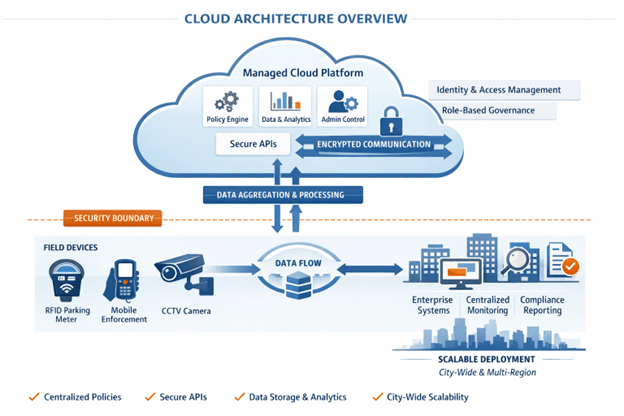
Cloud Architecture Overview
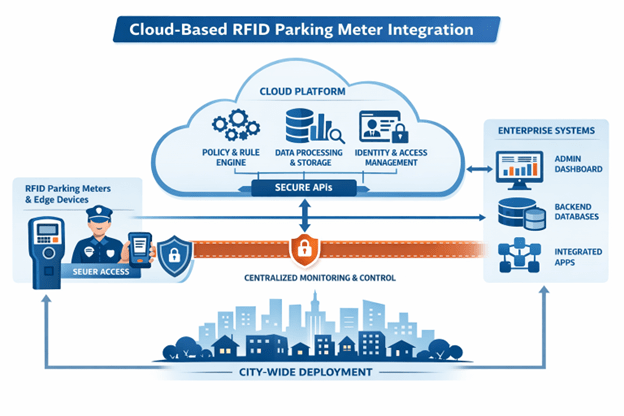
Cloud-based RFID Parking Meter Integration centralizes policy enforcement, data aggregation, analytics, and administrative control within a managed cloud environment.
- Centralized rule engines govern parking policies across regions
- Secure APIs connect meters, enforcement tools, and enterprise systems
- Data flows from edge devices to cloud services for processing and storage
- Identity, access, and role governance enforced at platform level
- Horizontal scalability supports city-wide or multi-region deployments
Security boundaries isolate field devices from core systems while maintaining encrypted communication channels. Operational responsibilities include centralized monitoring, software lifecycle management, and compliance reporting.
Non-Cloud Architecture Overview
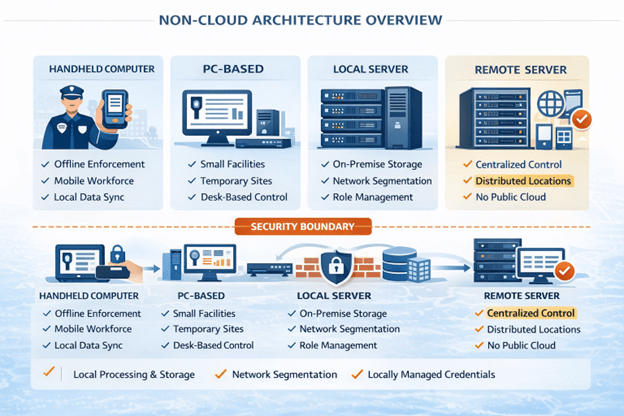
Non-cloud deployments localize system execution to meet regulatory, latency, or autonomy requirements.
- Handheld computer deployments support offline enforcement workflows
- PC-based deployments serve small facilities or temporary sites
- Local server deployments enable on-premise governance and storage
- Remote server deployments allow controlled centralization without public cloud reliance
Data processing, rule execution, and reporting occur within defined network boundaries. Security controls are enforced through physical access restrictions, network segmentation, and locally managed credentials. Scalability depends on infrastructure capacity planning and operational staffing.
Cloud vs Non-Cloud RFID Parking Meter Integration Comparison
| Aspect | Cloud-Based Integration | Non-Cloud Integration |
| Deployment Control | Centrally managed | Locally administered |
| Latency Sensitivity | Network dependent | Deterministic local response |
| Regulatory Alignment | Suitable where cloud is permitted | Required where cloud is restricted |
| Scalability | Elastic across regions | Limited by local infrastructure |
| Typical Selection Scenarios | Municipal systems, multi-site enterprises | Secure campuses, offline zones |
| Handheld Usage | Connected enforcement devices | Fully offline enforcement |
| Maintenance Model | Centralized updates | Manual or scheduled updates |
Cloud Integration and Data Management
Cloud integration focuses on structured data lifecycle governance rather than device-level operations.
- Data ingestion pipelines normalize parking events and credential interactions
- Processing layers apply validation rules, anomaly detection, and policy logic
- Storage tiers separate transactional records, historical archives, and analytics datasets
- Analytics services support utilization analysis, compliance reporting, and trend forecasting
- Integration interfaces connect ERP, payment platforms, and municipal systems
- Security controls enforce encryption, audit logging, and access segmentation
- Governance policies define data retention, residency, and role-based access
The cloud environment enables controlled visibility for compliance officers, operations directors, and auditors without exposing field-level systems.
Major Components of RFID Parking Meter Integration Architecture
RFID Credentials
- Vehicle tags, cards, or embedded identifiers
- Selection based on durability, lifecycle, and issuance model
- Managed through credential provisioning workflows
RFID Readers
- Fixed readers integrated into meters or gantries
- Mobile readers used by enforcement personnel
- Selected based on read range, interference tolerance, and environment
Edge Devices
- Handheld computers and embedded controllers
- Execute local validation and buffering
- Operate under constrained power and connectivity
Middleware Layer
- Translates reader data into system transactions
- Applies preliminary validation rules
- Buffers data during connectivity interruptions
Cloud Platforms or Local Servers
- Host rule engines, databases, and integrations
- Enforce security and access governance
- Support reporting and administration
Databases
- Store credential records, parking events, and audit logs
- Designed for write-intensive workloads
- Segregated by operational and analytical use
Dashboards and Reporting Tools
- Provide operational visibility and compliance reporting
- Role-based access for administrators and auditors
- Export capabilities for external review
RFID Technologies Used in RFID Parking Meter Integration
UHF RFID
- Long read range suitable for drive-by validation
- High throughput in vehicle-dense environments
- Sensitive to metal and environmental interference
HF RFID
- Moderate read range with controlled interaction zone
- Stable performance near vehicles and meters
- Widely standardized and interoperable
NFC
- Very short read range requiring intentional interaction
- Commonly used for user-initiated validation
- Strong alignment with mobile devices
LF RFID
- Short read range with strong tolerance to interference
- Reliable in harsh or electrically noisy environments
- Lower data rates and tag density
RFID Technology Comparison for RFID Parking Meter Integration
| Technology | Interaction Distance | Typical Integration Context | Selection Considerations |
| UHF | Long range | Drive-through validation zones | Interference management |
| HF | Short to mid-range | Meter-based identification | Standard compliance |
| NFC | Very short range | User-present interactions | User behavior dependency |
| LF | Very short range | Secure or harsh environments | Limited scalability |
Combining Multiple RFID Technologies
Multi-technology architectures are selected when operational diversity requires differentiated interaction models.
- UHF combined with HF supports both drive-by and proximity validation
- NFC added for user confirmation or exception handling
- Architectural benefits include operational flexibility and redundancy
- Trade-offs include increased integration complexity and lifecycle management
- Risk mitigation requires clear technology boundaries and governance
Applications of RFID Parking Meter Integration Using RFID Technologies
- Municipal on-street parking enforcement supporting zoning, permits, and time limits through automated vehicle validation and enforcement handhelds
- University campus parking managing faculty, student, visitor, and service vehicle access across distributed lots and structures
- Corporate campus parking controlling employee access, visitor authorization, and compliance reporting
- Airport parking facilities managing short-term, long-term, and staff parking with audit-grade records
- Hospital parking enforcing staff privileges and patient access under regulated conditions
- Government facility parking supporting secure credential-based vehicle authorization
- Residential complexes managing tenant permits, visitor access, and enforcement workflows
- Logistics hubs controlling commercial vehicle staging and dwell time
- Event venue parking managing temporary credentials and rapid throughput
- Industrial sites enforcing safety and access policies for vehicles
Deployment Options for RFID Parking Meter Integration
Cloud Deployment Use Cases and Advantages
- Multi-site organizations requiring centralized governance
- Environments with fluctuating parking demand
- Operations requiring advanced analytics and reporting
- Reduced infrastructure maintenance burden
Non-Cloud Deployment Use Cases and Advantages
- Regulatory environments restricting external data storage
- Facilities requiring deterministic latency
- Remote sites with limited connectivity
- Organizations requiring full operational autonomy
Handheld, PC, local server, and remote server deployments provide flexibility for enforcement-led or facility-controlled operations.
GAO Expertise and Role in RFID Parking Meter Integration
GAO supports RFID Parking Meter Integration through system design, technology selection, and deployment planning. Our teams operate from New York City and Toronto and work with public and private organizations across the U.S., Canada, and global markets.
Experience gained from decades of serving government agencies, universities, R&D organizations, and large enterprises informs our architectural trade-off analysis, compliance alignment, and operational support models. Investments in R&D and quality assurance ensure system reliability, while remote and onsite expert support assists throughout the system lifecycle.
GAO Case Studies of RFID Parking Meter Integration Using RFID Technologies
United States Case Studies
Urban On-Street Parking Enforcement, New York City, New York
- Problem
Dense curbside parking zones faced enforcement delays, permit misuse, and inconsistent citation validation. Manual checks caused revenue leakage and public disputes.
- Solution
GAO supported RFID Parking Meter Integration using UHF and HF RFID technologies. Fixed readers were integrated with meters, while enforcement teams used handheld computers running non-cloud software with periodic synchronization to a cloud platform for analytics and audit trails.
- Result
Unauthorized parking incidents dropped by 38 percent within nine months.
- Lesson or Trade-off
UHF improved drive-by verification but required calibration to manage signal reflections in dense urban corridors.
Municipal Parking Garage Operations, Chicago, Illinois
- Problem
Multi-level garages experienced congestion at entry points and difficulty correlating permits with vehicle identities.
- Solution
RFID Parking Meter Integration using HF RFID for gate validation and a local server deployment for latency-sensitive access control. Cloud reporting was used for utilization analytics.
- Result
Average vehicle entry time decreased by 27 percent.
- Lesson or Trade-off
Local servers ensured low latency but increased on-premise maintenance responsibility.
University Campus Parking Management, Boston, Massachusetts
- Problem
Large academic campuses struggled with permit sharing and enforcement coverage gaps.
- Solution
GAO assisted with RFID Parking Meter Integration using UHF RFID for vehicle identification and handheld enforcement devices operating in non-cloud mode with end-of-day synchronization.
- Result
Permit violations declined by 41 percent during the first academic year.
- Lesson or Trade-off
Offline enforcement improved coverage but delayed real-time dispute resolution.
Hospital Parking Compliance, Houston, Texas
- Problem
Hospitals required strict differentiation between staff, patient, and emergency vehicle parking under compliance constraints.
- Solution
HF RFID-based Parking Meter Integration deployed on a local server with role-based access controls. Cloud access was restricted due to regulatory policies.
- Result
Improper staff parking incidents reduced by 33 percent.
- Lesson or Trade-off
Compliance alignment limited cloud analytics depth.
Airport Long-Term Parking, Los Angeles, California
- Problem
Long-term parking zones faced ticket fraud and overstays that were difficult to detect.
- Solution
RFID Parking Meter Integration using UHF RFID combined with a cloud-based analytics platform for duration tracking and anomaly detection.
- Result
Overstay revenue recovery increased by 22 percent.
- Lesson or Trade-off
Cloud dependency required redundant connectivity planning.
Smart City Pilot Program, Austin, Texas
- Problem
A pilot smart parking initiative needed scalable enforcement without expanding staff.
- Solution
GAO supported cloud-based RFID Parking Meter Integration with UHF RFID readers and mobile enforcement devices.
- Result
Enforcement productivity improved by 31 percent per officer.
- Lesson or Trade-off
Scalability benefits depended on reliable cellular coverage.
Corporate Campus Parking, San Jose, California
- Problem
Employee and visitor parking zones overlapped, creating compliance disputes.
- Solution
HF RFID credentials integrated with parking meters and a PC-based non-cloud management console.
- Result
Visitor violations dropped by 29 percent.
- Lesson or Trade-off
PC-based systems limited multi-site visibility.
Government Facility Parking, Washington, D.C.
- Problem
High-security facilities required vehicle validation without exposing data externally.
- Solution
LF RFID-based Parking Meter Integration deployed on a local server with strict network isolation.
- Result
Unauthorized vehicle access incidents reduced to near zero.
- Lesson or Trade-off
LF reliability came at the cost of lower throughput.
Downtown Commercial District, Seattle, Washington
- Problem
Retail districts faced rapid parking turnover and frequent overstays.
- Solution
UHF RFID Parking Meter Integration with cloud analytics to monitor dwell time patterns.
- Result
Average space turnover increased by 18 percent.
- Lesson or Trade-off
Analytics accuracy depended on consistent tag placement.
Industrial Site Parking, Detroit, Michigan
- Problem
Industrial facilities required separation of employee and contractor parking.
- Solution
HF RFID with a remote server deployment supporting centralized policy control without public cloud usage.
- Result
Contractor parking violations decreased by 35 percent.
- Lesson or Trade-off
Remote server hosting required dedicated IT oversight.
Event Venue Parking Operations, Las Vegas, Nevada
- Problem
Temporary events needed rapid credential issuance and enforcement.
- Solution
NFC-based Parking Meter Integration for user-present validation, supported by handheld devices running non-cloud software.
- Result
Event-day enforcement disputes reduced by 44 percent.
- Lesson or Trade-off
NFC required active user participation.
Residential Complex Parking, Miami, Florida
- Problem
High-rise residential parking suffered from permit duplication.
- Solution
HF RFID Parking Meter Integration with a cloud-based credential management system.
- Result
Duplicate permit cases dropped by 37 percent.
- Lesson or Trade-off
Cloud systems required tenant data governance policies.
Logistics Hub Parking Control, Memphis, Tennessee
- Problem
Truck staging areas lacked visibility into dwell time compliance.
- Solution
UHF RFID Parking Meter Integration using local servers for latency-sensitive tracking.
- Result
Average truck dwell time reduced by 21 percent.
- Lesson or Trade-off
Metal-rich environments required antenna tuning.
Public Transit Park-and-Ride, Denver, Colorado
- Problem
Park-and-ride facilities experienced commuter permit misuse.
- Solution
HF RFID integrated with parking meters and a cloud reporting platform.
- Result
Misuse incidents declined by 34 percent.
- Lesson or Trade-off
Hybrid cloud models required clear data ownership policies.
Canadian Case Studies
Municipal Parking Zones, Toronto, Ontario
- Problem
Dense urban parking zones faced enforcement consistency issues and public complaints.
- Solution
GAO supported RFID Parking Meter Integration using UHF RFID with cloud-based enforcement dashboards and handheld non-cloud enforcement tools.
- Result
Citation accuracy improved by 36 percent.
- Lesson or Trade-off
Urban density required careful RF planning.
University Campus Parking, Vancouver, British Columbia
- Problem
Distributed campuses struggled with cross-lot permit enforcement.
- Solution
HF RFID Parking Meter Integration with a local server deployment for campus autonomy.
- Result
Cross-lot violations reduced by 32 percent.
- Lesson or Trade-off
Local hosting limited regional benchmarking.
Hospital Network Parking, Montreal, Quebec
- Problem
Bilingual compliance reporting and regulated data handling were required.
- Solution
RFID Parking Meter Integration using HF RFID and a remote server hosted within national boundaries.
- Result
Compliance audit preparation time decreased by 28 percent.
- Lesson or Trade-off
Localization increased configuration complexity.
Government Office Parking, Ottawa, Ontario
- Problem
Government offices required auditable parking access without cloud dependency.
- Solution
LF RFID Parking Meter Integration deployed on a local server with restricted access controls.
- Result
Audit discrepancies were eliminated during annual review.
- Lesson or Trade-off
LF systems limited read distance flexibility.
Industrial Research Facility, Waterloo, Ontario
- Problem
Research facilities needed separation of staff, visitor, and service vehicle parking.
- Solution
Multi-technology RFID Parking Meter Integration combining HF RFID for staff and NFC for visitors, managed through a PC-based system.
- Result
Unauthorized parking incidents declined by 39 percent.
- Lesson or Trade-off
Multi-technology systems increased credential lifecycle management effort.
Our products and systems have been developed and deployed for a wide range of industrial applications. They are available off-the-shelf or can be customized to meet your needs. If you have any questions, our technical experts can help you
For any further information on GAO’s products and systems, to request evaluation kits, free samples, recorded video demos, or explore partnership opportunities, please fill out this form or email us.