
Overview of GAO’s RFID- Based RFID Recycling Center Systems
RFID Recycling Center Systems provide digital traceability, asset visibility, and process accountability across material recovery facilities, scrap yards, e-waste processors, and municipal recycling operations. The system establishes persistent digital identities for containers, bins, pallets, vehicles, and bulk material movements, enabling accurate tracking across intake, sorting, processing, storage, and outbound logistics. Operational data is captured in real time and associated with location, timestamp, and process state to support regulatory reporting and operational audits.
The architecture supports multiple deployment models, including centralized cloud platforms and non-cloud configurations operating on handheld computers, PCs, local servers, or enterprise-managed remote servers. This flexibility allows recycling operators to align technology choices with data residency, connectivity, and operational maturity requirements. Recycling Center Systems Using RFID technologies are designed to integrate with weighbridge systems, material classification workflows, environmental compliance records, and enterprise resource planning platforms without forcing uniform infrastructure across sites.
RFID Recycling Center Systems Structure, Capabilities, and Operational Scope
RFID Recycling Center Systems focus on the orchestration of physical material flows and digital records within complex, high-volume recycling environments. Core system design emphasizes traceability, accountability, and controlled data exchange rather than consumer-grade automation.
Functional characteristics include:
- Persistent identification of recyclable assets, containers, and transport units
• Event-based recording of material state transitions
• Controlled access to operational data based on role and responsibility
• Support for both centralized and site-isolated deployments
• Interoperability with compliance, billing, and logistics systems
Applications span municipal recycling centers, industrial scrap recovery, hazardous material handling, and extended producer responsibility programs. GAO works with recycling operators to align Recycling Center Systems Using RFID technologies with local regulations, material handling workflows, and audit requirements.
Description, Purpose, Issues Addressed and Benefits of GAO’s RFID-Enabled RFID Recycling Center Systems
System Description
RFID Recycling Center Systems consist of identification media, capture infrastructure, processing platforms, and reporting interfaces. Each recyclable asset or container is associated with an RFID credential that persists throughout its lifecycle. Events generated during intake, sorting, compaction, shredding, storage, and shipment are recorded and correlated with operational context.
System Purposes
- Establish auditable material traceability from intake to disposition
- Reduce manual logging errors during high-throughput operations
- Support regulatory documentation and chain-of-custody verification
- Enable process optimization through event analytics
- Improve accountability across contractors, operators, and logistics partners
Issues Addressed
- Loss of material traceability across multi-stage workflows
- Inconsistent data capture across geographically distributed facilities
- Manual reconciliation of compliance and reporting records
- Limited visibility into container utilization and dwell times
- Difficulty enforcing process controls across shifts and contractors
System Benefits
- Improved accuracy of material tracking records
- Reduced operational disputes related to weight, classification, and handling
- Faster regulatory reporting and audit response
- Enhanced oversight of outsourced or third-party operations
- Scalable governance across multiple recycling sites
System Architecture of Recycling Center Systems Using RFID Technologies
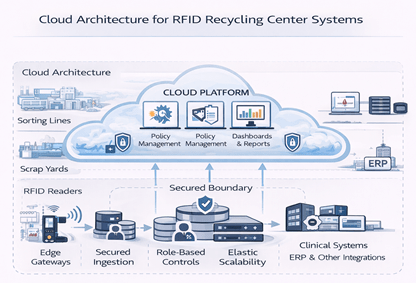
Cloud Architecture for RFID Recycling Center Systems
Cloud-based RFID Recycling Center Systems centralize configuration, policy enforcement, and reporting within controlled environments. RFID events generated at recycling facilities are transmitted through secure gateways to centralized services responsible for state management and analytics.
Overall structure combines distributed capture at recycling sites with centralized governance. Local operations teams manage readers, antennas, and capture points, while centralized IT and compliance teams oversee policies, dashboards, and integrations. Security boundaries isolate device communication, tenant data, and administrative access using encrypted channels and role-based controls. Scalability is achieved through elastic processing capacity and standardized onboarding of new facilities.
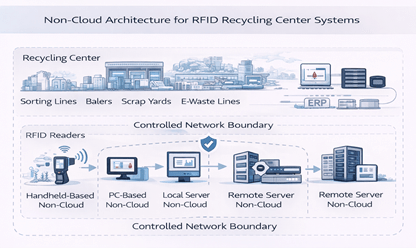
Non-Cloud Architecture for RFID Recycling Center Systems
Non-cloud RFID Recycling Center Systems support environments requiring infrastructure isolation, offline operation, or strict data residency. System software operates on handheld computers, PCs, local servers, or enterprise-managed remote servers.
Data processing, reporting, and policy enforcement occur within defined network boundaries. Operational responsibility shifts toward local IT teams, including system maintenance, backups, and capacity planning. Synchronization with external systems remains optional and tightly governed. Scalability depends on hardware provisioning, system partitioning, and site-level configuration rather than elastic resources.
Cloud Versus Non-Cloud Deployment Comparison for RFID Recycling Center Systems
| Dimension | Cloud Deployment | Non-Cloud Deployment |
| Data residency | Centrally governed with configurable regions | Fully site-controlled |
| Connectivity | Requires reliable WAN connectivity | Supports offline or intermittent networks |
| Operational ownership | Shared between site and central teams | Primarily local IT responsibility |
| Scalability | Elastic compute and storage | Hardware-dependent scaling |
| Compliance management | Centralized enforcement and reporting | Site-specific compliance controls |
| Typical scenarios | Multi-site recycling operators | Isolated facilities or regulated sites |
Non-cloud configurations vary by platform choice:
- Handheld computer deployments for mobile yard operations
- PC-based systems for small processing centers
- Local server installations for mid-scale facilities
- Remote server deployments for enterprise-managed private environments
Cloud Integration and Data Management for RFID Recycling Center Systems
Cloud integration focuses on controlled ingestion, lifecycle management, and governed access to recycling data. Event streams are validated, normalized, and stored according to retention and compliance policies. Analytics engines derive operational metrics such as throughput, dwell time, and exception rates.
Security controls include encrypted data paths, tenant isolation, role-based access, and audit logging. Access governance ensures that operators, compliance officers, and external auditors view only authorized datasets. GAO assists organizations in aligning data management practices with environmental reporting standards and internal governance frameworks.
Major Components of RFID Recycling Center Systems Architecture
RFID Credentials
Identification media encode asset identifiers and classification attributes. Selection depends on environmental exposure, attachment method, and lifecycle duration.
RFID Readers and Antennas
Capture infrastructure is positioned at intake gates, sorting lines, compactors, and shipping points. Read reliability depends on placement, shielding, and interference control.
Edge Devices and Gateways
Edge components aggregate events, apply filtering logic, and manage secure transmission. Constraints include latency tolerance and local buffering capacity.
Middleware and Processing Platforms
Middleware correlates events with business rules and operational context. Platform selection considers integration complexity and governance requirements.
Cloud Platforms or Local Servers
Processing environments host analytics, policy engines, and reporting services. Deployment choice affects scalability, maintenance, and compliance posture.
Databases and Data Stores
Structured and time-series storage supports traceability queries and historical analysis. Retention policies align with regulatory mandates.
Dashboards and Reporting Tools
Interfaces provide operational visibility and compliance reporting. Role-specific views support supervisors, auditors, and executives.
RFID Technologies Used in RFID Recycling Center Systems
- UHF RFID
UHF operates at longer read ranges and supports high-throughput scanning. Performance depends on environmental interference and tag orientation.
- HF RFID
HF provides moderate range and stable performance near liquids and metals. Read rates are lower than UHF but more predictable.
- NFC
NFC operates at very short range with intentional user interaction. Performance favors authentication and manual verification scenarios.
- LF RFID
LF offers low sensitivity to environmental noise with limited data rates and range. Performance remains stable in harsh industrial conditions.
RFID Technology Comparison for RFID Recycling Center Systems
| Technology | Read Range | Data Rate | Environmental Sensitivity | Typical Role |
| UHF | Long | High | Higher | Bulk material movement |
| HF | Medium | Medium | Moderate | Container identification |
| NFC | Very short | Low | Low | Operator verification |
| LF | Short | Low | Very low | Harsh environment tagging |
Combining Multiple RFID Technologies in Recycling Center Systems
Hybrid RFID architectures are appropriate when operational zones exhibit different environmental constraints or interaction models. Combining UHF for bulk tracking with HF or LF for container identification balances throughput and reliability. NFC may supplement workflows requiring human confirmation.
Architectural trade-offs include increased integration complexity, higher maintenance overhead, and expanded testing requirements. GAO advises organizations to adopt multi-technology designs only when operational benefits outweigh governance and lifecycle management costs.
Applications of Recycling Center Systems Using RFID Technologies
- Municipal recycling intake management with automated container association
- Scrap metal yard inventory reconciliation across processing stages
- E-waste chain-of-custody documentation for compliance audits
- Hazardous material segregation tracking within controlled zones
- Weighbridge integration for inbound and outbound material validation
- Container lifecycle tracking for reusable bins and pallets
- Contractor accountability across outsourced processing operations
- Material dwell time analysis for throughput optimization
- Environmental reporting data aggregation for regulators
- Cross-facility transfer tracking for distributed recycling networks
Each application relies on structured event capture aligned with operational roles and physical workflows.
Deployment Options for RFID Recycling Center Systems
Cloud Deployment Use Cases and Advantages
Cloud deployments suit organizations operating multiple recycling centers requiring centralized oversight, standardized reporting, and scalable analytics. Advantages include reduced infrastructure burden, centralized compliance management, and faster onboarding of new sites.
Non-Cloud Deployment Use Cases and Advantages
Non-cloud deployments align with facilities requiring offline operation, strict data residency, or isolated networks. Advantages include full control over infrastructure, predictable performance, and simplified compliance alignment for regulated environments.
Case Studies of Recycling Center Systems Using RFID Technologies
U.S. Case Studies
Urban Municipal Recycling Facility, New York City, NY
- Problem
High inbound material volume and manual logging created reconciliation gaps between intake records and outbound recovery reports. Audit preparation required extensive manual cross-checking across shifts.
- Solution
Recycling Center Systems Using RFID technologies were deployed with UHF tags on collection containers and readers at intake gates and processing zones. A cloud-based deployment centralized data governance, while site staff managed capture points. GAO supported integration with existing material classification workflows.
- Result
Material traceability accuracy improved to 98.6 percent.
Regional Scrap Metal Processor, Newark, NJ
- Problem
Frequent disputes with logistics partners over material quantities and container dwell times affected billing cycles.
- Solution
A non-cloud RFID Recycling Center System running on a local server tracked container movements using UHF and HF RFID technologies. Processing data remained within facility boundaries, with optional exports for financial systems. GAO assisted with system configuration aligned to yard operations.
- Result
Billing dispute resolution time decreased by 42 percent.
E-Waste Recycling Center, San Jose, CA
- Problem
Regulatory audits required verifiable chain-of-custody records for hazardous electronic components.
- Solution
HF RFID credentials were assigned to e-waste containers, with event capture at dismantling and storage zones. A cloud deployment enabled centralized compliance reporting across multiple facilities. GAO supported role-based access configuration.
- Result
Audit preparation time reduced by 55 percent.
Construction Debris Recovery Site, Phoenix, AZ
- Problem
Lack of visibility into material sorting efficiency caused inconsistent recovery rates across shifts.
- Solution
RFID Recycling Center Systems using UHF RFID technologies captured movement data at sorting lines. A PC-based non-cloud deployment supported on-site analytics without external connectivity. GAO assisted with dashboard customization for supervisors.
- Result
Sorting accuracy increased by 18 percent.
Industrial Plastics Recycling Facility, Houston, TX
- Problem
Manual tracking of reusable bins resulted in loss and underutilization of assets.
- Solution
Reusable bins were tagged with UHF RFID and monitored through a cloud-based RFID Recycling Center System. Centralized reporting enabled asset utilization analysis across yards. GAO provided integration guidance with inventory systems.
- Result
Bin loss incidents dropped by 31 percent.
Hazardous Materials Processing Center, Baton Rouge, LA
- Problem
Strict data residency requirements limited use of external platforms.
- Solution
A non-cloud deployment on an enterprise-managed remote server tracked hazardous containers using LF RFID technologies. Data remained within a controlled network segment. GAO supported security boundary design.
- Result
Compliance exceptions reduced by 24 percent.
Municipal Transfer Station, Chicago, IL
- Problem
Inconsistent container handoff records between collection contractors and facility operators.
- Solution
NFC-enabled RFID credentials were introduced for manual confirmation at transfer points, combined with UHF for bulk tracking. A cloud deployment centralized records. GAO assisted with hybrid architecture design.
- Result
Handoff discrepancies reduced by 37 percent.
Paper Recycling Mill, Green Bay, WI
- Problem
Limited insight into bale dwell times affected production scheduling.
- Solution
UHF RFID tags tracked bale movement through storage and processing zones using a local server deployment. GAO helped align analytics with production metrics.
- Result
Average dwell time decreased by 21 percent.
Glass Recycling Facility, Toledo, OH
- Problem
- Manual reconciliation of inbound and outbound glass loads delayed reporting.
- Solution
- Cloud-based RFID Recycling Center Systems captured load movements using UHF RFID technologies. Centralized dashboards supported daily reconciliation. GAO provided onboarding support.
- Result
- Reporting cycle time shortened by 46 percent.
Textile Recycling Operation, Charlotte, NC
- Problem
Difficulty tracking reusable transport cages across multiple partner sites.
- Solution
UHF RFID credentials enabled cross-site tracking through a cloud deployment. GAO supported configuration of partner access controls.
- Result
Cage utilization improved by 29 percent.
Battery Recycling Facility, Reno, NV
- Problem
High-risk material handling demanded precise movement records.
- Solution
HF RFID tracked containers within controlled zones using a non-cloud local server. GAO assisted with compliance-oriented reporting design.
- Result
Incident investigation time reduced by 33 percent.
Metals Recovery Yard, Gary, IN
- Problem
Manual gate logs caused inaccuracies during peak inbound periods.
- Solution
UHF RFID readers automated gate capture through a cloud-based system. GAO supported reader placement optimization.
- Result
Gate record accuracy reached 97.9 percent.
Agricultural Plastics Recycling Center, Fresno, CA
- Problem
Seasonal volume spikes overwhelmed manual tracking processes.
- Solution
A handheld-based non-cloud RFID Recycling Center System enabled mobile scanning of containers using UHF RFID. GAO provided workflow alignment support.
- Result
Peak-season processing delays decreased by 19 percent.
Demolition Waste Recovery Facility, Baltimore, MD
- Problem
Limited traceability across temporary storage zones.
- Solution
UHF RFID technologies tracked container movements through a cloud deployment. GAO assisted with zone-level reporting configuration.
- Result
Material misplacement incidents dropped by 27 percent.
Canadian Case Studies
Municipal Recycling Center, Toronto, ON
- Problem
Fragmented data across city-operated facilities hindered consolidated reporting.
- Solution
Cloud-based RFID Recycling Center Systems unified data capture using UHF RFID technologies. GAO supported centralized governance design.
- Result
Citywide reporting accuracy improved to 99.1 percent.
Electronics Recycling Facility, Mississauga, ON
- Problem
Manual chain-of-custody logs increased audit risk.
- Solution
HF RFID credentials tracked containers through dismantling and storage using a local server deployment. GAO assisted with compliance alignment.
- Result
Audit findings related to documentation fell by 41 percent.
Industrial Scrap Processor, Hamilton, ON
- Problem
Disputes over material classification delayed settlements.
- Solution
UHF RFID captured material movements with classification metadata through a cloud deployment. GAO supported analytics configuration.
- Result
Settlement cycle time reduced by 34 percent.
Construction Waste Facility, Vancouver, BC
- Problem
Remote site connectivity constraints limited centralized oversight.
- Solution
A non-cloud deployment on a remote server tracked containers using UHF RFID. Periodic synchronization supported reporting. GAO assisted with connectivity planning.
- Result
Operational visibility increased without continuous connectivity.
Plastics Recovery Operation, Laval, QC
- Problem
Reusable pallet losses affected operating costs.
- Solution
UHF RFID technologies enabled pallet tracking through a cloud-based RFID Recycling Center System. GAO supported asset lifecycle configuration.
- Result
Pallet replacement costs decreased by 26 percent.
Our products and systems have been developed and deployed for a wide range of industrial applications. They are available off-the-shelf or can be customized to meet your needs. If you have any questions, our technical experts can help you.
For any further information on GAO’s products and systems, to request evaluation kits, free samples, recorded video demos, or explore partnership opportunities, please fill out this form or email us.