
AI and RFID for Fiber Infrastructure in Telecommunications
AI-Driven Fiber Infrastructure Management with RFID
AI and RFID for Fiber Infrastructure combines AI-driven analysis with UHF RFID, HF RFID, and LF RFID identification to improve how telecommunications organizations track, install, maintain, and verify fiber infrastructure assets. The approach is particularly useful for fiber distribution frames, optical distribution cabinets, splice closures, patch panels, fiber reels, cables, transceivers, tools, and maintenance inventory that move across warehouses, central offices, data centers, outside plant locations, and field service operations. RFID provides machine-readable asset identity and location events, while AI can correlate those events with work orders, inventory records, network topology, maintenance history, and technician activity. This creates a more reliable operational record for fiber infrastructure. GAO supplies RFID, BLE, and IoT hardware products and systems that can support asset identification, inventory control, field operations, and telecommunications workflows.
AI and RFID Fiber Infrastructure Operations
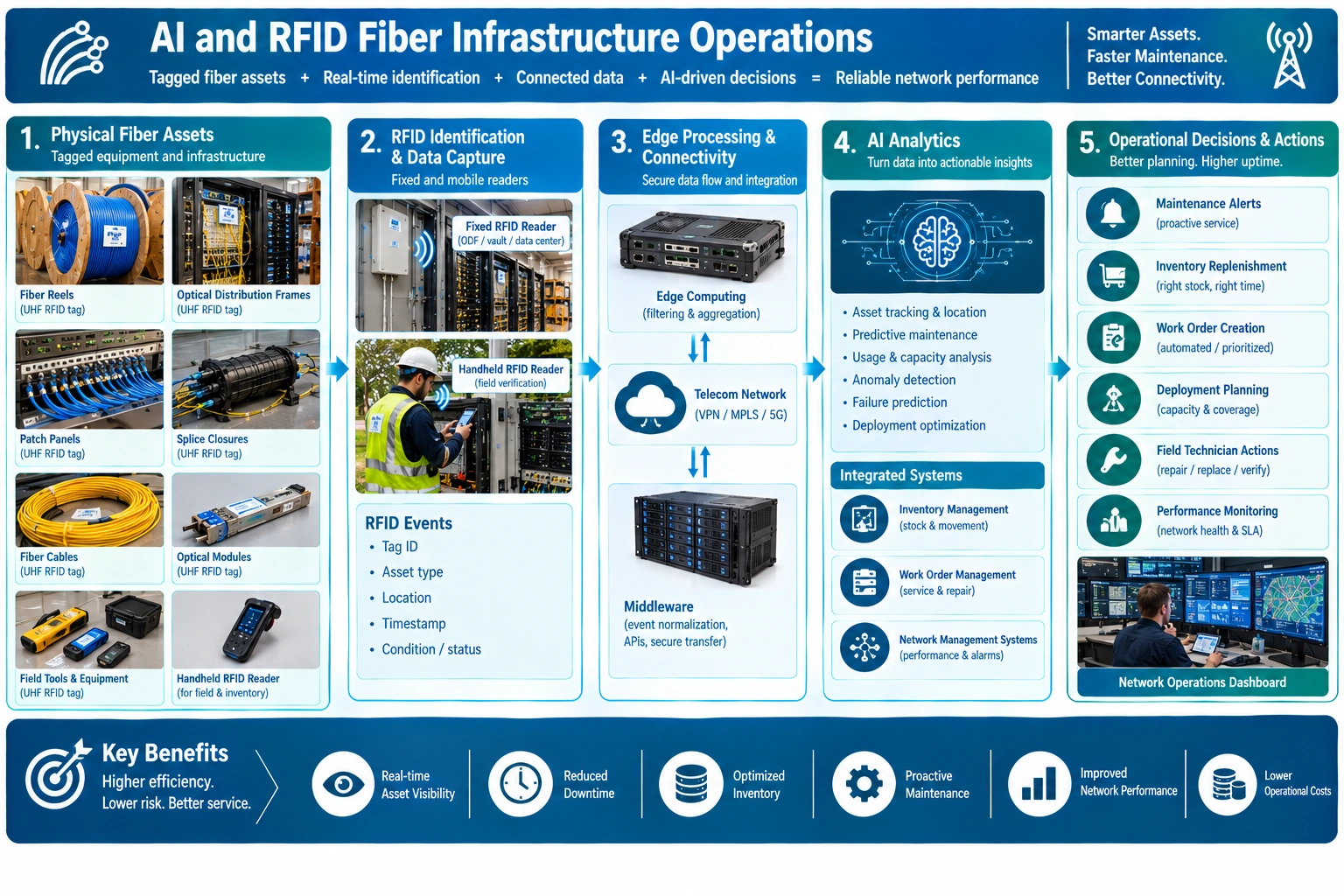
This diagram shows tagged fiber assets flowing through RFID identification, edge processing, secure telecom connectivity, AI analytics, and integrated systems to support maintenance, inventory, deployment, and network performance decisions.
Why AI Matters for Fiber Infrastructure Operations
Fiber infrastructure generates operational data across many locations and lifecycle stages. A telecommunications provider may manage thousands or millions of identifiers associated with fiber cables, connectors, patch cords, optical network terminals, distribution equipment, cabinets, splice points, test equipment, and maintenance materials. The difficulty is not simply identifying these items. The larger challenge is connecting asset identity with physical location, network assignment, installation status, work-order history, inventory availability, and maintenance condition.
AI can help telecommunications teams turn those disconnected records into operational decisions. Machine learning can identify unusual inventory movements, detect recurring installation discrepancies, estimate replenishment requirements, classify maintenance exceptions, and prioritize field work. Rules-based analytics remain useful for deterministic controls, while anomaly detection and predictive models can address more variable conditions.
For fiber infrastructure, the most useful AI outcomes often include:
- Faster verification of fiber materials before installation
- More accurate reconciliation between physical inventory and software records
- Identification of misplaced or unexpectedly moved fiber assets
- Improved work-order validation for installation and maintenance activities
- Detection of recurring discrepancies between field records and inventory systems
- Better forecasting of fiber cable, connector, transceiver, and consumable requirements
- Prioritization of maintenance activities using asset history and operational conditions
- Improved chain of custody for high-value optical equipment
- More accurate reporting across central offices, data centers, warehouses, and field locations
GAO’s experience supplying RFID and IoT hardware products and systems can support telecommunications organizations that need physical asset identification to complement existing network and operational software.
Fiber Infrastructure Workflows Where AI and RFID Deliver the Most Value
Fiber Material Receiving and Inventory Control
Fiber infrastructure projects often receive reels, cable assemblies, patch panels, optical modules, connectors, splice materials, cabinets, and installation accessories in different quantities and packaging configurations. Manual barcode scanning can become inefficient when large shipments contain many individually managed items.
RFID can associate each tagged item or handling unit with a unique identifier during receiving. Readers can capture multiple identifiers without requiring technicians to individually align every barcode. The resulting events can be compared with purchase orders, advance shipping notices, warehouse records, and project requirements.
AI can then identify receiving anomalies, such as unexpected quantities, repeated discrepancies, unusual movement patterns, or material requirements that differ from the project schedule. This is particularly useful when fiber infrastructure inventory is distributed between regional warehouses and field deployment teams.
Fiber Cable Reel Tracking and Deployment
Fiber cable reels represent an important tracking challenge because reels can move through receiving areas, staging locations, construction sites, contractor facilities, and field installation zones. Losing track of a reel can create project delays, duplicate purchasing, unnecessary transportation, and inaccurate material records.
A practical RFID implementation can associate the reel identifier with cable type, fiber count, length, project number, supplier information, and storage location. Fixed readers can monitor controlled movement points, while handheld readers can perform field verification.
AI can combine RFID movement history with project schedules and consumption records to identify abnormal reel movements, estimate remaining material requirements, and highlight projects where material consumption differs significantly from expected installation progress.
Optical Distribution Frame and Patch Panel Traceability
Optical distribution frames and patch panels require accurate identification because individual ports, fiber circuits, patch cords, and connected equipment can form complex physical relationships. A simple asset inventory record is insufficient when technicians need to understand what equipment is installed, where it is installed, and which work order authorized the change.
RFID can provide an electronic identity for selected physical assets and service components. The RFID record can be associated with port, cabinet, rack, room, facility, circuit, or network information in the operational software.
AI can assist by comparing physical identification events against expected configuration records. A mismatch can indicate an installation error, an incomplete work order, or an asset that was moved without corresponding software updates.
Fiber Splicing and Outside Plant Maintenance
Outside plant fiber operations introduce additional challenges because assets are distributed across cabinets, handholes, splice closures, poles, conduits, rights-of-way, and customer access locations. Technicians may also carry specialized tools and replacement components between sites.
RFID can support identification of tagged tools, maintenance kits, spare components, closures, cabinets, and selected infrastructure assets. Handheld RFID readers are particularly relevant where fixed reader coverage is impractical.
AI can correlate asset history with maintenance tickets, technician dispatch records, geographic information, inspection results, and previous failures. The resulting analysis can help determine which sites require attention and which materials technicians should carry before traveling to a location.
Fiber Network Expansion and Commissioning
New fiber deployments require material staging, installation verification, testing, documentation, and commissioning. A discrepancy between physical installation and project documentation can create downstream problems for operations teams.
RFID can provide physical identity during staging and installation. The associated identifier can follow the asset from warehouse preparation through deployment and commissioning.
AI can analyze installation events against project milestones and expected material consumption. This can expose missing assets, unexpected movements, incomplete deployment records, or unusual project patterns before they become larger operational issues.
Realistic Fiber Infrastructure RFID Deployment
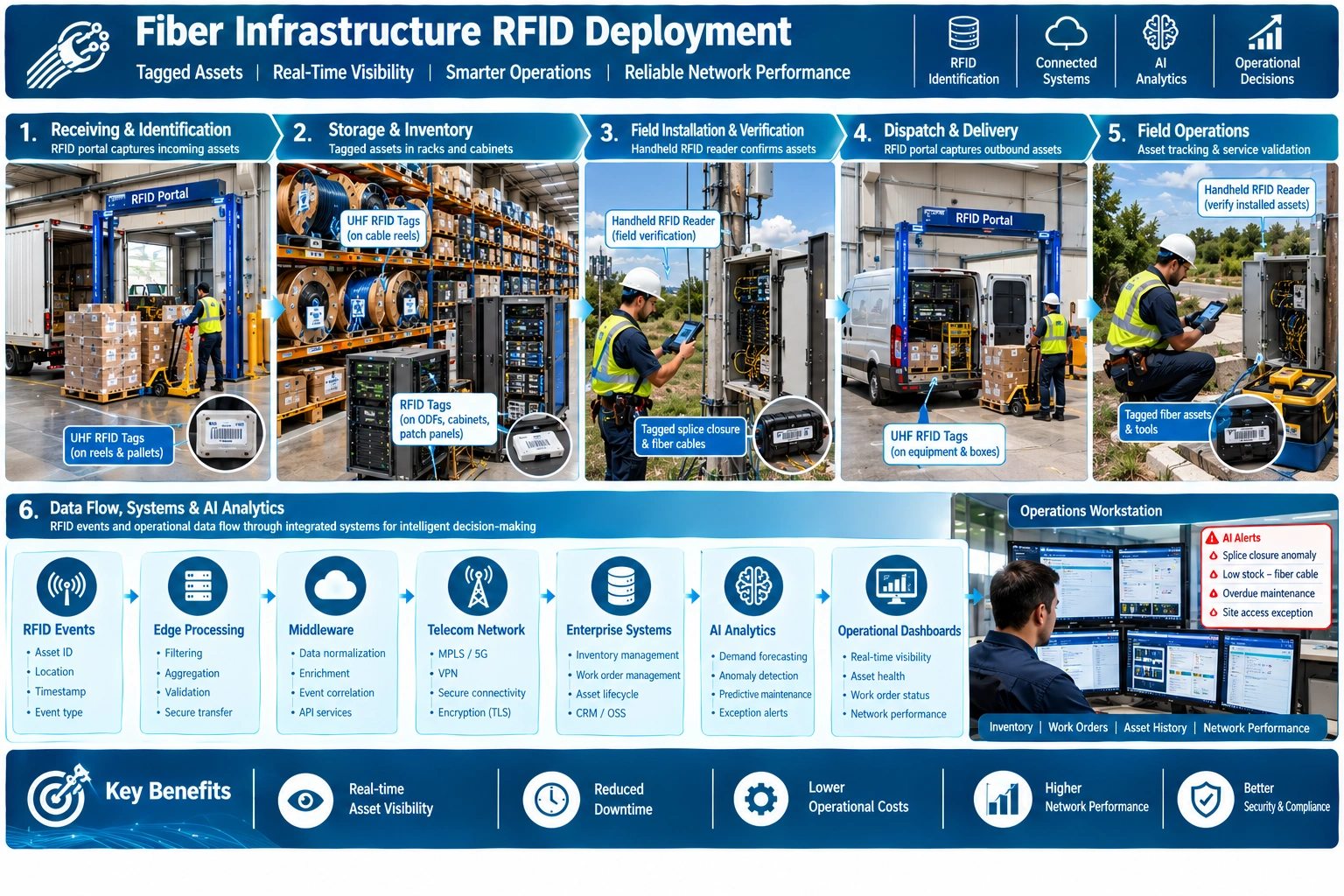
This visual demonstrates RFID deployment across fiber infrastructure operations, from warehouse receiving and storage to field installation and dispatch. RFID events flow through enterprise systems and AI analytics to improve asset visibility, maintenance planning, inventory management, and network operations.
Fiber Infrastructure Operational Challenges AI Can Address
Physical-to-Digital Record Mismatches
Fiber infrastructure records frequently span warehouse management systems, project databases, network management software, geographic information systems, asset databases, and field-service applications. Physical changes may occur before corresponding digital records are updated.
AI can identify inconsistencies between expected and observed asset states. RFID provides another source of physical evidence that can be compared against the software record.
Distributed Inventory and Material Visibility
Fiber construction and maintenance require material to move between central warehouses, regional depots, contractor locations, staging areas, and field sites. Conventional inventory records may not provide sufficient event granularity.
RFID movement events can create additional evidence of where tagged materials entered or left controlled areas. AI can analyze those events together with project demand and historical consumption.
Field Verification Burden
Technicians often need to verify that the correct fiber equipment and materials are present before starting work. Manual identification consumes time and can introduce transcription errors.
Handheld RFID readers can accelerate identification of compatible tagged assets. AI-assisted software can then compare the captured information against the assigned work order and identify exceptions requiring technician attention.
Asset Misplacement and Unauthorized Movement
High-value optical equipment, test instruments, specialized tools, and project materials can move between facilities and field locations. Unplanned movement can lead to shortages and delays.
RFID event histories can establish movement patterns, while AI can identify unusual transfers based on location, timing, asset type, project assignment, and historical behavior.
Maintenance Planning
Fiber infrastructure maintenance requires coordination between network condition, physical assets, technician availability, replacement materials, access requirements, and service priorities.
AI can rank maintenance activities by combining asset history, work-order urgency, location, failure patterns, and available resources. RFID contributes physical asset identity so that technicians can verify the correct equipment before performing work.
AI and RFID Data Flow Across the Fiber Infrastructure Lifecycle
A practical fiber infrastructure solution should treat physical asset identification as one component of a larger operational data flow. RFID events become valuable when they are associated with meaningful telecommunications records such as asset IDs, facility IDs, rack positions, project numbers, work orders, cable specifications, and maintenance activities.
The operational flow typically includes:
- Asset identification: RFID tags are associated with fiber reels, equipment, tools, cabinets, patch panels, or other selected assets.
- Data acquisition: Fixed readers, handheld readers, or controlled RFID portals capture asset events.
- Connectivity: Ethernet, Wi-Fi, cellular, or other available telecommunications connectivity transports events to the processing environment.
- Edge processing: Local software can filter duplicate reads, apply reader rules, validate event structure, and continue basic operations during temporary network interruptions.
- RFID middleware: Middleware normalizes reader data and maps RFID identifiers to enterprise asset records.
- Enterprise integration: APIs, databases, message queues, or integration services exchange information with inventory, warehouse, field-service, project-management, GIS, and network operations software.
- AI processing: Machine learning, anomaly detection, forecasting, classification, and rules-based analytics evaluate historical and current operational data.
- Decision support: Dashboards and alerts identify inventory discrepancies, unexpected movements, installation exceptions, or maintenance priorities.
- Business action: Warehouse personnel, project managers, network operations teams, or field technicians validate the exception and perform the required action.
- Lifecycle record: The completed action is written back into the relevant operational system, preserving traceability for future maintenance and audit activities.
RFID, AI Software, and Telecommunications Infrastructure Components
RFID selection for fiber infrastructure should be driven by the physical environment and operational workflow rather than by reader specifications alone. UHF RFID is generally useful for longer-range identification of tagged materials and assets in warehouses, staging areas, and controlled movement zones. HF RFID can be appropriate for shorter-range identification where deliberate item-level interaction is desirable. LF RFID can serve specialized short-range identification requirements where its physical characteristics match the application.
The supporting system normally includes RFID tags, fixed or handheld readers, antennas, edge computers or gateways, RFID middleware, databases, APIs, and enterprise software. AI functions may run within server infrastructure or cloud computing resources depending on data governance, latency, connectivity, cybersecurity, and operating requirements.
Cloud Version for Distributed Fiber Operations
A cloud-hosted SaaS deployment can be appropriate when telecommunications organizations need centralized visibility across multiple warehouses, regional facilities, field operations, and project locations. Cloud software can simplify centralized analytics, fleet-wide reporting, model management, and multi-site data aggregation.
The cloud approach is most useful when network connectivity is reliable and organizational policies permit operational RFID data to be processed in externally hosted infrastructure. Edge processing should still handle time-sensitive reader functions and temporary connectivity interruptions.
Server Version for Controlled Telecommunications Environments
A Server Version can run on customer-managed servers, private data centers, regional facilities, central-office computing infrastructure, or other privately hosted enterprise infrastructure. This approach can be preferable when telecommunications operators require greater control over data location, integration interfaces, cybersecurity policies, network segmentation, or operational availability.
A hybrid arrangement can also be practical. RFID event processing may occur locally, while selected analytical workloads are transferred to centralized servers. The correct deployment model depends on the organization’s network design, security requirements, latency constraints, integration standards, and operational governance.
AI Methods for Fiber Infrastructure
AI methods should be selected according to the decision being automated or supported.
- Anomaly detection: Identifies unusual asset movement, inventory discrepancies, or unexpected operational patterns.
- Time-series forecasting: Estimates material requirements based on historical consumption, project schedules, and maintenance demand.
- Classification: Categorizes work-order exceptions, inventory conditions, or operational events.
- Predictive analytics: Supports maintenance prioritization by correlating historical asset and service information.
- Computer vision: Can complement RFID where visual inspection of cabinets, labels, connectors, or installation conditions is required.
- Generative AI: Can help technicians and operations personnel retrieve relevant asset history, work instructions, and exception explanations from approved enterprise data sources.
Fiber Infrastructure Deployment and Integration Considerations
Successful deployment starts with selecting the fiber infrastructure assets and workflows that justify automated identification. Tagging every physical item is not always necessary. A better approach is to prioritize assets whose movement, location, value, installation status, or maintenance history has measurable operational consequences.
Asset and RFID Tag Selection
RFID tag selection should consider the physical material, mounting surface, read distance, environmental exposure, and required identification point.
Fiber cable reels require tags that remain readable during warehouse handling, transportation, and field deployment.
Metal cabinets, racks, and equipment may require RFID tags specifically designed for metal mounting.
Patch panels, optical equipment, and other compact assets require tags that do not interfere with connectors, ports, ventilation, or service access.
Outdoor infrastructure may require ruggedized tags capable of tolerating moisture, temperature variation, UV exposure, dust, and mechanical handling.
Tools and test instruments should use tags that remain attached during repeated field use and cleaning.
High-value optical equipment can receive persistent identifiers linked to serial numbers, purchase records, warranty information, and maintenance history.
Tag placement should be documented during commissioning. Poor placement can create read-shadowing, orientation problems, or inconsistent performance, particularly around metal cabinets and dense collections of fiber equipment.
Reader Placement and RF Coverage
Reader placement should follow actual telecommunications workflows rather than simply maximizing coverage. A warehouse receiving portal, for example, has a different requirement from a technician performing close-range verification inside a network cabinet.
Fixed readers can be positioned at controlled transitions such as receiving docks, warehouse exits, staging areas, and equipment rooms. Handheld readers provide flexibility for field audits and outside plant verification.
RF performance testing should examine:
- Read reliability at normal asset orientations
- Tag-to-reader distance
- Dense tag populations
- Metal and cable interference
- Reader antenna positioning
- Adjacent reader interference
- False reads from nearby assets
- Movement speed through controlled zones
- Environmental effects at outdoor locations
These measurements should be documented during commissioning rather than relying solely on laboratory specifications.
Integration with Telecommunications Software
RFID data becomes operationally useful when it is connected to existing telecommunications software. Depending on the organization’s environment, relevant systems may include:
- Warehouse management systems
- Inventory management software
- Enterprise asset management systems
- Field service management software
- Work-order management systems
- Geographic information systems
- Network management systems
- Configuration management databases
- Project management software
- Procurement systems
- Maintenance management software
- Data warehouses and business intelligence systems
Integration can use REST APIs, database interfaces, message queues, webhooks, middleware, or other approved enterprise integration methods. A stable identifier strategy is essential. The RFID tag ID should map consistently to an enterprise asset identifier rather than becoming an isolated record.
Security and Data Governance for AI-Enabled Fiber Tracking
Fiber infrastructure systems can contain information about facilities, equipment locations, network projects, field activities, and maintenance operations. Security controls should therefore cover RFID readers, edge gateways, middleware, application servers, APIs, databases, user accounts, and AI processing environments.
Network segmentation can isolate RFID readers and gateways from critical network-management infrastructure. Authentication should be applied to readers, gateways, APIs, and administrative interfaces where supported. Role-based access can restrict warehouse personnel, field technicians, network engineers, maintenance managers, and system administrators to the information required for their responsibilities.
Data governance should also distinguish between raw RFID events and validated business events. A reader detecting a tag does not necessarily prove that an asset was intentionally transferred. Middleware can apply location rules, duplicate-read filtering, timestamp normalization, and event validation before the data reaches operational software.
AI models should similarly operate within defined data boundaries. Model outputs should be traceable to relevant source data, and high-impact actions such as network configuration changes should remain subject to established authorization procedures.
GAO can support organizations that require RFID and IoT hardware products and systems as part of a broader telecommunications asset-tracking implementation, including deployments where cybersecurity and integration requirements must be considered alongside physical RFID performance.
AI-Enabled Operational Improvements for Fiber Infrastructure
Higher Inventory Accuracy
RFID can capture physical asset events with less manual intervention than item-by-item data entry. AI adds value by identifying discrepancies between physical observations, historical inventory records, project requirements, and expected consumption.
The result is not simply a larger inventory database. It is a more useful indication of whether the required fiber materials are physically available where the operation expects them to be.
Faster Installation Verification
Installation teams can verify tagged assets against assigned work orders before closing a task. AI can compare the observed asset set with the expected installation record and identify exceptions.
This can reduce the time spent reconciling field documentation after installation and help project teams identify incomplete records earlier.
Better Material Forecasting
Fiber deployment programs consume materials according to project schedules, network expansion plans, repair activity, and regional demand. AI forecasting can combine these variables with historical RFID-derived consumption events.
Forecasting can help procurement and warehouse teams determine where additional cable, connectors, optical modules, patching materials, or maintenance inventory may be required.
Improved Field Technician Productivity
A technician arriving at a fiber site needs the correct tools, replacement materials, documentation, and asset information. RFID can verify physical equipment and tools, while AI can help prioritize relevant information from work-order and maintenance records.
This can reduce avoidable return trips caused by missing materials or incorrect asset identification.
Stronger Asset Traceability
Persistent identification creates a lifecycle record that can follow selected fiber infrastructure assets through receiving, storage, deployment, maintenance, relocation, and retirement.
For regulated, high-value, or operationally important equipment, this history can support maintenance audits, warranty administration, project closeout, and asset reconciliation.
Fiber Infrastructure KPIs for AI and RFID Programs
Measurement should focus on operational outcomes rather than RFID read counts alone. Useful KPIs include:
- Physical-to-digital inventory accuracy
- Fiber material reconciliation rate
- RFID read success rate
- Asset identification time
- Inventory search time
- Fiber reel location accuracy
- Installation verification cycle time
- Work-order exception rate
- Incorrect material issue rate
- Unplanned material shortage rate
- Technician return-trip rate
- Maintenance response time
- Mean time to identify an asset
- Asset movement exception rate
- Project material variance
- Inventory carrying cost
- Stockout frequency
- Excess inventory rate
- Asset lifecycle traceability
- Maintenance record completeness
Baseline measurements should be captured before deployment where practical. Otherwise, organizations may know that RFID generated more data without knowing whether it improved the underlying telecommunications operation.
Standards, Regulations, and Engineering Governance
Fiber infrastructure programs may involve telecommunications regulations, information-security requirements, workplace rules, radio-frequency requirements, construction standards, and customer-specific controls. Applicable requirements depend on jurisdiction, network type, deployment environment, and organizational role.
Relevant standards and regulatory domains may include:
- FCC requirements for applicable radio-frequency equipment in the United States
- Industry Canada and Innovation, Science and Economic Development Canada requirements where applicable
- ANSI and TIA telecommunications infrastructure standards
- ISO and IEC standards relevant to RFID, information security, asset management, and quality processes
- IEEE standards relevant to supporting network connectivity
- Occupational safety requirements for telecommunications field work
- Customer-specific security and access-control requirements
- Data-retention and privacy requirements applicable to operational records
- Procurement and documentation requirements for government telecommunications projects
Standards should be validated for the specific deployment jurisdiction and application before procurement or commissioning. RFID frequency selection, antenna configuration, permitted transmit characteristics, and installation practices should comply with applicable local requirements.
Practical Implementation Roadmap for Fiber Infrastructure
Assess the Existing Fiber Workflow
Document how fiber materials and assets currently move through receiving, storage, staging, installation, commissioning, maintenance, repair, and retirement. Identify where manual reconciliation creates measurable delays or errors.
Establish the Asset Identification Model
Define which assets require RFID identification and what enterprise identifier will be associated with each tag. Establish naming conventions before large-scale tagging begins.
Conduct an RFID Site Survey
Evaluate reader locations, tag types, materials, RF interference, metal surfaces, environmental conditions, and required read zones. Test representative fiber equipment rather than generic test objects.
Build the Integration Layer
Connect RFID events to inventory, work-order, field-service, asset-management, GIS, or network-management records. Establish event validation and duplicate-read filtering before AI analytics are introduced.
Pilot a High-Value Workflow
A controlled pilot might focus on fiber reel tracking, warehouse dispatch, optical equipment traceability, or field work-order verification. The pilot should have measurable baseline KPIs and defined acceptance criteria.
Validate AI Outputs
AI recommendations should be tested against historical operational data and reviewed by telecommunications personnel. False positives and false negatives should be measured because excessive alerts can reduce user trust.
Commission and Optimize
Reader placement, tag attachment, middleware rules, data mappings, and AI thresholds should be adjusted using actual operating conditions. Performance should be reassessed when facilities, workflows, equipment types, or network processes change.
Scale by Operational Priority
Expansion should follow measurable value. Organizations can extend from warehouse inventory into field-service verification, project commissioning, maintenance tracking, and broader fiber lifecycle management after the initial workflow demonstrates reliable results.
Key Takeaways for AI and RFID in Fiber Infrastructure
AI-enabled fiber infrastructure management is most effective when it connects physical asset evidence with telecommunications operational records. RFID provides a practical identification mechanism for selected fiber materials, equipment, tools, and infrastructure assets, while AI analyzes the resulting information alongside inventory, project, maintenance, geographic, and work-order data.
The strongest implementations focus on measurable operational problems rather than technology deployment for its own sake. Fiber reel visibility, inventory reconciliation, installation verification, maintenance preparation, asset traceability, and material forecasting are practical starting points.
GAO supports organizations by supplying RFID, BLE, and IoT hardware products and systems that can be incorporated into these workflows. Our experience serving organizations in the United States and Canada includes Fortune 500 companies, R&D organizations, universities, and government agencies. GAO Group companies are based in New York City and Toronto, Canada, with substantial investment in product and system R&D, quality assurance, and remote or onsite technical support.
Organizations evaluating AI and RFID for fiber infrastructure can begin by mapping their highest-cost asset and workflow discrepancies, establishing measurable KPIs, and determining where physical identification can provide reliable operational evidence. GAO can provide technical information, RFID hardware options, system guidance, and engineering support for organizations developing or expanding telecommunications asset-management solutions.
Building the Future of Industrial AI and IoT with Aperture Venture Studio and GAO RFID Inc.
For more than three decades, GAO Group of Companies has invested heavily in R&D for industrial RFID, BLE, and IoT. As generative AI became useful for industrial applications, we expanded our work across AI, IoT, RFID, and BLE, including solutions relevant to fiber infrastructure and telecommunications asset operations. We have founded Aperture Venture Studio to develop and scale AI and IoT solutions relevant to industries such as telecommunications and fiber infrastructure.
Aperture has attracted AI and IoT technical experts, entrepreneurial and operational executives, influential investors, and leading companies. We have also developed the Aperture Ventures Summit and TekSummit to discuss advanced AI and IoT topics and build technical communities around these technologies.
We welcome you to join us as:
- Advisors, Co-founders, or Employees
- Investors
- Customers