
AI and RFID for Food Cold Chain
AI-Powered Food Cold Chain Visibility and Control
AI-powered food cold chain management combines machine learning, predictive analytics, computer vision, connected temperature sensing, RFID-enabled identification, and logistics data to protect temperature-sensitive food from origin through final distribution. Food processors, refrigerated warehouses, cold storage operators, distributors, grocery supply networks, and logistics providers use these technologies to monitor product identity, temperature history, dwell time, inventory movement, and handling conditions.
AI transforms captured cold chain data into operational intelligence. Models can identify temperature excursion patterns, predict refrigeration equipment problems, estimate spoilage risk, detect abnormal shipment delays, optimize inventory rotation, and prioritize corrective actions before food quality deteriorates. UHF RFID supports high-volume identification of pallets, cases, reusable transport items, and containers, while HF and LF RFID can support specialized identification and short-range applications.
GAO supplies RFID, BLE, IoT hardware products, and supporting systems that organizations can integrate with food cold chain monitoring and traceability solutions. The resulting AIoT environment improves product visibility while supporting food safety, quality assurance, inventory accuracy, and temperature-controlled logistics.
AI and RFID Food Cold Chain Deployment and Real-Time Monitoring System
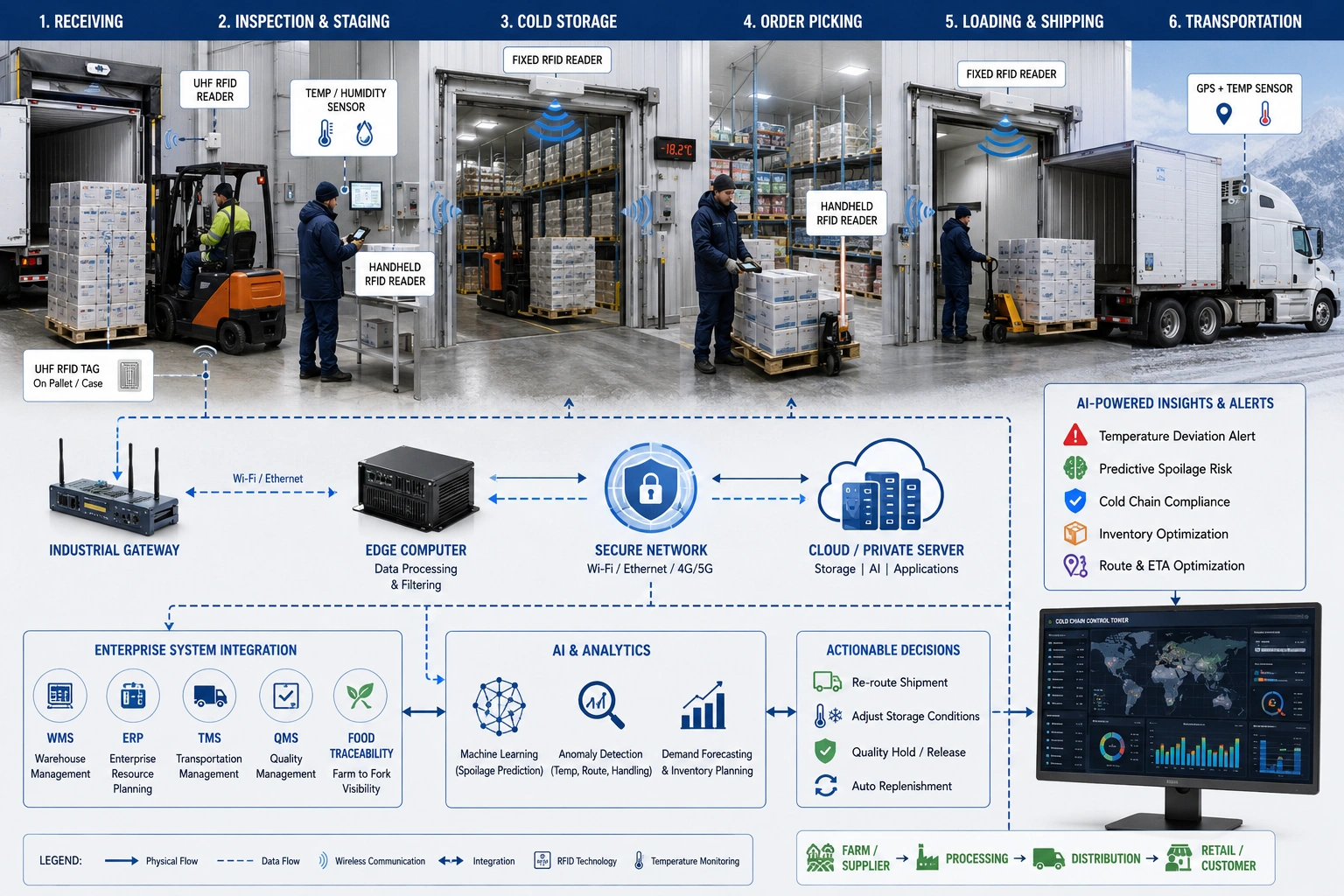
This visual illustrates an end-to-end AI and RFID-enabled food cold chain, covering receiving, inspection, cold storage, order picking, refrigerated shipping, and transportation. It shows how RFID, temperature sensors, edge computing, enterprise systems, and AI analytics work together to maintain product quality, traceability, inventory visibility, and cold chain compliance.
How AI, RFID, and IoT Work Across the Food Cold Chain
Food cold chain operations depend on maintaining required product conditions while food moves through receiving, storage, processing, consolidation, transportation, distribution, and retail replenishment. A monitoring system therefore needs more than a temperature reading. It needs to associate environmental conditions with the correct product, lot, pallet, case, location, shipment, and time interval.
RFID provides machine-readable identity and movement data. AI provides the analytical layer that interprets those observations together with sensor measurements and operational records. This relationship is particularly important for perishable foods because temperature exposure is cumulative. A shipment that appears compliant when inspected at the destination may have experienced damaging conditions earlier during loading, staging, transportation, cross-docking, or unloading.
RFID Identification for Temperature-Sensitive Food
UHF RFID is well suited to pallet, case, container, reusable transport item, and logistics asset identification because multiple tags can be read without requiring direct line of sight. Fixed readers can capture movements through dock doors, portals, conveyor points, and controlled transitions. Handheld readers support cycle counting, exception handling, receiving verification, and location searches.
Food, liquids, metal racks, dense pallet configurations, condensation, frost, and insulated structures can affect RF performance. Tag placement, antenna orientation, reader power, portal geometry, material composition, and site-specific RF testing therefore matter considerably in refrigerated environments.
HF RFID and NFC can support shorter-range identification and product interaction scenarios, while LF RFID may be appropriate for specialized applications requiring short read distances or operation near challenging materials.
AIoT for Food Quality and Cold Chain Decisions
Artificial Intelligence of Things, or AIoT, combines AI with connected sensors, RFID readers, gateways, refrigeration equipment, logistics assets, and business software. Food cold chain AIoT systems can correlate RFID events with temperature, humidity, door status, refrigeration telemetry, GPS, shipment schedules, inventory records, and quality data.
Machine learning models can then identify patterns that basic threshold alarms may miss. Examples include gradual refrigeration deterioration, repeated temperature instability at a specific dock, unusually long staging periods, shipment-delay patterns associated with spoilage risk, and abnormal dwell times between cold zones.
Edge AI can process time-sensitive data close to cold rooms, distribution centers, or transportation operations. Centralized AI software can analyze longer historical datasets across facilities, suppliers, carriers, routes, products, and seasons.
GAO has helped organizations deploy identification and IoT hardware products that provide the data foundation required for such connected monitoring and analytics.
Food Cold Chain Applications for AI-Driven RFID Data
AI-enabled cold chain systems create the greatest value when identification, environmental measurements, and operational data are connected to specific food handling decisions.
AI Food Traceability and Lot-Level Visibility
Traceability systems must connect incoming ingredients, production lots, finished products, palletization, storage locations, shipments, and receiving events. RFID can automatically capture product movement, reducing dependence on manual barcode scanning at high-volume transition points.
AI analytics can examine traceability records for missing events, unusual product movement, mismatched shipment data, abnormal dwell periods, or patterns requiring investigation. During a recall, accurate identification and movement histories can help quality teams narrow the affected inventory rather than treating an unnecessarily broad quantity of food as potentially impacted.
AI Temperature Excursion Detection
Traditional monitoring commonly uses upper and lower temperature thresholds. These controls remain essential, but AI can add contextual analysis.
A model can consider:
- Product category and temperature requirements
- Duration and magnitude of an excursion
- Previous temperature exposure
- Pallet or case movement history
- Refrigerated zone conditions
- Door-open events
- Loading and unloading duration
- Refrigeration equipment telemetry
- Route and transportation delays
- Historical quality outcomes
This approach can help food safety and quality teams prioritize excursions according to likely operational significance rather than treating every threshold event identically.
Predictive Food Quality and Shelf-Life Management
Remaining shelf life depends on the product, packaging, initial quality, handling conditions, temperature history, and other factors. Where scientifically validated quality models and sufficient operational data exist, AI can support dynamic shelf-life estimation.
Cold storage operators can use predicted risk alongside FEFO, or first-expired-first-out, inventory policies. Products with higher deterioration risk can be prioritized for inspection, allocation, processing, or shipment.
AI should not independently override validated food safety limits. Models are most effective when used as decision-support tools within established HACCP plans, quality procedures, regulatory requirements, and product-specific controls.
AI Inventory Management in Refrigerated Warehouses
Cold storage inventory is difficult to manage because products move through receiving lanes, inspection areas, blast chilling or freezing operations, reserve storage, picking zones, staging areas, and shipping docks.
RFID-enabled movement records can improve visibility into pallet and case locations. AI can use these records to identify inventory discrepancies, predict replenishment needs, detect unusual dwell times, and improve allocation decisions.
GAO’s RFID readers, tags, antennas, and related IoT hardware can support automated data collection for refrigerated inventory systems when RF characteristics, read zones, tag types, and installation conditions are properly engineered.
Refrigerated Transportation and Reefer Monitoring
Reefer transportation creates additional risk because food leaves the controlled environment of a warehouse. Temperature sensors, telematics, GPS, RFID shipment identity, trailer door status, refrigeration unit data, and transportation records can provide a more complete shipment history.
AI can analyze these inputs to detect:
- Abnormal temperature trends
- Unexpected route deviations
- Excessive loading or unloading dwell time
- Refrigeration performance deterioration
- Repeated door openings
- Delayed deliveries
- High-risk lanes or carriers
- Shipment patterns associated with quality claims
The objective is not simply to generate more alerts. A well-designed system prioritizes actionable exceptions so logistics personnel can focus on shipments most likely to require intervention.
AI Food Cold Chain Risk and Decision Matrix for Predictive Quality and Safety Management
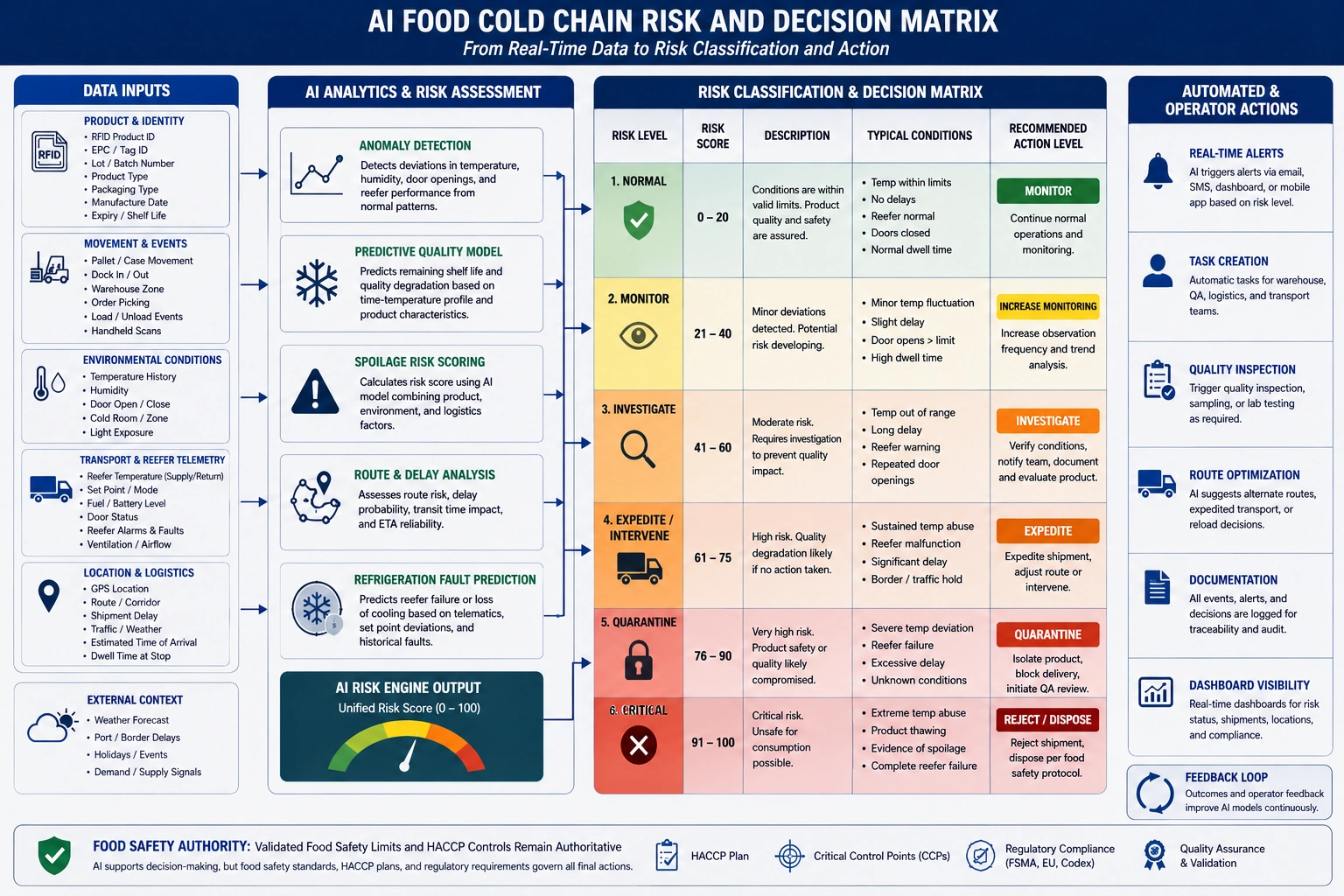
This visual shows how RFID data, environmental conditions, reefer telemetry, logistics events, and product information feed into AI analytics to assess cold chain risk. It illustrates risk classifications from normal to critical and the corresponding monitoring, investigation, intervention, quarantine, inspection, and corrective actions, while keeping validated HACCP and food safety controls authoritative.
End-to-End Data Flow for AI Food Cold Chain Operations
A reliable AI food cold chain solution begins with accurate data capture and ends with a defined operational response. Poor RFID reads, incorrectly associated sensor measurements, inconsistent timestamps, or incomplete inventory master data can undermine even sophisticated AI models.
Food Identification and Sensor Data Capture
Data acquisition starts at operational control points such as receiving docks, inspection stations, refrigerated storage entrances, freezer transitions, picking zones, staging lanes, shipping portals, and transportation assets.
RFID tags identify pallets, cases, containers, or reusable transport items. Temperature and humidity sensors record environmental conditions. Other sources may include door sensors, refrigeration controllers, pressure sensors, energy meters, GPS devices, telematics units, industrial cameras, weighing systems, and data loggers.
The design must determine whether a measurement represents ambient room conditions, trailer conditions, pallet-level conditions, package-level conditions, or actual product temperature. These values are not interchangeable.
Gateways, Edge Processing, and Communication
RFID readers and IoT sensors transmit observations through industrial Ethernet, Wi-Fi, cellular communications, BLE, or other appropriate networks. Gateways normalize device data and can filter duplicate events before sending records to higher-level software.
Edge computing is valuable where facilities require rapid local decisions or cannot depend on uninterrupted internet connectivity. A refrigerated warehouse, for example, may continue processing RFID events and temperature alarms locally during a WAN interruption and synchronize records after connectivity returns.
Timestamp synchronization is critical. RFID events, temperature measurements, door events, and logistics transactions need sufficiently consistent time references to reconstruct a reliable custody and condition history.
Middleware and Food Cold Chain Data Context
Raw tag reads have limited business meaning until middleware associates an EPC, tag ID, or device identifier with product master data and operational context.
The software may connect an RFID observation to:
- SKU or GTIN
- Food category
- Batch or lot
- Production date
- Expiration or best-before date
- Supplier
- Pallet or case hierarchy
- Storage requirement
- Warehouse location
- Shipment
- Purchase order
- Customer order
- Carrier
- Quality status
Event filtering is equally important. A fixed reader may observe the same tagged pallet repeatedly while it remains within a read zone. Middleware must distinguish useful movement events from redundant observations.
AI Analytics and Operational Actions
Contextualized records can feed anomaly detection, forecasting, classification, predictive maintenance, computer vision, optimization, and risk-scoring models.
Model output must connect to defined workflows. A predicted temperature-control problem could generate a maintenance work order. A high-risk pallet could be placed on quality hold. An approaching shelf-life constraint could influence FEFO allocation. An unexpected pallet movement could create a WMS exception. A delayed reefer shipment could trigger logistics intervention.
This closed-loop relationship between physical events, AI analysis, and operational action is what turns connected cold chain data into practical business value.
AI and RFID Food Cold Chain Data Workflow for Intelligent Monitoring and Operations
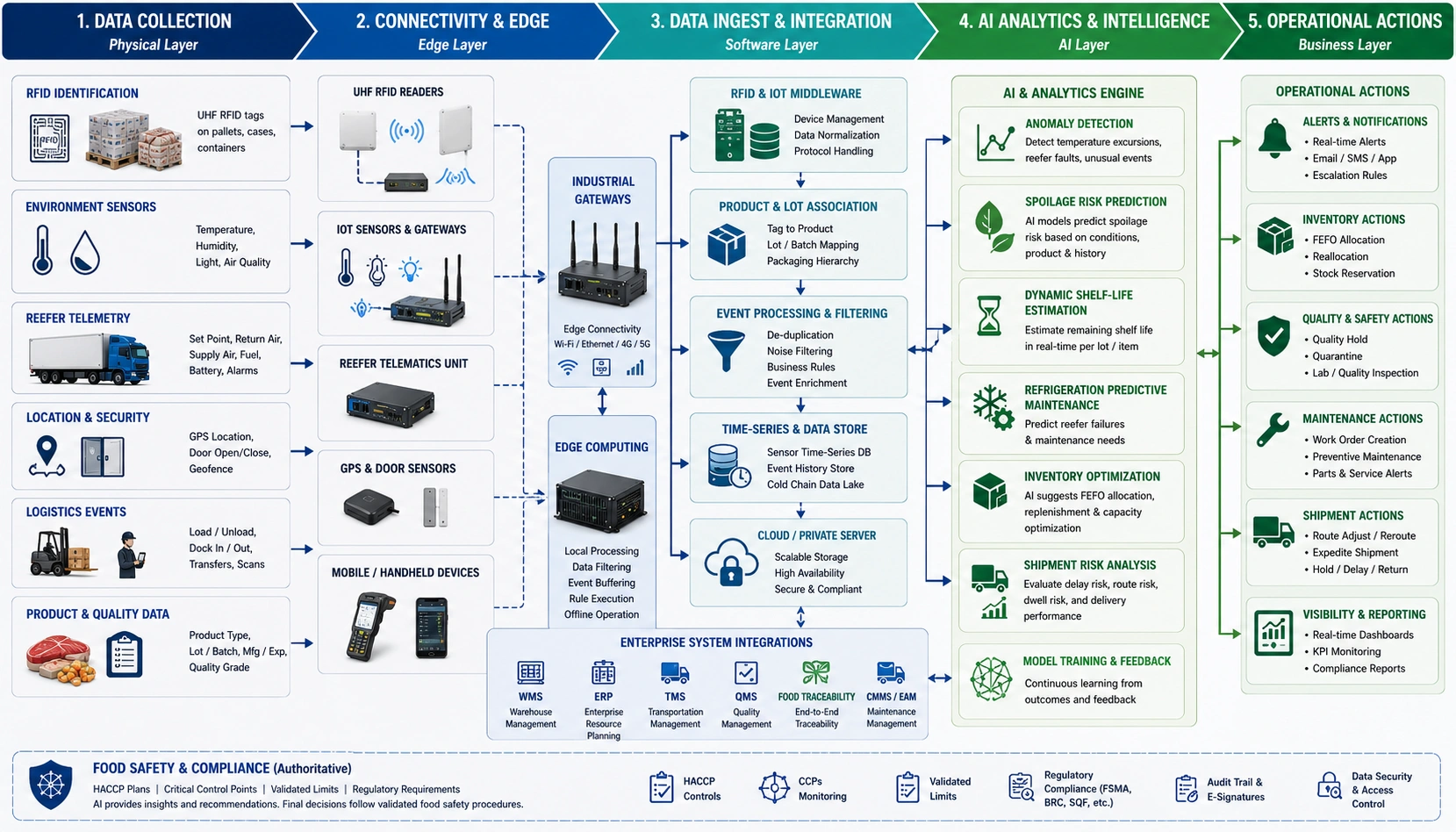
This visual illustrates the complete AI and RFID food cold chain data workflow, from RFID identification, environmental sensors, reefer telemetry, and edge computing through enterprise integration and AI analytics. It shows how real-time data supports spoilage prediction, shelf-life estimation, predictive maintenance, inventory optimization, shipment risk analysis, and operational actions while maintaining HACCP and food safety compliance.
Engineering Challenges in Food Cold Chain Deployments
Food cold chain facilities create environmental and operational conditions that must be considered before deploying RFID, sensors, gateways, or AI software.
RF Performance Around Food, Liquids, and Metal
Many foods contain substantial water, which can absorb UHF RF energy. Metal shelving, stainless-steel equipment, foil packaging, insulated panels, dense pallet loads, and refrigerated structures can also reflect or obstruct signals.
A site survey should therefore evaluate tag orientation, pallet composition, antenna position, read distance, reader power, multipath behavior, neighboring read zones, and unwanted reads. Laboratory tag testing alone does not replace validation using representative food products and actual facility conditions.
Condensation, Frost, and Low-Temperature Hardware
Cold rooms, freezers, refrigerated docks, and transitions between temperature zones can expose devices to condensation and frost. Enclosures, connectors, cables, tags, antennas, and sensors should be selected according to expected temperature, humidity, ingress, washdown, and cleaning conditions.
Freezer installations may also affect battery-powered sensor performance. Battery chemistry, transmission interval, device sleep behavior, maintenance accessibility, and expected service life should be evaluated before large-scale deployment.
Data Quality Before AI Model Development
AI performance depends on trustworthy operational data. Missing sensor records, duplicate RFID reads, clock drift, incorrect pallet associations, uncalibrated sensors, incomplete quality outcomes, and inconsistent product master data can create misleading model relationships.
Food cold chain projects should therefore establish data-quality KPIs before model development. Useful measures include RFID read reliability, sensor completeness, timestamp accuracy, device availability, tag-to-product association accuracy, false alert rate, missing gateway events, and percentage of inventory with complete traceability histories.
For three decades, GAO has served organizations across the U.S. and Canada, including Fortune 500 companies, R&D organizations, universities, and government agencies, while investing substantially in product and system R&D, quality assurance, and technical support. These capabilities are particularly relevant where cold chain deployments require careful hardware selection, RF engineering, testing, and integration rather than simple device installation.
Technologies Supporting AI Food Cold Chain Management
Effective AI food cold chain systems depend on coordinated identification, sensing, communications, computing, analytics, and business software. Technology selection should reflect product characteristics, storage temperatures, facility layout, shipment volume, traceability requirements, network availability, and the operational decisions the system must support.
RFID Tags, Readers, and Antennas for Food Cold Chain Operations
UHF RFID can provide automated identification of food pallets, cases, reusable transport items, insulated containers, roll cages, and other logistics assets. Passive tags are commonly suitable where low tag cost and maintenance-free identification are priorities. Specialized tags may be required around liquids, foil packaging, metal containers, or reusable assets.
Fixed RFID readers can monitor receiving doors, cold-room transitions, conveyors, staging zones, and shipping portals. Handheld readers support inventory searches, exception resolution, cycle counting, and receiving verification. Antenna placement determines the effective read zone and should be validated under realistic loading conditions.
HF RFID and NFC can support shorter-range identification, verification, and product interaction applications. LF RFID may be selected for specialized short-range identification scenarios where its RF characteristics are advantageous.
GAO supplies RFID tags, readers, antennas, handheld devices, and related IoT hardware that can be configured for different food cold chain identification requirements.
Temperature, Humidity, and Condition Sensors
Temperature sensing provides the environmental data required to evaluate cold chain performance. Depending on the application, sensors may monitor cold-room air, refrigerated trailers, containers, pallets, packages, or representative product conditions.
Humidity sensors can add useful context for products and packaging sensitive to moisture. Door sensors help identify periods when refrigerated spaces are exposed to warmer ambient air. Additional measurements may include vibration, light exposure, pressure, refrigeration equipment parameters, energy consumption, and GPS location.
Sensor calibration, sampling intervals, measurement accuracy, response time, battery life, placement, and data retention requirements should be defined according to the food product and operational risk.
Edge Gateways and Local Computing
Industrial gateways connect RFID readers, sensors, refrigeration controllers, and other devices to higher-level software. They can normalize device protocols, buffer records, filter RFID observations, execute local business rules, and maintain data acquisition when external connectivity is unavailable.
Edge servers can host more advanced processing, including anomaly detection or machine learning inference. Local processing is particularly useful in distribution centers and refrigerated warehouses where temperature excursions, equipment failures, or movement exceptions may require immediate response.
AI Models for Food Cold Chain Analytics
Different food cold chain problems require different AI methods.
Machine learning classification can categorize shipments or inventory according to quality or excursion risk. Regression models can estimate remaining shelf life or expected temperature behavior where suitable validated datasets exist. Time-series forecasting can identify refrigeration trends and predict equipment deterioration.
Anomaly detection can recognize unusual sensor patterns, unexpected pallet movements, abnormal dwell times, and deviations from normal refrigeration behavior. Optimization algorithms can support inventory allocation, order fulfillment, routing, and FEFO decisions.
Computer vision can complement RFID and sensors at inspection points by evaluating packaging condition, label presence, pallet condition, product appearance, or loading practices. AI results should remain traceable to the underlying data so food safety, quality, and operations personnel can investigate significant decisions.
Cloud Version for Multi-Site Food Cold Chain Operations
A Cloud Version hosts cold chain software and AI services within cloud infrastructure. RFID events, sensor records, shipment data, and other authorized information are transmitted from facilities and logistics operations to centralized services.
Cloud deployment can be appropriate for geographically distributed food networks involving multiple warehouses, processing sites, suppliers, carriers, or distribution centers. Centralized computing simplifies cross-site analytics, model management, dashboards, data aggregation, and scalability.
Reliable connectivity, data residency requirements, cybersecurity controls, integration requirements, and cloud operating costs should be evaluated before deployment.
Server Version for Controlled Food Cold Chain Computing
A Server Version can run on an edge server, customer-managed server, private data center, facility server, or another privately hosted computing environment.
This approach may be preferred where organizations require greater control over food traceability data, have strict cybersecurity policies, operate facilities with unreliable external connectivity, or require low-latency local processing.
Hybrid deployment is also practical. Time-critical RFID processing and temperature alarms can remain local while approved historical information is synchronized with centralized systems for fleet-level or multi-facility analytics.
The decision between Cloud Version, Server Version, and hybrid deployment should therefore be based on latency, availability, security, integration, data governance, scalability, and operational continuity rather than a single default model.
Integrating AI Cold Chain Data with Business Systems
Food cold chain intelligence becomes more valuable when RFID and sensor information is connected to the systems already controlling inventory, production, transportation, quality, maintenance, and traceability.
WMS and Inventory Integration
Warehouse management systems can consume RFID movement events to confirm receiving, put-away, transfers, picking, staging, and shipping. AI analysis can add predicted shelf-life risk, dwell-time exceptions, inventory anomalies, and FEFO recommendations.
Accurate integration requires consistent product, location, lot, pallet, and shipment identifiers between RFID middleware and the WMS.
ERP and Food Traceability Integration
ERP systems contain purchasing, inventory, production, order, supplier, and customer information needed to place physical observations into business context.
Food traceability software can link RFID events with lot genealogy and custody history. Combining this information with sensor records can create a more complete record of where food traveled and the environmental conditions associated with its journey.
TMS and Reefer Logistics Integration
Transportation management systems provide shipment plans, routes, carriers, appointments, delivery status, and freight information. Combining TMS data with GPS, reefer conditions, RFID shipment identity, and door events allows AI models to evaluate transportation risk using both planned and actual activity.
A delayed shipment, for example, becomes more meaningful when the system also knows the food category, temperature history, remaining transit time, refrigeration condition, and destination appointment.
QMS and Food Safety Workflows
Quality management systems can receive excursion events, AI risk classifications, inspection requests, and nonconformance records. Quality personnel can then document investigations, dispositions, corrective actions, and release decisions.
HACCP critical limits, validated food safety controls, regulatory requirements, and approved quality procedures should remain authoritative. AI can improve prioritization and analysis but should not replace scientifically validated controls.
CMMS and Refrigeration Maintenance
Refrigeration compressors, evaporators, condensers, fans, pumps, doors, and other equipment generate operational information that can support predictive maintenance.
AI can correlate equipment telemetry with temperature instability and historical maintenance records. When deterioration is detected, integration with CMMS or EAM software can generate an inspection or maintenance request before equipment performance creates a larger product-quality risk.
AI-Enabled Food Cold Chain Systems Integration Architecture with RFID and IoT
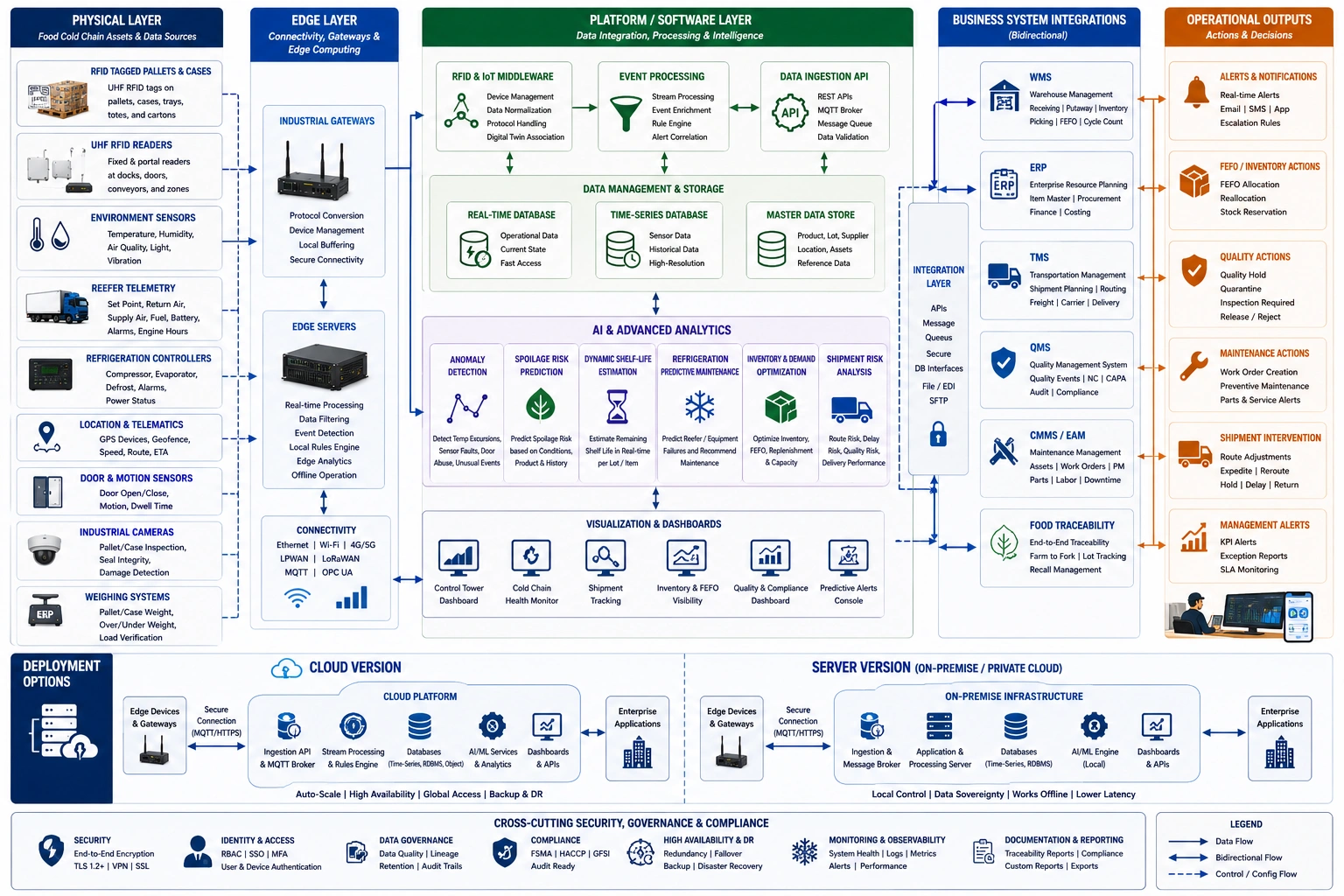
This visual illustrates how RFID, environmental sensors, reefer telemetry, refrigeration controls, GPS, cameras, and weighing systems connect through edge infrastructure to AI analytics and enterprise software. It highlights bidirectional WMS, ERP, TMS, QMS, CMMS/EAM, and traceability integration, along with cloud and on-premise deployment options that support quality, inventory, maintenance, shipment, and management decisions.
Cybersecurity and Reliability for Connected Food Cold Chains
Cold chain digitization increases the number of connected readers, sensors, gateways, servers, applications, and interfaces that require protection. Cybersecurity therefore needs to be considered during system design rather than added after commissioning.
Device authentication helps prevent unauthorized hardware from connecting to the system. Encrypted communications protect data moving between gateways, servers, cloud services, and business software. Role-based access control can restrict administrative, quality, maintenance, warehouse, and management functions according to job responsibilities.
Network segmentation can separate IoT and operational technology traffic from general corporate IT networks. Firewalls and controlled interfaces should restrict communication between zones. API authentication, credential management, security logging, software maintenance, backup procedures, and recovery testing should also form part of operational security.
Reliability is equally important because incomplete data can produce incorrect conclusions. System health monitoring should detect offline readers, failed gateways, missing sensor transmissions, low batteries, clock synchronization problems, storage capacity issues, and communication failures.
Food operations should also define fallback procedures. A network or software outage should not eliminate the facility’s ability to maintain validated food safety controls or perform essential receiving, storage, shipping, and temperature-monitoring activities.
GAO’s technical support and quality assurance experience can assist organizations selecting and deploying RFID and IoT hardware where system availability, environmental suitability, and reliable data capture are critical requirements.
Business and Operational Benefits of AI Food Cold Chain Systems
The value of AI-enabled cold chain management comes from improving specific operational outcomes rather than simply collecting additional data.
Reduced Food Spoilage and Waste
Continuous condition monitoring can identify temperature instability earlier. AI can distinguish patterns associated with increasing product risk and help personnel prioritize intervention.
Earlier detection can reduce the quantity of food exposed to unsuitable conditions and provide better evidence for quality decisions.
Stronger Food Traceability
RFID-enabled identification can automate movement capture at high-volume control points. When connected to lot, shipment, inventory, and temperature records, this creates a more detailed chain of custody.
Better traceability can accelerate investigations, improve recall precision, and help teams determine which inventory actually requires attention.
Improved Cold Storage Inventory Accuracy
Automated identification reduces dependence on manual scanning and physical searches. Warehouse teams gain better visibility into pallets, cases, staging areas, and storage locations.
AI can analyze movement patterns to identify misplaced inventory, excessive dwell time, unusual movements, and allocation problems.
More Effective FEFO Inventory Rotation
Static expiration dates remain important, but products with similar dates may have experienced different handling conditions.
Where appropriate validated models are available, predicted quality or shelf-life information can supplement FEFO decisions. Warehouse teams can prioritize vulnerable inventory while maintaining applicable food safety and quality requirements.
Faster Temperature Excursion Response
Conventional monitoring may produce a large number of alarms with limited context. AI can combine excursion severity, duration, product identity, shipment history, location, and previous exposure to support more informed prioritization.
Quality teams can focus first on exceptions with the greatest potential operational impact.
Reduced Unplanned Refrigeration Downtime
Predictive models can detect changes in refrigeration behavior before complete equipment failure. Maintenance personnel can investigate developing problems during planned service windows where possible.
This benefit extends beyond maintenance costs because refrigeration reliability directly affects stored food quality and operational continuity.
Better Refrigerated Transportation Visibility
Combining shipment identity with temperature, GPS, reefer telemetry, door status, and transportation schedules provides a richer view than location tracking alone.
Logistics teams can identify shipments that are delayed, experiencing unusual temperature behavior, or showing signs of refrigeration problems and intervene before delivery.
Scalable Multi-Facility Cold Chain Intelligence
Standardized data models allow organizations to compare cold storage sites, routes, carriers, refrigeration assets, suppliers, and product categories.
AI can identify recurring problems that may not be obvious from a single shipment, such as a loading dock with repeated temperature exposure, a route associated with excessive delays, or a refrigeration unit with increasingly unstable performance.
KPIs for Measuring AI Food Cold Chain Performance
Implementation should be measured against operational and food-quality outcomes established before deployment. Relevant KPIs vary by product and process, but commonly include:
- Temperature excursion frequency
- Average excursion duration
- Percentage of shipments within specified temperature conditions
- Food spoilage and waste rate
- Product rejection rate
- Quality hold frequency
- Cold storage inventory accuracy
- RFID read reliability
- Sensor data completeness
- Traceability record completeness
- Recall investigation time
- Pallet dwell time
- Dock-to-stock time
- Order picking accuracy
- FEFO compliance
- Refrigerated shipment delay rate
- Reefer equipment availability
- Refrigeration downtime
- Mean time between refrigeration failures
- Maintenance response time
- False alarm rate
- AI model precision and recall for defined exception classes
- Percentage of actionable alerts
- Device availability
- Gateway connectivity
- Battery replacement frequency
Technical metrics should be evaluated alongside business outcomes. A high-performing model has limited value if operators ignore its alerts, the RFID system does not reliably identify the correct pallet, or recommended actions are not integrated into established workflows.
Implementing AI and RFID in Food Cold Chain Operations
Successful implementation should begin with a clearly defined food cold chain problem rather than selecting technology first. Examples include reducing temperature excursions during staging, improving pallet traceability, decreasing spoilage, detecting reefer failures, improving FEFO compliance, or reducing inventory discrepancies.
The project team should map the existing workflow and identify where data is created, where visibility is lost, which decisions are delayed, and which outcomes can be measured.
Assess Food Cold Chain Processes and Data
Document receiving, inspection, storage, picking, staging, shipping, transportation, and quality workflows. Identify product categories, temperature ranges, packaging materials, pallet configurations, storage zones, refrigeration equipment, and existing identification methods.
Review WMS, ERP, TMS, QMS, CMMS, traceability, sensor, and refrigeration data before determining AI requirements.
Conduct RFID and Wireless Site Testing
Perform RF testing using representative products, pallets, racks, doors, forklifts, and loading conditions. Food and liquid content can substantially change UHF RFID behavior.
Reader and antenna locations should be tested for required reads, missed reads, cross-zone reads, interference, and environmental exposure.
Establish a Measurable Pilot
A pilot should target a specific workflow and define baseline KPIs before installation. Suitable examples include one receiving portal, one refrigerated storage zone, a group of reefer trailers, or a defined product family.
The pilot should test hardware reliability, tag performance, sensor accuracy, integration, user workflows, alert quality, and measurable operational improvement.
Validate AI Models with Operational Experts
Historical datasets should be checked for missing values, biased samples, inconsistent labels, sensor errors, and changes in operational conditions.
Food safety, quality, refrigeration, warehouse, and logistics specialists should participate in model validation. False positives and false negatives can have different operational consequences and should be evaluated separately.
Commission, Train, and Scale
Commissioning should verify RFID read zones, sensor calibration, communication reliability, event processing, software integrations, security controls, AI inference, alerts, and fallback procedures.
Operators need practical training on what an alert means, how to investigate it, and how to record the resulting action. After KPI improvements are demonstrated, the solution can expand to additional cold rooms, dock doors, products, transportation assets, facilities, or distribution networks.
GAO can support organizations with RFID and IoT hardware products, system components, technical expertise, and deployment support for food cold chain identification and monitoring requirements.
AI and RFID Food Cold Chain Implementation Roadmap from Pilot to Multi-Site Deployment
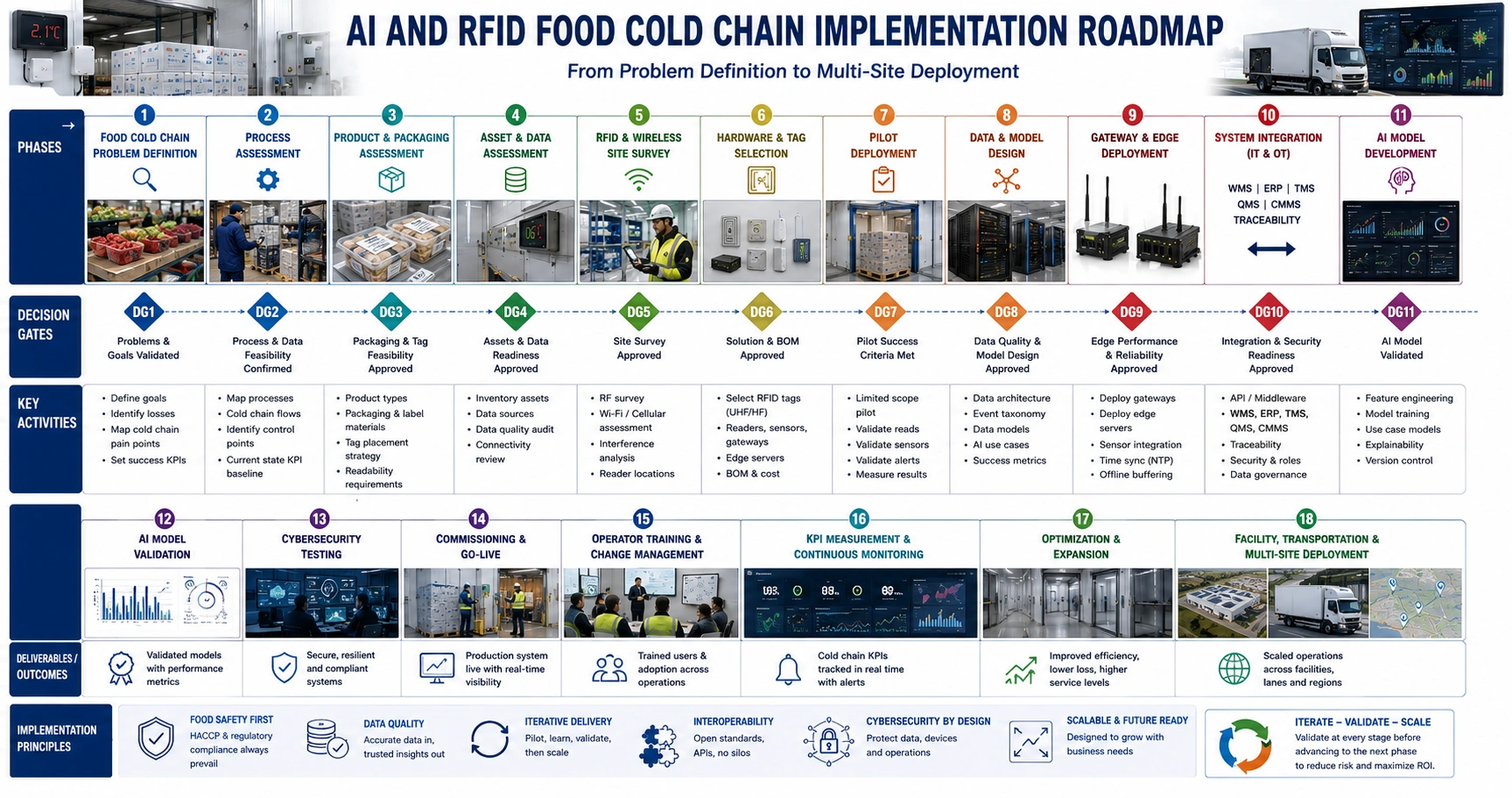
This visual presents the complete implementation roadmap for AI and RFID in food cold chain operations, from problem definition, assessments, and site surveys through pilot deployment, systems integration, AI validation, cybersecurity testing, training, and KPI monitoring. It emphasizes engineering decision gates and iterative validation before expanding across facilities, transportation networks, and multiple sites.
Building Reliable AI-Driven Food Cold Chain Operations
AI-powered food cold chain management delivers the greatest value when accurate product identity, environmental measurements, logistics events, refrigeration data, and operational records are converted into timely decisions. RFID supports automated identification and movement visibility, while sensors establish the condition history required for meaningful AI analysis.
Implementation quality depends on RF engineering, sensor accuracy, reliable communications, clean master data, system integration, validated AI models, cybersecurity, operator workflows, and measurable KPIs. Organizations should begin with defined cold chain problems, validate performance under real operating conditions, and scale only after technical and business outcomes have been demonstrated.
Headquartered in New York City and Toronto, Canada, GAO is ranked among the leading B2B and B2G RFID and BLE suppliers worldwide. We provide RFID, BLE, IoT hardware products, systems, engineering expertise, and technical support that organizations can use when building connected food cold chain solutions. Readers can explore GAO’s technologies and technical resources to evaluate suitable components for their specific cold storage, traceability, inventory, and refrigerated logistics requirements.
Building the Future of Industrial AI and IoT with Aperture Venture Studio and GAO RFID Inc.
For more than three decades, GAO Group of Companies has invested heavily in R&D of industrial RFID, BLE, and IoT. Since generative AI demonstrated practical value in industrial applications, we have been developing AI and IoT technologies that can support applications such as intelligent food traceability, cold storage monitoring, and refrigerated logistics. We have also founded Aperture Venture Studio to advance and scale AI and IoT innovation for industries including temperature-controlled food operations.
Aperture has attracted AI and IoT technical experts, operational executives, influential investors, and leading companies. Through Aperture Ventures Summit and TekSummit, we have developed technical communities for discussing advanced AI and IoT applications.
We welcome you to join us as:
- Advisors, Co-founders or Employees
- Investors
- Customers