
AI for Oil & Gas Downstream Operations with RFID-Enabled Intelligence
AI-Driven Oil & Gas Downstream Operations
Artificial Intelligence is changing Oil & Gas Downstream operations by converting data from refinery assets, terminals, warehouses, pipelines, maintenance activities, and material movements into actionable operational intelligence. AI can help downstream organizations improve asset visibility, maintenance planning, inventory control, turnaround management, contractor coordination, safety monitoring, and operational decision-making. RFID provides an enabling data-capture layer by identifying tagged equipment, tools, components, containers, materials, and other physical assets as they move through refineries, tank farms, terminals, warehouses, and maintenance areas.
For downstream operators, the value comes from connecting physical operations with AI-based analytics rather than treating RFID as an isolated identification technology. RFID data can be combined with CMMS, EAM, ERP, DCS, SCADA, laboratory systems, warehouse management software, access-control systems, and operational databases. AI models can then identify patterns, predict maintenance requirements, detect inventory discrepancies, prioritize work, and support decisions. GAO provides RFID, BLE, and IoT hardware products and systems that can support these data-driven operational requirements.
Why AI Matters Across Oil & Gas Downstream Operations
Oil & Gas Downstream facilities operate complex networks of processing units, rotating equipment, storage systems, utilities, warehouses, maintenance teams, contractors, and logistics operations. The physical environment generates large volumes of operational data, but many important events still depend on manual identification, inspections, spreadsheets, radio communication, paper records, or disconnected software systems.
AIoT, commonly referred to as AI and IoT, combines artificial intelligence with IoT devices, sensors, connected equipment, and industrial systems. In downstream operations, this can include Industrial AI, machine learning, Edge AI, computer vision, and, where autonomous physical actions are appropriate, Physical AI.
AI applications can address operational questions such as:
- Which maintenance tools, spare parts, and tagged assets are currently available at a refinery location?
- Which critical equipment requires inspection, maintenance, or follow-up?
- Which materials have not reached the required work area for a planned maintenance activity?
- Where are high-value tools, containers, components, and maintenance assets located?
- Which inventory records do not correspond with physical stock?
- Which recurring operational patterns indicate a potential maintenance, logistics, or process problem?
- How can turnaround activities be monitored against planned schedules and material availability?
RFID contributes by creating machine-readable identity and location events. The resulting data becomes more valuable when correlated with equipment history, work orders, inventory records, operating conditions, maintenance schedules, and other downstream information.
Key AI Applications in Oil & Gas Downstream
AI Asset Tracking and Equipment Visibility
Refineries and terminals contain large numbers of valves, pumps, motors, tools, instruments, containers, maintenance equipment, and temporary assets. AI-assisted asset tracking can combine RFID events with historical records and operational context to provide better visibility into asset movement and utilization.
RFID readers can capture the identity of tagged assets at defined checkpoints or operating areas. AI software can analyze movement histories to identify unusual asset movement, prolonged inactivity, missing equipment, or utilization patterns that may support maintenance and resource planning.
AI Inventory Management for Refineries and Terminals
Downstream maintenance operations depend on reliable access to spare parts, consumables, tools, fittings, instruments, and other materials. Inventory discrepancies can delay maintenance work and increase the risk of emergency procurement.
RFID-supported AI inventory management can correlate physical identification events with ERP and warehouse records. AI analytics can help identify unusual consumption patterns, stock discrepancies, slow-moving materials, frequently requested components, and potential shortages.
AI Predictive Maintenance Support
Predictive maintenance in downstream facilities generally depends on multiple data sources rather than a single identification technology. Equipment condition data can include vibration, temperature, pressure, operating hours, inspection records, alarm histories, maintenance work orders, and component replacement history.
RFID can contribute equipment and component identity to this information. For example, when a tagged pump component, motor, instrument, or maintenance asset is associated with a work order, the system can maintain a stronger relationship between the physical item and its digital maintenance history. AI models can use this combined information to improve maintenance prioritization and traceability.
AI Turnaround and Maintenance Material Coordination
Refinery turnarounds involve tightly coordinated work packages, contractors, equipment, spare parts, tools, permits, inspections, and temporary materials. Delays can occur when required components or tools are physically unavailable even though software records indicate that they should be available.
RFID checkpoints can provide physical movement events, while AI can correlate those events with turnaround schedules, work orders, material requirements, and inventory records. This can help supervisors identify potential material-related delays earlier and prioritize corrective action.
Realistic RFID Deployment in Oil & Gas Downstream Operations
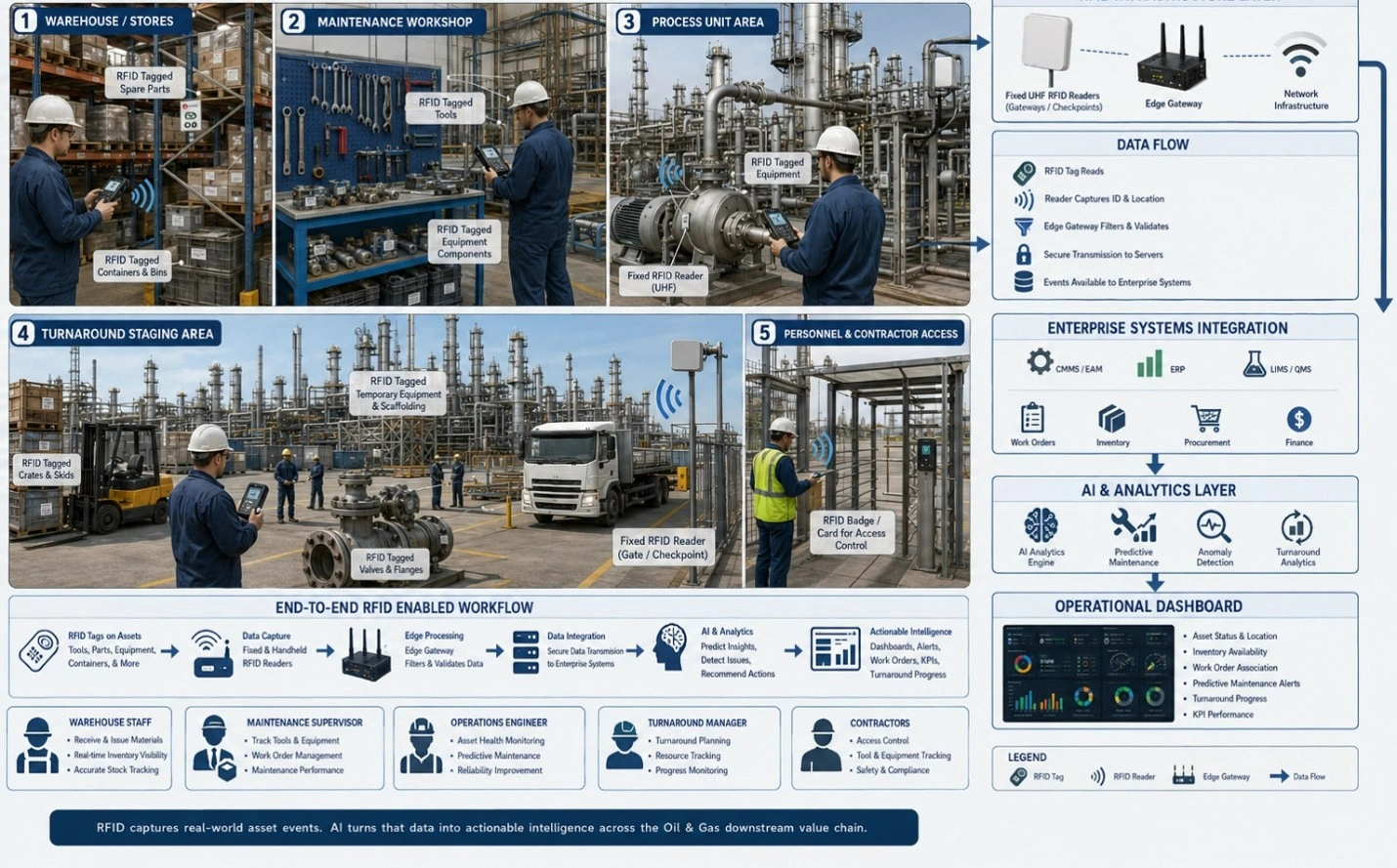
A realistic refinery deployment showing how RFID captures asset data across warehouses, maintenance workshops, process units, and turnaround areas, connecting physical assets with edge gateways, AI analytics, CMMS/EAM, ERP, and operational dashboards.
Oil & Gas Downstream Operational Workflows for AIoT
A practical downstream AIoT solution begins with physical data acquisition and continues through communication, processing, analytics, and operational action. The workflow should be designed around the actual decision that the refinery, terminal, warehouse, maintenance group, or operations team needs to make.
Physical Data Capture
RFID readers capture tag identities at designated locations. Depending on the use case, fixed readers, handheld readers, portal readers, or other reader configurations can be deployed. Tag selection depends on the asset material, mounting location, read range, environmental conditions, and required identification performance.
For example, tagged maintenance equipment can generate movement events when entering or leaving a controlled area. Spare parts can be associated with receiving, storage, picking, and issuing events. Tagged tools can be associated with maintenance teams and work orders.
Edge Processing and Communications
Reader-generated events can be filtered and processed before being transmitted to downstream software. Edge gateways or industrial computers can aggregate reader data, remove duplicate reads, normalize events, and forward relevant information to local servers or cloud-based software.
Communication methods depend on the facility and use case. Ethernet, Wi-Fi, cellular connectivity, industrial networking, and other communications technologies can be used where appropriate. Network design must account for refinery operating conditions, coverage, cybersecurity requirements, segmentation, and availability.
Enterprise Software Integration
RFID events become operationally useful when associated with business records. Middleware can map tag identities to asset IDs, material numbers, equipment records, personnel workflows, work orders, or inventory records.
Integration may involve:
- Enterprise resource planning systems
- Computerized maintenance management systems
- Enterprise asset management systems
- Warehouse management software
- Maintenance work-order systems
- Turnaround management software
- Access-control systems
- Operational dashboards
- Data historians
- Industrial databases
- AI and machine-learning software
AI Analytics and Operational Decisions
After data is normalized and integrated, AI models can identify patterns that are difficult to detect through manual review. Depending on the use case, models can support anomaly detection, forecasting, classification, optimization, predictive maintenance, demand estimation, image analysis, or operational prioritization.
The output should lead to a defined operational action. For example, an AI-generated inventory exception can initiate a physical stock check. A predicted maintenance requirement can trigger engineering review. A turnaround material exception can alert the responsible supervisor. The goal is not simply to generate more alerts but to improve the timing and quality of downstream decisions.
AIoT Workflow in Oil & Gas Downstream Operations: From Asset Identification to AI-Driven Decisions
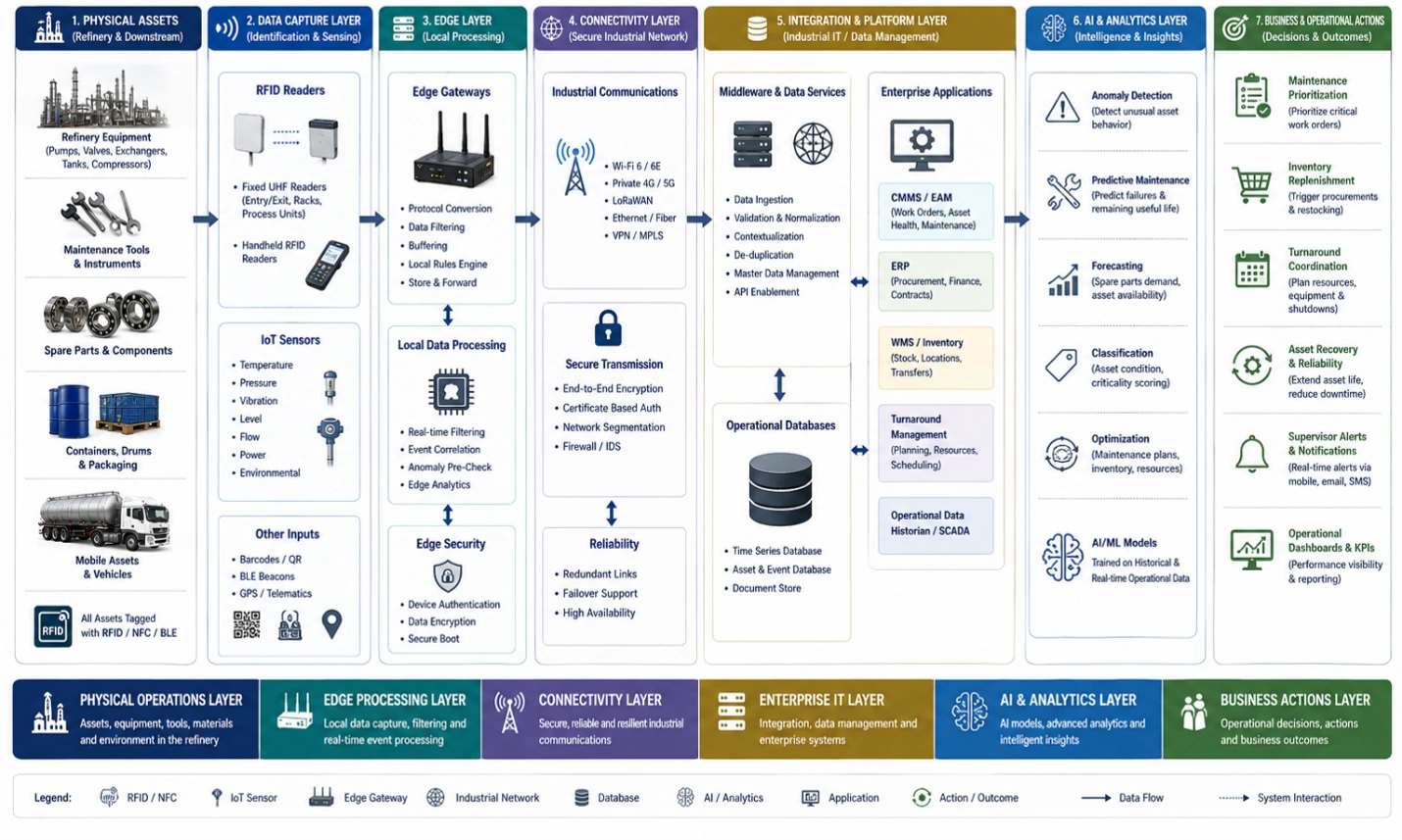
This workflow diagram illustrates how AIoT connects refinery assets, RFID readers, IoT sensors, edge gateways, secure industrial networks, enterprise systems, and AI analytics to support predictive maintenance, inventory optimization, turnaround coordination, asset recovery, and real-time operational decisions.
RFID and Supporting Technologies for Downstream AI Solutions
RFID should be selected according to the physical and operational requirements of the downstream application. UHF RFID is generally suited to longer-range identification and higher-throughput asset or inventory applications. HF RFID can be appropriate for shorter-range identification scenarios where controlled read distances are desirable. LF RFID can support specialized identification applications where its characteristics match the asset and operating environment.
The surrounding system is equally important. RFID readers, antennas, tags, handheld devices, edge gateways, industrial computers, databases, middleware, communication networks, AI software, and enterprise applications must operate together to produce reliable operational information.
Hardware Selection for Refinery and Terminal Environments
Hardware selection should consider:
- Asset material and tag mounting surface
- Required read distance
- Read-zone geometry
- Metal interference
- Environmental exposure
- Temperature and chemical conditions
- Reader density
- Network availability
- Mobile versus fixed operations
- Required identification speed
- Maintenance and replacement requirements
- Hazardous-area requirements where applicable
A key engineering consideration is that RFID hardware should not be selected solely according to nominal read range. The physical configuration of the asset, tag, antenna, reader, environment, and movement pattern determines actual performance. Downstream deployments should therefore include representative testing before large-scale commissioning.
Cloud Version and Server Version
A cloud-hosted deployment can be appropriate when downstream organizations require centralized access to analytics, multi-site visibility, scalable computing resources, and remote software administration. A cloud deployment can also simplify aggregation of information from multiple facilities when connectivity and cybersecurity policies permit.
A Server Version can be deployed on edge servers, customer-managed servers, private data centers, refinery servers, or other privately hosted enterprise infrastructure. This approach can be appropriate where operational data must remain within controlled infrastructure, where local processing is important, or where connectivity to external cloud services is restricted.
The choice should be based on data governance, latency, network availability, cybersecurity requirements, integration constraints, operating procedures, and the desired level of centralized management.
Cloud vs. Server Deployment for AIoT in Oil & Gas Downstream Operations
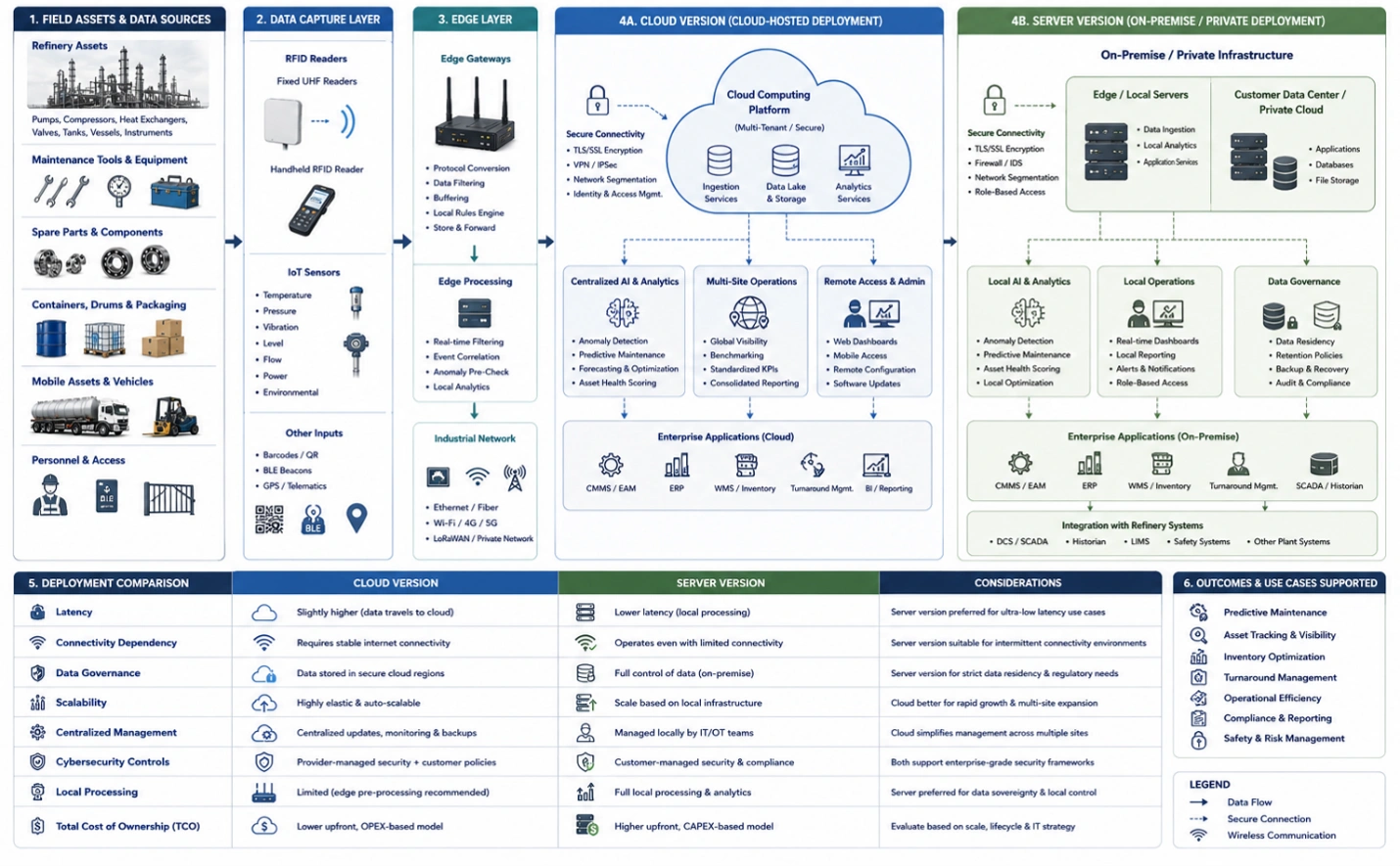
Comparison visual showing how cloud-hosted and privately managed server deployments handle AIoT data from refinery RFID readers, IoT sensors, edge gateways, and enterprise systems, with key differences in latency, connectivity, data governance, scalability, cybersecurity, and local processing.
Technical Capabilities That Improve Downstream Performance
The practical value of AI-enabled Oil & Gas Downstream systems comes from connecting physical operational events with engineering decisions. RFID alone identifies an asset or material. AI adds analytical context by relating identification events to maintenance history, equipment criticality, inventory requirements, turnaround schedules, operating conditions, and other information.
Asset Visibility and Utilization
AI-assisted asset tracking can provide more than a static location record. Historical RFID events can reveal how frequently tools, equipment, containers, and temporary assets move between warehouses, workshops, process areas, and turnaround zones.
This information can support:
- Asset utilization analysis
- Identification of underused equipment
- Detection of assets that remain outside designated areas
- Recovery of misplaced maintenance equipment
- Improved allocation of shared tools
- More accurate asset lifecycle records
Maintenance and Reliability
Reliability teams can combine RFID-based asset identity with condition-monitoring information and CMMS or EAM records. The resulting dataset can help correlate physical components with inspection results, maintenance work orders, replacement histories, and equipment operating conditions.
AI models can then support maintenance prioritization by identifying patterns associated with equipment degradation. This does not eliminate engineering judgment. Instead, it gives reliability engineers a method for focusing attention on assets with stronger evidence of elevated risk.
AI is already being applied in refining to support predictive maintenance and turnaround planning, including the analysis of historical performance and facility dependencies. (Aramco)
Inventory and Spare Parts Optimization
Refinery maintenance organizations often maintain inventories of critical spare parts whose availability can directly affect equipment repair schedules. RFID can provide physical confirmation that a material has been received, stored, picked, issued, or transferred.
AI can analyze these events alongside ERP and maintenance records to identify:
- Abnormal consumption
- Stock discrepancies
- Frequently used spare parts
- Slow-moving materials
- Potential shortages
- Emergency procurement patterns
- Materials associated with recurring equipment failures
The resulting intelligence can improve inventory planning without requiring every material-management decision to be automated.
Turnaround Coordination
Turnarounds introduce an unusually high concentration of maintenance personnel, contractors, equipment, tools, temporary materials, inspection activities, and work orders. RFID can provide physical movement evidence while AI can compare that information with planned turnaround activities.
A downstream turnaround system can therefore identify situations such as:
- Required materials not physically present in the staging area
- Tools assigned to one work package being used elsewhere
- Equipment waiting for inspection
- Work packages affected by material delays
- Unexpected asset movement
- Resources with unusually low utilization
This type of analysis can help supervisors address constraints before they become schedule-critical.
Cybersecurity and Data Integrity for Downstream AIoT
AI and RFID deployments in refineries should be designed as operational technology systems rather than treated as ordinary office IT applications. RFID readers, gateways, servers, network infrastructure, enterprise applications, and AI services can introduce additional interfaces that must be governed.
Important controls include:
- Network segmentation between operational technology and business networks
- Role-based access control
- Multi-factor authentication for administrative access
- Secure device provisioning
- Encryption for data transmitted across untrusted networks
- Strong credentials and credential rotation
- Firmware and software lifecycle management
- Centralized logging and monitoring
- Asset inventory for connected devices
- Secure API authentication
- Backup and recovery procedures
- Incident response procedures
- AI model access controls
- Validation of data entering AI models
Data integrity is particularly important because AI predictions depend on the quality of their input data. Duplicate RFID reads, incorrectly associated tags, missing timestamps, damaged tags, incorrect asset mappings, or stale maintenance records can reduce analytical reliability.
Downstream cybersecurity planning should therefore address both the RFID infrastructure and the systems receiving its data. Cybersecurity risks in oil and gas infrastructure can have physical, environmental, and economic consequences, making network and system protection an operational concern rather than solely an IT requirement.
Implementation Lifecycle for AI and RFID in Downstream Facilities
A practical implementation should progress from a defined operational problem toward measurable engineering outcomes.
Planning and Use-Case Definition
Start with a specific downstream problem rather than beginning with RFID hardware. Examples include refinery tool accountability, critical spare-parts visibility, turnaround material coordination, equipment identification, inspection traceability, or asset utilization.
Define:
- The operational decision to improve
- The assets and materials involved
- Required identification frequency
- Required location accuracy
- Existing software systems
- Available sensor and maintenance data
- Network constraints
- Cybersecurity requirements
- Success metrics
Site Survey and Hardware Selection
A physical site survey should evaluate metal surfaces, process equipment, reader locations, antenna orientation, warehouse layout, vehicle movement, interference sources, environmental exposure, and hazardous-area requirements.
Tag testing should use representative assets rather than laboratory assumptions. A tag that performs well on plastic may behave differently when attached to steel equipment or installed near dense metallic structures.
Pilot Deployment
A controlled pilot should cover a representative operational area. The objective is to verify the complete chain from tag identification through software action.
Testing should include:
- Read performance
- Missed reads
- Duplicate reads
- Tag durability
- Reader coverage
- Network availability
- Event-processing latency
- Asset-to-tag mapping
- CMMS/ERP integration
- Dashboard accuracy
- AI data quality
- User workflow acceptance
Commissioning and Integration
After hardware validation, the solution can be connected to production software. Integration should be tested with realistic operational records and failure scenarios.
For example, if an RFID event indicates that a spare part has been issued, the system should correctly associate that event with the relevant material record and work order. Exceptions should be visible to users instead of silently disappearing in middleware.
Continuous Optimization
RFID deployments require ongoing monitoring. Changes to warehouse layouts, equipment, maintenance procedures, tag mounting locations, network infrastructure, and operating conditions can affect performance.
AI models also require monitoring because equipment behavior and operating conditions can change. Model drift, data-quality degradation, changes in maintenance practices, and changes in production patterns should be incorporated into an ongoing model-governance process.
AI-Enabled RFID Implementation Lifecycle for Oil & Gas Downstream Operations
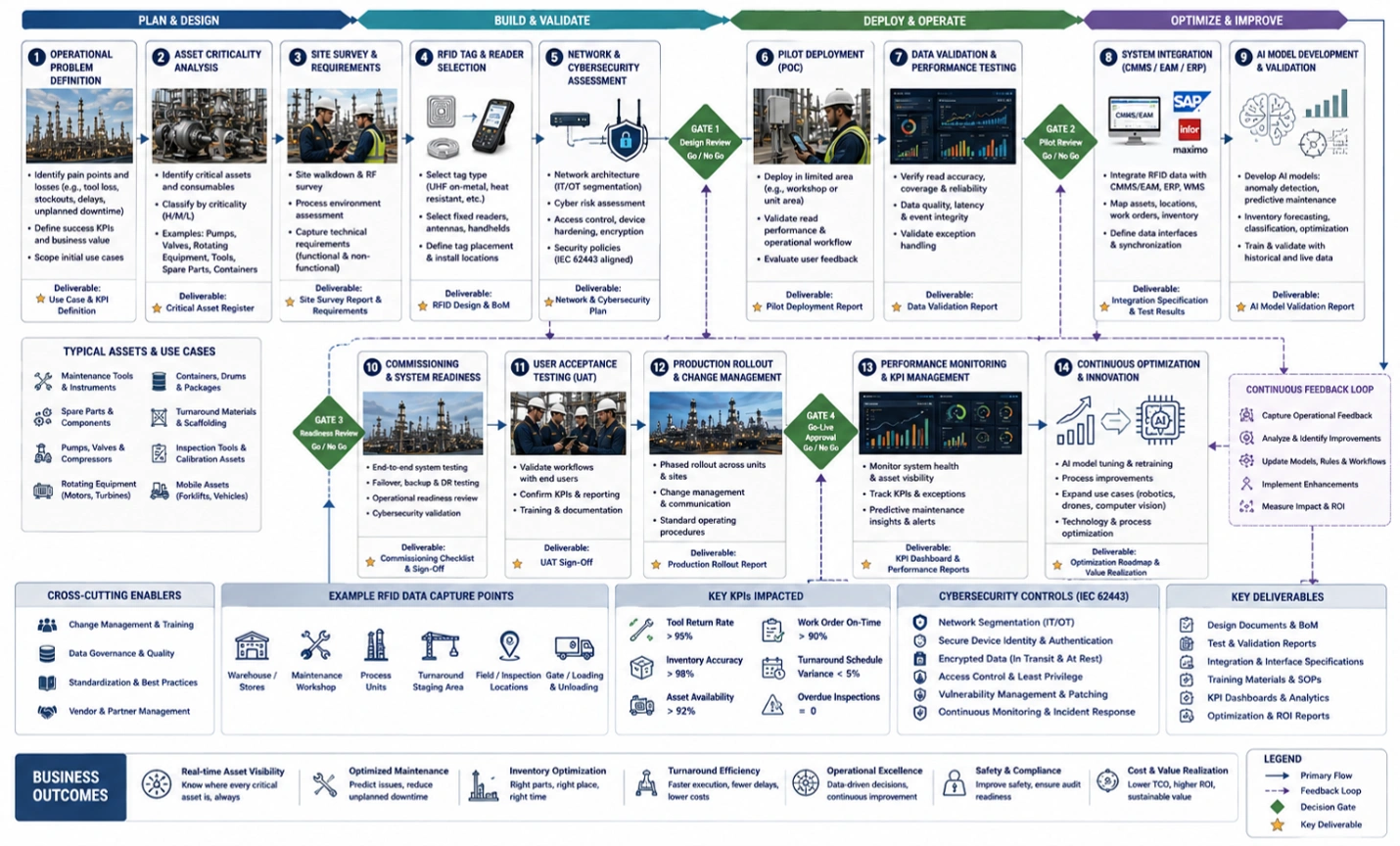
An engineering implementation roadmap covering RFID use-case definition, asset criticality analysis, site assessment, hardware selection, cybersecurity validation, pilot deployment, data validation, enterprise integration, AI model development, commissioning, rollout, performance monitoring, and continuous optimization.
KPIs for Measuring AI-Enabled Downstream Operations
A successful deployment should be evaluated through operational metrics rather than the number of RFID tags installed.
Relevant KPIs can include:
| Operational Area | Example KPI |
|---|---|
| Asset management | Asset location accuracy |
| Tool management | Tool recovery time |
| Inventory | Physical-to-system inventory accuracy |
| Maintenance | Mean time to repair |
| Reliability | Unplanned downtime |
| Predictive maintenance | Prediction lead time |
| Turnaround | Work-package schedule variance |
| Materials | Material availability at work location |
| Inspection | Inspection completion rate |
| Safety | Safety-equipment availability |
| Workforce | Time spent searching for tools or materials |
| AI performance | Model precision, recall, false-positive rate |
| RFID performance | Read success rate and event accuracy |
| System performance | Event-processing latency |
The most useful KPI framework connects technology performance with an operational outcome. For example, improving RFID read accuracy is valuable, but reducing the time required to locate critical maintenance equipment provides a more meaningful business measure.
Engineering Trade-Offs and Practical Design Considerations
No single RFID or AI configuration is appropriate for every downstream facility.
Longer read ranges can increase coverage but may require more careful control of read zones. Dense metal environments can create challenging RF conditions. Fixed readers can provide automated monitoring at controlled locations, while handheld readers offer greater flexibility for field inspections and maintenance activities.
Similarly, centralized AI processing can simplify multi-site analytics, while local edge inference can reduce latency and maintain functionality during connectivity interruptions.
The correct design therefore depends on:
- Asset density
- Facility layout
- Required location precision
- Operating environment
- Data volume
- Network availability
- Response-time requirements
- Existing IT and OT infrastructure
- Cybersecurity policy
- Maintenance procedures
- Budget and lifecycle requirements
This engineering-first approach prevents the common mistake of selecting technology based solely on specifications instead of the actual downstream workflow.
GAO Expertise for Oil & Gas Downstream RFID and AIoT
GAO is headquartered in New York City and Toronto, Canada, and provides RFID, BLE, and IoT technologies for demanding B2B and B2G applications. GAO RFID Inc., GAO Research Inc., and GAO Tek Inc. form the GAO Group, with operations based in New York City and Toronto.
For three decades, GAO Group has served customers in the United States and Canada, including Fortune 500 companies, research and development organizations, universities, and government agencies. Its work includes substantial investment in research and development, quality assurance, RFID and IoT hardware, and technical support.
For Oil & Gas Downstream applications, this experience is relevant where RFID hardware must operate as part of a larger industrial solution rather than as a standalone identification system. GAO can support organizations evaluating readers, tags, BLE and IoT devices, and related systems for asset management, inventory, maintenance, monitoring, and operational workflows.
Key Takeaways for AI-Enabled Oil & Gas Downstream Operations
AI can help downstream operators move from basic asset visibility toward predictive and decision-oriented operations. RFID provides reliable physical identification that can connect equipment, tools, materials, and operational events with digital records.
The strongest implementations focus on specific operational problems and integrate RFID data with CMMS, EAM, ERP, warehouse, turnaround, and industrial systems. AI can then analyze these combined datasets to support maintenance prioritization, inventory forecasting, turnaround coordination, anomaly detection, asset utilization, and other operational decisions.
Implementation success depends on appropriate tag and reader selection, site testing, reliable communications, data governance, cybersecurity, integration quality, and continuous performance monitoring. GAO’s RFID, BLE, and IoT technologies can provide the physical data-capture foundation for these solutions, supported by engineering expertise and technical assistance.
Building the Future of Industrial AI and IoT with Aperture Venture Studio and GAO RFID Inc.
For more than three decades, GAO Group of Companies has invested heavily in R&D for industrial RFID, BLE, and IoT technologies. As AI became increasingly useful for industrial applications, we expanded our work in AIoT and founded Aperture Venture Studio to build, launch, and scale AI and IoT companies focused on practical industrial applications, including intelligent monitoring and asset management. Aperture brings together AI and IoT technical experts, entrepreneurial and operational executives, investors, and leading companies. Through the Aperture Ventures Summit and TekSummit, we also support discussion of advanced AI and IoT topics. We welcome advisors, co-founders and employees, investors, and customers to join us.