
AI and RFID for Oil & Gas Midstream
AI-Driven Oil & Gas Midstream Operations with RFID
AI is changing how oil and gas midstream operators manage pipelines, compressor stations, pump stations, terminals, tank farms, metering facilities, maintenance activities, spare parts, tools, and field assets. AI-driven asset tracking uses operational data from RFID, sensors, SCADA, inspection systems, maintenance software, and other connected sources to identify patterns, predict events, and support faster decisions. RFID provides a practical identification layer for physical assets, components, tools, containers, maintenance materials, and inspection records, while AI converts the resulting data into operational intelligence. For midstream operators, the value is not simply knowing where an asset is. The objective is to connect asset identity and movement with maintenance history, work orders, inspection status, operating conditions, personnel workflows, and safety requirements. GAO supplies RFID and IoT hardware products and systems that can support these data acquisition requirements across demanding oil and gas operating environments.
AIoT Architecture for Intelligent Midstream Asset Management
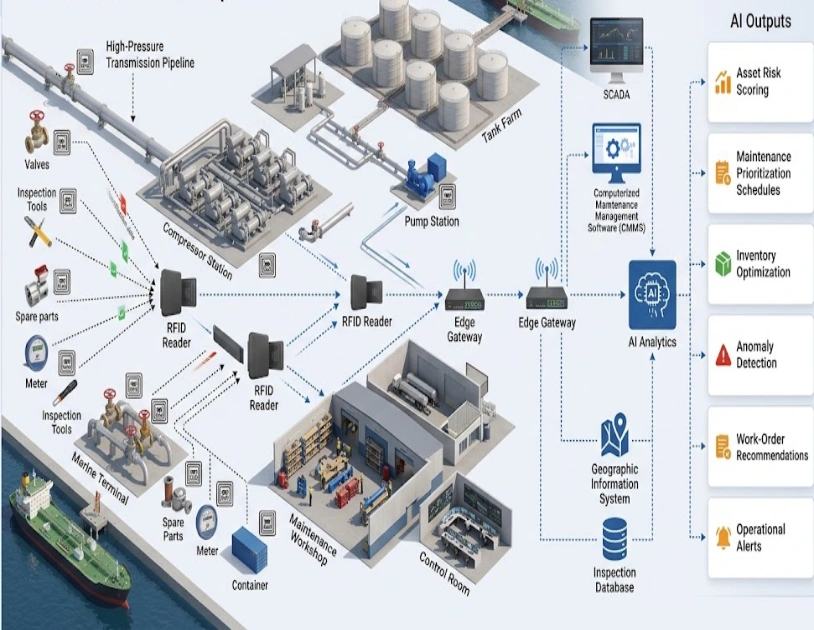
An isometric diagram illustrating an integrated AIoT system for an oil and gas midstream operation. The visual shows data flow from physical assets (pipelines, tank farms, terminals) via RFID tags to edge gateways, connecting to SCADA, CMMS, GIS, and inspection databases for AI Analytics. The final section lists six key AI Outputs, including asset risk scoring, maintenance schedules, and anomaly detection.
What AI Means for Oil & Gas Midstream Asset Operations
Oil and gas midstream covers the transportation, storage, processing, compression, pumping, measurement, and transfer of hydrocarbons between production areas, processing facilities, storage locations, refineries, export terminals, and other downstream destinations. The operational environment is geographically distributed and contains both fixed infrastructure and mobile or semi-mobile assets.
AI becomes useful when operators have enough reliable operational data to move beyond static asset registers and manual status updates. Machine learning can analyze historical maintenance events, inspection findings, equipment condition indicators, alarm patterns, utilization records, and work-order histories. Computer vision can support inspection workflows where cameras are appropriate. Edge AI can process selected information close to field equipment when latency, connectivity, or data sovereignty makes centralized processing unsuitable.
RFID contributes primarily by giving physical objects a machine-readable identity. UHF RFID can support longer-range identification of tagged tools, components, containers, maintenance materials, and selected outdoor assets. HF RFID is useful for short-range identification and controlled read points, while LF RFID can be considered where specialized low-frequency identification characteristics are required.
The resulting AIoT system combines artificial intelligence with IoT devices, sensors, connected equipment, and industrial systems. For midstream operations, this can create a traceable relationship between what an asset is, where it is, what has happened to it, what work is planned, and what operational decision should follow.
GAO’s RFID, BLE, and IoT hardware products and systems can serve as data-capture components within these workflows, particularly where physical asset identification must be connected to maintenance, inventory, inspection, or operational processes.
Where AI Delivers Value Across Oil & Gas Midstream
AI applications should be selected according to the operational decision they improve rather than simply the availability of an AI model. Midstream operators have different requirements at pipeline rights-of-way, compressor stations, storage terminals, pump stations, and maintenance facilities.
AI Asset Tracking for Pipeline and Field Equipment
Pipeline operators manage extensive inventories of valves, actuators, fittings, flanges, instruments, inspection equipment, maintenance tools, temporary equipment, and replacement components. Asset identification becomes difficult when equipment moves between depots, contractors, field locations, and maintenance areas.
RFID can associate a physical item with its asset identifier, specification, maintenance history, inspection status, and location. AI can then analyze movement and maintenance records to identify unusual utilization patterns, overdue inspections, frequently replaced components, or recurring maintenance requirements.
Useful applications include:
- Tracking maintenance tools between central workshops and remote pipeline locations
- Recording movement of valves, fittings, actuators, instruments, and replacement components
- Associating serialized equipment with work orders and inspection records
- Identifying missing or misplaced maintenance equipment before field dispatch
- Supporting automated asset reconciliation after maintenance campaigns
- Prioritizing assets requiring inspection based on historical and operational data
AI Inventory Management for Midstream Spare Parts
Midstream facilities maintain critical spare parts because equipment downtime can have significant operational consequences. Excess inventory, however, ties up capital and creates storage and obsolescence problems.
AI inventory management can evaluate historical consumption, equipment populations, maintenance schedules, lead times, failure patterns, criticality classifications, and seasonal requirements. RFID provides automated identification at receiving, storage, issue, return, and cycle-count points.
The resulting system can help maintenance planners distinguish between frequently consumed materials and low-frequency but critical spares. This is particularly useful for compressor packages, pumps, valves, instrumentation, electrical equipment, and pipeline maintenance materials.
AI-Powered Maintenance and Inspection Management
Maintenance information is often distributed among CMMS or EAM records, inspection databases, technician reports, spreadsheets, sensor systems, and control-room information. AI can correlate these data sources to identify relationships that are difficult to see manually.
For example, a recurring pump maintenance requirement may become more meaningful when correlated with operating hours, vibration trends, previous work orders, spare-part consumption, and equipment location. RFID can provide the physical identity confirmation required to ensure that the technician is working on the intended asset and that the correct replacement component is issued.
AI should normally support maintenance personnel rather than independently authorize safety-critical intervention. Recommendations should remain traceable to source data, operating limits, inspection evidence, and established maintenance procedures.
Midstream Workflows That Benefit from AI-Enabled Asset Identification
The strongest deployments connect RFID events with existing operational workflows instead of creating a separate database that technicians must maintain manually.
Pipeline Maintenance Workflow
A practical workflow can begin when a maintenance work order is created in a CMMS or EAM system.
- The maintenance system identifies the equipment requiring work.
- The required tools, components, instruments, and consumables are associated with the work order.
- RFID identifies the required physical items as they leave the maintenance store.
- A reader or handheld device confirms the equipment issued to the technician or field crew.
- Field personnel scan or read the RFID identity of the target equipment before beginning work.
- The system validates asset identity against the work order and maintenance record.
- Inspection findings, photographs, sensor readings, and technician observations are associated with the asset record.
- AI evaluates the accumulated information for maintenance trends, anomalies, recurring failures, or inspection priorities.
- The resulting recommendation is routed to maintenance planners or reliability engineers.
- Approved actions are recorded back into the maintenance system.
This approach creates a digital chain from maintenance planning to physical asset identification to field execution to engineering analysis.
Terminal and Tank Farm Asset Workflow
Terminals and tank farms introduce another set of tracking requirements involving loading equipment, hoses, valves, meters, maintenance tools, sampling equipment, inspection devices, containers, and spare parts.
RFID can establish automated identification points at maintenance stores, workshops, controlled access areas, receiving locations, and equipment staging areas. AI can combine those events with equipment utilization, maintenance history, inspection records, and operating schedules.
For example, an AI-supported system can identify that a particular inspection instrument is repeatedly assigned to maintenance activities but has not completed its required calibration workflow. Rather than treating the RFID event as the final answer, the system uses the identification event as one input to a broader operational rule or AI-assisted decision.
Compressor and Pump Station Operations
Compressor and pump stations contain rotating machinery, motors, drives, valves, instrumentation, electrical equipment, lubrication systems, and supporting maintenance assets. Their maintenance requirements are strongly influenced by operating conditions and equipment history.
AI can evaluate condition-monitoring information such as vibration, temperature, pressure, flow, motor current, runtime, alarm history, and maintenance records. RFID can associate field tools, replacement components, inspection equipment, and serialized maintenance items with specific work orders and equipment.
This combination helps reduce ambiguity during field maintenance. The AI system analyzes operational and historical information, while RFID helps establish which physical asset or component is actually involved.
Engineering Challenges in Midstream AI and RFID Deployment
Oil and gas midstream environments impose constraints that are different from conventional warehouse or office deployments. Pipeline corridors may have limited connectivity, compressor stations may contain electrically classified areas, and terminals may combine heavy equipment, metallic structures, outdoor exposure, and stringent operational controls.
RF Performance Around Metal and Industrial Equipment
Metal pipe, tanks, valves, vessels, structural steel, and machinery can affect RFID performance through reflection, detuning, multipath propagation, and attenuation. Tag selection therefore requires testing against the actual asset material and mounting position.
A tag that performs well on a plastic container may behave differently when mounted directly to carbon steel pipework or a metal tool cabinet. Industrial deployments should validate read distance, orientation, reader placement, antenna polarization, interference conditions, and environmental exposure before large-scale rollout.
Hazardous Locations and Equipment Selection
Equipment deployed in or near classified hazardous areas must be evaluated against the applicable site classification and certification requirements. RFID hardware should not be selected solely on advertised read range. Operators must consider electrical safety, enclosure requirements, temperature range, ingress protection, installation practices, and the specific requirements applicable to the facility.
The RFID system should also be designed so that identification hardware does not interfere with established safety instrumented systems, emergency shutdown functions, process control, or other safety-critical controls.
Distributed Connectivity
Pipeline operations frequently span long distances. A solution that assumes uninterrupted high-bandwidth connectivity between every field location and a centralized server may perform poorly.
A more practical design can use local RFID readers and gateways, store-and-forward processing, edge filtering, and synchronized databases. AI models that require immediate response can run at the edge, while computationally intensive analytics can run on centralized servers or cloud infrastructure.
AI, RFID, SCADA and Midstream Software Integration
RFID should not become an isolated asset database. Its greatest operational value comes from connecting physical identification events with systems already used by midstream organizations.
Typical integrations can include:
- SCADA for operational process information and equipment status
- CMMS and EAM software for maintenance planning and work orders
- ERP systems for purchasing, inventory, and financial records
- GIS for pipeline routes, facilities, rights-of-way, and geographic asset context
- Laboratory and inspection databases for test and inspection results
- Warehouse management software for spare-part receiving and issuing
- Identity and access systems for controlled personnel workflows
- Historian systems for time-series operational data
- Mobile workforce applications for field technicians
- AI analytics software for anomaly detection, forecasting, classification, and prioritization
The integration layer should normalize identifiers so that the RFID identity, enterprise asset number, equipment tag, work-order reference, and location identifier consistently refer to the same physical object.
This identity discipline is critical. AI can generate sophisticated predictions, but a prediction linked to the wrong valve, pump, compressor, or maintenance component is operationally worse than having no prediction at all.
UHF RFID & AI Analytics Architecture for Compressor Station Asset Management
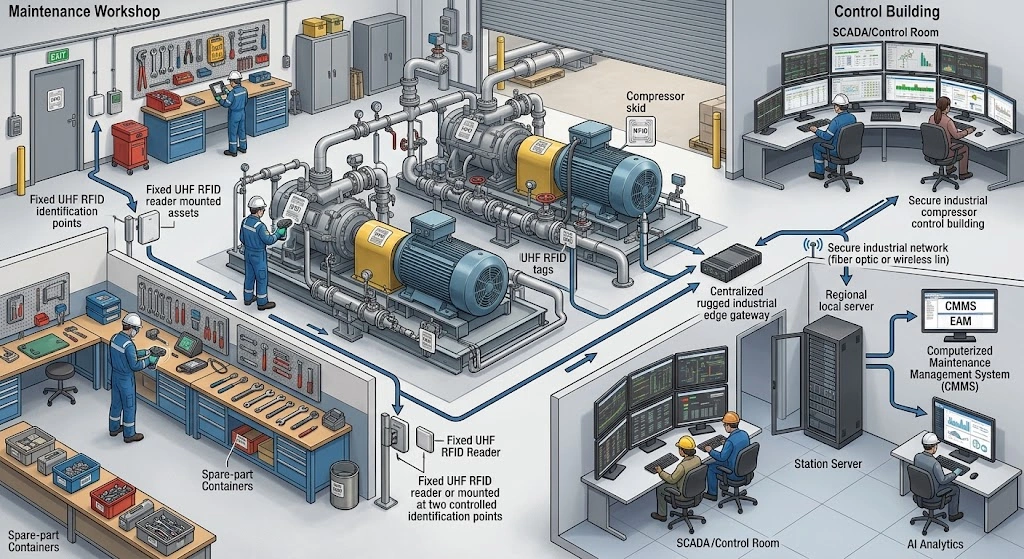
An integrated diagram illustrating the deployment of a UHF RFID asset management system within a combined maintenance workshop and compressor station environment. It maps the full data lifecycle: from physical tracking via handheld and fixed readers on compressor skids, tools, and spare parts, to processing by an edge gateway and regional server. The architecture supports two critical operational centers—a primary SCADA/Control Room for process control and a dedicated AI Analytics workstation for predictive maintenance using CMMS/EAM data.
RFID Hardware and AI Processing for Midstream Systems
A midstream RFID deployment normally contains several layers rather than a single RFID reader.
RFID Identification Layer
The selection among UHF, HF, and LF RFID depends on the physical asset, read distance, environment, mounting material, workflow, and required identification speed.
- UHF RFID: Appropriate for many longer-range identification applications involving tools, components, containers, inventory, and controlled movement points. Its performance must be validated around metal and other challenging materials.
- HF RFID: Useful for short-range controlled identification where deliberate proximity between the reader and tagged object is desirable.
- LF RFID: Suitable for specialized identification scenarios where low-frequency characteristics are advantageous, although the shorter read range generally makes it less appropriate for broad-area inventory tracking.
For midstream applications, RFID selection should begin with the operational workflow and asset characteristics rather than choosing a frequency simply because it is widely used.
Edge Processing and Industrial Connectivity
RFID readers transmit identification events to an edge gateway or local processing system. That layer can remove duplicate reads, apply business rules, associate events with locations, buffer information during connectivity interruptions, and forward normalized events to central software.
Industrial communication may involve Ethernet, Wi-Fi, cellular connectivity, private wireless networks, serial interfaces, MQTT, REST APIs, OPC UA, or other protocols depending on the existing control and information environment.
SCADA remains responsible for its established operational functions. RFID and AI systems should normally operate alongside those controls with clearly defined interfaces and permissions.
AI Models for Midstream Decision Support
Different midstream problems require different AI techniques.
- Time-series models can forecast equipment behavior and maintenance requirements.
- Anomaly detection can identify deviations from established operating patterns.
- Classification models can prioritize inspection or maintenance cases.
- Predictive models can estimate failure risk when sufficient historical data exists.
- Computer vision can support selected inspection and condition-monitoring workflows.
- Optimization models can help evaluate spare-part requirements, technician scheduling, and maintenance priorities.
- Natural language processing can extract structured information from maintenance notes, inspection reports, and historical records when appropriate.
Midstream Standards, Regulation and Cybersecurity Considerations
U.S. midstream operators must account for applicable federal and state requirements as well as company engineering standards and industry practices. PHMSA regulates natural gas pipeline safety under 49 CFR Part 192 and hazardous liquid pipeline safety under 49 CFR Part 195.
Control-room considerations are particularly important because pipeline operators use SCADA systems for remote monitoring and control. PHMSA’s control-room management requirements address controllers, control rooms, SCADA systems, human factors, alarm management, fatigue, change management, training, and operating experience.
Cybersecurity also becomes more important when RFID gateways, AI software, mobile devices, servers, and integration interfaces are connected to operational information systems. API Standard 1164, 3rd Edition, addresses cybersecurity for pipeline control systems and industrial automation and control environments, including security, integrity, resiliency, and risk assessment.
PHMSA also updated incorporated standards under 49 CFR Parts 192 and 195 through rulemaking effective in 2026, making standards management an important part of current deployment planning.
NIST’s AI Risk Management Framework provides a voluntary framework for managing AI risks across the AI lifecycle, while NIST’s Cybersecurity Framework 2.0 provides a broad approach for managing cybersecurity risks. Both are useful reference points when AI and connected asset systems are introduced into critical operational environments.
Deployment Planning for Oil & Gas Midstream
A technically sound deployment starts with a defined operational problem. Operators should identify the assets, decisions, workflows, and KPIs that need improvement before selecting RFID readers, tags, gateways, AI software, or integration methods.
A practical pilot can focus on a controlled workflow such as maintenance-tool tracking, critical spare-part management, compressor-station equipment identification, or inspection-equipment traceability. The pilot should establish baseline performance and measure read accuracy, identification latency, inventory reconciliation time, technician adoption, data completeness, false reads, missed reads, and integration reliability.
GAO can support these deployments by supplying RFID and IoT hardware products and systems that can be evaluated against the physical and operational requirements of the midstream environment.
AI and RFID Technology Stack for Oil & Gas Midstream
A production deployment requires more than RFID tags and AI software. The system must connect physical identification, industrial communications, data processing, enterprise applications, and operational decision-making while preserving the separation required for safety-critical control functions.
RFID Tags, Readers and Antennas
RFID tags should be selected according to the asset’s material, dimensions, mounting surface, environmental exposure, and required read distance. Metal-mount UHF tags are generally more appropriate for steel tools, equipment, cabinets, valves, and other metallic assets than ordinary labels. Tags used outdoors may require resistance to moisture, temperature variation, chemicals, vibration, impact, and ultraviolet exposure.
Fixed readers can be installed at controlled movement points such as maintenance stores, workshops, receiving areas, equipment staging locations, and selected facility entrances. Handheld readers provide flexibility for technicians performing inspections or inventory reconciliation.
A practical engineering principle is to treat the RFID read zone as part of the workflow. Reader placement should make the desired action easy while reducing opportunities for unintended reads.
Edge Gateway and Data Processing
The edge gateway provides a local processing point between field devices and central software. It can:
- Receive RFID events from fixed and handheld readers
- Remove duplicate or low-confidence reads
- Apply location and workflow rules
- Buffer events when communications are temporarily unavailable
- Normalize asset identifiers
- Forward validated events through secure interfaces
- Provide local diagnostics and health monitoring
This layer is particularly useful for remote pipeline facilities where connectivity may be intermittent or expensive. It also reduces unnecessary transmission of raw device events to centralized systems.
Cloud Version
A Cloud Version places the application software and associated databases within managed cloud infrastructure. This model can be appropriate when midstream organizations operate geographically distributed facilities and need centralized access to asset, inventory, maintenance, and analytics information.
Cloud deployment can simplify centralized software updates, provide scalable computing resources for AI workloads, and support consolidated analytics across multiple facilities. Connectivity, cybersecurity, data residency, integration with operational technology, and corporate security requirements must still be evaluated before deployment.
Cloud processing is particularly useful for analytical workloads that combine RFID events with historical maintenance, inventory, inspection, and operational datasets.
Server Version
A Server Version places application software on edge servers, customer-managed servers, private data centers, facility servers, or other privately hosted enterprise infrastructure. This approach can be appropriate where the operator requires greater control over data location, network connectivity, system interfaces, or operational technology boundaries.
A server deployment can also support locations where external connectivity is restricted or where local processing is necessary for operational continuity.
The two models can coexist. For example, a compressor station can process RFID events locally while sending selected normalized data to centralized analytics. The appropriate design depends on facility connectivity, cybersecurity requirements, latency, data governance, maintenance capabilities, and corporate IT policies.
AI Capabilities That Improve Midstream Operations
AI becomes operationally valuable when it transforms large volumes of physical and digital events into decisions that maintenance, reliability, inventory, safety, and operations teams can act upon.
Predictive Maintenance and Failure Risk
Predictive maintenance models can combine equipment operating history, condition-monitoring information, maintenance records, inspection findings, alarm events, runtime, and component replacement history.
RFID adds another dimension by establishing reliable physical identity and movement history. For example, repeated movement of a particular pump component between a maintenance store and workshop can be correlated with work-order information and failure history.
A mature implementation should distinguish between:
- Condition monitoring, which reports current equipment behavior
- Anomaly detection, which identifies unusual patterns
- Predictive maintenance, which estimates future failure or degradation risk
- Prescriptive support, which evaluates potential maintenance actions
These functions should not be treated as interchangeable.
AI-Based Inspection Prioritization
Pipeline integrity programs generate substantial quantities of inspection and maintenance information. AI can assist engineers by identifying patterns across inspection findings, corrosion information, previous repairs, operating history, and asset criticality.
RFID can help connect inspection instruments, tools, replacement components, and physical equipment to the relevant inspection activity. This improves traceability and reduces manual identification errors.
AI recommendations should remain explainable enough for reliability and integrity engineers to verify the underlying evidence before approving consequential maintenance decisions.
AI Inventory Optimization
Spare-part optimization requires balancing availability against inventory cost and obsolescence. AI can analyze:
- Historical spare-part consumption
- Equipment population
- Failure frequency
- Supplier lead times
- Maintenance schedules
- Minimum and maximum stock levels
- Asset criticality
- Seasonal demand
- Emergency replacement requirements
RFID can automate physical inventory events and provide more accurate information about what has actually entered, left, or returned to a maintenance store.
The combination is especially useful for high-value or critical components where a missing item can delay planned maintenance.
Operational Benefits of AI-Enabled RFID in Oil & Gas Midstream
Better Asset Traceability
Automated identification provides a more consistent relationship between physical equipment and digital records. This can reduce reliance on handwritten logs and manually updated spreadsheets.
Faster Maintenance Preparation
Technicians and planners can verify the availability and identity of required tools and components before dispatching personnel to remote facilities. This reduces avoidable return trips caused by missing or incorrect equipment.
More Reliable Inventory Records
RFID events can automate receiving, issuing, returning, and cycle-count activities. AI can then identify unusual consumption patterns or potential inventory risks.
Improved Maintenance Prioritization
AI can rank equipment or work orders using condition information, historical failures, criticality, and other available data. Maintenance teams can focus engineering attention where the available evidence indicates greater risk.
Greater Operational Visibility
Distributed pipeline and terminal operations can generate a unified view of asset movement, maintenance status, inspection activity, and inventory availability without requiring every field event to be entered manually.
Scalable Multi-Facility Operations
Once asset identifiers, event structures, interfaces, and governance rules are standardized, the same operating principles can be extended from one compressor station or maintenance depot to additional facilities.
GAO’s experience supplying RFID, BLE, and IoT products and systems supports organizations that need physical identification technologies integrated into broader operational workflows rather than deployed as isolated tracking devices.
Key KPIs for AI and RFID Midstream Deployments
Measurement should begin before deployment so that the organization can establish a baseline and quantify operational improvement.
| KPI | What It Measures | Why It Matters |
|---|---|---|
| RFID read accuracy | Percentage of intended reads successfully captured | Indicates identification reliability |
| Missed-read rate | Frequency of expected events not captured | Identifies installation or tag-placement problems |
| Asset location accuracy | Agreement between recorded and actual location | Measures asset-tracking quality |
| Inventory reconciliation time | Time required to verify physical inventory | Measures workflow efficiency |
| Inventory record accuracy | Agreement between digital and physical inventory | Supports maintenance planning |
| Tool availability | Percentage of required tools available when needed | Reduces field delays |
| Work-order readiness | Percentage of jobs with required materials available | Measures maintenance preparation |
| Maintenance turnaround time | Time from work initiation to completion | Indicates operational efficiency |
| Unplanned downtime | Time equipment is unavailable unexpectedly | Measures reliability impact |
| Repeat failure rate | Frequency of recurring equipment failures | Supports reliability improvement |
| Inspection compliance | Percentage of required inspections completed | Supports integrity management |
| Data completeness | Percentage of required asset records containing expected information | Indicates AI data readiness |
| AI alert precision | Percentage of alerts judged operationally relevant | Measures model usefulness |
| Mean time to respond | Time between an identified condition and action | Measures decision efficiency |
| System availability | Percentage of time the tracking system is operational | Measures technical reliability |
AI performance should not be evaluated solely through conventional machine-learning metrics. A model with high statistical accuracy may provide little operational value if its predictions arrive too late, cannot be explained, or cannot be connected to an actionable maintenance workflow.
Commissioning and Testing of Midstream RFID Systems
Commissioning should validate both the technology and the operating procedure.
RFID Site Testing
Testing should include the actual tags, assets, mounting surfaces, readers, antennas, network conditions, and environmental conditions expected during operation.
Important tests include:
- Read performance on carbon steel and other target materials
- Tag orientation sensitivity
- Read performance at expected distances
- Reader performance around pumps, motors, pipework, and structural steel
- False-read behavior outside intended zones
- Simultaneous tag detection
- Handheld reader usability
- Outdoor environmental performance
- Network interruption and event buffering
- Battery and power-loss recovery where applicable
Software and Integration Testing
Software testing should confirm that RFID events are correctly associated with asset records and workflows.
Test cases should verify:
- Asset identifier mapping
- Location association
- Work-order linkage
- Inventory transactions
- Duplicate-event handling
- API authentication
- Data synchronization
- Offline operation
- Exception handling
- User permissions
- Audit logging
- Recovery after communication failures
A commissioning test should deliberately introduce expected failure conditions. Disconnecting a gateway, presenting an incorrectly tagged item, generating duplicate reads, or temporarily interrupting connectivity can reveal weaknesses that normal demonstrations may not expose.
Cybersecurity and Data Governance for AIoT Midstream Systems
Connecting RFID and AI software to maintenance and operational data creates additional cybersecurity considerations.
A defensible implementation should apply network segmentation, least-privilege access, strong authentication, encrypted communications where appropriate, secure API design, centralized logging, vulnerability management, and controlled software updates.
AI models also require data governance. Operators should know which datasets train or influence a model, how data quality is assessed, when a model was last validated, and which personnel are authorized to act on its recommendations.
RFID identifiers should not automatically be treated as proof of physical condition. An RFID tag can establish identity, but it does not independently confirm that a valve is operational, that a component is fit for service, or that maintenance has been correctly completed.
That distinction is important for safety and integrity management. Identification data should complement established inspection, maintenance, process-control, and engineering procedures rather than replace them.
Scaling from Pilot to Multi-Site Midstream Operations
A successful pilot should establish reusable technical and operational standards before expanding to additional locations.
Standardize Asset Identity
Each asset should have a clear relationship between:
- RFID tag identifier
- Enterprise asset number
- Equipment tag
- Physical location
- Equipment type
- Maintenance record
- Inspection record
- Relevant work orders
Standardize Event Definitions
A common event model should distinguish between events such as asset received, asset issued, asset returned, asset moved, asset inspected, asset assigned, and asset verified.
This makes information easier to exchange between RFID middleware, maintenance systems, inventory software, and AI analytics.
Expand According to Operational Value
Expansion does not need to begin with every asset. Critical tools, high-value components, frequently moved equipment, inspection instruments, and maintenance inventory often provide stronger initial business cases.
GAO can provide RFID, BLE, and IoT hardware products and systems for organizations evaluating these use cases and developing practical deployment approaches around their existing workflows.
Practical Implementation Recommendations for Oil & Gas Midstream
A technically successful AI and RFID project should be treated as an operational transformation project supported by technology, not simply as an RFID installation.
Recommended practices include:
- Start with a clearly defined midstream operational problem and measurable KPI.
- Select assets according to workflow value, criticality, mobility, and identification difficulty.
- Test RFID tags on the actual materials and surfaces before purchasing large quantities.
- Validate performance around steel pipe, tanks, machinery, and other RF-challenging structures.
- Establish asset identity standards before connecting RFID events to AI models.
- Keep SCADA and safety-critical control functions separated from noncritical tracking applications.
- Use edge processing where connectivity is unreliable or local response is important.
- Select Cloud Version or Server Version according to connectivity, cybersecurity, data governance, and operational requirements.
- Integrate RFID events with CMMS, EAM, ERP, GIS, inventory, inspection, and analytics systems where justified.
- Establish cybersecurity controls before connecting field devices to enterprise networks.
- Validate AI models against real operational data rather than relying solely on generic datasets.
- Maintain human engineering review for consequential maintenance and integrity decisions.
- Test failure scenarios during commissioning.
- Monitor RFID read quality and AI model performance after production deployment.
- Establish procedures for tag replacement, reader maintenance, software updates, and data-quality correction.
- Scale from proven workflows rather than attempting to instrument every midstream asset simultaneously.
Technical Outlook for AI-Enabled Oil & Gas Midstream Operations
AI will increasingly connect operational history, asset condition, maintenance activity, inspection information, inventory status, and field observations into decision-support workflows. The strongest implementations will not depend on one technology. They will combine RFID identification with sensors, industrial networks, SCADA, historians, CMMS/EAM software, GIS, mobile applications, edge computing, and AI.
RFID provides an important physical identity layer, particularly where organizations need to know which component, tool, container, instrument, or equipment item participated in a workflow. AI adds analytical capabilities that can identify patterns, prioritize activities, and support forecasting.
The engineering challenge is ensuring that these technologies produce trustworthy information. Accurate asset identity, high-quality data, secure integration, appropriate model governance, reliable communications, and disciplined maintenance procedures are therefore as important as the AI algorithms themselves.
Why GAO Is Relevant to Oil & Gas Midstream AI and RFID Projects
Headquartered in New York City and Toronto, Canada, GAO is ranked among the top 10 leading B2B and B2G BLE and RFID suppliers globally. GAO and its sister companies, GAO Research and GAO Tek, form the GAO Group, with operations based in New York City and Toronto.
For three decades, the GAO Group has served customers across the United States and Canada, including Fortune 500 companies, leading research and development organizations, prestigious universities, and U.S. and Canadian government agencies. Its substantial investment in R&D, stringent quality assurance processes, and expert remote and onsite support provide a foundation for deploying RFID, BLE, and IoT technologies in technically demanding applications.
For oil and gas midstream organizations, this experience is relevant where RFID hardware and IoT systems must be evaluated against real operating environments, existing software, physical asset characteristics, connectivity constraints, and deployment requirements.
Building the Future of Industrial AI and IoT with Aperture Venture Studio and GAO RFID Inc.
For more than three decades, GAO Group of Companies has invested heavily in R&D of industrial RFID, BLE, and IoT. As generative AI became increasingly useful in industrial applications, we expanded our work in AI and IoT, including RFID and BLE, and founded Aperture Venture Studio to develop AI and IoT solutions relevant to applications such as oil and gas midstream asset tracking, maintenance, inventory, and operational intelligence.
Aperture brings together technical experts, operational leaders, investors, and leading companies. Through Aperture Ventures Summit and TekSummit, we also support discussion of advanced AI and IoT topics.
We welcome you to join us as:
- Advisors, co-founders, or employees
- Investors
- Customers
Explore AI and RFID Solutions for Oil & Gas Midstream
Oil and gas midstream operators can use AI-supported asset tracking, inventory intelligence, maintenance analytics, and inspection workflows to connect physical operations with better-informed decisions. RFID provides reliable physical identification, while AI, edge computing, industrial connectivity, and enterprise software transform those identification events into actionable information.
GAO can help organizations evaluate RFID, BLE, and IoT hardware products and systems according to asset characteristics, operating environments, connectivity requirements, integration needs, and deployment models.
For organizations planning a pilot or evaluating a broader midstream deployment, learning more about GAO’s RFID and IoT technologies, engineering capabilities, and technical support is a practical next step.