
AI and RFID for Pharmaceutical Cold Chain
AI-Driven Pharmaceutical Cold Chain Visibility and Control
AI and RFID for Pharmaceutical Cold Chain operations combines artificial intelligence, connected sensing, identification data, environmental monitoring, and pharmaceutical logistics software to improve how temperature-sensitive medicines are received, stored, handled, transported, and reconciled. The primary value is not RFID identification alone. AI can correlate product identity, lot or serial information, location, temperature history, handling events, shipment status, and operational context to identify risks that conventional manual processes may miss. For vaccines, biologics, specialty medicines, cell and gene therapy materials, and other temperature-sensitive products, this creates a more complete operational record across refrigerators, freezers, cold rooms, refrigerated vehicles, insulated shipping containers, staging areas, warehouses, and distribution points. GAO supplies RFID and IoT hardware and systems that can provide the underlying identification and sensing data required for pharmaceutical cold chain analytics, while AI software can convert those events into exception detection, forecasting, prioritization, and operational decisions.
AI-Enabled Pharmaceutical Cold Chain Operations
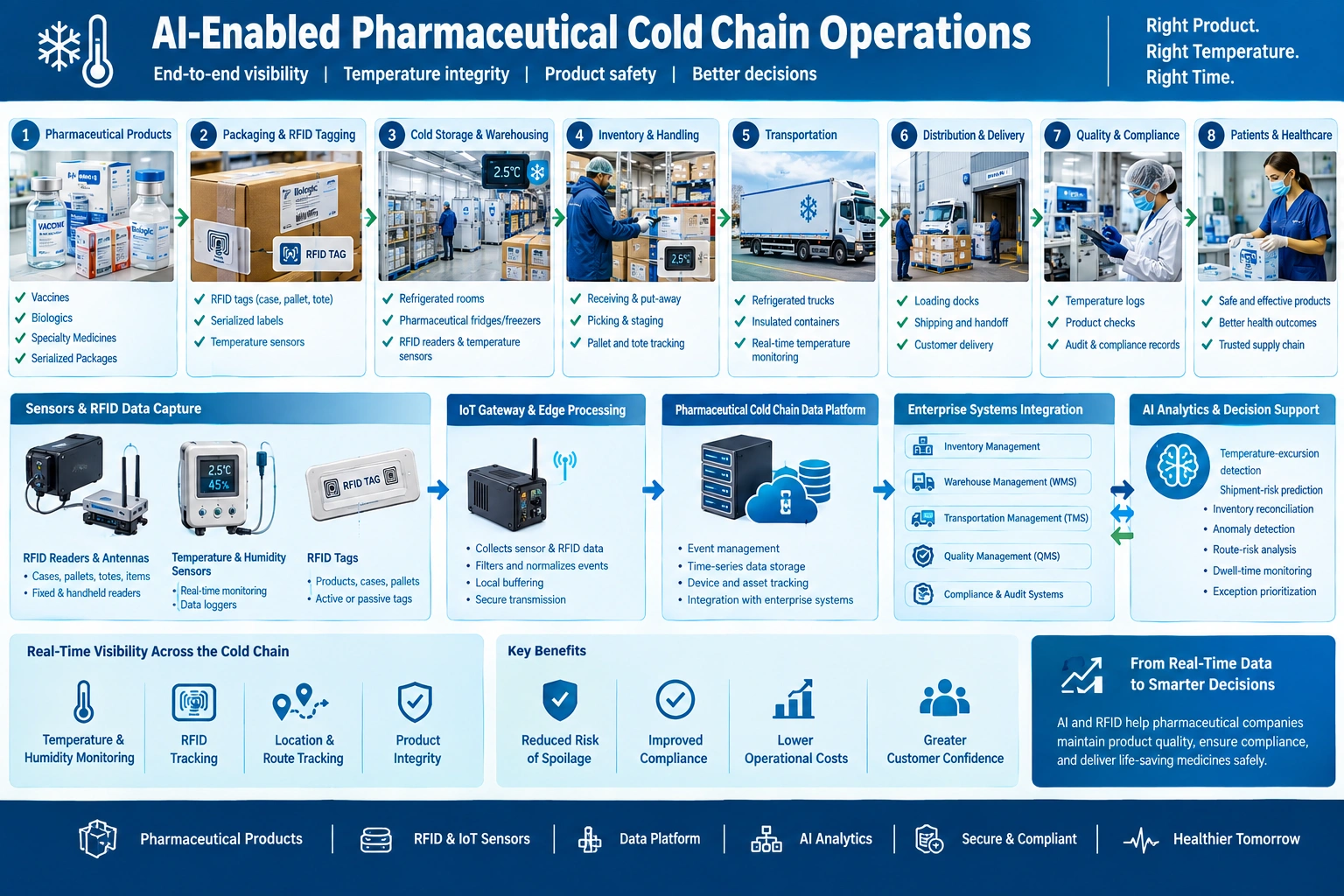
An enterprise workflow infographic showing how RFID, temperature and humidity sensors, IoT gateways, data platforms, and AI analytics support pharmaceutical products across storage, handling, transportation, distribution, quality control, and delivery. It highlights temperature-excursion detection, shipment-risk prediction, inventory reconciliation, route-risk analysis, and exception prioritization.
Why AI Matters in Pharmaceutical Cold Chain Management
Pharmaceutical cold chain management is fundamentally a controlled logistics problem in which product identity, environmental exposure, location, handling events, and timing must remain associated throughout storage and transportation. A temperature reading without reliable product identity may show that a refrigerator experienced an excursion but cannot necessarily establish which specific lots or packages were exposed. Conversely, an RFID event without environmental context can establish where an asset was detected without explaining whether its storage conditions remained acceptable.
AI becomes valuable when these separate data streams are correlated.
A pharmaceutical cold chain AI solution can combine:
- Product identifiers, GTINs, serial numbers, lot numbers, expiration dates, container identifiers, and shipment identifiers
- RFID read events from receiving docks, cold rooms, staging areas, freezers, warehouses, and controlled access points
- Temperature, humidity, door-state, power, and equipment-condition data
- Shipment milestones, carrier events, route information, estimated arrival times, and dwell intervals
- Warehouse management, inventory management, quality management, laboratory, enterprise resource planning, and transportation systems
- Historical excursion records, deviation investigations, corrective and preventive actions, product disposition decisions, and maintenance records
- Environmental and operational context needed to distinguish normal handling variation from potentially significant cold chain events
The resulting system can move beyond threshold-based alarms. Machine learning models can identify abnormal temperature patterns, predict potential excursions, recognize unusual dwell times, prioritize investigations, and identify recurring process conditions associated with cold chain failures.
This distinction is particularly important because pharmaceutical stability depends on the complete exposure history of a product rather than a single instantaneous temperature measurement. USP General Chapter <1079> addresses risks and mitigation strategies for storage and transportation of finished drug products, while USP <1079.2> addresses mean kinetic temperature when evaluating temperature excursions.
Pharmaceutical Cold Chain Applications for AI and RFID
AI-driven pharmaceutical cold chain systems can support several operational environments. The appropriate application depends on the product’s temperature requirements, packaging configuration, identification level, facility layout, handling process, and regulatory obligations.
Pharmaceutical cold chain environment AI application RFID-enabled data Operational outcome
Vaccine storage Excursion risk detection Product, tote, pallet, and location identification Faster investigation and controlled inventory decisions
Biologics distribution Shipment condition monitoring Shipment and container identity Better chain-of-custody visibility
Pharmaceutical warehouses Inventory reconciliation Case, pallet, tote, and asset reads Reduced search and reconciliation effort
Refrigerated staging Dwell-time monitoring Product movement and zone events Faster identification of delayed shipments
Specialty pharmacy distribution Order and product verification Package and shipment identification Improved fulfillment accuracy
Cold rooms and freezers Environmental anomaly analysis Product-location association More precise exposure assessment
Refrigerated transportation Transit-risk prediction Shipment and container identity Earlier intervention for high-risk loads
3PL pharmaceutical logistics Exception prioritization Handling and custody events Better coordination between trading partners
Returns and quarantine Product disposition support Product and lot identification Improved segregation and investigation
Clinical trial logistics Material traceability Kits, containers, and shipment IDs Better visibility of time-sensitive materials
For pharmaceutical manufacturers and distributors, one of the strongest use cases is AI inventory management. Rather than treating inventory as a static count, the system can understand where temperature-sensitive inventory is located, how long it has remained in a particular zone, whether its environmental history is complete, and whether its remaining shelf life creates a fulfillment priority.
Another important application is AI cold chain exception management. Instead of sending the same alarm to every operator, AI can rank exceptions according to product criticality, duration, temperature severity, location, shipment status, historical patterns, and available response options.
AI Applications Across Pharmaceutical Cold Chain Workflows
Receiving and Inbound Pharmaceutical Inspection
Receiving is a critical control point because product identity, quantity, condition, shipment documentation, and temperature information must be reconciled before inventory becomes available for downstream use.
RFID readers can identify tagged cases, totes, pallets, reusable containers, and selected packages as they enter a receiving area. AI software can compare the observed events with expected shipment information and identify discrepancies such as:
- Unexpected product or lot identifiers
- Missing cases or containers
- Duplicate identification events
- Incorrect receiving locations
- Abnormally long unloading or staging periods
- Missing temperature history
- Unexpected shipment arrival patterns
- Potential mismatch between physical inventory and system records
The system can direct an operator toward an exception rather than requiring the operator to manually inspect every normal transaction.
Cold Storage and Warehouse Operations
Cold rooms, pharmaceutical refrigerators, ultra-low-temperature freezers, and controlled staging areas create different monitoring requirements. AI can associate environmental measurements with product locations and operational events to provide more useful context than isolated sensor alarms.
For example, if a cold room shows a rising temperature trend, the system can examine door openings, occupancy, recent inbound activity, refrigeration equipment status, product movement, and historical temperature behavior. This helps distinguish a routine door event from a developing refrigeration problem.
AI can also support FEFO inventory management, where products approaching expiration are prioritized according to expiry date and operational constraints. RFID identification provides rapid product-location visibility, while AI can incorporate demand, shipment commitments, remaining shelf life, temperature history, and handling status when recommending inventory actions.
Pharmaceutical Transportation and Shipment Monitoring
Transportation introduces additional variables including loading delays, route duration, external temperature, vehicle refrigeration performance, door openings, cross-docking, carrier handoffs, and unexpected dwell time.
An AI-driven shipment monitoring system can evaluate these variables together. A refrigerated shipment that is slightly delayed may not represent the same risk as a shipment with repeated temperature instability, multiple unplanned stops, or an approaching product-specific exposure limit.
RFID events can establish when a shipment leaves a controlled zone and when it enters another facility. Environmental sensors can provide the associated temperature record. AI can then correlate the two streams and identify shipments requiring attention.
Quarantine, Returns, and Product Disposition
Pharmaceutical products associated with temperature excursions, damaged packaging, suspected diversion, incorrect shipments, or other quality events may require segregation and investigation.
AI can assist by connecting the affected product identity with its location and historical events. When an excursion occurs, the system can identify potentially affected inventory and distinguish it from products stored in unaffected zones.
This can support:
- Automated quarantine candidate identification
- Product and lot-level exposure assessment
- Location verification
- Investigation prioritization
- Return-material identification
- Recall preparation
- Disposition workflow support
- Audit-trail completeness
The AI recommendation should support qualified personnel rather than independently determine whether a pharmaceutical product is safe for release. Final disposition remains a controlled quality decision governed by the organization’s procedures and applicable regulations.
Pharmaceutical Cold Chain Workflow from Data Capture to AI Decisions
A practical pharmaceutical cold chain solution begins with reliable physical data capture. AI performance is constrained by the quality, completeness, timestamp accuracy, and association of the underlying operational events.
Product and Environmental Data Acquisition
Data can originate from RFID readers, RFID tags, temperature sensors, humidity sensors, refrigerator controllers, freezer monitoring systems, vehicle telematics, barcode systems, warehouse terminals, handheld devices, and enterprise applications.
RFID is particularly useful for associating a physical product, container, tote, pallet, or reusable asset with a location and handling event. Temperature monitoring remains a separate engineering function and should be selected according to the product, environment, required accuracy, calibration program, and applicable quality procedures.
Edge Data Processing
An IoT gateway or edge computer can collect RFID and sensor events close to the operational environment. Local processing can remove duplicate reads, normalize timestamps, validate device messages, buffer data during network interruptions, and apply preliminary rules.
This is important at refrigerated facilities where network interruptions should not automatically result in loss of operational events.
Edge processing can also reduce unnecessary transmission of duplicate RFID reads. A reader may detect the same tagged container multiple times as it remains within a read zone. Middleware should convert raw reader activity into meaningful business events such as:
- Container entered cold room
- Pallet moved to quarantine
- Shipment passed outbound dock
- Product entered refrigerated staging
- Reusable container returned
- Inventory moved between temperature zones
Centralized Pharmaceutical Cold Chain Data
After local processing, normalized events can be transferred to centralized software through secure network connections. Depending on the operating model, this may be a cloud-hosted service or software running on customer-controlled servers.
A centralized data layer can maintain relationships among:
- Product identifiers
- Lots and serial numbers
- Locations
- Shipments
- Temperature records
- RFID events
- Personnel actions
- Equipment
- Quality events
- Inventory transactions
- Maintenance records
This contextual association is what enables AI models to reason over cold chain events rather than analyzing disconnected sensor streams.
AI Analytics and Decision Support
AI processing can include statistical anomaly detection, supervised machine learning, time-series forecasting, classification, clustering, computer vision where appropriate, and rule-plus-model decision logic.
Examples include:
- Predicting the likelihood of a temperature excursion
- Detecting unusual refrigerator temperature patterns
- Identifying abnormal shipment dwell times
- Predicting inventory shortages
- Detecting discrepancies between physical and digital inventory
- Ranking cold chain exceptions by operational risk
- Identifying recurring causes of excursion events
- Forecasting maintenance requirements for refrigeration equipment
- Detecting unusual movement patterns associated with inventory control risks
AI should operate within validated business processes when its outputs influence regulated pharmaceutical operations. Model versioning, input traceability, access control, auditability, change management, and human review are important design considerations.
RFID, IoT Hardware, AI Software, and Deployment Design
RFID should be treated as one data acquisition mechanism within a broader pharmaceutical cold chain solution. The correct implementation depends on the identification level, physical packaging, read distance, material composition, operating environment, and required workflow.
For pharmaceutical applications, UHF RFID is often useful when organizations need longer-range identification of cases, totes, pallets, reusable containers, or selected packaged products. HF RFID can be appropriate for shorter-range identification and controlled point-of-use interactions. LF RFID is generally associated with shorter-range applications and specialized environments where its propagation characteristics are advantageous. Actual selection should be validated against tag construction, reader placement, packaging materials, regulatory requirements, and the required read performance.
RFID tag selection also matters. Tags attached to corrugated cases behave differently from tags placed near liquids, foil packaging, metalized materials, refrigeration equipment, or dense pallet configurations. Cold temperatures, condensation, packaging geometry, and read-zone congestion should be included in qualification testing.
The wider solution can include:
- Fixed RFID readers at receiving docks, cold-room entrances, dispatch points, and controlled transition zones
- Handheld RFID readers for inventory checks, exception investigation, cycle counts, and quarantine verification
- RFID antennas designed around the physical read zone rather than simply maximizing read distance
- Temperature and humidity sensors appropriate to the storage or transportation environment
- IoT gateways for local collection, filtering, buffering, and protocol conversion
- Edge computers for low-latency processing and continued operation during network interruptions
- Middleware for device management, event normalization, duplicate filtering, and business-event generation
- AI software for anomaly detection, forecasting, classification, risk scoring, and operational recommendations
- WMS, TMS, ERP, QMS, laboratory systems, maintenance software, and serialization or traceability systems
- Secure APIs and message interfaces for exchanging validated events with pharmaceutical applications
For organizations operating in the United States, traceability design should also account for the Drug Supply Chain Security Act. FDA describes DSCSA as requiring interoperable and electronic identification and tracing of certain prescription drugs at the package level, and FDA recommends GS1 EPCIS for secure, interoperable electronic data exchange in the enhanced drug distribution environment.
Cloud Version can be appropriate for geographically distributed pharmaceutical operations that need centralized analytics, multi-site reporting, remote monitoring, and scalable computing resources. Server Version can be appropriate when pharmaceutical organizations require customer-controlled infrastructure, private data centers, local processing, specific cybersecurity controls, or integration with systems that cannot be exposed to a public cloud environment.
A hybrid deployment can also place RFID and environmental processing close to the cold chain while transferring normalized events to centralized software for analytics and reporting. The key engineering principle is to determine which functions must continue operating locally and which functions benefit from centralized computing.
GAO provides RFID, BLE, and IoT hardware products and systems that can serve as components of these pharmaceutical identification and monitoring workflows, with remote or onsite technical support available for deployment and integration requirements.
Data Integrity, Security, and Regulatory Control
A pharmaceutical cold chain AI solution should treat data integrity as an engineering requirement rather than a reporting feature. A temperature value without a trustworthy timestamp, sensor identity, calibration context, or association with the affected shipment has limited investigative value.
Important controls include:
- Unique identities for RFID readers, sensors, gateways, and connected equipment
- Role-based access control for operators, warehouse personnel, quality teams, IT administrators, and system owners
- Encryption for data in transit and appropriate protection for stored data
- Secure device provisioning and credential management
- Tamper detection where required by the physical application
- Synchronized system clocks for reliable event sequencing
- Audit trails for critical data changes and operator actions
- Controlled software and configuration changes
- Backup and recovery procedures
- Network segmentation between operational devices and business systems
- Monitoring for unauthorized device or account activity
- Validation and qualification procedures appropriate to the intended pharmaceutical use
For electronic records and electronic signatures, organizations may also need to assess applicable requirements such as FDA 21 CFR Part 11 alongside their quality-system procedures. Regulatory applicability depends on the specific system, records, process, and organizational role, so implementation should involve qualified quality and regulatory personnel.
Pharmaceutical cold chain organizations should also distinguish monitoring from release or disposition decisions. AI can prioritize investigations and provide evidence, but a model should not be presented as replacing qualified quality personnel when product disposition requires formal review.
Technical Capabilities and Operational Value
Combining AI with RFID-enabled identification and environmental IoT data can improve pharmaceutical cold chain operations because the system gains both context and continuity. RFID establishes the identity and movement of physical products, containers, pallets, and reusable logistics assets, while temperature and environmental sensors provide condition data. AI correlates these events to support more precise operational decisions.
Key capabilities include:
- AI temperature-excursion detection: Models can evaluate temperature trends, duration, rate of change, door activity, refrigeration status, and product location to identify developing risks before a conventional threshold alarm becomes the only source of notification.
- Product-location intelligence: RFID events can associate pharmaceutical inventory with cold rooms, freezers, staging areas, quarantine locations, loading docks, and transportation containers.
- AI inventory management: AI can reconcile physical RFID observations with WMS and ERP records, identify discrepancies, and highlight inventory requiring investigation.
- FEFO optimization: Product identity, expiration dates, demand, shipment commitments, and storage status can be combined to support more informed first-expire, first-out decisions.
- Shipment-risk prediction: AI can assess dwell time, route conditions, environmental trends, handoff events, and shipment schedules to prioritize loads that may require intervention.
- Exception prioritization: Rather than treating every alert equally, risk scoring can help quality, warehouse, and logistics personnel focus first on events involving high-value, temperature-sensitive, time-critical, or potentially affected products.
- Cold-chain asset monitoring: RFID can identify reusable containers, insulated shippers, temperature-monitoring devices, transport totes, and other logistics assets, while AI can identify abnormal utilization or return patterns.
- Predictive refrigeration maintenance: Equipment telemetry and historical maintenance information can be analyzed to identify patterns associated with refrigeration degradation, abnormal cycling, or other equipment conditions.
- Recall and quarantine support: RFID-based product identification can accelerate the search for affected lots, cases, pallets, or containers when a quality event requires controlled segregation.
- Traceability improvement: Time-stamped identification and environmental events can create a more complete operational history for receiving, storage, handling, transportation, and distribution.
The practical advantage comes from connecting these capabilities to the pharmaceutical workflow. A temperature excursion becomes more useful when the system can identify which inventory was present, where it was located, how long it was exposed, whether it subsequently moved, and which quality workflow should receive the event.
Pharmaceutical Cold Chain KPIs for AI-Enabled Operations
AI implementation should be evaluated against measurable cold chain outcomes rather than the number of RFID tags installed or sensor events collected. KPI selection should reflect the organization’s quality procedures, product profiles, logistics model, and regulatory obligations.
Relevant measures include:
- Temperature-excursion frequency and duration
- Time to detect a developing temperature excursion
- Time from alert generation to qualified investigation
- Time to identify potentially affected inventory
- Inventory record accuracy
- RFID read accuracy within defined read zones
- Shipment dwell time
- Cold-room dwell time
- Receiving cycle time
- Order fulfillment accuracy
- FEFO adherence
- Product quarantine identification time
- Recall search and reconciliation time
- Shipment traceability completeness
- Refrigeration equipment downtime
- Preventive maintenance compliance
- False-positive exception rate
- Unresolved exception aging
- Missing environmental-data intervals
- Sensor communication availability
- RFID reader availability
- Gateway data-buffer recovery performance
- Percentage of shipments with complete condition history
- Product-location reconciliation accuracy
- Reusable container turnaround time
- Cold chain deviation investigation time
- Inventory shrinkage or unexplained variance
- On-time shipment performance
- Quality-event recurrence rate
- Operator response time to high-priority alerts
The most useful KPI structure normally combines quality, product protection, operational efficiency, data integrity, and system performance. A reduction in manual inventory work is valuable, but it should not be considered a success if identification errors or incomplete environmental records increase.
Engineering Considerations for Pharmaceutical RFID Deployment
RFID deployment in pharmaceutical cold chain facilities requires site-specific testing. A reader that performs well in an empty test environment may behave differently when surrounded by liquid-filled products, foil packaging, metal shelving, insulated containers, refrigeration equipment, people, and densely packed pallets.
Engineers should evaluate:
- Tag placement on cartons, cases, totes, pallets, or individual products
- Liquid and metal effects on RF performance
- Tag orientation and antenna polarization
- Reader sensitivity and transmit configuration
- Antenna placement around dock doors and cold-room entrances
- Read-zone boundaries
- Potential cross-reads between adjacent storage areas
- Refrigerated and frozen operating conditions
- Condensation and packaging changes
- Reader enclosure and environmental protection
- Handheld reader ergonomics for warehouse personnel
- Network coverage around cold rooms and loading docks
- Gateway buffering during connectivity interruptions
- Time synchronization across readers, sensors, gateways, and servers
- Integration with existing WMS, ERP, TMS, QMS, and traceability software
Read-zone control is particularly important. Maximizing RF range is not always desirable. A receiving-door reader should identify products passing through its intended transition zone rather than products sitting several meters away in another inventory location. Antenna orientation, shielding where appropriate, reader configuration, physical layout, and middleware filtering should therefore be engineered together.
Temperature monitoring requires similar discipline. Sensor placement should represent the environmental condition being evaluated, and calibration, alarm thresholds, sampling intervals, battery performance, communication reliability, and sensor replacement procedures should be defined before operational deployment.
GAO’s RFID and IoT hardware can be incorporated into pharmaceutical identification and monitoring workflows, with product selection and deployment requiring validation against the customer’s packaging, storage environment, read-zone requirements, and integration objectives.
Cloud and Server Deployment for Pharmaceutical Cold Chain
Pharmaceutical organizations can select cloud-hosted, privately hosted, or hybrid deployment models depending on operational, cybersecurity, connectivity, data-governance, and integration requirements.
Consideration Cloud Version Server Version
Hosting Cloud infrastructure Customer-managed or privately hosted infrastructure
Multi-site visibility Strong fit for geographically distributed facilities Requires inter-site connectivity or centralized private infrastructure
Local operation Usually supported through gateways or edge components Strong fit for local processing
Infrastructure management Reduced customer infrastructure responsibility Greater customer control and administration
AI computing Scalable centralized resources Customer-controlled compute resources
Connectivity dependency Higher for centralized functions Can support more local operation
Data control Cloud-provider and customer controls must be evaluated Greater direct infrastructure control
Integration APIs and secure interfaces Useful for private enterprise systems
Best fit Multi-site analytics and centralized monitoring Controlled infrastructure and sensitive local operations
A Cloud Version is often appropriate when pharmaceutical manufacturers, distributors, 3PLs, and logistics networks need centralized visibility across multiple warehouses, distribution centers, transportation operations, or regional facilities. Centralized AI can compare events across locations and provide consolidated reporting.
A Server Version may be preferable where an organization requires privately hosted software, tighter control over infrastructure, local data processing, or integration with systems that operate within a restricted network.
A hybrid approach can place RFID processing, sensor collection, event buffering, and time-critical logic near the pharmaceutical cold chain while sending normalized events to centralized software. This arrangement reduces dependence on uninterrupted wide-area connectivity without giving up centralized analytics.
Integration with Pharmaceutical Enterprise Systems
AI-driven cold chain operations become substantially more useful when identification and environmental events are connected to existing business systems.
Common integration points include:
- WMS: Inventory location, receiving, put-away, picking, staging, cycle counting, and shipment preparation
- TMS: Shipment planning, carrier events, route milestones, delivery status, and transportation exceptions
- ERP: Purchase orders, inventory records, financial transactions, supplier information, and product master data
- QMS: Deviations, investigations, CAPA workflows, product disposition, and quality records
- MES: Manufacturing and packaging events where cold-chain inventory originates within pharmaceutical production
- LIMS: Laboratory-related material and sample workflows where environmental control and traceability are required
- Serialization and traceability systems: Package-level identity, aggregation relationships, and pharmaceutical supply-chain events
- CMMS or maintenance systems: Refrigeration maintenance, equipment work orders, inspections, and service history
- Identity and access systems: User authentication, authorization, and controlled access to sensitive functions
Integration should use stable identifiers and clearly defined event semantics. A common engineering mistake is to connect raw RFID reads directly to business applications. Middleware should first interpret those reads into validated events.
For example, five RFID observations of the same pallet within several seconds should not necessarily create five separate inventory movements. Middleware can consolidate the observations into a single location event with appropriate timestamp and reader context.
Pharmaceutical Cold Chain Enterprise Integration Map
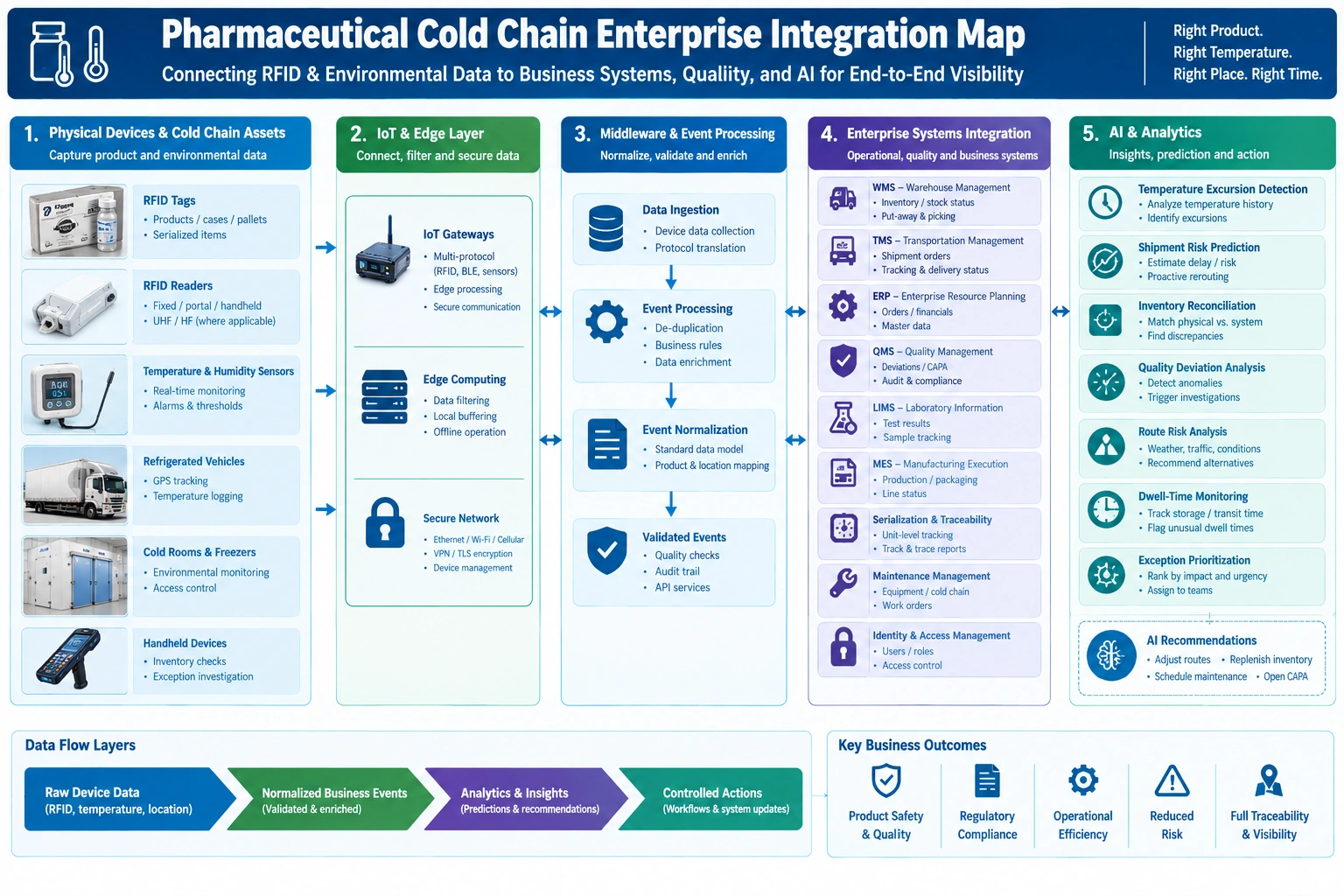
An enterprise systems diagram showing how RFID-tagged pharmaceutical products, environmental sensors, refrigerated assets, and handheld devices connect through secure middleware and validated event processing. It illustrates integration with WMS, TMS, ERP, QMS, LIMS, MES, serialization, maintenance, identity management, and AI analytics for traceability, compliance, risk detection, and operational decision-making.
Cybersecurity and Resilience for Connected Cold Chain Systems
Connecting RFID readers, sensors, gateways, refrigeration equipment, and enterprise software expands the number of components that require security controls. A pharmaceutical cold chain deployment should therefore include cybersecurity from the design stage rather than adding controls after commissioning.
Recommended measures include:
- Network segmentation for RFID, IoT, operational technology, and business applications
- Device identity and certificate or credential management
- Role-based access control
- Multi-factor authentication for administrative functions
- Encryption for communications and protected data
- Secure API authentication
- Firewall and gateway controls
- Centralized logging and security monitoring
- Controlled firmware and software updates
- Vulnerability management
- Backup and disaster-recovery procedures
- Configuration baselines for readers and gateways
- Physical protection of edge equipment
- Alerting for unexpected device behavior
- Defined procedures for compromised or unavailable devices
Resilience is equally important. A cold room should not lose all event history because a temporary network outage prevents communication with centralized software. Gateways can buffer events locally and forward them after connectivity is restored. Local alarms and safety controls should also remain operational when higher-level analytics or enterprise software is temporarily unavailable.
AI models introduce additional considerations. Organizations should maintain appropriate model governance, monitor model performance, document significant model changes, and retain sufficient input and output context for investigations where AI recommendations influence controlled workflows.
Pharmaceutical Cold Chain Implementation Lifecycle
Successful deployment should proceed through controlled engineering stages rather than beginning with a large-scale RFID installation.
Planning and Site Assessment
The first stage should document pharmaceutical products, temperature ranges, storage zones, material flows, receiving and shipping processes, quality controls, existing software, and current traceability gaps.
A site survey should identify RF obstructions, refrigeration equipment, doors, shelving, loading areas, network infrastructure, and locations where read-zone isolation is necessary.
Proof of Concept and RF Qualification
A controlled pilot should test representative pharmaceutical packaging, tags, readers, antennas, sensor locations, environmental conditions, and movement patterns.
Testing should include realistic pallet density and packaging configurations. Engineers should measure read reliability, missed reads, false reads, transition-zone performance, and environmental effects.
Software and Data Integration
After physical identification performance is established, normalized events should be connected to the relevant WMS, TMS, ERP, QMS, or other systems.
Data mappings should define product identifiers, location identifiers, shipment identifiers, event timestamps, status codes, and exception states.
AI Model Development and Validation
AI should initially operate alongside existing processes where practical. Historical cold chain data can be used to establish baseline behavior and identify useful features.
Models should then be evaluated using operationally meaningful measures such as detection performance, false-positive frequency, alert lead time, and investigation usefulness.
Commissioning and Operational Qualification
Production commissioning should verify reader configuration, sensor operation, gateway connectivity, event processing, integration, access controls, alarm behavior, data retention, and recovery procedures.
The organization should define acceptance criteria before production rollout so that deployment decisions are based on measurable performance rather than subjective impressions.
Continuous Optimization
After deployment, engineers should periodically review read performance, sensor failures, battery conditions, network interruptions, false alerts, product-layout changes, and software integration errors.
AI models should also be monitored because pharmaceutical workflows change. New packaging, facilities, carriers, storage equipment, routes, or product profiles can alter the underlying data distribution.
Scaling AI-Enabled Pharmaceutical Cold Chain Operations
Once a deployment performs reliably at one facility, expansion should preserve the same event definitions, identity conventions, security controls, and data-quality practices.
Multi-site scaling can support:
- Centralized visibility across pharmaceutical distribution centers
- Standardized cold-room monitoring
- Cross-site inventory reconciliation
- Regional shipment-risk analysis
- Consistent exception classification
- Shared AI models where operating conditions are sufficiently comparable
- Site-specific models where climate, equipment, packaging, or workflow differences require local calibration
- Centralized maintenance analytics
- Consolidated quality reporting
- Comparative analysis of warehouse and transportation performance
Scaling should not mean simply installing additional readers. Every new facility can introduce different building materials, RF interference patterns, packaging configurations, network conditions, refrigeration equipment, and operational practices. Site acceptance testing remains important even when the same hardware and software are reused.
GAO Expertise for RFID and IoT-Based Pharmaceutical Cold Chain Solutions
GAO is headquartered in New York City and Toronto, Canada, and provides RFID, BLE, and IoT hardware products and systems for identification, sensing, tracking, and connected operational workflows. GAO’s pharmaceutical cold chain applications can use these technologies to support product identification, inventory visibility, equipment monitoring, and data collection.
GAO and its sister companies, GAO Research Inc. and GAO Tek Inc., form GAO Group, with operations based in New York City and Toronto. For three decades, GAO Group has served organizations across the United States and Canada, including Fortune 500 companies, research and development organizations, universities, and government agencies. The group has invested substantially in product and systems research and development and maintains quality-assurance processes with remote and onsite technical support.
For pharmaceutical cold chain deployments, this engineering capability is relevant because successful implementation depends on more than selecting an RFID reader or tag. Packaging qualification, environmental conditions, reader placement, software integration, cybersecurity, data quality, and operational validation must all be considered together.
Key Recommendations for AI-Enabled Pharmaceutical Cold Chain
Organizations evaluating AI and RFID for Pharmaceutical Cold Chain operations should prioritize measurable operational problems rather than beginning with technology selection.
Recommended practices include:
- Start with high-value cold chain workflows such as receiving, cold-room inventory, refrigerated staging, shipment monitoring, or quarantine.
- Define the product, lot, serial, shipment, container, and location identifiers that must remain associated.
- Test RFID performance using actual pharmaceutical packaging and representative environmental conditions.
- Engineer read zones to prevent unintended reads rather than maximizing reader range.
- Keep environmental sensing and RFID identification logically distinct while correlating their data through timestamps and product or container identity.
- Use edge processing where local continuity, buffering, or low-latency decisions are important.
- Integrate normalized business events with WMS, TMS, ERP, QMS, and other relevant systems instead of forwarding raw reader events.
- Establish cybersecurity controls for readers, sensors, gateways, APIs, servers, and user accounts.
- Treat AI recommendations as decision support and maintain appropriate human quality oversight for regulated product decisions.
- Establish measurable KPIs before deployment and compare baseline performance against post-deployment results.
- Validate AI models using representative historical and operational data.
- Design for network outages, device failures, sensor replacement, and data recovery.
- Expand from pilot facilities only after RF performance, software integration, data integrity, and operational acceptance have been demonstrated.
Advancing Pharmaceutical Cold Chain Operations with AI
AI-driven pharmaceutical cold chain management is most valuable when it connects product identity, environmental conditions, location, timing, and operational context into a usable decision process. RFID can provide the physical identification events needed to associate products and logistics assets with cold chain locations, while IoT sensors provide environmental evidence and AI helps interpret the resulting data.
The strongest implementations focus on practical outcomes such as faster excursion investigation, more accurate inventory reconciliation, better shipment visibility, improved FEFO execution, controlled quarantine, predictive equipment maintenance, and stronger traceability.
GAO provides RFID, BLE, and IoT products and systems that can support these connected workflows. Organizations evaluating a pharmaceutical cold chain deployment can learn more about GAO’s technology products, engineering capabilities, integration options, and technical support to determine which approach fits their facilities and operating requirements.
Building the Future of Industrial AI and IoT with Aperture Venture Studio and GAO
For more than three decades, GAO Group of Companies has invested heavily in R&D of industrial RFID, BLE, and IoT. As generative AI became increasingly useful for industrial applications, we expanded our work on AI and IoT, including RFID and BLE, and founded Aperture Venture Studio to advance, launch, and scale practical AI and IoT solutions for applications such as pharmaceutical cold chain operations. Aperture has attracted AI and IoT technical experts, entrepreneurial and operational executives, investors, and leading companies. We have also developed Aperture Ventures Summit and TekSummit to discuss advanced AI and IoT topics. We welcome you to join us as:
- Advisors, Co-founders or Employees
- Investors
- Customers