
AI and RFID for Pharmaceutical Plants
AI-Driven Pharmaceutical Plant Operations with RFID
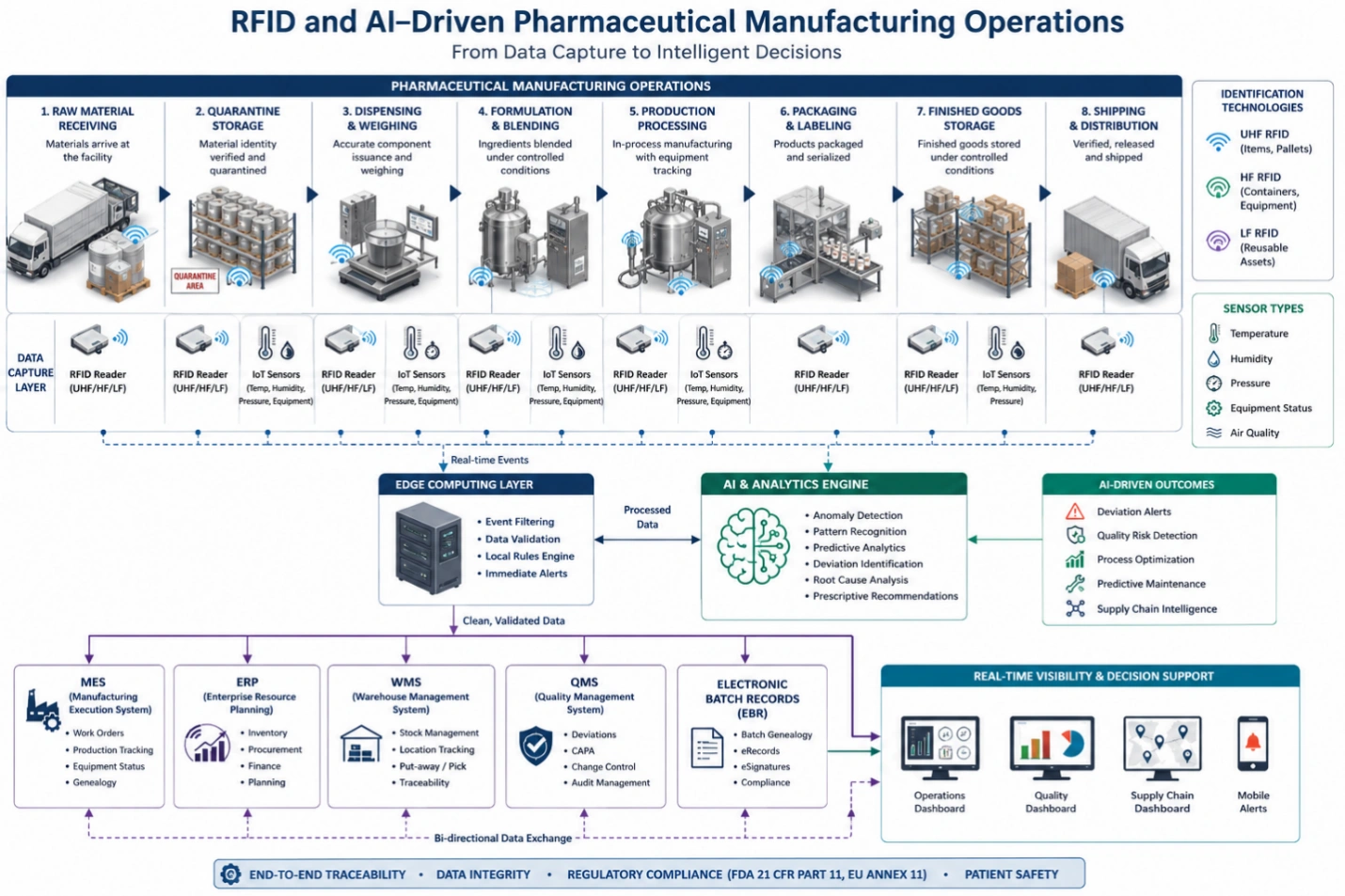
AI and RFID for Pharmaceutical Plants combines artificial intelligence, connected identification devices, industrial sensors, and pharmaceutical manufacturing software to improve visibility across raw materials, active pharmaceutical ingredients, excipients, packaging components, work-in-process materials, finished products, equipment, tools, and controlled production areas. UHF, HF, and LF RFID technologies provide machine-readable identification and event capture, while AI analyzes movement, inventory patterns, process deviations, and operational conditions. The resulting solution can support material genealogy, batch traceability, warehouse control, dispensing operations, cleanroom access monitoring, equipment utilization, and exception management. For pharmaceutical manufacturers, the value is not simply knowing where an RFID-tagged item is located. The objective is to connect identification events with batch records, manufacturing execution systems, quality workflows, environmental data, and human activity so that deviations can be detected earlier and operational decisions can be supported with reliable, time-stamped information.
What AI and RFID Mean for Pharmaceutical Manufacturing
Pharmaceutical plants operate under stringent requirements for product quality, contamination control, material identity, data integrity, and traceability. Manufacturing workflows may involve receiving, quarantine, sampling, quality release, dispensing, staging, formulation, granulation, blending, compression, coating, filling, packaging, inspection, serialization, warehousing, and shipment. Each stage can generate identification and process events that need to remain associated with the correct material, lot, batch, equipment, and production order.
RFID provides an automated identification layer for these workflows. AI adds analytical capabilities that can interpret the resulting event streams alongside data from sensors, cameras, manufacturing systems, and enterprise applications.
For example, an RFID event showing that an excipient container entered a dispensing room becomes more useful when the software can verify:
- Whether the material belongs to the scheduled batch
- Whether the lot has passed the required quality-release status
- Whether the container was routed through the expected staging area
- Whether the dispensing activity occurred within the authorized production window
- Whether the correct operator and equipment were associated with the transaction
- Whether unusual dwell time or movement patterns indicate an operational exception
This creates a practical connection between AI pharmaceutical manufacturing, RFID material tracking, batch traceability, and manufacturing execution.
GAO supplies RFID readers, tags, antennas, sensors, gateways, and related IoT hardware products and systems that can support these identification and monitoring requirements. Hardware selection should be based on the pharmaceutical process, tag material, read environment, cleanroom requirements, metal interference, liquids, required read distance, and validation strategy rather than simply choosing the longest-range RFID technology.
Pharmaceutical Plant Applications for AI-Enabled RFID
AI and RFID can be applied across several pharmaceutical manufacturing workflows, but deployment priorities should be established from measurable operational problems rather than attempting to tag every asset.
Raw Material and Excipient Traceability
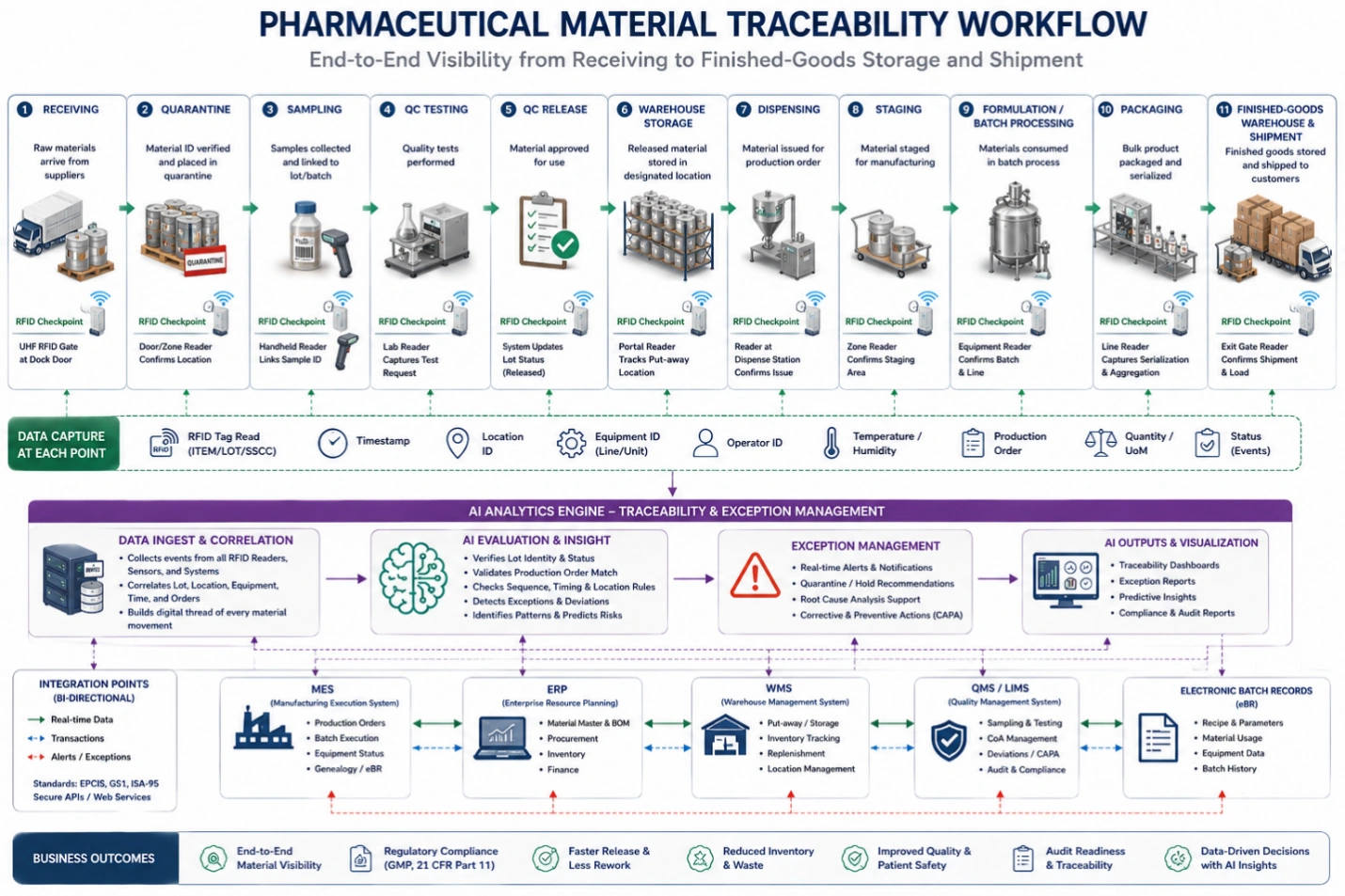
Raw materials and excipients frequently pass through receiving, quarantine, sampling, quality release, storage, staging, dispensing, and production. RFID can associate physical containers with unique identities, while AI can evaluate movement histories against expected material workflows.
A pharmaceutical material tracking solution can help identify:
- Containers entering an unauthorized production or storage zone
- Materials remaining in quarantine beyond expected processing times
- Unexpected movement between storage and dispensing areas
- Repeated handling events associated with operational bottlenecks
- Material-location discrepancies between physical operations and inventory software
- Potential mismatches between production schedules and staged materials
AI models can use historical movement patterns to distinguish normal workflow variation from unusual behavior.
Dispensing and Weighing Operations
Dispensing is particularly suitable for automated identification because material identity, lot status, quantity, operator activity, and production order can be closely connected.
RFID identification at dispensing stations can provide an electronic event confirming which container was presented to the workstation. Weight scales, barcode systems, MES transactions, and environmental sensors can provide additional context.
AI can then identify patterns such as repeated dispensing delays, abnormal staging durations, frequent material substitutions, or workflow sequences that differ from established operating patterns.
Work-in-Process and Batch Traceability
WIP containers, intermediate products, bins, totes, trays, and process vessels can become difficult to track when multiple batches move through shared manufacturing areas. RFID provides automated identification at defined checkpoints, while AI can reconstruct movement histories and detect unexpected process sequences.
For batch genealogy, the important design principle is to associate every material movement with contextual information such as:
- Material and container identity
- Lot or batch number
- Production order
- Process step
- Equipment identifier
- Timestamp
- Production zone
- Operator or authorized workstation
- Quality status
- Related electronic record
The resulting event history can support investigations, reconciliation, and production analytics without replacing validated pharmaceutical quality systems.
Pharmaceutical Equipment and Tool Tracking
Manufacturing plants may track mobile process equipment, stainless-steel containers, IBCs, carts, tooling, change parts, sampling equipment, and maintenance tools. RFID can reduce manual searches and provide location events when equipment passes through controlled checkpoints.
AI can analyze utilization and movement histories to identify underused equipment, recurring search events, unusual dwell times, or maintenance-related movement patterns.
Cleanroom and Controlled-Zone Movement
Personnel and material movement between classified areas must be carefully controlled. RFID badges, tags, access readers, door controllers, and location technologies can provide event data for authorized movement.
AI can evaluate movement sequences for operational anomalies, such as unexpected transitions between zones, prolonged presence in restricted areas, or material movement that does not match a scheduled manufacturing process.
RFID should not be treated as a replacement for validated access-control procedures. Instead, it can provide additional machine-readable evidence for operational monitoring and investigation.
Packaging and Finished Product Traceability
Packaging operations involve components such as labels, cartons, bottles, caps, blister materials, cases, and pallets. RFID can complement barcode and serialization technologies where automated physical identification provides additional value.
AI can correlate material movements with packaging orders and production events to identify unusual component consumption, staging delays, or inventory discrepancies.
Pharmaceutical Manufacturing Challenges AI and RFID Address
Pharmaceutical facilities face operational problems that are difficult to solve through manual scanning and periodic inventory checks alone. The challenge is often not a lack of data, but fragmented data and weak association between physical events and validated production records.
Material Identity and Location Accuracy
Manual transactions can create discrepancies between the physical location of a container and its recorded location. RFID can capture movement automatically at defined points, reducing dependence on manual status updates.
AI can further analyze historical movements to identify recurring location discrepancies and prioritize investigation.
Batch Genealogy and Traceability
A batch may depend on numerous raw materials, intermediate containers, equipment assets, packaging components, and production steps. Establishing reliable relationships between these objects requires consistent event timestamps and identifiers.
An AI-enabled traceability system can correlate RFID events with MES, ERP, QMS, WMS, and electronic batch-record information to provide a more complete operational history.
Inventory Reconciliation
High-value APIs, controlled materials, excipients, packaging components, and specialized consumables require accurate inventory records. RFID can automate identification during receiving, storage, staging, and issue transactions.
AI can analyze consumption rates and inventory movements to identify unusual depletion patterns or reconciliation exceptions.
Contamination and Controlled-Environment Considerations
RFID hardware deployed around cleanrooms must be selected according to environmental and process requirements. Tag construction, adhesives, enclosure materials, cleaning agents, sterilization processes, temperature exposure, and electromagnetic behavior should all be evaluated.
Reader installation also requires careful consideration of antenna placement, RF reflections from stainless-steel equipment, liquid-filled containers, doors, walls, and other conductive structures.
Data Integrity and Validation
Pharmaceutical manufacturing introduces requirements that go beyond ordinary warehouse tracking. RFID and AI solutions may interact with systems subject to validation, electronic records requirements, audit controls, and change-management procedures.
A technically sound implementation therefore needs clear boundaries between automated event collection, analytical recommendations, and controlled manufacturing records. AI-generated predictions should not silently modify validated records or production parameters.
GAO’s experience supplying RFID and IoT hardware products and systems can support the physical data-capture layer, while pharmaceutical organizations should establish their own validation, quality, cybersecurity, and electronic-record procedures appropriate to the intended use.
AI Methods That Improve Pharmaceutical RFID Visibility
AI should be selected according to the operational decision it needs to support. A pharmaceutical plant does not necessarily need a complex model for every RFID event. Deterministic rules may be more appropriate for basic authorization and traceability, while machine learning can provide greater value when historical behavior must be analyzed.
Anomaly Detection
Unsupervised or semi-supervised anomaly detection can identify RFID movement patterns that differ from historical norms. Examples include unexpected material routes, unusually long dwell times, repeated access events, or atypical equipment movement.
Predictive Analytics
Historical RFID events can be combined with inventory transactions, production schedules, equipment data, and consumption records to forecast material requirements and identify potential shortages.
Process Pattern Analysis
Machine learning can evaluate sequences of manufacturing events to identify recurring bottlenecks. If particular dispensing stations, staging areas, or warehouse routes consistently create delays, analytics can quantify the pattern and support process improvement.
Computer Vision and Sensor Fusion
RFID does not need to operate independently. Computer vision can verify labels or containers, while weight sensors can validate dispensing quantities and environmental sensors can monitor temperature, humidity, differential pressure, or other controlled conditions.
Sensor fusion can provide stronger operational evidence than any single technology. For example, an RFID event identifies a container, a camera verifies its visual identity, and a connected scale confirms the expected weight transaction.
RFID Hardware, AI Software, and Pharmaceutical Plant Integration
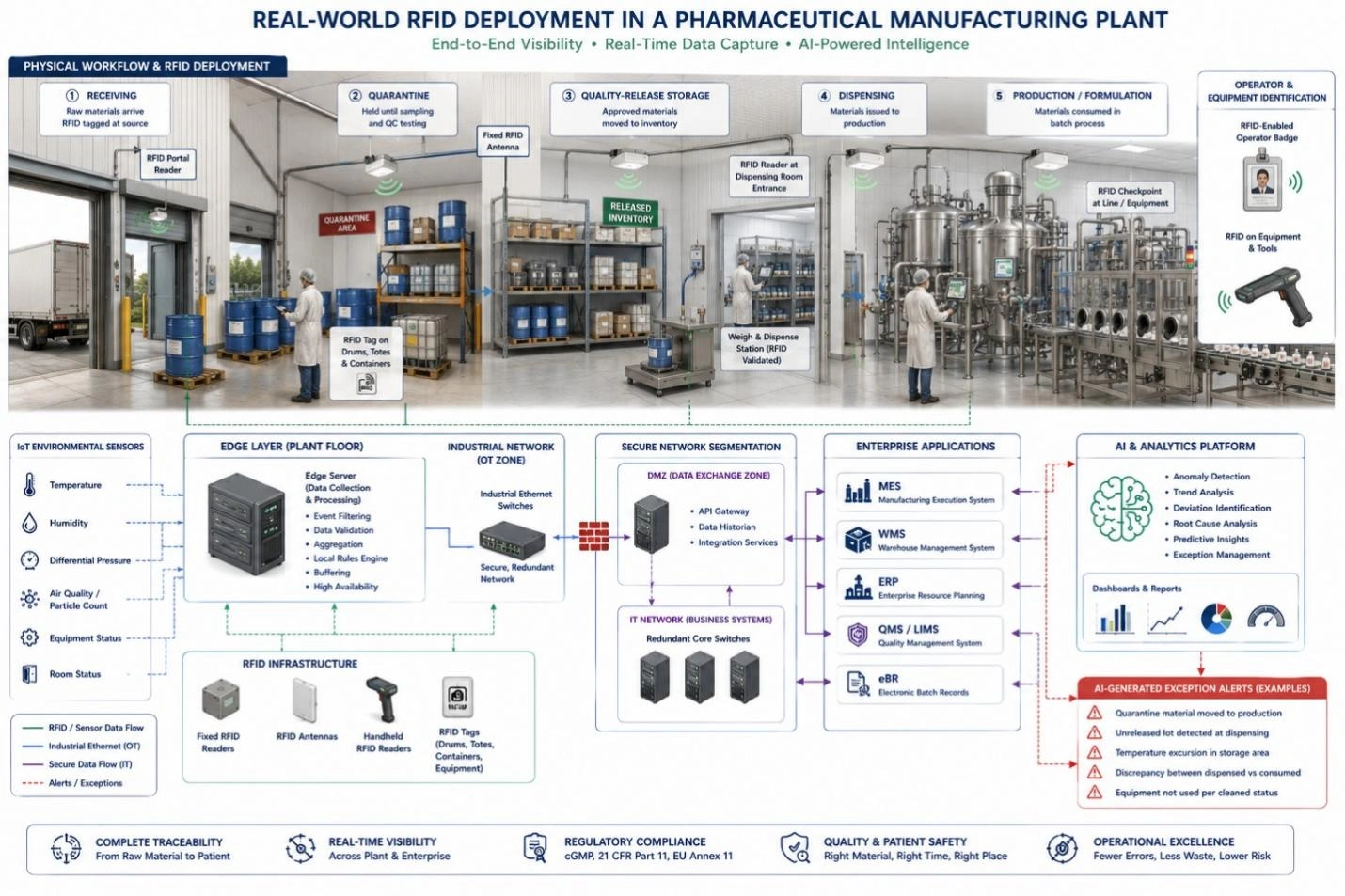
A pharmaceutical RFID solution normally combines identification hardware with industrial networking, edge computing, AI software, and validated business applications. The engineering objective is to create reliable event capture without introducing unnecessary changes to established production processes.
UHF, HF, and LF RFID Selection
RFID frequency should be selected according to the physical process, read distance, material composition, and required identification behavior.
- UHF RFID is generally appropriate for longer-range identification of pallets, cases, containers, totes, warehouse inventory, and movement through receiving or storage portals. Pharmaceutical facilities should evaluate liquid absorption, metal reflections, antenna polarization, and portal geometry during site testing.
- HF RFID can be useful for shorter-range identification where controlled read zones, near-field interaction, or item-level identification is more important than long read distance. It can complement pharmaceutical workstations and controlled identification points.
- LF RFID supports short-range identification in specialized applications where low-frequency behavior and proximity-based detection are advantageous. Its practical use should be determined through application-specific testing rather than assuming one RFID frequency is suitable for the entire facility.
The RFID tag itself is equally important. Pharmaceutical containers may include glass, plastic, stainless steel, liquids, foils, and other RF-sensitive materials. Tag selection therefore needs to account for substrate, mounting location, cleaning procedures, temperature, chemical exposure, and sterilization requirements.
Readers, Antennas, Sensors, and Edge Devices
Fixed RFID readers can be installed at warehouse doors, production-room entrances, dispensing stations, staging areas, and other controlled checkpoints. Handheld readers can support cycle counts, exception investigation, and mobile material verification.
Antennas should be positioned to establish a predictable read zone rather than simply maximizing RF power. Shielding, antenna orientation, reader sensitivity, tag placement, and read-event filtering can help reduce unintended reads.
Supporting IoT devices may include:
- Temperature and humidity sensors
- Differential-pressure sensors
- Vibration sensors for selected equipment
- Weight and load sensors
- Door and occupancy sensors
- BLE beacons and badges
- Barcode and QR-code scanners
- Industrial gateways
- Edge computing servers
GAO provides RFID and IoT hardware products that can form part of this physical data-capture layer, with final device selection based on the environmental, RF, networking, and validation requirements of the pharmaceutical facility.
Communication and Data Transport
Industrial Ethernet and secure Wi-Fi can connect fixed readers, gateways, workstations, and edge servers. BLE may supplement RFID for personnel or mobile equipment location, while cellular IoT or LoRaWAN can be considered for selected remote monitoring scenarios where appropriate.
Common application-layer technologies can include MQTT, HTTPS, REST APIs, OPC UA, and Modbus TCP, depending on the equipment and integration boundary.
The event pipeline should normalize data from different devices into a consistent structure containing fields such as tag ID, reader ID, timestamp, location, event type, device status, and associated business identifier.
Edge, Cloud, and Server Deployment
Cloud Version can be suitable when pharmaceutical organizations want centralized software management across multiple manufacturing sites and their cybersecurity and regulatory policies permit cloud-hosted processing. Cloud deployment can simplify centralized analytics, fleet monitoring, reporting, and cross-site comparison.
Server Version can be preferable when operational data must remain within customer-controlled infrastructure, when low-latency local processing is important, or when plant-network isolation and data-governance requirements favor privately hosted software. This can include factory servers, private data centers, customer-managed edge servers, or other controlled infrastructure.
A hybrid approach can place real-time event filtering and critical workflows close to the manufacturing operation while transferring selected historical data to centralized analytics.
MES, ERP, WMS, QMS, and Electronic Records Integration
The greatest value normally occurs when RFID events are connected to existing pharmaceutical manufacturing software.
Typical integration targets include:
- MES: production orders, process steps, WIP status, equipment assignments, and manufacturing execution events
- ERP: purchasing, material master data, inventory transactions, production planning, and financial records
- WMS: warehouse locations, receiving, put-away, picking, staging, and cycle counts
- QMS: quality status, deviations, investigations, CAPA, and release workflows
- Electronic batch records: controlled association of material and process events with manufacturing documentation
- CMMS/EAM: maintenance history, equipment identity, work orders, and spare-parts consumption
- Serialization systems: product and package identity where serialization requirements apply
Integration should use stable identifiers and clearly defined ownership of master data. An RFID system should not become a second uncontrolled source of truth for batch, material, or quality status.
Cybersecurity and Access Controls
Connected pharmaceutical manufacturing systems should use network segmentation, least-privilege access, encrypted communications, strong authentication, secure device configuration, audit logging, vulnerability management, and controlled software updates.
RFID reader networks should be separated from general-purpose user networks where appropriate. Edge servers should receive only the connectivity required for their operational functions.
AI applications should also maintain traceable model versions, input-data lineage, access records, and appropriate change controls. Where an AI result affects a regulated workflow, organizations should establish how the recommendation is reviewed, approved, documented, and validated.
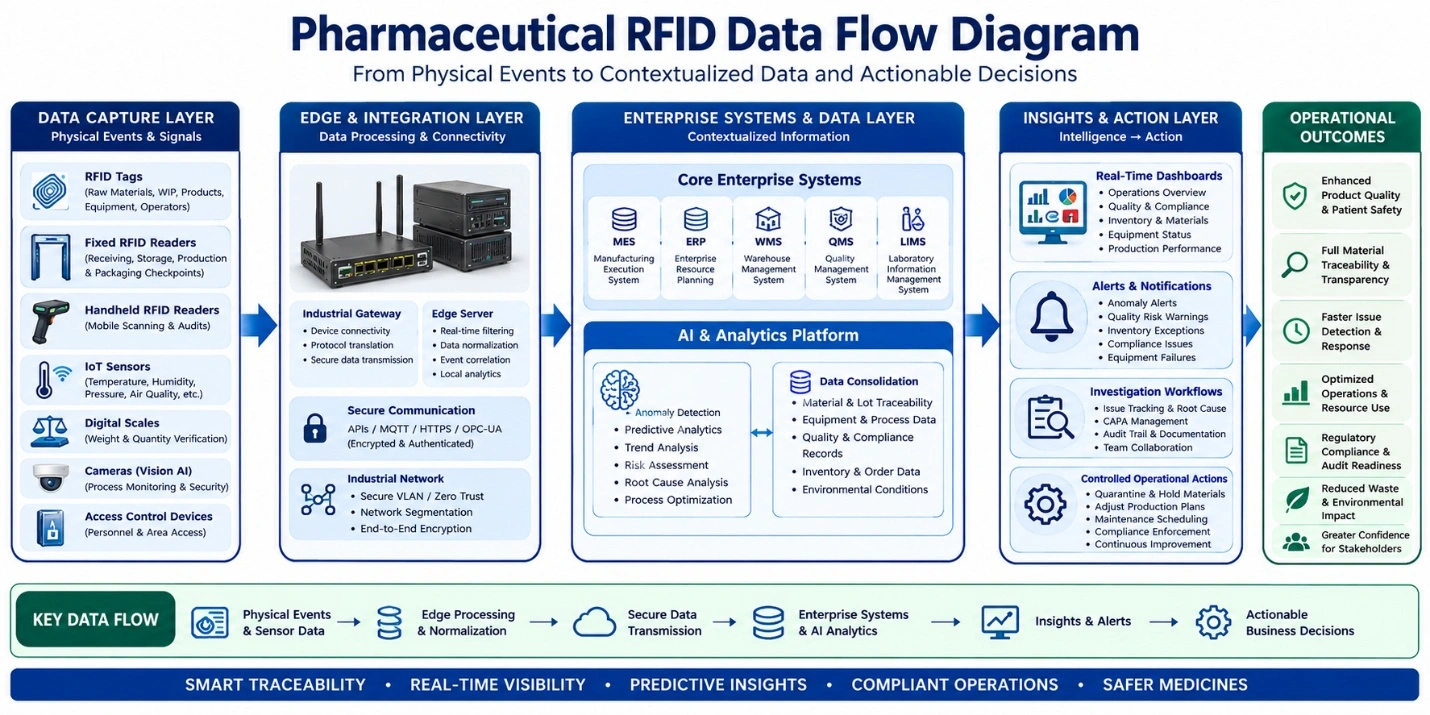
Pharmaceutical RFID Data Workflow from Capture to Decision
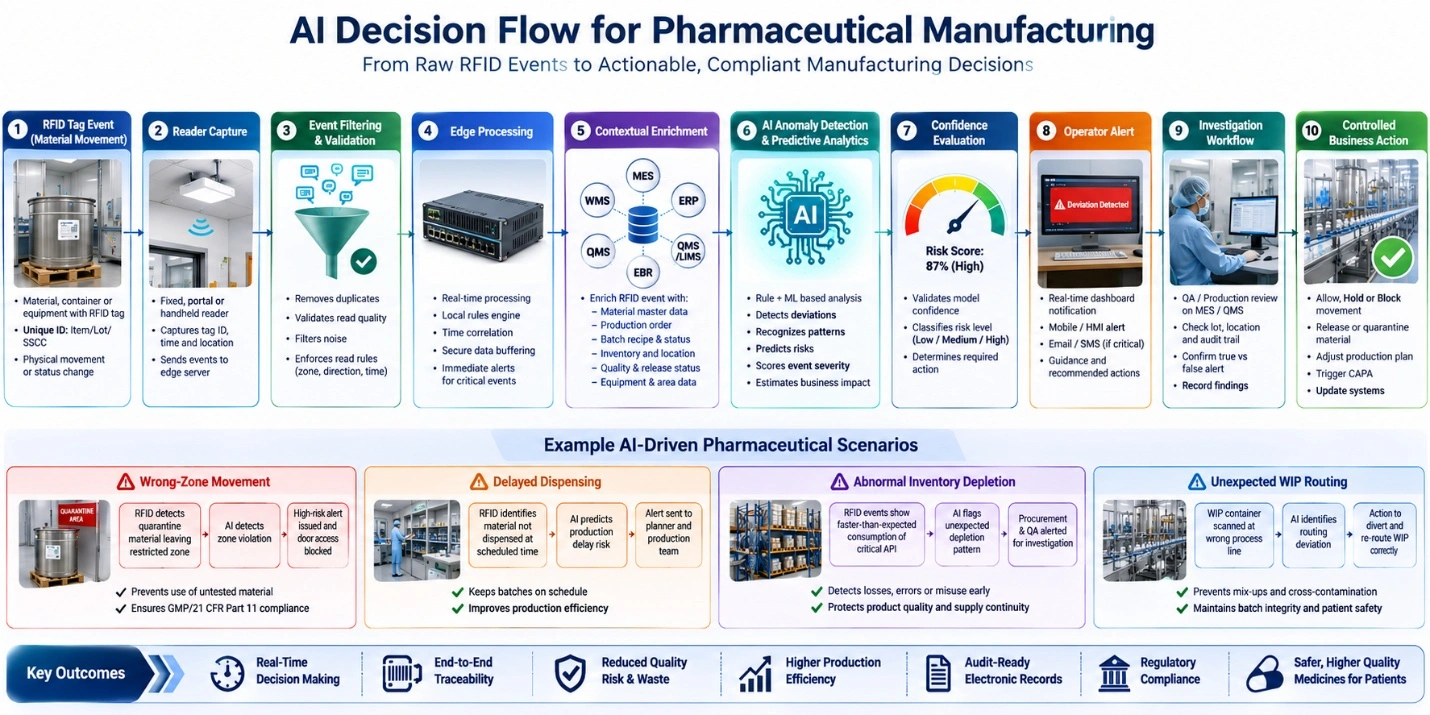
A well-designed AI-enabled RFID system begins with physical events and progressively adds context until the information becomes operationally useful.
Pharmaceutical RFID Data Flow: From Physical Events to Actionable Decisions
Data Acquisition
RFID readers capture tag observations as containers, pallets, equipment, tools, or other tagged objects pass through defined read zones. Sensors and connected systems contribute additional information.
For example, a dispensing transaction can combine:
- RFID tag identity
- Reader and workstation identity
- Timestamp
- Material or container ID
- Lot number
- Warehouse or room location
- Operator identity
- Production-order reference
- Scale reading
- Material quality status
Event Filtering and Edge Processing
Raw RFID readers can generate repeated observations when a tag remains inside a read zone. Edge software should therefore apply debouncing, duplicate suppression, signal filtering, zone logic, and event correlation before information reaches higher-level applications.
This reduces unnecessary data volume and improves event quality.
Contextual Enrichment
The normalized RFID event can then be associated with master data from MES, ERP, WMS, QMS, or other systems. A tag ID by itself has limited business meaning. The combination of tag ID, material identity, lot, quality status, location, and production order provides the context needed for pharmaceutical operations.
AI Analysis
AI models can evaluate historical and real-time data for anomaly detection, demand forecasting, workflow analysis, inventory optimization, and predictive maintenance.
For example, an AI model may identify that a particular material class repeatedly experiences extended staging periods before dispensing. The system can then alert the appropriate production or warehouse team and provide the historical evidence supporting the exception.
Human Decision and Controlled Action
AI should support accountable pharmaceutical personnel rather than obscure the basis of an operational decision. Alerts should provide sufficient context for an operator, supervisor, quality professional, warehouse manager, or maintenance engineer to investigate.
Actions may include:
- Requesting material verification
- Investigating a location discrepancy
- Escalating a quality-related exception
- Replenishing staging inventory
- Checking equipment availability
- Reviewing an unusual movement sequence
- Initiating a controlled investigation
Key AI and RFID Capabilities for Pharmaceutical Plants
The combined solution should be evaluated according to measurable manufacturing outcomes rather than the number of devices deployed.
Automated Material Visibility
Automated identification reduces reliance on manual location updates and can provide near-real-time visibility into material movement between warehouse, quarantine, staging, dispensing, and production areas.
Batch and Lot Traceability
Correlating RFID events with batch and lot information can strengthen material genealogy and support faster investigation when discrepancies occur.
Inventory Accuracy
Automated identification can improve cycle-count efficiency and reduce errors associated with manual inventory transactions. AI adds value by identifying unusual consumption patterns and forecasting potential material requirements.
Exception Detection
AI can continuously examine event streams instead of relying exclusively on periodic reviews. This makes it possible to detect deviations in movement, dwell time, access behavior, equipment utilization, and inventory activity.
Production Flow Optimization
Movement data can reveal recurring congestion around dispensing rooms, staging locations, material airlocks, warehouse doors, and shared equipment. Process engineers can use these findings to redesign workflows and resource allocation.
Equipment Utilization and Maintenance Visibility
RFID can identify equipment movement and usage events, while sensor data can contribute condition information. AI can combine these datasets to identify utilization patterns and support maintenance planning.
Controlled-Zone Monitoring
RFID badges and access events can supplement existing pharmaceutical facility controls by providing additional movement data for authorized personnel and materials.
Multi-Site Scalability
Standardized event models allow organizations with multiple pharmaceutical manufacturing facilities to establish consistent identification and reporting practices while retaining site-specific configuration for equipment, processes, quality procedures, and network controls.
GAO’s hardware products and systems can support deployments ranging from individual RFID identification points to broader IoT-enabled material and equipment tracking initiatives. The appropriate scope depends on the pharmaceutical plant’s operational priorities, integration maturity, facility layout, and validation requirements.
KPIs for AI-Enabled RFID in Pharmaceutical Manufacturing
Measurement should begin before deployment so the plant can establish a baseline and determine whether automation is producing meaningful improvement.
| KPI | What It Measures | AI and RFID Contribution |
|---|---|---|
| Material location accuracy | Agreement between physical and recorded locations | Automated movement events reduce manual location errors |
| Inventory record accuracy | Physical versus system inventory | RFID-supported counting and reconciliation |
| Material search time | Time required to locate containers or equipment | Location history reduces manual searching |
| Dispensing cycle time | Time from material staging to dispensing completion | Event analytics identify recurring delays |
| Batch traceability completeness | Availability of relevant material and process relationships | Automated event association strengthens genealogy |
| Quarantine dwell time | Duration materials remain in quarantine | AI identifies prolonged or unusual dwell patterns |
| Staging dwell time | Time materials wait before production | Process analytics expose bottlenecks |
| Inventory variance | Difference between expected and observed stock | Automated identification supports reconciliation |
| Equipment utilization | Time equipment is available or in use | RFID movement and AI analytics reveal utilization |
| Exception response time | Time from anomaly detection to investigation | Automated alerts accelerate response |
| False-read rate | Unwanted or incorrect RFID observations | RF tuning and event filtering improve reliability |
| RFID read success rate | Percentage of expected events captured | Site testing and antenna optimization improve coverage |
KPIs should be tied to a specific pharmaceutical process. A warehouse may prioritize inventory accuracy and material search time, while dispensing operations may emphasize cycle time, identity verification, and traceability completeness.
Implementation and Commissioning Considerations
A successful pharmaceutical RFID deployment requires more than installing readers. The physical environment, process definition, software integration, validation strategy, and operating procedures must be considered together.
Start with a Controlled Use Case
A dispensing room, material warehouse, or high-value equipment workflow can provide a manageable initial deployment. The selected process should have a measurable operational problem and clearly defined success criteria.
Conduct RF Site Testing
Testing should use the actual tags, containers, racks, doors, equipment, and materials expected during production. Stainless steel and liquids can materially affect RFID performance, so laboratory specifications alone are insufficient.
Establish Read Zones
Readers should be configured so that an event represents a meaningful operational transition. Excessive RF coverage can be counterproductive if tags from adjacent rooms or storage positions are unintentionally detected.
Define Data Ownership
The implementation team should establish which system owns material master data, lot status, quality release status, inventory quantity, production orders, personnel identity, and equipment records.
Validate Integration
API transactions, database interfaces, event handling, failure recovery, authentication, audit logs, and time synchronization should be tested before production use.
Test Failure Conditions
Commissioning should include network interruption, reader failure, duplicate reads, missing tags, incorrect tag placement, gateway restart, server failure, API unavailability, and recovery after communication is restored.
Separate AI Recommendations from Regulated Decisions
AI-generated recommendations should be evaluated according to their intended use. If an AI model supports an investigation or planning process, its role can be different from an application that directly influences a validated manufacturing record.
Clear human review and documented procedures help maintain accountability.
Security, Validation, and Long-Term Maintenance
Pharmaceutical RFID systems should be managed as operational technology rather than as isolated warehouse equipment.
Security controls should include:
- Role-based access control
- Device authentication
- Encrypted communications
- Network segmentation
- Secure API credentials
- Audit logging
- Controlled firmware and software updates
- Backup and recovery procedures
- Vulnerability monitoring
- Time synchronization
- Asset and configuration inventories
AI models require additional lifecycle controls. Training datasets should be documented, model versions should be traceable, and changes should be evaluated before deployment. Model drift should be monitored when production behavior changes substantially.
Maintenance teams should periodically inspect RFID antennas, reader health, network connectivity, tag attachment, sensor calibration, edge-server resources, and integration services.
GAO Group’s long-standing investment in RFID, BLE, and IoT R&D supports the development and supply of hardware products and systems for demanding operational environments. GAO also provides technical support remotely or onsite, helping customers address deployment and operational requirements after hardware selection.
Business Value of AI-Enabled RFID for Pharmaceutical Plants
The strongest business case usually comes from several improvements occurring together rather than from RFID identification alone.
Accurate material visibility can reduce time spent searching for containers, equipment, and WIP. Better traceability can make investigations more efficient by providing time-stamped movement evidence. Automated inventory events can reduce reconciliation effort. AI can then identify patterns that are difficult to detect through individual transactions.
For pharmaceutical manufacturing, these improvements can contribute to:
- More reliable material availability for production
- Better warehouse and dispensing coordination
- Faster identification of traceability discrepancies
- Reduced manual inventory effort
- Improved visibility into WIP movement
- More effective equipment utilization analysis
- Earlier identification of unusual process behavior
- Stronger operational evidence for investigations
- More consistent multi-site reporting
- Better integration between physical operations and manufacturing software
The financial justification should be based on the plant’s baseline costs, including labor spent on searching and counting, production delays caused by missing materials, reconciliation effort, inventory discrepancies, equipment downtime, and investigation time.
Practical Roadmap for Pharmaceutical RFID and AI Deployment
A phased implementation generally reduces technical and operational risk.
- Assess: Map material, WIP, equipment, personnel, and packaging workflows and identify the highest-value visibility gaps.
- Design: Select RFID frequency, tag type, readers, antennas, sensors, gateways, networking, edge processing, and software according to the actual environment.
- Pilot: Deploy a limited workflow such as warehouse movement, dispensing, or mobile equipment tracking.
- Integrate: Connect RFID events with MES, ERP, WMS, QMS, CMMS/EAM, and other relevant systems.
- Validate: Test functional performance, data integrity, cybersecurity controls, integration behavior, and applicable pharmaceutical procedures.
- Commission: Establish production read zones, operating procedures, exception handling, maintenance responsibilities, and monitoring.
- Optimize: Use accumulated event data to improve antenna placement, workflow design, inventory policies, and AI models.
- Scale: Extend proven configurations to additional rooms, material classes, production lines, warehouses, or manufacturing sites.
This approach prevents the common mistake of treating RFID as a standalone hardware installation. The measurable result should be improved pharmaceutical manufacturing visibility and decision quality.
Building Smarter Pharmaceutical Manufacturing with AI and RFID
AI-enabled RFID can provide pharmaceutical plants with a practical connection between physical material movement and digital manufacturing information. UHF, HF, and LF RFID technologies provide identification at selected process points, while AI can interpret movement histories, inventory behavior, production workflows, equipment activity, and sensor information.
The most effective deployments begin with specific pharmaceutical manufacturing problems such as material traceability, dispensing visibility, inventory reconciliation, WIP control, or equipment utilization. They then integrate RFID events with existing MES, ERP, WMS, QMS, and related systems.
GAO provides RFID, BLE, and IoT hardware products and systems that can support these deployments, complemented by technical expertise for application-specific device selection and implementation. Organizations evaluating pharmaceutical RFID can learn more about GAO’s technologies, technical resources, and support to determine which approach best fits their manufacturing processes.
Building the Future of Industrial AI and IoT with Aperture Venture Studio and GAO RFID Inc.
For more than three decades, GAO Group of Companies has invested heavily in R&D for industrial RFID, BLE, and IoT technologies. As AI has become increasingly useful in industrial applications, we have expanded our work across AI-enabled manufacturing, connected sensing, and intelligent identification, including solutions relevant to pharmaceutical material traceability and plant operations. We have also founded Aperture Venture Studio to advance AI and IoT solutions for specialized industrial applications.
Aperture brings together AI and IoT technical experts, entrepreneurial and operational executives, investors, and leading companies. Through Aperture Ventures Summit and TekSummit, we also support technical discussions around advanced AI and IoT applications.
GAO, headquartered in New York City and Toronto, Canada, is ranked among the world’s leading B2B and B2G BLE and RFID suppliers. GAO and sister companies GAO Research Inc. and GAO Tek Inc. form GAO Group, serving customers across the U.S. and Canada, including Fortune 500 companies, R&D organizations, universities, and government agencies. We welcome you to engage with us as advisors, employees, investors, or customers.