
AI and RFID for Robotics Manufacturing
How AI-Powered RFID Is Transforming Robotics Manufacturing
Artificial intelligence powered by RFID is reshaping robotics manufacturing by providing continuous visibility into robotic components, production assets, tooling, work-in-progress assemblies, automated guided vehicles, collaborative robots, quality operations, and factory logistics. By combining industrial AI with RFID-generated operational data, robotics manufacturers can automate production decisions, improve traceability, reduce downtime, optimize inventory, and strengthen quality assurance across highly automated production environments.
Robotics manufacturing involves far more than assembling robotic arms. Modern facilities produce industrial robots, collaborative robots (cobots), autonomous mobile robots (AMRs), articulated robots, SCARA robots, delta robots, robotic controllers, servo systems, harmonic drives, end effectors, machine vision modules, sensors, and safety systems. These products require precise component traceability, synchronized manufacturing operations, strict quality validation, and efficient material movement throughout fabrication, machining, electronics assembly, calibration, testing, packaging, and shipment.
Industrial AI enhances RFID-enabled identification by recognizing production patterns, predicting equipment failures, optimizing scheduling, detecting bottlenecks, forecasting inventory requirements, and supporting autonomous operational decisions. Rather than relying solely on historical production reports, robotics manufacturers gain continuous operational intelligence that improves throughput, engineering productivity, production consistency, and lifecycle traceability.
For organizations seeking AI-driven manufacturing intelligence, RFID serves as one of several enabling Industrial IoT technologies that delivers reliable identification and event data into AI software. This combination supports highly automated robotics production while maintaining the precision demanded by modern machinery manufacturing.
GAO has supplied RFID hardware products and Industrial IoT solutions to organizations across North America for decades, helping manufacturers improve production visibility, asset identification, inventory accuracy, and operational efficiency through proven engineering practices.
Why AI and RFID Matter in Modern Robotics Manufacturing
Robotics manufacturing differs significantly from general machinery production because every finished system integrates mechanical assemblies, embedded electronics, precision motion systems, industrial software, calibration procedures, and extensive validation testing. Thousands of serialized components move through synchronized manufacturing operations before a robot reaches final acceptance testing.
Artificial intelligence becomes valuable because robotics factories generate enormous volumes of operational data from:
- RFID readers
- CNC machining centers
- Servo motor assembly stations
- PCB assembly lines
- Torque tools
- Automated storage systems
- Machine vision inspection systems
- Functional testing equipment
- Environmental test chambers
- Calibration stations
- Automated guided vehicles
- Industrial robots
- Manufacturing execution software
- Warehouse management software
- Enterprise resource planning software
- Quality management software
Without AI, much of this production data remains underutilized.
Machine learning transforms these operational events into predictive maintenance recommendations, production optimization opportunities, material flow improvements, workforce scheduling insights, quality predictions, and supply chain intelligence.
This capability is especially valuable when manufacturing:
- Industrial robotic arms
- Collaborative robots
- Autonomous mobile robots
- Robotic welding systems
- Pick-and-place robots
- Packaging robots
- Palletizing robots
- Vision-guided robots
- Precision assembly robots
- Robotic medical devices
- Educational robots
- Mobile manipulation systems
AI and RFID Robotics Manufacturing Workflow with Real-Time Production Intelligence
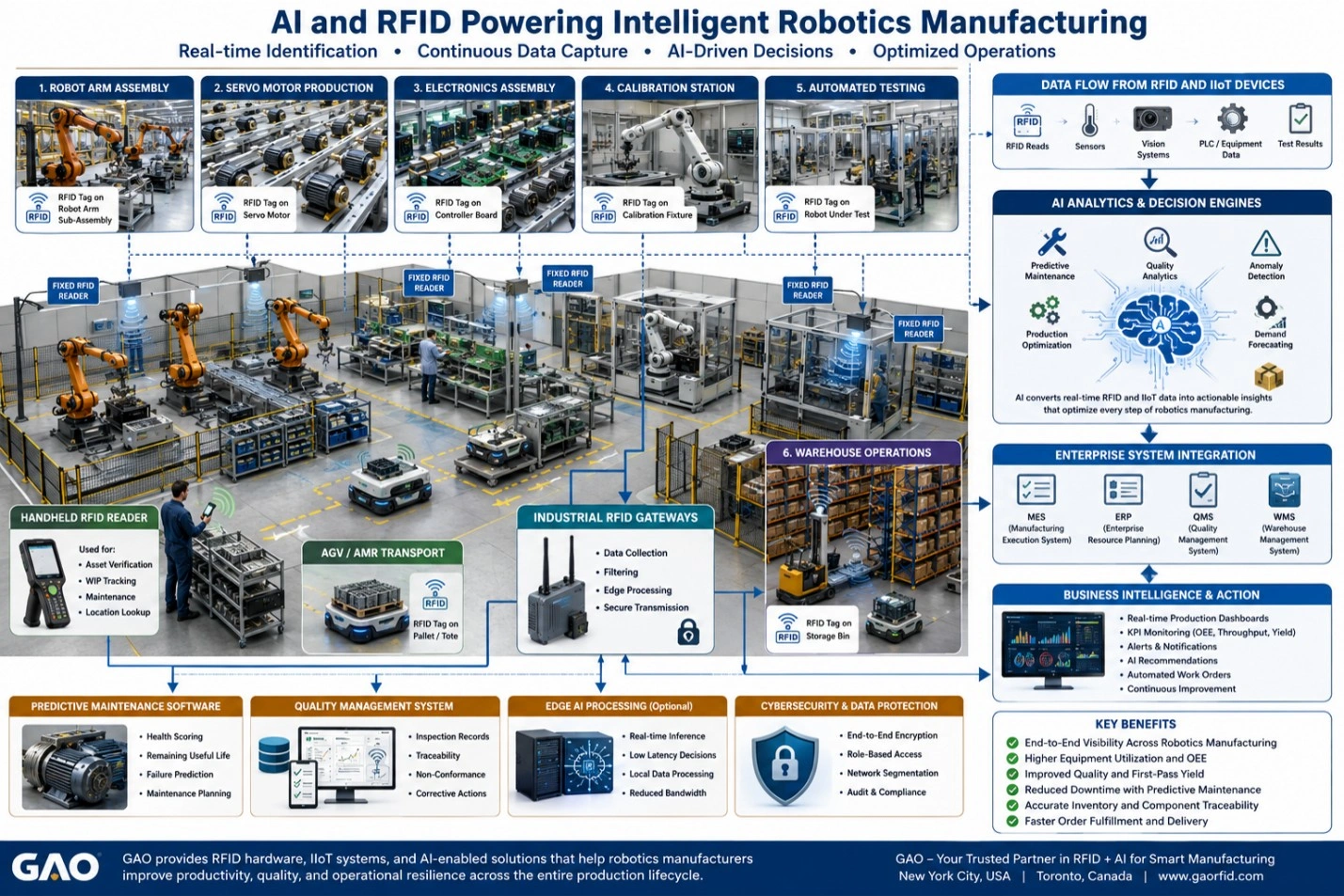
Core Technical Concepts Behind AI-Enabled RFID in Robotics Manufacturing
Artificial Intelligence of Things (AIoT) combines artificial intelligence with Industrial IoT devices, connected equipment, industrial sensors, and identification technologies to improve manufacturing decisions. Within robotics manufacturing, RFID supplies highly reliable identification and movement information while AI analyzes operational behavior across production processes.
Rather than identifying only finished robots, RFID supports visibility across numerous manufacturing assets, including:
- Robot base frames
- Joint assemblies
- Harmonic gearboxes
- Servo motors
- Gear reducers
- Linear actuators
- Control cabinets
- Printed circuit boards
- Cable harnesses
- End effectors
- Vision cameras
- Laser scanners
- Torque tools
- Calibration fixtures
- Production pallets
- Returnable containers
- Assembly tooling
- Test equipment
- Warehouse inventory
- Spare parts
Each RFID event contributes contextual production intelligence that AI software evaluates alongside machine telemetry, production schedules, quality measurements, maintenance history, and engineering documentation.
Common AI methods include:
- Supervised machine learning
- Predictive analytics
- Reinforcement learning for production optimization
- Computer vision
- Time-series anomaly detection
- Deep learning
- Natural language processing for maintenance documentation
- Edge AI inference
- Statistical process control models
These techniques enable robotics manufacturers to improve scheduling, reduce production interruptions, optimize robot calibration workflows, identify component shortages before they affect production, and maintain complete digital traceability.
AI Applications Across Robotics Manufacturing Operations
Robotics manufacturing presents unique operational requirements because products combine precision mechanics, electrical engineering, embedded software, and advanced automation. AI improves nearly every production stage when supported by reliable RFID identification.
AI Component Traceability
Each robotic joint, actuator, gearbox, encoder, servo motor, controller, and sensor can be associated with serialized RFID identification.
AI correlates this information with:
- Assembly records
- Supplier history
- Inspection measurements
- Functional testing
- Firmware versions
- Calibration certificates
- Engineering revisions
This creates comprehensive production genealogy that simplifies warranty analysis, field service investigations, and regulatory documentation.
AI Production Scheduling
Production scheduling becomes increasingly complex when robotics manufacturers build multiple robot models simultaneously.
AI continuously analyzes:
- Material availability
- Component shortages
- Production priorities
- Machine utilization
- Operator availability
- Robot testing capacity
- Inventory levels
- Supplier delivery performance
Production schedules are adjusted dynamically to reduce idle equipment and improve throughput.
AI Inventory Management
Robotics production depends on thousands of precision components with varying lead times.
AI evaluates RFID inventory data to:
- Predict shortages
- Optimize replenishment
- Identify slow-moving inventory
- Improve warehouse slotting
- Reduce excess stock
- Balance production demand
- Improve kitting accuracy
GAO has supported manufacturers by providing RFID hardware systems that improve inventory visibility and material identification throughout complex manufacturing operations.
AI Predictive Maintenance
Critical manufacturing equipment continuously generates operational information.
AI analyzes:
- CNC spindle utilization
- Robot cycle counts
- Conveyor performance
- Motor temperatures
- Vibration measurements
- Maintenance records
- RFID equipment utilization history
Maintenance activities can therefore be scheduled before failures interrupt robotics production
AI-Driven RFID Workflow for End-to-End Robotics Manufacturing
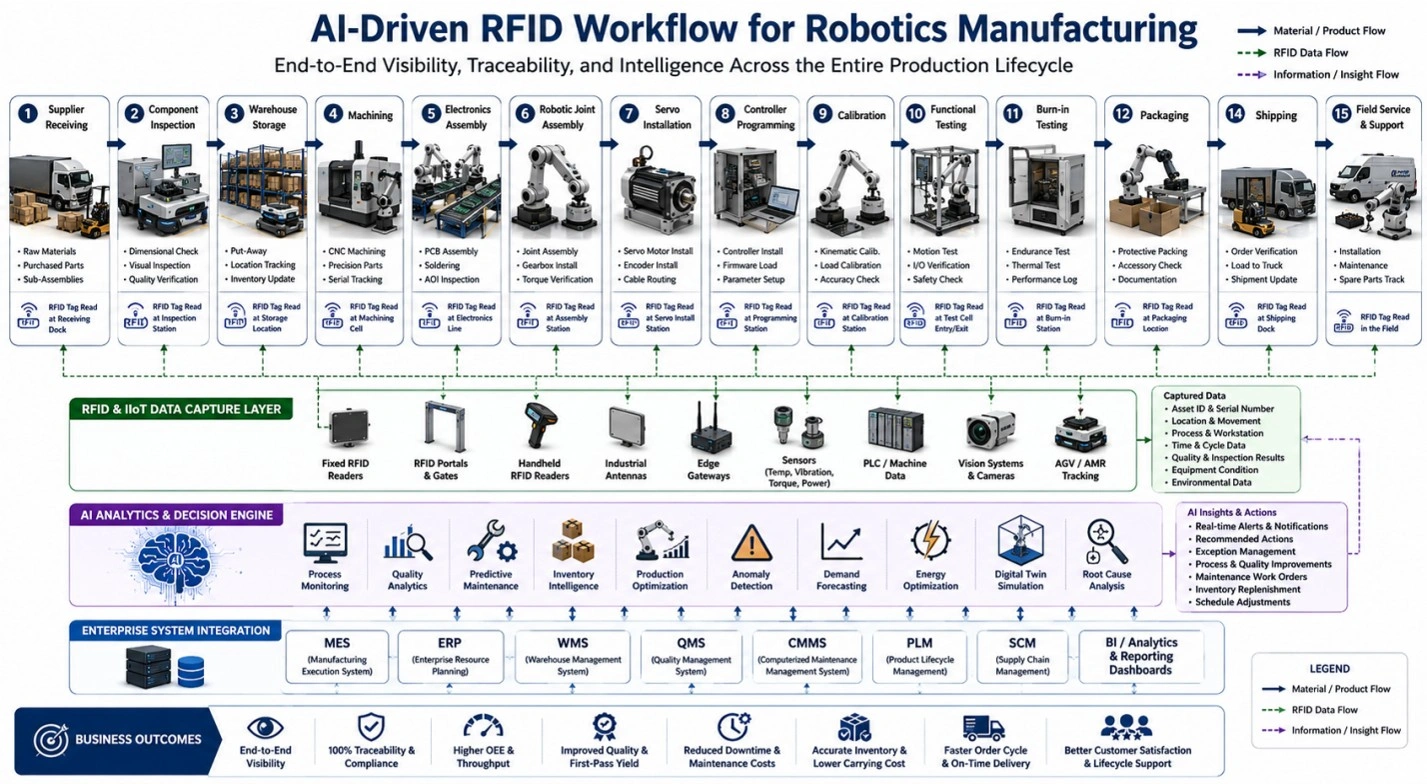
Robotics Manufacturing Workflow from Data Capture to AI Decision-Making
A successful AI-enabled robotics manufacturing solution depends on reliable operational data flowing through multiple manufacturing systems before intelligent decisions are generated.
Production Identification
Production begins with RFID identification assigned to incoming materials, purchased components, subassemblies, reusable fixtures, production pallets, and finished robotic systems.
RFID events are captured throughout receiving, machining, assembly, testing, warehouse operations, and shipping.
Industrial Communication Infrastructure
Operational events are transmitted through industrial communication networks that may include Ethernet/IP, PROFINET, EtherCAT, OPC UA, MQTT, Modbus TCP, REST APIs, and secure industrial gateways.
These communication methods synchronize information between production equipment, industrial controllers, AI software, and enterprise systems while maintaining deterministic manufacturing operations.
Edge Processing
Edge servers located near manufacturing cells process RFID events with minimal latency.
Typical edge functions include:
- Event filtering
- Duplicate removal
- Local AI inference
- Production rule validation
- Equipment monitoring
- Temporary buffering
- Alarm generation
Edge processing reduces unnecessary network traffic while enabling rapid production responses for robotic assembly lines.
Enterprise Software Integration
Filtered operational information is exchanged with business software including:
- Manufacturing Execution Systems (MES)
- Enterprise Resource Planning (ERP)
- Product Lifecycle Management (PLM)
- Warehouse Management Systems (WMS)
- Computerized Maintenance Management Systems (CMMS)
- Quality Management Systems (QMS)
- Manufacturing Intelligence software
- Digital twin applications
These integrations enable synchronized production planning, engineering change control, inventory management, quality assurance, maintenance scheduling, and operational reporting.
AI Analytics and Operational Decisions
Once operational information has been consolidated, AI software evaluates production performance across robotics manufacturing activities.
Typical AI-generated recommendations include:
- Production sequence optimization
- Quality risk identification
- Component shortage forecasting
- Equipment maintenance scheduling
- Warehouse replenishment
- Calibration prioritization
- Production bottleneck detection
- Workforce allocation
- Energy optimization
- Process improvement opportunities
RFID Technologies, AI Infrastructure, and Deployment Considerations for Robotics Manufacturing
Building an AI-enabled robotics manufacturing solution requires coordinated deployment of RFID hardware, Industrial IoT infrastructure, AI software, enterprise applications, communication networks, cybersecurity controls, and operational governance. Every component contributes to reliable production intelligence, but the primary objective remains improving robotics manufacturing performance rather than deploying RFID technology alone.
RFID Technologies Used in Robotics Manufacturing
Different RFID technologies support different manufacturing requirements.
UHF RFID
UHF RFID is commonly deployed for:
- Work-in-progress tracking
- Production pallet identification
- Warehouse inventory management
- Returnable transport item tracking
- Finished robot identification
- AGV material movement
- Shipping verification
- Loading dock automation
Longer read ranges make UHF suitable for automated production environments where multiple tagged assets move through RFID portals.
HF RFID
HF RFID is frequently selected for:
- Electronic component identification
- Precision workstations
- Calibration fixtures
- Tool authentication
- Engineering laboratories
- Controlled assembly processes
Its shorter read range helps minimize unintended tag reads in dense manufacturing cells.
LF RFID
LF RFID remains useful where harsh industrial environments require reliable identification despite contamination from oil, grease, dust, or metal-rich surroundings. Applications include production tooling, reusable fixtures, maintenance assets, and specialized manufacturing equipment.
Hardware Supporting AI-Driven Robotics Manufacturing
A robotics manufacturing solution typically includes:
- Fixed RFID readers
- Handheld RFID readers
- RFID antennas
- Industrial RFID gateways
- Passive RFID tags
- Rugged industrial tags
- Embedded RFID labels
- Edge servers
- Industrial PCs
- Programmable logic controllers (PLCs)
- Human-machine interfaces (HMIs)
- Industrial Ethernet switches
- Wi-Fi 6 industrial access points
- Vision inspection cameras
- Environmental sensors
- Vibration sensors
- Temperature sensors
- Smart torque tools
- Automated storage systems
- Autonomous mobile robots (AMRs)
Each device contributes operational information that AI software correlates to provide broader manufacturing intelligence.
AI Software Components
AI software within robotics manufacturing commonly includes:
- Predictive maintenance models
- Machine learning pipelines
- Time-series analytics
- Computer vision inference
- Anomaly detection
- Production optimization software
- Demand forecasting
- Inventory optimization
- Quality prediction
- Digital twin simulation
- Explainable AI reporting
- Decision support dashboards
Rather than replacing engineering expertise, AI augments manufacturing teams by identifying patterns that would otherwise remain hidden within millions of production events.
Enterprise Software Integration
Successful deployments exchange operational information with business software including:
- Manufacturing Execution Systems (MES)
- Enterprise Resource Planning (ERP)
- Product Lifecycle Management (PLM)
- Warehouse Management Systems (WMS)
- Supply Chain Management (SCM)
- Computerized Maintenance Management Systems (CMMS)
- Quality Management Systems (QMS)
- Customer Relationship Management (CRM)
- Engineering document management software
- Manufacturing intelligence software
These integrations ensure engineering, production, logistics, procurement, quality, and maintenance teams operate using synchronized operational information.
GAO has assisted customers by supplying RFID hardware and Industrial IoT systems designed for reliable integration into existing manufacturing software environments while minimizing operational disruption.
Communication Infrastructure
Reliable communication is essential because robotics production generates continuous operational events.
Frequently used industrial protocols include:
- OPC UA
- MQTT
- EtherNet/IP
- PROFINET
- EtherCAT
- Modbus TCP
- HTTPS
- REST APIs
- AMQP
These communication methods enable secure information exchange between production equipment, RFID infrastructure, AI software, and enterprise systems.
Cloud Version and Server Version Deployment
Selecting the appropriate deployment model depends on production requirements, cybersecurity policies, regulatory obligations, latency expectations, and operational governance.
Cloud Version
Cloud-hosted software is typically appropriate when organizations require:
- Multi-factory production visibility
- Centralized AI model management
- Simplified software updates
- Elastic computing resources
- Enterprise-wide reporting
- Global supply chain analytics
- Remote operational monitoring
This deployment model is well suited for robotics manufacturers operating multiple facilities across different geographic regions.
Server Version
Server-based deployments use customer-managed servers located in private data centers, factory server rooms, edge computing environments, or other privately hosted enterprise infrastructure.
This approach is often preferred when robotics manufacturers require:
- Low-latency manufacturing decisions
- Strict cybersecurity governance
- Production data residency
- Integration with isolated factory networks
- Independent software lifecycle control
- High operational resilience
- Deterministic manufacturing performance
Many robotics manufacturers also implement hybrid deployments where edge servers perform real-time operational processing while selected information is synchronized with cloud-hosted software for enterprise reporting and long-term AI model training.
AI-Enabled RFID Deployment Models for Robotics Manufacturing: Cloud, Server, and Hybrid Comparison
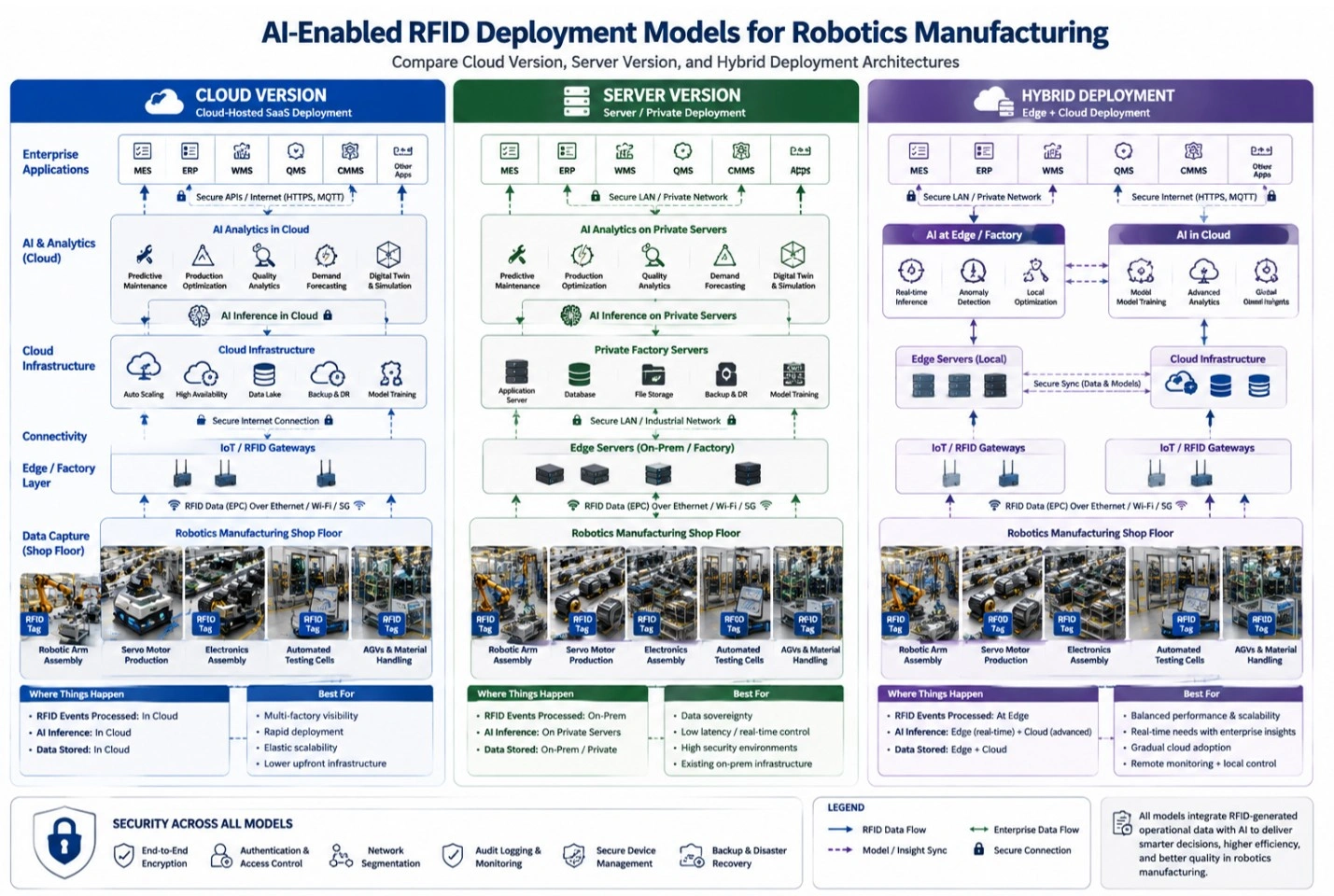
Cybersecurity and Data Protection
Robotics manufacturing facilities frequently contain proprietary robot designs, embedded software, motion control algorithms, customer-specific configurations, and intellectual property that require strong cybersecurity protections.
Recommended security practices include:
- Zero Trust access policies
- Role-based access control
- Multi-factor authentication
- End-to-end encryption
- Secure device authentication
- Network segmentation
- Certificate-based communications
- Continuous vulnerability management
- Security information and event management (SIEM)
- Backup and disaster recovery procedures
- Secure firmware management
- Audit logging
- AI model governance
Security should be incorporated throughout solution planning rather than added after deployment.
Technical Capabilities and Operational Benefits
AI supported by RFID-generated operational information delivers measurable improvements throughout robotics manufacturing.
Improved Production Visibility
Continuous identification of robot assemblies, components, tooling, pallets, and production assets enables engineering teams to monitor manufacturing progress without relying on manual reporting.
Enhanced Component Traceability
Every serialized gearbox, servo motor, encoder, controller, and robotic joint can be associated with inspection records, firmware revisions, calibration certificates, supplier information, and production history.
This level of genealogy simplifies warranty investigations and supports regulatory documentation.
Predictive Equipment Maintenance
AI evaluates historical maintenance records alongside equipment utilization, operating conditions, vibration data, and production schedules to identify maintenance opportunities before failures interrupt production.
Higher Inventory Accuracy
RFID identification combined with AI forecasting reduces inventory discrepancies, improves warehouse replenishment, minimizes production delays, and supports efficient component kitting.
Better Quality Management
AI identifies manufacturing patterns associated with defects before large batches are affected.
Quality engineers receive earlier visibility into:
- Torque deviations
- Calibration inconsistencies
- Assembly sequencing errors
- Component shortages
- Inspection failures
- Functional testing trends
Improved Equipment Utilization
AI recommends production balancing strategies that increase utilization across CNC machining centers, robotic assembly cells, calibration stations, automated testing equipment, and warehouse automation systems.
Supply Chain Intelligence
Manufacturers gain improved visibility across suppliers, inbound logistics, warehouse inventory, production schedules, and customer shipments.
Operational Scalability
As robotics production expands to additional manufacturing lines or facilities, standardized RFID identification and AI analytics can be extended while maintaining consistent operational reporting.
GAO supports organizations by providing RFID hardware products and technical expertise that help manufacturers scale Industrial IoT deployments with confidence
AI Executive Dashboard for Robotics Manufacturing with RFID Production Intelligence
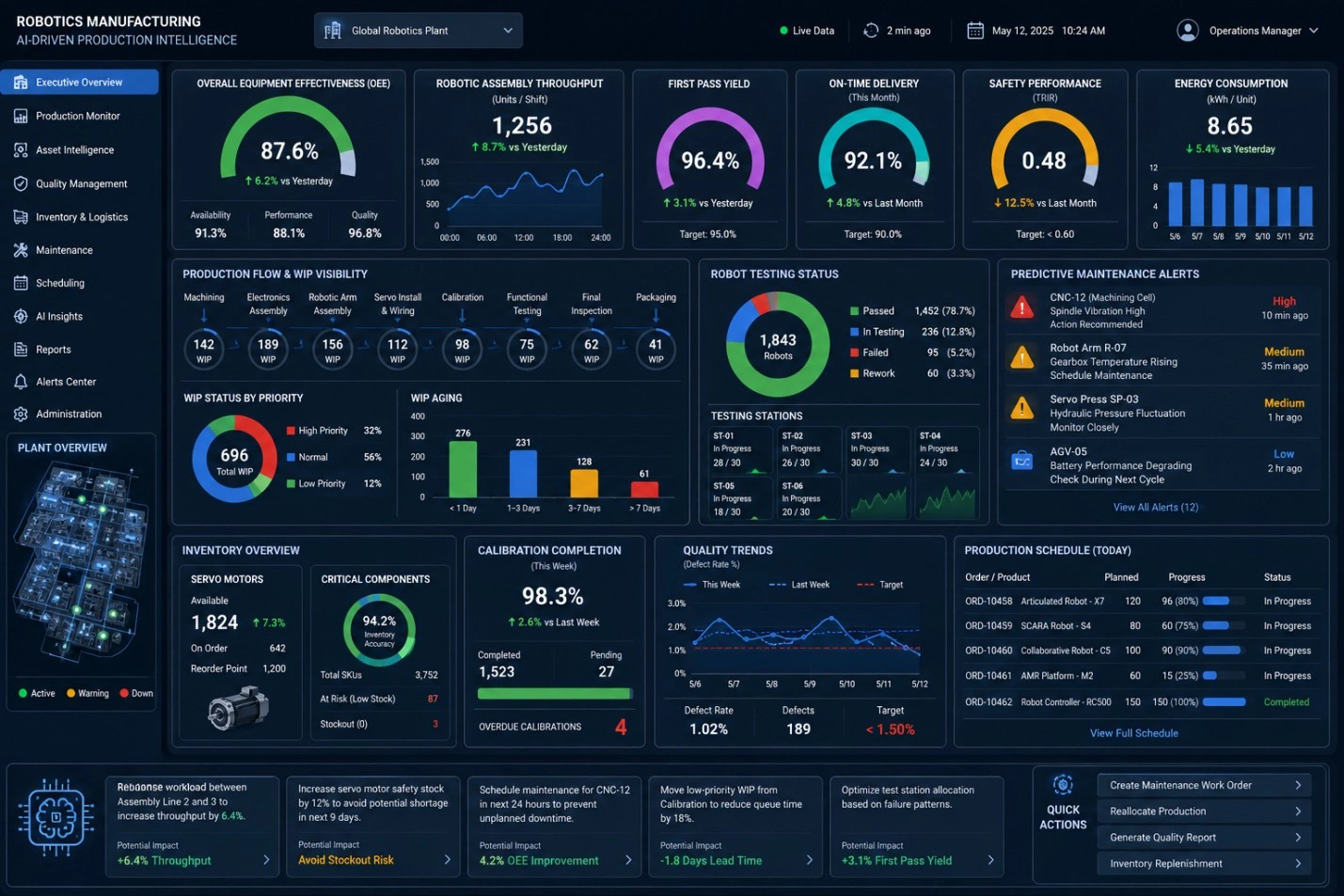
Engineering Best Practices for Implementation
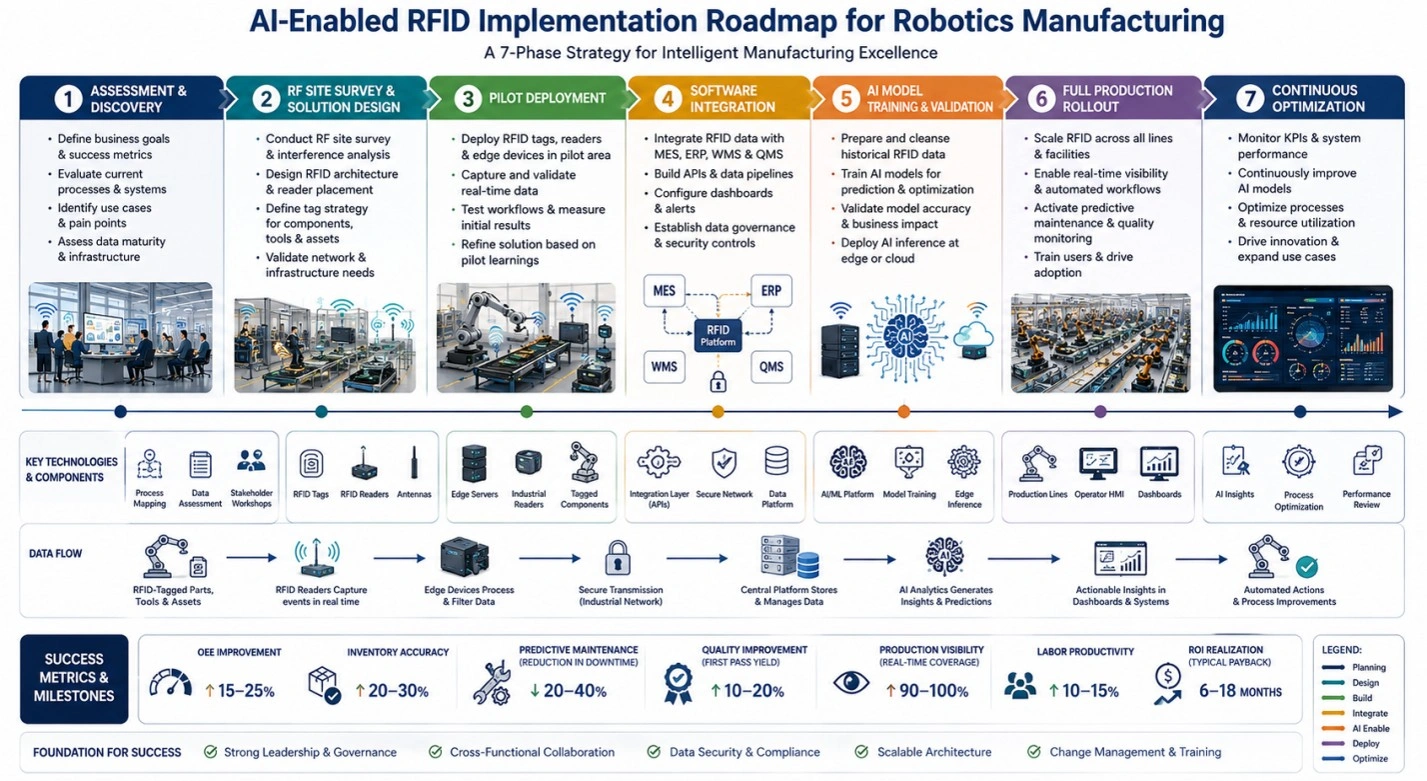
Organizations planning AI-enabled RFID solutions for robotics manufacturing should adopt a structured implementation strategy.
Recommended engineering practices include:
- Define measurable business objectives before selecting hardware.
- Perform RF site surveys around robotic work cells, metal fixtures, conveyors, and automated storage systems.
- Validate RFID tag placement on metallic robot components to ensure reliable read performance.
- Integrate production identification with MES, ERP, QMS, WMS, and CMMS software.
- Deploy edge processing where low-latency production decisions are required.
- Establish data quality validation before AI model training.
- Monitor model performance and retrain AI using updated production data.
- Implement cybersecurity controls throughout hardware, software, and communications.
- Conduct pilot deployments before expanding across multiple manufacturing lines.
- Define KPIs such as OEE, first-pass yield, inventory accuracy, equipment utilization, order cycle time, and predictive maintenance accuracy to measure deployment success.
AI-Enabled RFID Implementation Roadmap for Robotics Manufacturing
Advancing Robotics Manufacturing with AI-Enabled RFID
AI-supported RFID solutions enable robotics manufacturers to transform production visibility into actionable operational intelligence. By combining reliable identification with Industrial AI, manufacturers can optimize scheduling, improve traceability, strengthen quality management, enhance predictive maintenance, reduce inventory inefficiencies, and support data-driven manufacturing decisions.
Successful implementations require thoughtful planning, appropriate RFID technology selection, robust integration with manufacturing software, secure communications, and continuous optimization of AI models. Organizations that invest in disciplined engineering practices are better positioned to improve productivity, operational resilience, and long-term manufacturing performance.
Headquartered in New York City and Toronto, GAO is recognized among the world’s leading B2B and B2G suppliers of RFID and BLE technologies. For more than three decades, we have supported customers throughout the United States and Canada, including Fortune 500 companies, leading research organizations, universities, and government agencies. Through ongoing investment in research and development, stringent quality assurance, and expert remote and onsite technical support, GAO continues to help robotics manufacturers deploy reliable RFID and Industrial IoT solutions that address real-world operational challenges.