
AI and RFID for Third-Party Logistics (3PL)
AI and RFID for Third-Party Logistics (3PL)
Third-Party Logistics providers manage complex warehouse, fulfillment, transportation, inventory, and customer operations where real-time visibility directly affects service quality and profitability. AI is increasingly helping 3PL companies predict demand, optimize warehouse activities, identify operational bottlenecks, and improve decision-making. RFID supports these AI-driven processes by providing automated identification and movement data for pallets, cartons, returnable transport items, inventory, and operational assets.
AI-powered 3PL management combines machine learning, edge processing, analytics, connected devices, and RFID data to create more responsive logistics operations. Instead of relying entirely on barcode scans and manual inventory updates, 3PL operators can capture operational events automatically and use AI to identify patterns across receiving, put-away, storage, picking, packing, shipping, and returns.
For Third-Party Logistics companies, the combination of AI and RFID can improve inventory accuracy, warehouse throughput, asset utilization, order fulfillment performance, and supply chain visibility while reducing manual data collection and operational uncertainty.
AI and RFID-Powered Third-Party Logistics Warehouse Operations
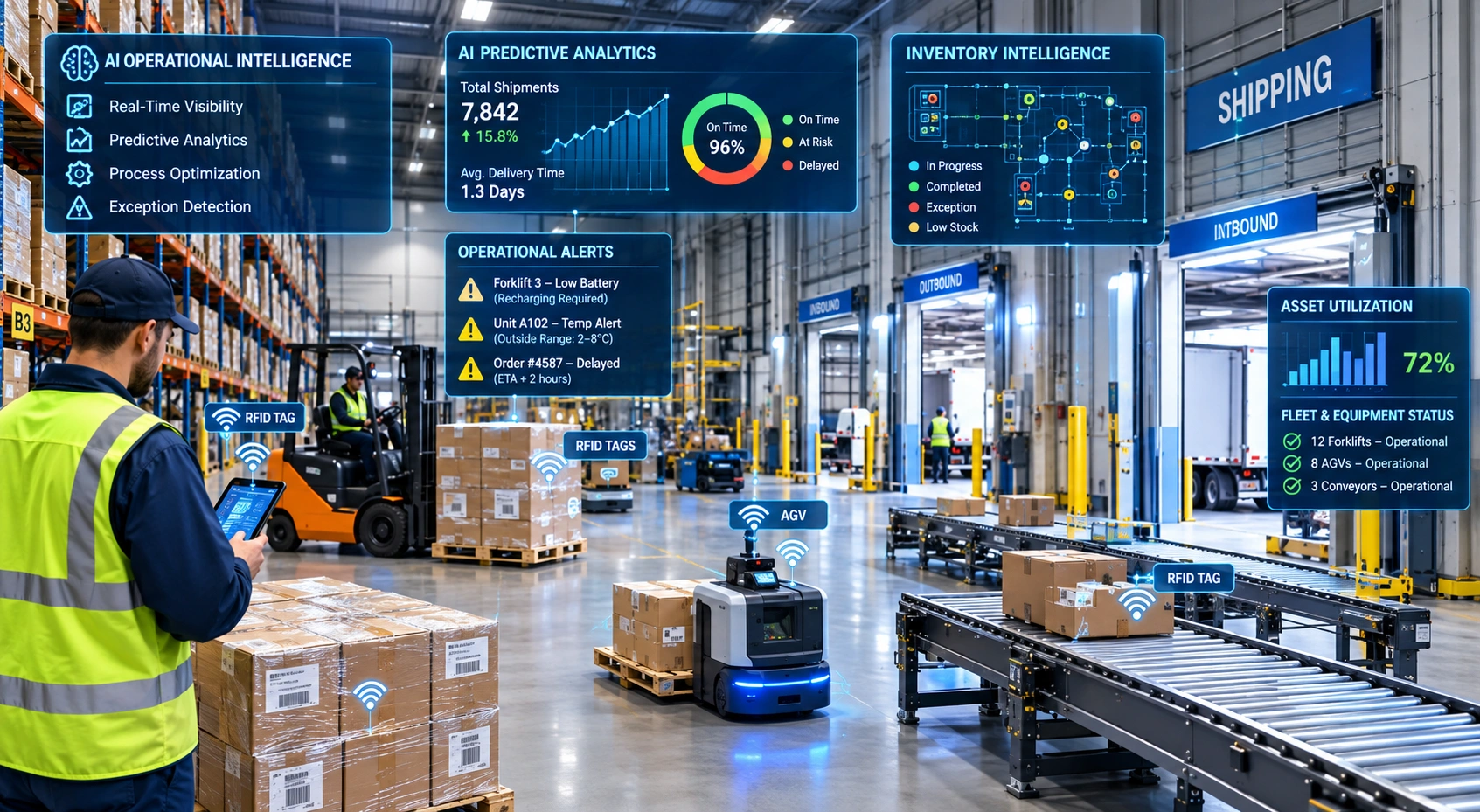
This visual illustrates a modern Third-Party Logistics warehouse where RFID technology captures the movement of pallets, cartons, and assets across receiving, storage, and shipping operations. AI-powered analytics transform this operational data into inventory visibility, predictive insights, operational alerts, and asset utilization recommendations.
How AI Is Transforming Third-Party Logistics Operations
Third-Party Logistics providers operate between manufacturers, retailers, distributors, e-commerce companies, transportation carriers, and end customers. Their performance depends on maintaining accurate inventory records while processing large volumes of inbound and outbound goods within strict service-level agreements.
Traditional warehouse management systems provide transaction records, but they do not always explain why delays, inventory discrepancies, congestion, or fulfillment errors occur. AI helps address this limitation by analyzing operational data and identifying patterns that human operators may not immediately recognize.
AI can support 3PL operations by analyzing:
- Historical order volumes
- SKU movement patterns
- Inventory turnover
- Dock activity
- Forklift movement
- Pick rates
- Labor productivity
- Storage utilization
- Order exceptions
- Carrier schedules
- Shipment delays
- RFID movement events
RFID strengthens AI systems by creating more frequent and automated operational data points. When tagged inventory or assets pass through RFID-enabled zones, readers can capture identification and location events without requiring workers to individually scan every item.
For example, an AI system can analyze RFID events associated with pallet movements and identify unusual dwell times between receiving and put-away. This may indicate dock congestion, insufficient forklift availability, incorrect staging procedures, or labor allocation problems.
Similarly, AI can analyze inventory movement history to predict which SKUs are likely to require replenishment or relocation before a high-volume fulfillment period.
GAO supplies RFID hardware and systems that can support these data-driven logistics environments, including RFID readers, antennas, tags, handheld devices, and related IoT technologies for warehouse and distribution operations.
Fundamental Concepts of AI-Driven RFID in 3PL
AI and RFID serve different but complementary functions within Third-Party Logistics operations.
RFID provides automatic identification and data capture. AI transforms operational data into predictions, recommendations, anomaly detection, and decision support.
A typical AI-driven RFID solution for a 3PL facility includes several connected layers:
- RFID tags attached to pallets, cartons, reusable containers, assets, or selected inventory
- Fixed RFID readers installed at dock doors, portals, conveyor points, storage zones, or process checkpoints
- Handheld RFID readers used for inventory verification and exception handling
- Edge computers or gateway devices for local data processing
- RFID middleware that filters and manages raw reader events
- Warehouse management systems and inventory software
- AI analytics and machine learning systems
- Operational dashboards and alerts
- Automation systems that support business actions
The RFID technology selected depends on the operational requirement.
UHF RFID is commonly relevant to warehouse and logistics applications because it supports longer read ranges and multi-tag reading. It can be used for pallets, cases, containers, returnable transport items, and warehouse assets.
HF RFID may be more appropriate for shorter-range identification requirements, specialized access processes, or applications where controlled read distances are important.
LF RFID is generally used for specialized short-range identification scenarios and can be relevant when environmental or material characteristics make other RFID frequencies less suitable.
The technology itself is not the primary business objective. The objective is improving 3PL processes such as inventory accuracy, fulfillment visibility, asset utilization, and operational decision-making. RFID acts as an enabling technology that provides reliable physical-world data to AI systems.
Key AI and RFID Applications in Third-Party Logistics
AI Inventory Management and RFID Inventory Visibility
Inventory management is one of the most important responsibilities of a Third-Party Logistics provider. A single facility may store inventory for dozens or hundreds of customers, each with different SKUs, handling requirements, service agreements, and reporting expectations.
RFID can automate inventory identification and verification across receiving, storage, cycle counting, and shipping processes.
AI can then analyze the resulting data to:
- Detect unusual inventory movements
- Identify potential inventory discrepancies
- Predict replenishment requirements
- Identify slow-moving inventory
- Analyze SKU velocity
- Recommend storage adjustments
- Predict stockout risks
- Detect abnormal dwell times
An important engineering consideration is data quality. Raw RFID reads should not automatically be treated as confirmed inventory transactions. Reader events may require filtering, aggregation, location validation, and business-rule processing before being transmitted to warehouse management software.
AI models are more reliable when RFID data is combined with WMS transactions, order data, historical inventory records, and operational context.
AI Warehouse Asset Tracking
3PL facilities depend on mobile and reusable assets such as forklifts, pallet jacks, roll cages, reusable pallets, containers, mobile printers, handheld terminals, and material handling equipment.
Lost or unavailable assets can delay operations and increase capital costs.
RFID asset tracking allows a 3PL operator to identify when tagged equipment enters or exits designated areas. AI can analyze asset movement and utilization patterns to identify:
- Underutilized equipment
- Frequently congested zones
- Excessive asset dwell times
- Unusual movement patterns
- Asset availability problems
- Potential process bottlenecks
For example, if forklifts equipped with RFID or associated with RFID-tracked operational zones repeatedly accumulate near receiving docks during specific hours, AI analysis may identify a mismatch between inbound delivery schedules and material handling capacity.
This information can support labor scheduling and equipment allocation decisions.
AI-Driven Receiving and Put-Away Operations
Receiving is a critical control point for Third-Party Logistics providers. Errors introduced during receiving can affect inventory accuracy throughout the fulfillment process.
RFID portals at dock doors or receiving lanes can capture tagged pallet or carton movements as goods enter the warehouse.
AI can analyze receiving data alongside:
- Advance shipping notices
- Purchase orders
- Supplier delivery patterns
- Dock schedules
- Receiving labor availability
- Storage capacity
- Historical processing times
The system can identify exceptions such as unexpected deliveries, incomplete shipments, unusual quantities, or products arriving at incorrect dock locations.
AI can also support put-away recommendations by considering SKU characteristics, storage availability, demand velocity, picking frequency, customer requirements, and travel distance.
Rather than using static storage logic alone, AI models can help identify changing warehouse conditions that justify dynamic slotting decisions.
AI Order Fulfillment Optimization
Order fulfillment is where inventory accuracy, labor availability, warehouse layout, and process efficiency converge.
AI can analyze order characteristics and operational conditions to improve:
- Pick path planning
- Batch picking decisions
- Wave planning
- Labor allocation
- Replenishment timing
- Packing station utilization
- Order prioritization
- Exception management
RFID data can provide additional visibility into physical inventory movement during fulfillment.
For high-volume operations, RFID checkpoints can confirm movement between operational zones without requiring repeated manual barcode scanning.
AI systems can use these events to identify delays. For example, if orders consistently spend excessive time between picking and packing, the problem may involve conveyor capacity, packing station availability, quality inspection requirements, or system integration delays.
The value comes from connecting physical events with operational analytics.
Complete AI and RFID Workflow for 3PL Operations
An AI-driven RFID solution in a Third-Party Logistics facility follows a continuous operational data flow from physical activity to business action.
Data Acquisition
The process begins when RFID readers capture identification events from tagged inventory, pallets, containers, or assets.
Data may be collected from:
- Dock door RFID portals
- Conveyor RFID checkpoints
- Warehouse zone readers
- Handheld RFID readers
- Forklift-mounted readers
- Smart storage areas
- Asset tracking locations
Each event can contain information such as tag identification, reader identification, timestamp, signal strength, and operational location.
Edge Processing and Event Filtering
Raw RFID systems can generate large volumes of repeated reads. Edge software or RFID middleware processes these events before transmitting meaningful information to business systems.
This layer may perform:
- Duplicate filtering
- Tag validation
- Reader health monitoring
- Location mapping
- Event aggregation
- Time-window processing
- Exception detection
This step is essential because sending every raw reader event directly to a WMS can create unnecessary data volume and operational noise.
Communication Infrastructure
RFID readers, gateways, edge computers, and operational devices communicate through wired or wireless networks.
Depending on facility requirements, infrastructure may include:
- Ethernet
- Wi-Fi
- Private cellular networks
- 4G or 5G connectivity
- VPN connections
- Industrial network switches
Network design should consider reader density, warehouse coverage, latency requirements, cybersecurity, and operational continuity.
Enterprise Software Integration
Processed RFID events can be integrated with:
- Warehouse Management Systems
- Enterprise Resource Planning systems
- Transportation Management Systems
- Inventory management software
- Order Management Systems
- Customer reporting systems
- Asset management software
Integration may use APIs, REST services, message queues, databases, middleware, or event-driven software.
The goal is to connect physical warehouse events with digital business processes.
AI Processing and Analytics
AI systems analyze historical and real-time operational data.
Relevant AI techniques may include:
- Machine learning
- Predictive analytics
- Anomaly detection
- Time-series forecasting
- Optimization algorithms
- Computer vision
- Edge AI
- Generative AI for operational reporting and knowledge assistance
Machine learning models may predict demand patterns, processing times, labor requirements, equipment availability, or inventory movement.
Anomaly detection models can identify unexpected movement patterns or operational events that differ from established warehouse behavior.
Business Decisions and Operational Actions
The final stage converts AI insights into practical actions.
Examples include:
- Reassigning warehouse labor
- Adjusting storage locations
- Investigating inventory discrepancies
- Scheduling asset maintenance
- Prioritizing delayed orders
- Changing dock assignments
- Rebalancing picking workloads
- Triggering operational alerts
This closed-loop process allows a 3PL provider to move from simple data collection toward AI-supported warehouse decision-making.
AI and RFID Operational Workflow for Third-Party Logistics (3PL)
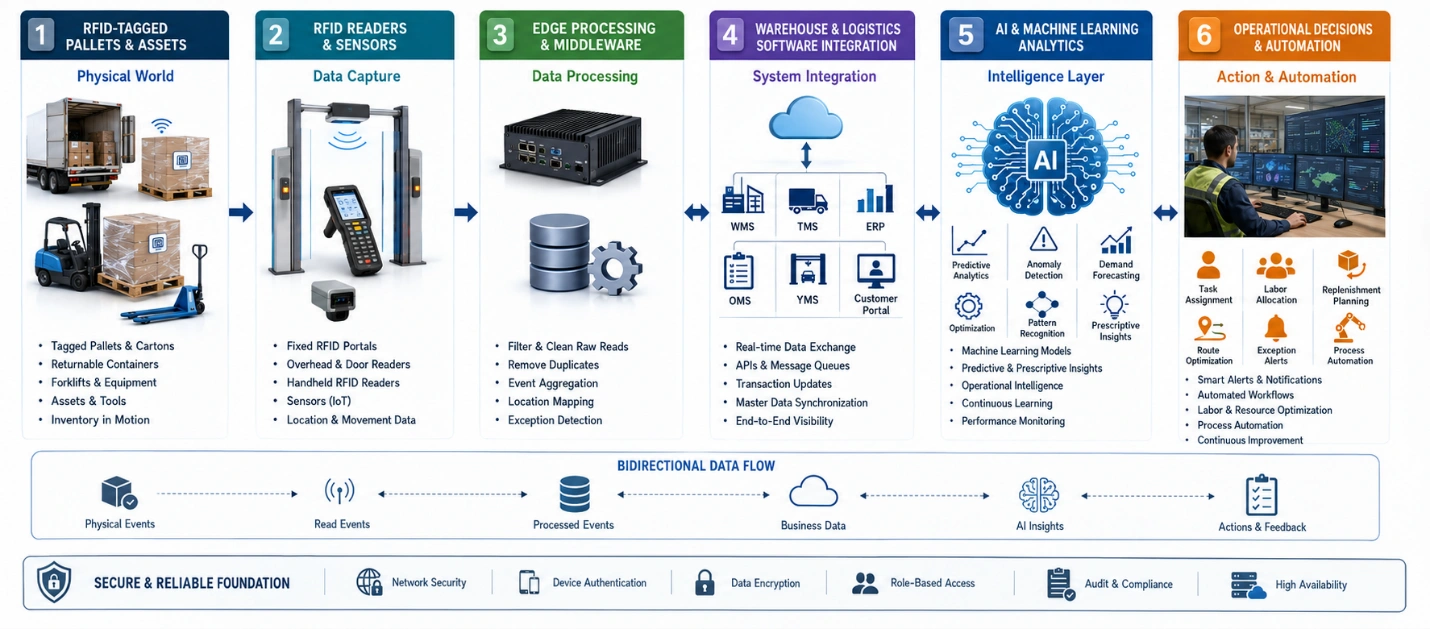
This workflow diagram illustrates how RFID-tagged pallets, assets, and warehouse events move through data capture, edge processing, logistics software integration, and AI analytics. The system transforms physical RFID events into predictive insights, operational alerts, and automated decisions for Third-Party Logistics operations.
Technology Components Supporting AI-Driven 3PL Operations
A successful AI and RFID implementation requires more than RFID tags and readers. Third-Party Logistics providers need an integrated combination of identification hardware, communication infrastructure, data processing software, AI tools, and operational systems.
RFID Hardware
RFID hardware can include:
- Fixed RFID readers
- RFID antennas
- Handheld RFID readers
- Vehicle-mounted RFID readers
- UHF RFID tags
- HF RFID tags
- LF RFID tags
- Rugged industrial enclosures
- RFID gateways
Hardware selection should consider warehouse layout, read range, tag orientation, pallet composition, metal and liquid interference, environmental conditions, conveyor speed, and expected read accuracy.
GAO provides RFID hardware and related systems that can support identification, tracking, inventory management, and logistics automation requirements.
AI Software and Analytics
AI software processes operational data collected from RFID, WMS, IoT devices, and other warehouse systems.
Depending on the deployment, AI software may support:
- Demand forecasting
- Inventory prediction
- Process optimization
- Operational anomaly detection
- Workforce analysis
- Asset utilization analysis
- Predictive maintenance
- Natural-language reporting
The AI system should be trained using data relevant to the specific 3PL operation. A model designed around retail inventory patterns may not perform effectively for a 3PL provider handling industrial spare parts, temperature-sensitive goods, e-commerce fulfillment, or multi-client distribution.
Cloud Version
A cloud-hosted deployment can be appropriate when a 3PL organization operates multiple geographically distributed facilities and requires centralized reporting.
Cloud software can provide:
- Centralized data management
- Multi-site analytics
- Remote access
- Scalable computing resources
- Central AI model management
- Cross-facility benchmarking
Cloud deployment can be useful for 3PL companies that manage multiple warehouses and need to compare performance across locations.
Server Version
A server-based deployment may be preferred when organizations require greater control over operational data or need local processing capabilities.
Server deployments may use:
- Edge servers
- Customer-managed servers
- Private data centers
- Privately hosted infrastructure
- Regional warehouse servers
This approach can reduce dependence on continuous external connectivity and support lower-latency processing for operational applications.
Hybrid deployments can combine local edge processing with centralized AI analytics.
Security Mechanisms
Cybersecurity should be considered throughout the deployment.
Important controls include:
- Network segmentation
- Device authentication
- Role-based access control
- Encrypted communications
- Secure APIs
- Reader and gateway monitoring
- Patch management
- Data backup
- Security logging
3PL providers frequently handle inventory and operational information belonging to multiple customers. Access control and data separation are therefore particularly important when integrating AI analytics with warehouse and customer systems.
Technical Capabilities and Operational Improvements for 3PL Providers
Combining AI with RFID-enabled operational data gives Third-Party Logistics providers a more detailed understanding of how goods, assets, and work activities move through their facilities. The primary value is not simply knowing where an item was last detected. The larger opportunity is using movement data to understand operational behavior and improve warehouse decisions.
Improved Inventory Accuracy
Inventory discrepancies create operational and financial problems for 3PL providers. A mismatch between physical inventory and WMS records can result in delayed fulfillment, customer disputes, emergency cycle counts, and inaccurate reporting.
RFID-enabled inventory processes can reduce dependence on manual scanning and individual item verification. AI can further analyze inventory events to identify unusual patterns before they become significant problems.
Examples include:
- Inventory remaining in a staging area longer than expected
- Pallets moving into unauthorized zones
- Repeated inventory discrepancies involving specific SKUs
- Unexpected movements outside scheduled operational periods
- Differences between RFID events and WMS transactions
AI can prioritize these exceptions based on operational risk rather than requiring warehouse personnel to investigate every event manually.
Faster Cycle Counting
Traditional cycle counting can require employees to manually scan individual barcodes or physically inspect storage locations. This process consumes labor and may interrupt normal warehouse activity.
Handheld RFID readers can identify multiple tagged items within a reading zone more quickly. AI can help determine which inventory locations should receive priority based on factors such as:
- Historical inventory discrepancies
- SKU value
- Inventory velocity
- Customer requirements
- Previous fulfillment errors
- Unusual movement activity
This creates a risk-based inventory verification process rather than treating every warehouse location equally.
Better Warehouse Throughput
Warehouse throughput depends on how efficiently goods move through receiving, storage, replenishment, picking, packing, and shipping.
AI can analyze RFID movement events to calculate operational timing between process stages.
For example, a 3PL provider can measure:
- Time from truck arrival to unloading
- Time from receiving to put-away
- Time from pick release to pick completion
- Time spent in staging
- Time between packing and shipping
- Asset utilization during peak periods
These measurements can help operations managers identify bottlenecks that may not be visible through traditional transaction reporting.
Improved Asset Utilization
Material handling equipment and reusable logistics assets represent significant operational investments.
AI can analyze RFID-generated asset movement data to understand:
- Which assets are frequently used
- Which assets remain idle
- Where assets accumulate
- Which operational zones experience shortages
- Whether additional equipment is required
A 3PL provider may discover that an apparent equipment shortage is actually an asset distribution problem. Equipment may exist within the facility but remain concentrated in locations where it is not currently needed.
Predictive Operational Management
Historical RFID data can become increasingly valuable over time.
Machine learning models can identify recurring patterns related to:
- Seasonal order volume
- Customer shipping patterns
- Warehouse congestion
- SKU demand
- Equipment utilization
- Labor requirements
- Dock activity
These predictions can support proactive operational planning.
Instead of reacting after a warehouse becomes congested, management can prepare labor, equipment, and storage capacity based on predicted conditions.
Business Benefits of AI-Driven RFID for Third-Party Logistics
The technical benefits of AI and RFID ultimately affect the commercial performance of a Third-Party Logistics provider. 3PL companies operate under customer service agreements, fulfillment commitments, inventory accuracy requirements, and cost pressures.
Improved operational intelligence can support measurable business outcomes.
Reduced Labor Requirements for Manual Data Collection
Warehouse personnel often spend significant time scanning, verifying, locating, and reconciling inventory.
Automated RFID data capture can reduce repetitive identification tasks. Employees can focus more on exception management, customer requirements, quality control, and operational improvements.
The objective is not necessarily to eliminate warehouse workers. In many 3PL environments, labor shortages and high order volumes make productivity improvement more important than labor replacement.
Reduced Inventory Disputes
3PL providers are responsible for inventory belonging to multiple customers.
When inventory discrepancies occur, resolving them can require physical inspections, transaction reviews, employee interviews, and customer communication.
RFID movement history can provide additional evidence about where and when inventory was detected. AI can analyze this information to reconstruct operational events and identify potential causes.
This can help reduce the time required to investigate inventory disputes.
Improved Customer Service
Customers increasingly expect their logistics providers to provide accurate information about inventory, order status, and fulfillment activity.
AI-driven analytics can support more proactive customer reporting by identifying potential operational issues before they affect service-level commitments.
For example, the system may detect that a group of high-priority orders is experiencing unusual processing delays.
Warehouse managers can investigate and respond before customers need to report a problem.
Higher Facility Scalability
As a 3PL company adds customers, SKUs, warehouse locations, and fulfillment volumes, manual processes become increasingly difficult to scale.
AI systems can analyze larger operational datasets without requiring proportional increases in management effort.
RFID-based data capture can also reduce the manual workload associated with tracking growing inventory volumes.
This combination can help 3PL operators expand operations while maintaining visibility.
Better Decision-Making
Traditional warehouse reporting often focuses on historical performance.
AI systems can add predictive and prescriptive capabilities by identifying:
- What is happening
- Why it may be happening
- What may happen next
- Which actions may improve the outcome
For Third-Party Logistics managers, this creates a transition from retrospective reporting toward operational intelligence.
GAO has helped organizations implement RFID and IoT technologies by supplying hardware products and systems designed to capture physical-world operational data. This experience is relevant to logistics organizations evaluating how identification technologies can support broader AI and automation initiatives.
AI and RFID Deployment Considerations for 3PL Facilities
Successful deployment requires careful planning. Installing RFID readers without understanding warehouse workflows can produce poor read performance and operational data that does not support meaningful business decisions.
A 3PL implementation should begin with the operational problem rather than the hardware selection.
Identify High-Value Use Cases
Not every warehouse process needs RFID.
Organizations should prioritize areas where automated identification provides measurable value.
Potential starting points include:
- Receiving verification
- Pallet tracking
- High-value inventory
- Returnable asset tracking
- Shipping verification
- Cycle counting
- Equipment tracking
A pilot deployment can validate technical performance and business value before expanding throughout the facility.
Conduct a Site Survey
RFID performance depends heavily on the physical environment.
A site survey should evaluate:
- Warehouse dimensions
- Rack configuration
- Dock door locations
- Conveyor systems
- Metal structures
- Liquid products
- RF interference
- Vehicle traffic
- Tag orientation
- Material movement speed
Testing should use actual pallets, cartons, products, and operational conditions whenever possible.
A reader configuration that performs well in a laboratory environment may produce different results in a busy 3PL warehouse.
Select the Correct RFID Tags
Tag selection should consider:
- Read distance
- Attachment surface
- Product material
- Exposure to metal
- Exposure to moisture
- Temperature
- Reusability
- Packaging design
- Required lifespan
Reusable logistics containers may require durable RFID tags, while disposable shipping cartons may require lower-cost labels.
The tag should match the operational requirement rather than simply being selected based on price.
Design for Operational Workflow
RFID equipment should support warehouse operations without creating unnecessary process changes.
For example, a dock door RFID portal should capture pallet movement without forcing forklift operators to stop or perform additional actions.
The best deployment often integrates identification technology into existing movement patterns.
Establish Data Governance
AI models depend on reliable data.
3PL organizations should define:
- Data ownership
- Customer data separation
- Data retention policies
- Data access permissions
- Integration responsibilities
- Data quality procedures
- AI model monitoring
Because a 3PL provider may manage sensitive operational information for multiple customers, data governance should be addressed during system design rather than after deployment.
Integration with Warehouse and Logistics Software
RFID and AI systems should not operate as isolated technologies.
Third-Party Logistics operations already depend on multiple software systems. Integration allows physical events captured in the warehouse to influence digital business processes.
Common integration targets include:
Warehouse Management Systems
The WMS manages inventory locations, receiving, put-away, picking, replenishment, packing, and shipping.
RFID data can provide additional automated confirmation of physical movement.
Integration can support:
- Inventory updates
- Location verification
- Receiving confirmation
- Shipping verification
- Cycle counting
- Exception management
Enterprise Resource Planning Systems
ERP systems manage financial, procurement, customer, and operational information.
AI-generated operational insights can be connected with broader business information to support planning and performance analysis.
Transportation Management Systems
Transportation Management Systems coordinate carrier operations, shipment planning, and transportation activity.
Warehouse RFID events can provide more accurate timing information for inbound and outbound logistics processes.
AI can analyze relationships between warehouse processing performance and transportation schedules.
Customer Portals
Many 3PL providers provide customers with online visibility into inventory and fulfillment operations.
AI and RFID data can improve the accuracy and timeliness of customer-facing information.
Integration should be carefully designed to ensure that each customer only accesses authorized information.
Automation Systems
Large 3PL facilities may use:
- Conveyor systems
- Automated storage systems
- Autonomous mobile robots
- Sortation equipment
- Automated guided vehicles
- Dimensioning and weighing systems
RFID data can act as an additional identification layer, while AI can coordinate operational decisions across connected equipment.
Scaling AI and RFID Across Multi-Site 3PL Networks
Many Third-Party Logistics providers operate multiple distribution centers across different geographic locations.
Scaling an AI and RFID solution requires standardization while allowing flexibility for differences between facilities.
A multi-site strategy should consider:
- Standard RFID hardware configurations
- Common tag specifications
- Consistent data models
- Shared integration standards
- Centralized cybersecurity policies
- Local operational variations
- AI model performance across facilities
A process that works in a high-volume e-commerce fulfillment center may require modification for a regional distribution warehouse.
AI models should also be monitored as operational conditions change. Changes in customer mix, SKU profiles, warehouse layouts, and order volumes can affect model performance.
Scalable deployments therefore require continuous testing and optimization.
GAO supports organizations with RFID, BLE, and IoT hardware and systems that can be incorporated into larger multi-location technology deployments. With operations connected to customers throughout the United States and Canada, GAO brings long-term experience in supplying technologies for complex organizational requirements.
Practical Engineering Lessons for AI-Driven RFID Projects
Experience with warehouse identification projects shows that several practical issues should be considered before full-scale deployment.
Do Not Begin with AI Models
AI cannot compensate for unreliable operational data.
The first priority should be defining:
- Which physical events need to be captured
- Where they occur
- How frequently they occur
- Which business systems need the information
- What decision will use the data
Once reliable data is available, AI models can be developed around meaningful operational objectives.
Avoid Collecting Data Without a Business Purpose
RFID systems can generate large amounts of movement information.
Not every event needs to be stored permanently or analyzed.
The data design should focus on information that supports specific warehouse decisions.
Test Real Operational Conditions
RFID performance should be tested with actual:
- Product packaging
- Pallet configurations
- Forklift movements
- Warehouse traffic
- Employee workflows
- Loading conditions
Laboratory testing alone is insufficient for a complex 3PL environment.
Maintain Human Operational Oversight
AI recommendations should support experienced warehouse managers rather than automatically replacing operational judgment.
Human oversight is particularly important when:
- Customer commitments are affected
- Inventory exceptions occur
- Safety considerations are involved
- AI predictions conflict with current operational knowledge
Plan for System Maintenance
An AI and RFID deployment requires ongoing maintenance.
This may include:
- Reader health monitoring
- Tag replacement
- Software updates
- AI model monitoring
- Integration testing
- Network security reviews
- Performance optimization
Technology deployment should be treated as a continuing operational capability rather than a one-time installation.
Why AI-Driven RFID Is Becoming Important for Third-Party Logistics
Third-Party Logistics providers face growing pressure from e-commerce expansion, customer expectations, labor challenges, inventory complexity, and increasingly demanding service-level agreements.
Traditional warehouse systems remain essential, but transaction records alone do not always provide a complete picture of physical operations.
AI helps transform operational data into predictions and decisions.
RFID provides automated identification data about physical inventory and assets.
Together, these technologies can support a more responsive 3PL operating model where warehouse managers can identify problems earlier, understand movement patterns more clearly, and make better-informed decisions.
The strongest implementations are not technology-first projects. They begin with operational problems such as inventory discrepancies, slow cycle counts, lost assets, warehouse congestion, or fulfillment delays.
The technology is then selected and engineered around solving those specific problems.
For organizations planning RFID-enabled AI initiatives, GAO can provide RFID and IoT hardware products and technical support to help develop solutions for warehouse tracking, inventory management, asset identification, and logistics operations.
Advancing Third-Party Logistics with AI and RFID
AI-driven logistics intelligence and RFID-enabled data capture can help Third-Party Logistics providers improve visibility across inventory, warehouse assets, fulfillment processes, and operational workflows.
The most effective approach begins by identifying specific operational challenges and then designing the technology solution around measurable outcomes. Reliable RFID data, properly integrated warehouse software, appropriate AI models, cybersecurity controls, and experienced operational teams are all required for successful implementation.
For 3PL providers, potential value includes improved inventory accuracy, faster cycle counting, stronger asset control, higher warehouse throughput, predictive operational planning, and more informed management decisions.
GAO has invested heavily in research and development involving industrial RFID, BLE, and IoT technologies and maintains stringent quality assurance processes for its products and systems. Headquartered in New York City and Toronto, GAO has served organizations across the United States and Canada for decades, including Fortune 500 companies, research organizations, universities, and government agencies.
Organizations evaluating AI warehouse management, RFID inventory tracking, AI asset tracking, or connected 3PL operations can learn more about GAO’s technologies and technical support for RFID and IoT deployments.
Building the Future of Industrial AI and IoT with Aperture Venture Studio and GAO
For more than three decades, GAO Group of Companies has invested extensively in research and development involving industrial RFID, BLE, and IoT technologies. As artificial intelligence has become increasingly practical for industrial and logistics applications, we have expanded our work in AI, IoT, RFID, and BLE technologies that support data-driven operations.
To further support the development and advancement of AI and IoT technologies across industries, we founded Aperture Venture Studio to help build and scale innovative technology initiatives in this rapidly developing field.
Aperture has attracted experienced AI and IoT technical professionals, entrepreneurial and operational executives, influential investors, and leading organizations. Through initiatives such as the Aperture Ventures Summit and TekSummit, we also support discussions around advanced developments in AI and IoT.
Together, these communities and technical initiatives help strengthen collaboration across the evolving AI and IoT landscape.
We welcome participation from:
- Advisors, co-founders, and employees
- Investors
- Customers