
AI and RFID for Vaccine Manufacturing
AI-Driven Traceability and Production Control for Vaccine Manufacturing
Vaccine manufacturing requires precise control of biological materials, production equipment, environmental conditions, batch records, quality testing, and finished-product handling. AI-enabled manufacturing systems can combine production data with RFID identification to improve visibility across material staging, formulation, filling, inspection, packaging, cold storage, and internal logistics. RFID provides machine-readable identity for materials, containers, equipment, tools, and inventory, while AI can analyze production events, historical records, process variables, and quality information to identify anomalies, predict operational requirements, and support faster decisions. For vaccine manufacturers, the objective is not simply to automate identification. It is to connect physical manufacturing events with electronic records and quality processes so that operators, manufacturing engineers, quality teams, and supply-chain personnel can establish stronger batch traceability. GAO supplies RFID and IoT hardware and systems that can support these identification and data-capture requirements when integrated into appropriately validated vaccine manufacturing environments.
How AI and RFID Support Modern Vaccine Manufacturing
Vaccine production differs from conventional discrete manufacturing because the product can involve biological materials, controlled processing conditions, aseptic operations, extensive laboratory testing, and strict batch-release requirements. A manufacturing event therefore needs to be associated with the correct material, equipment, batch, operator activity, process stage, and quality record.
RFID can establish the physical identity layer for these events. Depending on the manufacturing environment, UHF RFID, HF RFID, or LF RFID can be selected according to read distance, tag form factor, material compatibility, environmental conditions, and process requirements.
AI adds a decision-support layer above these identification events. Rather than treating an RFID read as an isolated inventory transaction, a vaccine manufacturing system can correlate RFID events with:
- Batch and lot numbers
- Raw materials and starting materials
- Cell banks, viral seeds, antigens, adjuvants, buffers, and other controlled materials
- Single-use assemblies and process containers
- Manufacturing equipment and reusable tools
- Cleanroom and controlled-area movements
- Formulation and filling activities
- Environmental monitoring information
- Laboratory testing and quality-control results
- Electronic batch records
- Manufacturing execution system records
- Warehouse management system transactions
- Quality management system events
- Maintenance and calibration records
- Cold-storage inventory
- Packaging and finished-goods movements
AI models can then identify relationships that are difficult to detect through individual transactions. For example, a system could identify unusual material consumption during a batch, detect repeated delays between manufacturing stages, identify inventory patterns that could create a production constraint, or flag an unexpected association between equipment usage and process deviations.
The result is more than automated identification. The objective is AI-assisted manufacturing traceability, where physical movements, production events, quality information, and operational decisions are connected.
Vaccine Manufacturing AIoT Workflow Using RFID and AI Analytics
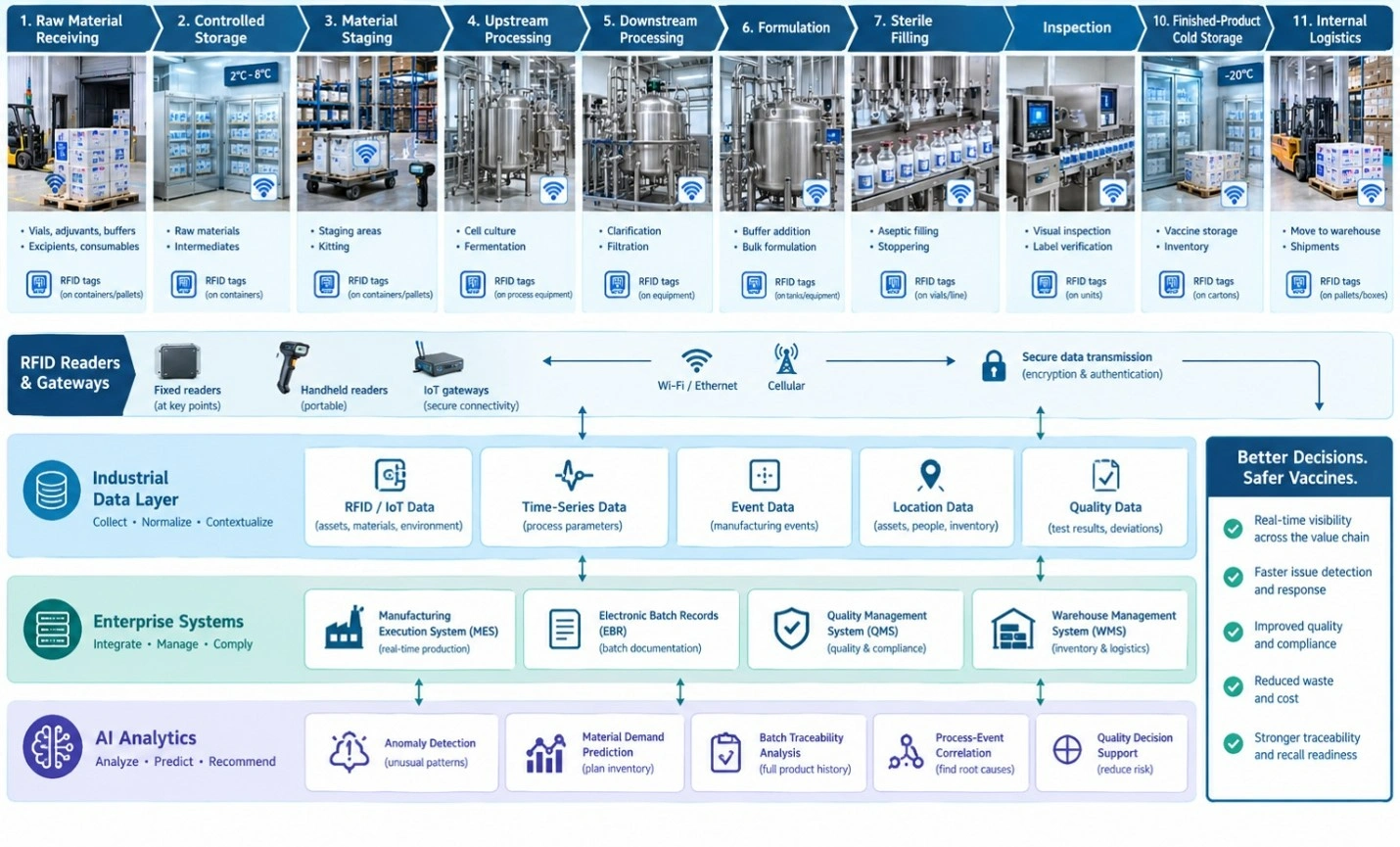
This workflow illustrates how RFID-enabled vaccine manufacturing connects raw materials, process equipment, inventory, and logistics with industrial data systems. It shows how MES, EBR, QMS, WMS, and AI analytics support traceability, anomaly detection, demand prediction, process correlation, and quality decision support.
Vaccine Manufacturing Processes Where AI Delivers the Most Value
AI and RFID should be deployed against specific manufacturing problems rather than added as technology layers without a defined operational objective. Vaccine manufacturers typically gain greater value when identification, process data, and AI analytics are connected to workflows where traceability, timing, quality, or material availability directly affect production.
Raw Material and Starting Material Traceability
Vaccine manufacturing depends on controlled receipt and release of materials used throughout production. Materials can include culture media, buffers, excipients, adjuvants, filtration components, single-use assemblies, containers, labels, and other production inputs.
RFID identification can associate material containers with supplier information, material codes, lot numbers, expiration dates, quarantine status, storage requirements, and quality-release status.
AI can analyze consumption history and production schedules to identify potential shortages or abnormal consumption. A material that normally supports a predictable number of batches but begins to show unusual usage can become an investigation trigger.
This is particularly valuable when multiple vaccine products or production campaigns share common materials and manufacturing resources.
Batch and Lot Traceability
Batch traceability is central to vaccine manufacturing because production records must establish what materials entered a batch, which equipment and process areas were involved, and what testing and quality decisions were performed.
RFID can automatically capture movement events as tagged materials enter or leave controlled production areas. AI can then correlate those events with batch records, production schedules, equipment records, and quality information.
A traceability system can help answer questions such as:
- Which material lots were staged for a specific vaccine batch?
- Which reusable equipment items were associated with the manufacturing campaign?
- Which production area received a particular container?
- Where was a material located before and after a process step?
- Which batches could potentially be affected by an identified material or equipment issue?
- Which inventory items have remained in quarantine beyond the expected period?
The technology does not replace validated batch documentation or quality review. Instead, it provides additional structured evidence that can reduce manual reconciliation and improve investigation efficiency.
Formulation and Process Material Management
Formulation operations require the correct materials, quantities, sequence, and processing conditions. An incorrect material or incorrect lot can create significant quality and compliance consequences.
RFID-enabled identification can verify that the intended container is present at a designated process location. AI can compare actual material movements with the expected manufacturing recipe or electronic work instruction.
A rules-based system may identify an immediate mismatch, while machine learning can identify broader patterns such as unusual staging delays, repeated material substitutions, or consumption behavior outside historical ranges.
The most effective approach is usually a combination of deterministic controls and AI analytics. Critical material identity checks should remain governed by explicit rules rather than relying exclusively on probabilistic models.
Sterile Filling and Packaging Operations
Filling and packaging create additional traceability requirements because product containers, components, labels, packaging materials, and production equipment must remain associated with the appropriate batch.
RFID can identify material lots and production assets moving through controlled areas. AI can analyze production events alongside inspection results, machine performance, reject rates, line stoppages, and changeover information.
For example, an AI model could identify an emerging relationship between extended changeover duration and increased reject rates. Manufacturing engineers could then investigate the underlying process rather than treating each event independently.
Cold Storage and Finished Vaccine Inventory
Temperature-sensitive vaccines require controlled storage and handling. RFID can identify pallets, cases, containers, and inventory locations, while dedicated environmental monitoring systems provide temperature and other relevant condition data.
AI can combine inventory identity with storage history to prioritize investigations and operational actions. A system could identify inventory exposed to unusual conditions, predict storage-space requirements, or detect discrepancies between expected and actual inventory movement.
RFID should not be treated as a replacement for validated temperature monitoring. RFID establishes identity and location, while qualified environmental sensors provide the condition measurements required for cold-chain control.
RFID-Enabled Vaccine Cold Storage and AI Analytics
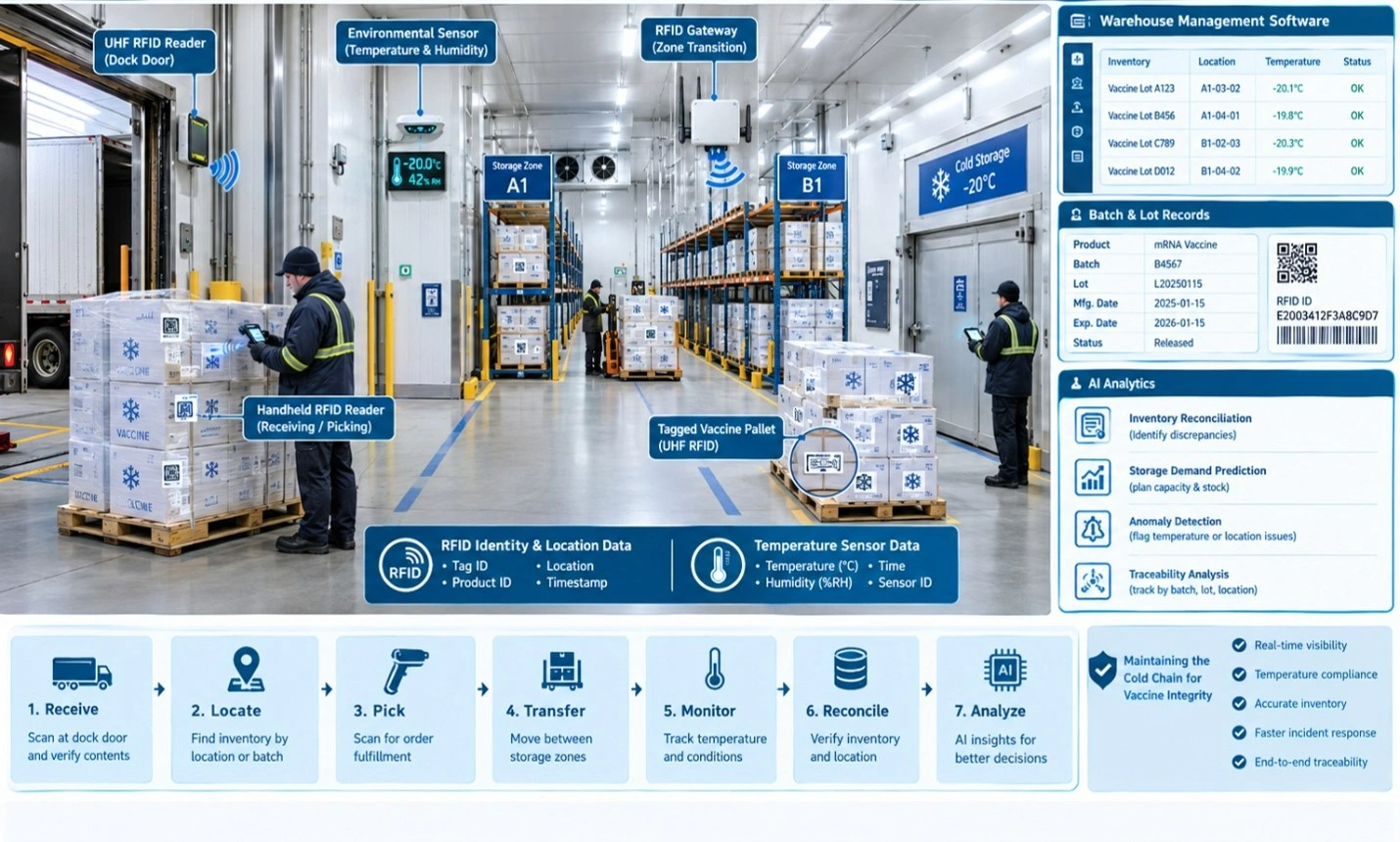
This visual depicts a realistic pharmaceutical cold-storage facility using UHF RFID, handheld readers, gateways, and environmental sensors to track vaccine inventory and conditions. It distinguishes RFID identity/location data from temperature measurements while showing AI-assisted reconciliation, demand prediction, anomaly detection, and traceability.
AI Use Cases Across Vaccine Production and Quality Operations
AI becomes more useful when manufacturing data is sufficiently structured and traceable. RFID can contribute to this data foundation by producing time-stamped identity and location events from physical operations.
AI Batch Traceability Analysis
AI can correlate material, equipment, personnel-access, production, laboratory, and inventory events around a vaccine batch. This can reduce the time required to reconstruct production histories during investigations or quality reviews.
A useful implementation should preserve the source event associated with every AI-generated finding. Quality personnel need to trace an alert back to the original RFID transaction, equipment record, batch record, or laboratory result rather than receiving an unexplained model output.
AI Inventory Forecasting
Vaccine manufacturing requires coordination between production campaigns, raw-material availability, packaging components, cold-storage capacity, and release schedules.
AI forecasting models can use historical consumption, planned production, supplier lead times, inventory levels, expiry dates, and campaign schedules to estimate future material requirements.
RFID strengthens this process by improving the reliability of physical inventory counts and movement records.
The resulting system can support:
- Material replenishment recommendations
- Expiry-risk identification
- Slow-moving inventory analysis
- Production material forecasting
- Cold-storage capacity planning
- Packaging-component demand prediction
- Exception-based inventory reconciliation
AI Anomaly Detection
Anomaly detection can be applied to production-event sequences, material consumption, equipment utilization, inventory movements, and manufacturing cycle times.
For example, if a particular vaccine production stage normally follows a consistent sequence of material transfers but a batch develops an unusual event pattern, AI can flag the deviation for investigation.
Such systems should distinguish between an operational anomaly and a confirmed quality defect. An AI alert is an investigation input, not automatically a batch-disposition decision.
Predictive Maintenance for Vaccine Manufacturing Equipment
Manufacturing facilities depend on equipment such as bioreactors, mixers, centrifuges, filling machines, autoclaves, clean utilities, refrigeration equipment, packaging machines, pumps, valves, and filtration systems.
AI can analyze equipment telemetry, maintenance history, alarms, runtime, calibration information, and RFID-based asset movement to identify maintenance patterns.
RFID can also help verify that the correct equipment, tools, or maintenance kits are associated with a work order.
This approach can improve maintenance planning without weakening preventive-maintenance schedules or validated equipment requirements.
AI-Assisted Quality Investigation
Quality investigations often require information from multiple systems. Relevant evidence may include batch records, laboratory results, equipment history, environmental monitoring, deviation records, material lots, and maintenance activities.
AI can help investigators retrieve and correlate these records, provided that the underlying data is controlled, attributable, and appropriately validated.
RFID contributes physical-event information that may otherwise be recorded manually. This can be particularly useful for determining when materials or equipment entered specific production areas.
Operational Challenges in Vaccine Manufacturing
AI and RFID deployments must account for the realities of regulated biological manufacturing. Technology selection should follow the process requirements, validation strategy, cleanroom constraints, and quality risk assessment.
Key challenges include:
- Data integrity: Production events must remain attributable, time-stamped, protected from unauthorized alteration, and traceable to their source.
- Cleanroom compatibility: RFID tags, readers, handheld devices, and associated materials must be suitable for the environmental and cleaning requirements of the target area.
- Material compatibility: RF performance can change around liquids, metal equipment, foil packaging, and dense storage configurations. Tag selection and reader placement therefore require site testing.
- Aseptic operations: Hardware placement must not interfere with personnel flows, material flows, cleaning procedures, or contamination-control strategies.
- Validation: Computerized systems and automated data capture must be assessed under the manufacturer’s quality and validation procedures.
- RF interference and read accuracy: Reader power, antenna orientation, tag placement, shielding, and reader density can affect identification reliability.
- Legacy integration: Existing MES, ERP, WMS, QMS, laboratory systems, and electronic batch records may use different identifiers and data structures.
- Human oversight: AI recommendations must remain understandable and reviewable by qualified manufacturing, quality, engineering, and supply-chain personnel.
FDA guidance on electronic records recognizes the importance of controls surrounding electronic records and electronic signatures under 21 CFR Part 11, while WHO emphasizes validated, documented, and controlled manufacturing and quality processes for vaccines. (U.S. Food and Drug Administration)
RFID Selection for Vaccine Manufacturing Environments
RFID selection should be driven by the physical process rather than by a preference for one frequency.
UHF RFID is generally appropriate when vaccine manufacturing operations require longer-range identification of cartons, cases, pallets, material containers, equipment, or inventory moving through defined read zones. Multiple tagged items can potentially be detected within a read area, making UHF useful for warehouse receiving, internal logistics, and controlled movement points.
HF RFID can be appropriate for shorter-range identification where controlled proximity between a reader and tagged object is desirable. It can support identification workflows involving containers, laboratory materials, operator interactions, or specialized equipment where the read distance is intentionally constrained.
LF RFID operates at lower frequencies and can be useful for specialized asset-identification scenarios where the physical environment or legacy identification requirements favor LF technology. Its use should be evaluated against the required read distance, tag availability, asset material, and integration requirements.
The correct choice also depends on the tag substrate, encapsulation, sterilization exposure, cleaning chemicals, temperature range, proximity to liquids or metals, mounting method, and required read reliability.
GAO provides RFID hardware and related IoT products that can be evaluated for specific pharmaceutical manufacturing identification and tracking requirements. A production deployment should still undergo site-specific radio testing, qualification, cybersecurity review, and validation according to the manufacturer’s quality system.
RFID Hardware Components
A vaccine manufacturing deployment can include:
- RFID tags and labels for materials, containers, pallets, cases, equipment, and reusable assets
- Fixed RFID readers at controlled movement points
- RFID antennas positioned around doors, conveyors, staging areas, and storage locations
- Handheld RFID readers for inventory reconciliation and exception handling
- RFID gateways connecting readers to local or enterprise software
- Industrial computers or edge servers for local data processing
- Barcode or 2D-code scanners where hybrid identification is required
- Environmental sensors for temperature and other facility conditions
- Network infrastructure supporting secure communication between RFID devices and enterprise systems
The physical design should avoid creating uncontrolled read zones. A reader that captures tags from adjacent batches or storage locations can generate ambiguous events. Reader placement, shielding, antenna orientation, tag orientation, and event filtering therefore become important engineering considerations.
Middleware and Data Processing
RFID middleware converts raw reader events into meaningful manufacturing events. It can filter duplicate reads, associate readers with physical locations, normalize identifiers, apply business rules, and forward validated events to higher-level systems.
For vaccine manufacturing, middleware may translate a sequence such as:
Tag detected → controlled-area reader → location identified → material identity validated → batch association → manufacturing record updated
AI analytics can then operate on the resulting structured event data rather than directly interpreting thousands of raw radio-frequency reads.
Cloud Version and Server Version
A Cloud Version can be appropriate when vaccine manufacturers need centrally managed analytics across multiple manufacturing sites, warehouses, or geographically distributed operations. Cloud-hosted software can support centralized dashboards, model management, cross-site analytics, and aggregated inventory visibility, subject to applicable data-governance, cybersecurity, validation, and connectivity requirements.
A Server Version can be deployed on customer-managed edge servers, factory servers, private data centers, or other privately hosted infrastructure. This approach can be valuable when manufacturing operations require local processing, tightly controlled network boundaries, reduced dependency on external connectivity, or integration with privately hosted MES, QMS, WMS, and production databases.
A hybrid design can use local RFID event processing and operational controls while transferring approved datasets to centralized analytics services.
Integration With Manufacturing Software
RFID and AI systems should integrate with existing vaccine manufacturing software rather than create isolated data stores.
Important integration points can include:
- Manufacturing Execution Systems
- Enterprise Resource Planning systems
- Warehouse Management Systems
- Quality Management Systems
- Laboratory Information Management Systems
- Electronic Batch Record systems
- Computerized Maintenance Management Systems
- Enterprise Asset Management systems
- Building Management Systems
- Environmental monitoring systems
- Serialization and packaging systems
- Identity and access-management systems
Common integration mechanisms include REST APIs, message brokers, database interfaces, OPC UA where appropriate for industrial equipment, MQTT for suitable IoT messaging, and structured enterprise data interfaces.
The integration design should maintain consistent identifiers for materials, batches, equipment, locations, and production orders. Without identifier governance, even highly accurate RFID reads can produce poor business information.
End-to-End AI-Assisted Vaccine Manufacturing Workflow
A practical deployment should connect physical vaccine manufacturing events to production and quality decisions without bypassing established GMP controls. The data flow typically begins when a material, container, equipment item, or finished product receives an approved identity. RFID readers capture movement or presence events at defined locations, while process equipment and environmental systems contribute operational measurements.
The resulting data passes through RFID middleware or an IoT gateway where duplicate reads, invalid identifiers, unexpected locations, and other event-quality issues can be filtered. Relevant events can then be associated with manufacturing orders, batches, lots, equipment records, and inventory transactions.
The AI layer operates on this structured information together with historical production and quality data. Depending on the use case, models can perform anomaly detection, forecasting, classification, pattern recognition, predictive maintenance, or process-event correlation.
A typical vaccine manufacturing workflow is:
- Material or asset identity is established through RFID, barcode, or another approved identifier.
- RFID readers capture movement through receiving, quarantine, storage, staging, production, packaging, or cold-storage areas.
- Gateways transmit relevant events through the plant network.
- Middleware filters and normalizes raw RFID reads.
- Master-data services associate identifiers with materials, batches, equipment, locations, and work orders.
- MES, ERP, WMS, QMS, LIMS, or electronic batch-record software receives the appropriate transactions.
- AI models analyze production history, inventory events, equipment information, and quality-related datasets.
- Exceptions and predictions are presented to authorized personnel.
- Manufacturing, quality, maintenance, warehouse, or supply-chain personnel review the finding.
- Approved business actions are recorded in the appropriate validated system.
The distinction between data generation, AI analysis, and regulated decision-making is important. An AI model can identify an unusual production pattern, but the qualified personnel and validated procedures remain responsible for determining whether that finding represents a deviation, investigation requirement, or other quality action.
AI-Assisted Vaccine Batch Management Workflow
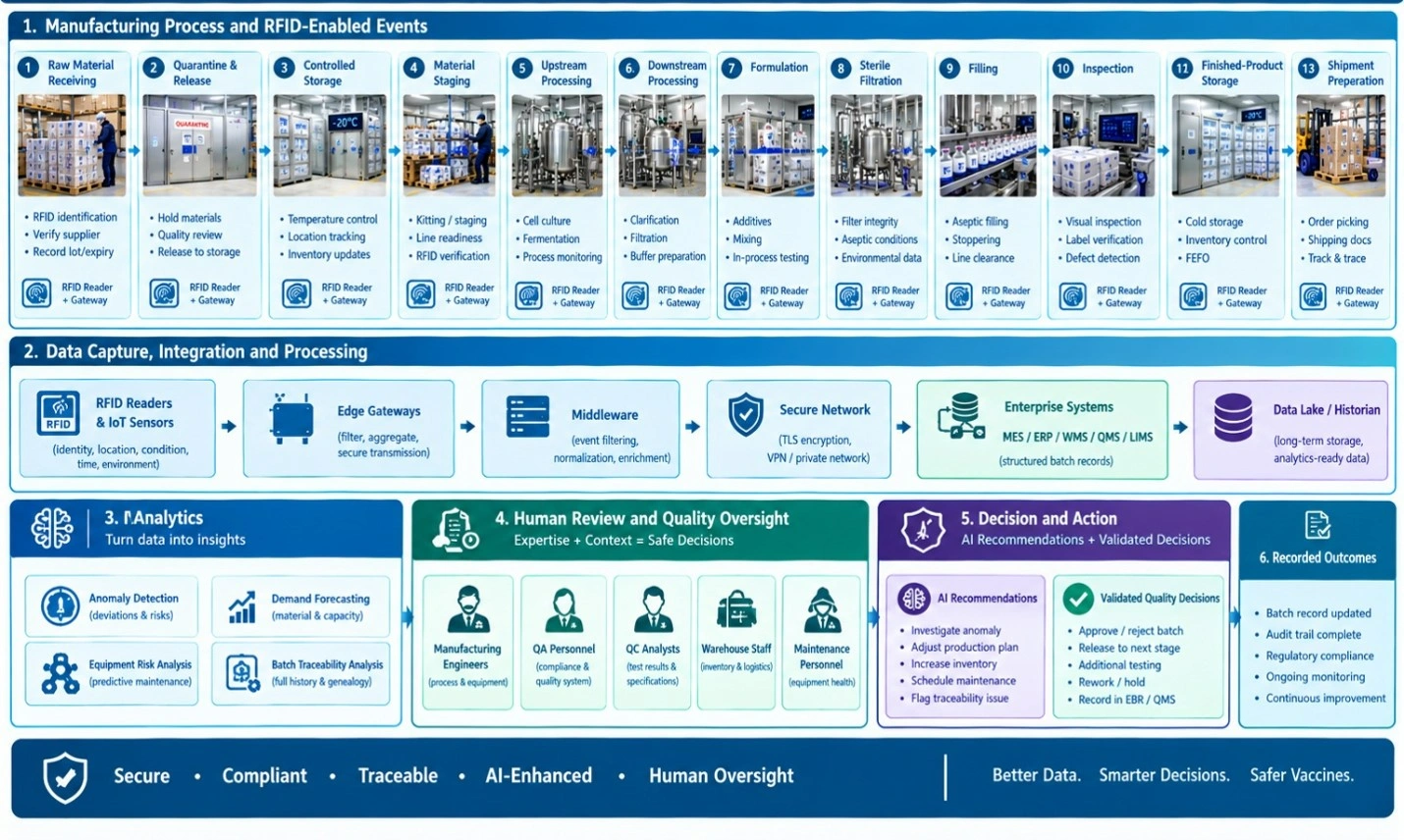
This end-to-end workflow shows how RFID and IoT events move from vaccine manufacturing operations through gateways, middleware, secure networks, and enterprise systems into AI analytics. It clearly separates AI recommendations from human-reviewed, validated quality decisions and recorded batch outcomes.
Commissioning and Validation of RFID and AI Systems
Commissioning should begin with the physical RFID installation and proceed toward operational qualification of the complete information flow.
A vaccine manufacturer should first establish the intended use of every reader, antenna, tag type, gateway, software interface, and AI function. Site surveys should evaluate RF propagation around stainless-steel equipment, liquid-filled containers, insulated panels, doors, racks, conveyors, and other structures common to pharmaceutical facilities.
Reader testing should measure more than nominal read range. The relevant question is whether the system reliably captures the correct tag at the correct process location while avoiding unintended reads.
Useful commissioning tests include:
- Read-rate testing with representative vaccine-manufacturing containers and packaging
- Tag orientation testing
- Reader and antenna placement verification
- Read-zone boundary testing
- False-read and cross-zone detection
- Duplicate-event filtering
- Network-loss and recovery testing
- Gateway failover testing
- Identifier validation
- MES, WMS, QMS, ERP, and batch-record interface testing
- User-access and authorization testing
- Audit-trail verification
- Timestamp synchronization
- Data-retention testing
- Alarm and exception testing
AI functions require a separate validation strategy. Model performance should be assessed against representative historical and operational datasets, with defined acceptance criteria for false positives, false negatives, latency, explainability, and model drift.
A model that predicts material demand does not require the same controls as a model used to identify potential quality anomalies. The intended use should determine the level of verification, monitoring, documentation, and human oversight.
Cybersecurity and Data Integrity for Vaccine Manufacturing
Cybersecurity must protect both the RFID infrastructure and the manufacturing records that depend on it. A compromised reader could generate false material movements, while compromised middleware could alter or suppress events before they reach manufacturing software.
A defense-in-depth approach can include:
- Network segmentation between RFID devices, production systems, corporate networks, and external services
- Role-based access control
- Strong authentication for administrative interfaces
- Encryption for data transmitted across untrusted networks
- Secure configuration of readers, gateways, servers, and databases
- Controlled firmware and software updates
- Centralized logging and security-event monitoring
- Device inventory and configuration management
- Backup and recovery procedures
- Time synchronization across connected systems
- Audit trails for material and batch-related transactions
- Least-privilege service accounts
- Controlled API authentication
- Incident-response procedures
- Periodic vulnerability assessment
RFID-specific cybersecurity also requires consideration of unauthorized tag reading, tag cloning, unauthorized reader access, and manipulation of tag-associated identifiers. Where the application involves high-value materials or sensitive production information, the manufacturer should evaluate whether additional authentication, encryption, protected network paths, or alternative identification mechanisms are warranted.
Data integrity is equally important. An RFID event should not merely state that a tag was seen. The system should retain sufficient context to determine which reader detected it, where that reader was located, when the event occurred, what identifier was captured, and how the event was transformed before entering an enterprise record.
GAO’s experience supplying RFID and IoT hardware systems can support organizations evaluating device-level requirements, while the manufacturer’s validated quality and cybersecurity processes remain essential to the final production implementation.
AI Performance, KPIs, and Operational Monitoring
A vaccine manufacturing AI solution should be measured against operational outcomes rather than the number of RFID tags installed or AI models deployed.
Relevant KPIs can include:
| KPI | Vaccine Manufacturing Application |
|---|---|
| Batch traceability completeness | Measures the percentage of required material and asset relationships captured for each batch |
| RFID read accuracy | Measures reliable identification within defined production and storage zones |
| Inventory accuracy | Compares system inventory with physical inventory |
| Material reconciliation time | Measures effort required to reconcile materials associated with a batch |
| Batch investigation time | Tracks time required to retrieve and correlate relevant production records |
| Material staging accuracy | Measures correct delivery of materials to production orders |
| Expiry-risk exposure | Tracks materials approaching expiration before use |
| Cold-storage inventory accuracy | Measures identification and location accuracy for temperature-controlled stock |
| Equipment utilization | Tracks use of production and support equipment |
| Unplanned downtime | Measures equipment-related production interruptions |
| AI alert precision | Measures how frequently AI alerts correspond to meaningful operational anomalies |
| False-alert rate | Tracks unnecessary AI-generated investigations |
| Data latency | Measures time between physical event capture and availability for analysis |
| Exception resolution time | Measures how quickly identified discrepancies are investigated |
| Electronic record completeness | Measures availability of required manufacturing event information |
These metrics should be segmented by production area, product, batch type, equipment group, and workflow where appropriate. A plant-wide average can hide a significant problem at a specific filling line or cold-storage zone.
AI models should also be monitored after deployment. Changes in production schedules, material suppliers, equipment configuration, tag populations, reader placement, or manufacturing procedures can change the underlying data distribution. Model monitoring should therefore include drift detection and periodic performance review.
Scaling AI and RFID Across Vaccine Manufacturing Sites
A successful pilot should not automatically be replicated across every production area. Each manufacturing site can have different building layouts, equipment, product portfolios, network conditions, tag requirements, and process controls.
A controlled scaling strategy can begin with a high-value workflow such as material staging, finished-product inventory, or reusable-equipment tracking. The manufacturer can establish reliable identification and event processing before introducing more complex AI functions.
Expansion should consider:
- Additional production suites
- More manufacturing lines
- Multiple vaccine products
- Additional warehouses and cold rooms
- External distribution facilities
- Multiple geographic sites
- Shared material inventories
- Centralized analytics
- Site-specific regulatory requirements
- Common master-data standards
Master-data governance becomes increasingly important during multi-site deployment. A material identifier used at one facility must be distinguishable from similarly named materials at another facility. Equipment identifiers, location codes, batch references, and inventory units should follow controlled conventions.
The same principle applies to RFID hardware. Standardizing on one reader model may simplify support, but different manufacturing areas may require different antenna arrangements, tag constructions, or reader configurations. Engineering teams should standardize where practical without forcing unsuitable hardware into environments with different RF or process requirements.
Practical Implementation Recommendations for Vaccine Manufacturers
A technically sound implementation should begin with the manufacturing problem rather than the RFID hardware.
Define the operational objective first.
Select a measurable problem such as material reconciliation, batch traceability, cold-storage inventory accuracy, equipment identification, or production-event anomaly detection.
Map the physical process.
Document material paths, personnel movement, production stages, storage zones, controlled areas, equipment locations, and transaction points. This identifies where automatic identification provides meaningful information.
Establish the identity model.
Define identifiers for materials, lots, batches, equipment, containers, pallets, locations, and work orders before connecting RFID data to enterprise software.
Perform RF site testing.
Test representative tags on actual containers and equipment. Liquids, metal surfaces, foil packaging, racks, doors, and dense inventory can materially change RFID behavior.
Use deterministic controls for critical checks.
AI should augment validated manufacturing controls rather than replace essential identity, recipe, authorization, or release checks.
Separate operational and analytical data paths.
Time-critical manufacturing transactions may require local processing, while historical datasets and computationally intensive AI workloads can be handled by centralized infrastructure.
Integrate with existing systems.
The RFID solution should update or enrich established MES, ERP, WMS, QMS, LIMS, maintenance, and batch-record workflows rather than forcing personnel to maintain parallel records.
Design for exceptions.
Every deployment should define what happens when an RFID tag is unreadable, a reader is unavailable, a material appears in the wrong location, the network fails, or an AI model produces an uncertain result.
Keep human accountability clear.
Operators, manufacturing engineers, quality professionals, and authorized managers should understand which actions are automated and which require human approval.
Monitor the system continuously.
Read performance, event latency, data completeness, AI accuracy, false-alert rates, network health, and hardware condition should be reviewed after commissioning and throughout the operating lifecycle.
Business and Technical Value of AI-Assisted Vaccine Manufacturing
The combination of AI, RFID, production data, and enterprise software can improve vaccine manufacturing primarily by making physical operations more observable and analytically useful.
Better identification can reduce uncertainty about where materials and assets are located. Better event histories can accelerate batch reconstruction and investigation. Better inventory information can reduce manual counting and support more accurate production planning. AI can then use these structured records to identify patterns that would otherwise remain difficult to detect.
The value is particularly significant when several data sources are correlated. An RFID movement by itself has limited meaning. An RFID event associated with a material lot, manufacturing order, production stage, equipment record, and quality event can become a much more useful manufacturing signal.
The resulting improvements can include:
- More complete material-to-batch traceability
- Faster inventory reconciliation
- Better production material availability
- Earlier identification of abnormal manufacturing patterns
- Improved equipment utilization
- More efficient maintenance planning
- Faster retrieval of investigation evidence
- Better visibility into cold-storage inventory
- Reduced manual data-entry requirements
- Stronger production-event histories
- Improved multi-site operational visibility
- More consistent manufacturing data for AI analytics
These benefits depend on implementation quality. Poor tag placement, inconsistent master data, weak integration, inadequate RF testing, or unvalidated AI outputs can undermine the expected results.
Key Technical Takeaways for AI and RFID in Vaccine Manufacturing
AI-enabled vaccine manufacturing is most effective when it connects physical production events with reliable manufacturing data and established quality processes. RFID provides a practical mechanism for identifying materials, equipment, containers, and inventory as they move through vaccine production and storage environments. AI can use those events with process, equipment, inventory, and quality data to support forecasting, anomaly detection, traceability analysis, maintenance planning, and operational decision-making.
GAO provides RFID, BLE, and IoT hardware products and systems that can support identification, tracking, sensing, and connected manufacturing requirements. Based in New York City and Toronto, Canada, GAO is ranked among the top 10 leading B2B and B2G RFID and BLE suppliers globally. Its sister companies, GAO Research Inc. and GAO Tek Inc., form GAO Group and support the broader technology development and engineering activities.
For organizations evaluating AI-enabled vaccine manufacturing, the practical starting point is a clearly defined manufacturing use case, followed by process mapping, RFID feasibility testing, data-model design, integration planning, cybersecurity assessment, validation, and controlled deployment. Readers can learn more about GAO’s RFID and IoT hardware, systems, engineering capabilities, and technical support when evaluating these requirements.
Future AI-Enabled Vaccine Manufacturing Facility with RFID and IoT
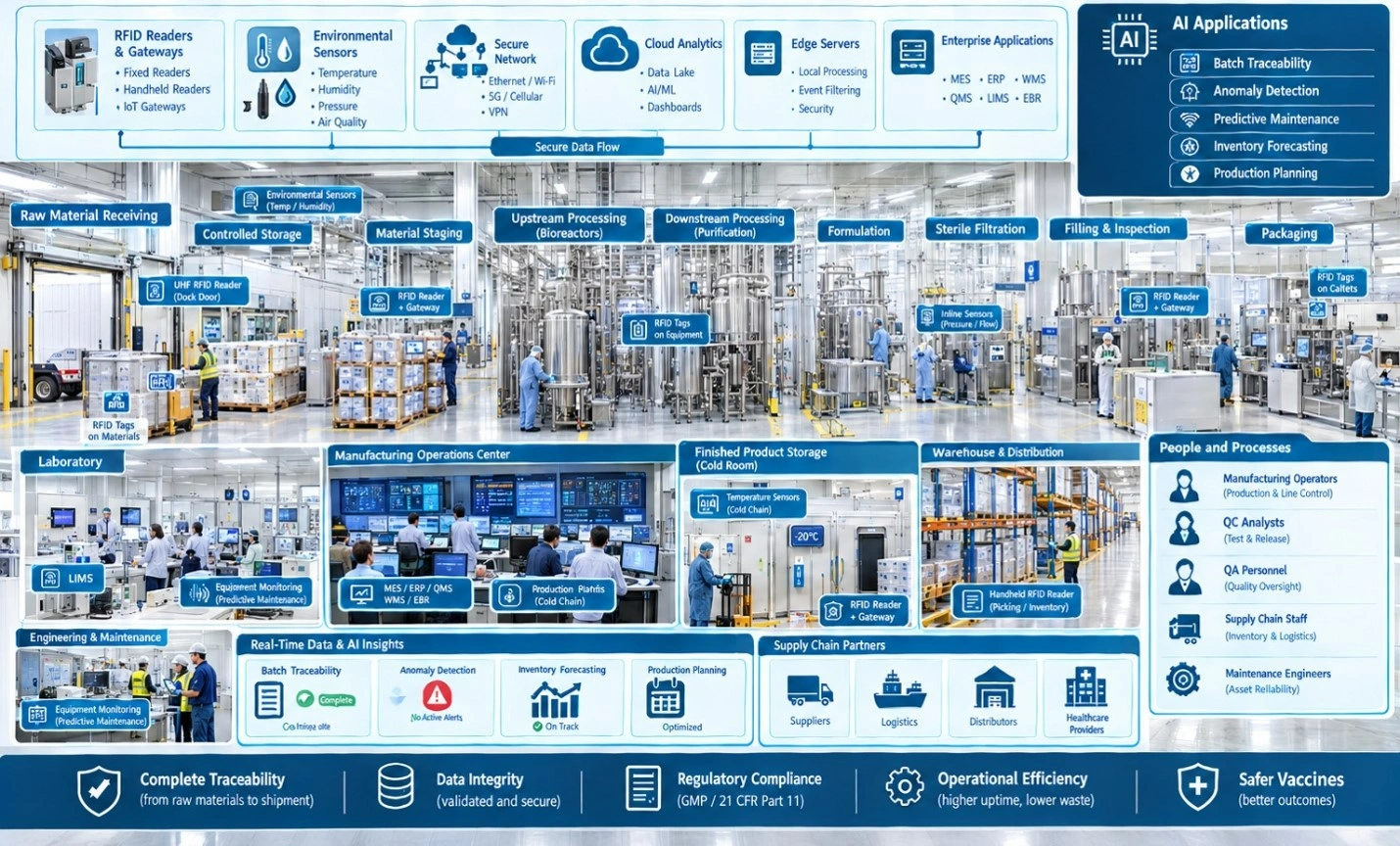
This technical facility illustration brings together RFID identification, IoT sensing, edge computing, enterprise systems, AI analytics, production, quality, laboratory, warehouse, and supply-chain operations. It shows how connected physical operations and digital systems support traceability, predictive maintenance, inventory forecasting, production planning, and regulated manufacturing.
Building the Future of Industrial AI and IoT with Aperture Venture Studio and GAO
For more than three decades, GAO Group of Companies has invested heavily in R&D covering industrial RFID, BLE, and IoT. As AI has become increasingly useful in industrial applications, the group has expanded work combining AI with connected technologies for areas such as vaccine manufacturing, traceability, production monitoring, and intelligent asset management. We have also founded Aperture Venture Studio to support the development and scaling of AI and IoT companies serving practical industry needs.
Aperture brings together AI and IoT technical experts, entrepreneurial and operational executives, investors, and leading companies. We have also developed the Aperture Ventures Summit and TekSummit to examine advanced AI and IoT topics. We welcome advisors, co-founders, employees, investors, and customers interested in these technologies.