
AI and RFID for Water Monitoring Operations
AI and RFID for Water Monitoring Operations
AI-enabled water monitoring combines AI, connected field devices, environmental instrumentation, operational software, and RFID identification to improve how water-quality and water-infrastructure information is collected, verified, analyzed, and acted upon. RFID can identify sampling equipment, monitoring devices, calibration assets, water-quality instruments, sample containers, field kits, and other physical resources associated with monitoring programs. UHF RFID can support longer-range identification at treatment facilities, laboratories, vehicle depots, storage areas, and controlled field locations, while HF and LF RFID can support shorter-range identification where intentional item presentation is preferred. AI can correlate RFID events with water-quality measurements, laboratory results, weather conditions, flow data, equipment status, sampling schedules, and historical records. This creates stronger traceability for sampling and equipment workflows while helping environmental teams identify abnormal readings, missed sampling activities, equipment maintenance needs, and data-quality issues. GAO supplies RFID and IoT hardware products and systems that can support these water-monitoring workflows.
AI and RFID Water Monitoring Operations Overview
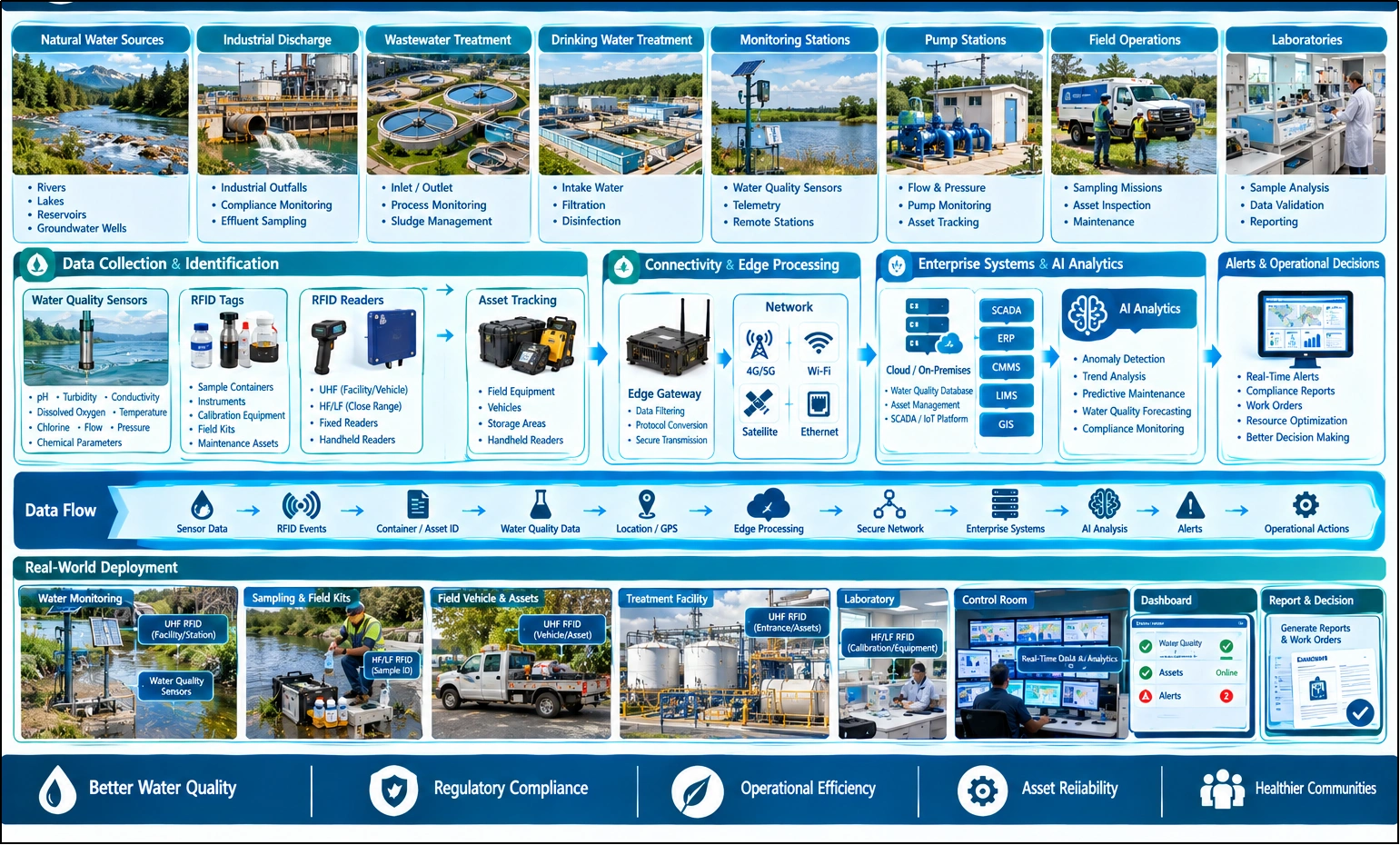
This enterprise infographic shows water monitoring across natural sources, industrial discharge, treatment facilities, pump stations, field operations, and laboratories. It connects water-quality sensors and RFID identification with edge processing, enterprise systems, AI analytics, real-time alerts, dashboards, and operational decisions.
Water Monitoring Deployment and Integration Considerations
Deploying AI and RFID for water monitoring requires more than attaching RFID tags to equipment. The implementation must connect physical asset identity, water-quality measurements, sampling records, field activities, laboratory information, and maintenance events into a consistent operational record. RFID provides a machine-readable identity layer, while AI helps evaluate the resulting data for patterns, anomalies, scheduling decisions, and maintenance requirements.
RFID Asset and Sample Identification
RFID selection should follow the physical characteristics of the water monitoring workflow rather than treating all assets as equivalent. Sampling containers, portable meters, calibration kits, field cases, replacement parts, and maintenance tools have different identification requirements.
- UHF RFID is appropriate where water monitoring facilities require longer-range identification of tagged equipment moving through controlled areas such as laboratories, equipment rooms, vehicle depots, and treatment facilities.
- HF RFID can support shorter-range identification where a technician intentionally presents a sample container, instrument, or maintenance item near a reader.
- LF RFID can be considered for specialized short-range identification environments where its propagation characteristics and operating conditions match the application.
- Tags used around water should be selected for moisture exposure, temperature variation, chemical contact, cleaning procedures, abrasion, and mounting surface.
- Sample identification should remain associated with the sampling event, location, time, technician, monitoring station, and applicable laboratory record.
- Portable RFID readers can allow field personnel to verify equipment and sample identities before departure, during collection, and at return.
- Fixed readers can automatically record movement through selected controlled points when the read environment is suitable.
RFID should not be treated as a replacement for laboratory identification procedures or regulatory sampling protocols. Its value comes from reducing manual identification and improving the consistency of digital records.
Reader Placement and RF Coverage
Water monitoring environments can create challenging RFID conditions. Metallic cabinets, vehicles, pumps, pipes, tanks, wet surfaces, concrete structures, and closely packed equipment can affect radio-frequency performance. A site survey should therefore precede large-scale deployment.
Engineering teams should evaluate:
- Required read distance for each workflow.
- Tag orientation and mounting location.
- Presence of water, metal, concrete, pipes, and other RF-obstructive materials.
- Reader antenna position and polarization.
- Expected movement speed of tagged assets.
- Potential cross-reads from adjacent equipment or sample containers.
- Reader interference and electromagnetic noise.
- Environmental temperature, humidity, and chemical exposure.
- Network connectivity between RFID readers and the water monitoring software.
- Local buffering requirements when connectivity is intermittent.
A controlled test should measure read reliability under realistic operating conditions rather than relying solely on laboratory specifications.
Integration with Water Monitoring Software
The strongest implementations connect RFID events with existing water monitoring systems instead of creating an isolated asset-tracking application. A typical enterprise deployment may exchange data with SCADA, laboratory information management systems, computerized maintenance management systems, GIS, enterprise resource planning software, telemetry systems, historians, and work-management software.
A common integration sequence is:
- RFID reader captures the identity of a tagged sample, instrument, kit, or asset.
- Gateway or edge software validates and timestamps the event.
- Water monitoring software associates the RFID identity with a site, workflow, work order, or sampling event.
- Measurement and environmental data are correlated with the identified asset or sample.
- AI software evaluates the combined data for anomalies, forecasting, classification, or maintenance indicators.
- The resulting recommendation is presented to the appropriate operations, laboratory, environmental compliance, or maintenance team.
- Confirmed actions and outcomes are written back into the operational record.
GAO can support organizations evaluating RFID hardware and connected systems for these workflows, including deployments where field identification must coexist with existing water monitoring and enterprise software.
Security and Data Governance for AI-Enabled Water Monitoring
Water monitoring systems can contain operational, environmental, regulatory, facility, and infrastructure information. Connected RFID readers, field devices, gateways, servers, and AI software therefore require security controls appropriate to the deployment.
Security planning should address:
- Device authentication and authorization.
- Role-based access to monitoring and maintenance information.
- Encryption for data in transit and, where appropriate, data at rest.
- Secure management of RFID readers, gateways, and connected devices.
- Network segmentation for operational technology and enterprise networks.
- Software and firmware update procedures.
- Audit logging for changes to sampling, calibration, and monitoring records.
- Backup and recovery procedures.
- Data retention requirements.
- Protection of API and system-to-system interfaces.
- Monitoring for unusual device or network behavior.
- Controlled access to remote monitoring locations.
AI introduces additional governance requirements. Operators should know which data sources contributed to an AI-generated recommendation, which model or rule produced the result, and whether the recommendation has been reviewed by a qualified person.
AI-generated results should not automatically be treated as regulatory findings. Water-quality decisions involving compliance, public health, environmental protection, or process control require appropriate human review and validation according to the applicable operating procedures and jurisdictional requirements.
AI-Enabled Operational Improvements for Water Monitoring
AI becomes most useful when it converts large volumes of water monitoring data into specific operational actions. RFID strengthens this process by providing reliable identity and workflow context for physical equipment and sampling activities.
Higher Water Monitoring Data Reliability
AI can identify missing values, inconsistent timestamps, improbable readings, repeated measurements, sudden discontinuities, and relationships that differ substantially from historical behavior.
RFID adds another layer of verification by establishing which instrument, sample container, calibration kit, or field asset participated in the event. This allows teams to distinguish a potential water-quality change from a data problem associated with a particular device or workflow.
Faster Sampling Verification
Manual sample identification can introduce transcription errors and delays. RFID can associate a unique identifier with the sample and its collection workflow.
AI can then evaluate sampling schedules, locations, historical collection patterns, weather conditions, and measurement results to help identify missed or unusual sampling activities.
Useful operational outputs include:
- Sampling tasks requiring attention.
- Locations with incomplete monitoring records.
- Samples missing expected associated information.
- Equipment required for upcoming field work.
- Sampling routes that may require operational adjustment.
- Repeated workflow exceptions.
Better Instrument Utilization
Portable water-quality meters and other monitoring equipment can represent significant capital expenditure. RFID can provide visibility into where tagged instruments are located or when they pass designated control points.
AI can use equipment movement, utilization history, calibration status, maintenance records, and upcoming sampling requirements to identify underused equipment, scheduling conflicts, and potential shortages.
Improved Water Quality Anomaly Detection
Water monitoring programs can generate high-frequency measurements from multiple locations. AI can evaluate trends across time and geography to identify unusual conditions.
Depending on the application, models can examine:
- pH variation.
- Turbidity changes.
- Conductivity trends.
- Dissolved oxygen behavior.
- Temperature changes.
- Chlorine residual patterns.
- Flow and pressure relationships.
- Water-level changes.
- Historical seasonal behavior.
- Weather and rainfall conditions.
- Upstream and downstream relationships.
RFID helps preserve the identity and history of the physical equipment associated with these measurements, making investigation more efficient when an anomaly appears.
Predictive Maintenance
Water monitoring equipment can experience fouling, calibration drift, battery depletion, communication failures, mechanical wear, and environmental damage.
AI can estimate maintenance risk by combining operating hours, historical failures, measurement quality, calibration records, environmental exposure, and service history. RFID can connect those predictions to specific instruments, equipment cases, spare parts, and maintenance assets.
The result can be a maintenance workflow based on condition and risk rather than a purely calendar-based schedule.
Stronger Sample Traceability
Sample chain of custody is particularly important when monitoring information may support environmental compliance, investigations, treatment decisions, or regulated reporting.
RFID can strengthen physical sample identification while software records the associated collection, transfer, receipt, analysis, and storage events. AI can identify incomplete or inconsistent chain-of-custody records before they create larger administrative problems.
Water Monitoring KPIs for AI and RFID Programs
A successful deployment should be measured through operational and data-quality indicators rather than RFID read counts alone. Relevant KPIs include:
- Water-quality measurement completeness.
- Measurement validity rate.
- RFID read success rate.
- Sample identification accuracy.
- Sample chain-of-custody completeness.
- Sampling schedule adherence.
- Instrument calibration compliance.
- Time to detect abnormal measurements.
- False alert rate.
- AI anomaly detection precision.
- Maintenance response time.
- Unplanned equipment downtime.
- Portable instrument utilization.
- Sample processing cycle time.
- Laboratory turnaround time.
- Monitoring station availability.
- Telemetry availability.
- Network uptime.
- Data reconciliation rate.
- Missing-data frequency.
- Duplicate-record frequency.
- Field visit productivity.
- Corrective maintenance frequency.
- Predictive maintenance lead time.
- Cost per monitoring event.
- Cost per sample processed.
- Asset loss or misplacement rate.
- Work-order completion time.
- Regulatory reporting data completeness.
- Percentage of monitoring events with complete digital traceability.
The appropriate KPI set depends on whether the deployment primarily supports environmental field monitoring, wastewater operations, drinking-water operations, industrial discharge monitoring, laboratory workflows, or a combination of these activities.
Standards, Regulations, and Engineering Governance
Water monitoring deployments should be engineered against the regulatory and technical requirements applicable to the specific jurisdiction, water use, monitoring program, and operating organization. No single regulatory framework applies to every water monitoring installation.
U.S. environmental monitoring programs may involve requirements associated with the Clean Water Act, National Pollutant Discharge Elimination System programs, Safe Drinking Water Act requirements, state environmental agencies, approved analytical methods, and site-specific permits. Canadian deployments may involve federal, provincial, territorial, and municipal requirements depending on the application.
Engineering teams should evaluate:
- Applicable federal, state, provincial, territorial, and local water-quality requirements.
- Sampling and laboratory procedures applicable to the monitoring program.
- Required record retention and reporting practices.
- Approved analytical methods.
- RFID radio requirements applicable to the deployment country.
- Applicable ISO and IEC RFID standards.
- FCC requirements for applicable U.S. radio equipment.
- ISED requirements for applicable Canadian radio equipment.
- Cybersecurity requirements for connected operational systems.
- Organizational quality-management procedures.
- Environmental-management requirements where adopted.
- Occupational health and safety requirements for field personnel.
- SCADA and industrial-control requirements where monitoring systems interact with treatment or process equipment.
AI models used for operational decisions should also have documented validation criteria, version control, data lineage, performance monitoring, and procedures for handling model degradation.
Regulatory applicability must be confirmed by the responsible organization and qualified compliance personnel before deployment.
Practical AI and RFID Implementation Roadmap for Water Monitoring
A phased implementation reduces technical risk and provides measurable evidence before expansion across multiple monitoring locations.
Assess the Existing Water Monitoring Workflow
Document how samples, instruments, calibration equipment, field kits, laboratory records, and monitoring measurements currently move through the organization.
Identify:
- Manual data-entry points.
- Sampling delays.
- Missing records.
- Equipment location uncertainty.
- Calibration problems.
- Data-quality exceptions.
- Communication gaps.
- Laboratory handoff issues.
- Maintenance bottlenecks.
- Regulatory reporting challenges.
Define the Asset and Sample Identity Model
Create consistent identifiers for sampling equipment, monitoring instruments, sample containers, calibration kits, field vehicles, maintenance assets, and other relevant resources.
The identity model should define how RFID identifiers connect with existing equipment IDs, sample IDs, station IDs, work orders, laboratory records, and GIS locations.
Conduct an RFID Site Survey
Test RFID performance at representative locations before purchasing equipment at scale. Evaluate wet environments, metallic surfaces, equipment rooms, vehicle depots, laboratories, treatment facilities, and field operations as applicable.
Document actual read performance and identify locations where alternative RFID frequencies, tag types, antenna arrangements, or manual verification procedures are required.
Integrate with SCADA, LIMS, GIS, CMMS, and Enterprise Software
Integration should be designed around existing operational records. The objective is not to duplicate information but to connect physical identity and event data with the systems already used by field, laboratory, engineering, maintenance, and compliance teams.
Pilot a High-Value Workflow
A practical pilot might focus on field sampling traceability, portable instrument management, laboratory sample receipt, or monitoring-station maintenance.
The pilot should establish measurable baseline KPIs and compare results after implementation.
Validate AI Outputs
AI models should be tested against historical and live operational data. False positives, false negatives, missing data, changing seasonal behavior, instrument drift, and unusual environmental conditions should be evaluated.
Human review should remain part of the process until model performance has been demonstrated for the intended use.
Commission and Optimize
Commissioning should verify RFID coverage, tag durability, reader performance, network communication, software integration, data timestamps, identity mappings, AI outputs, alarms, reporting, security controls, and recovery procedures.
Post-deployment optimization should use actual operational data rather than relying solely on initial design assumptions.
Scale Across Water Monitoring Sites
Once the pilot demonstrates measurable value, the organization can extend the solution to additional wells, watersheds, treatment facilities, laboratories, field vehicles, sampling teams, and monitoring stations.
Standardized tag-selection rules, reader configurations, data models, cybersecurity controls, integration interfaces, and commissioning procedures can reduce variation during expansion.
Water Monitoring RFID Security and System Integration
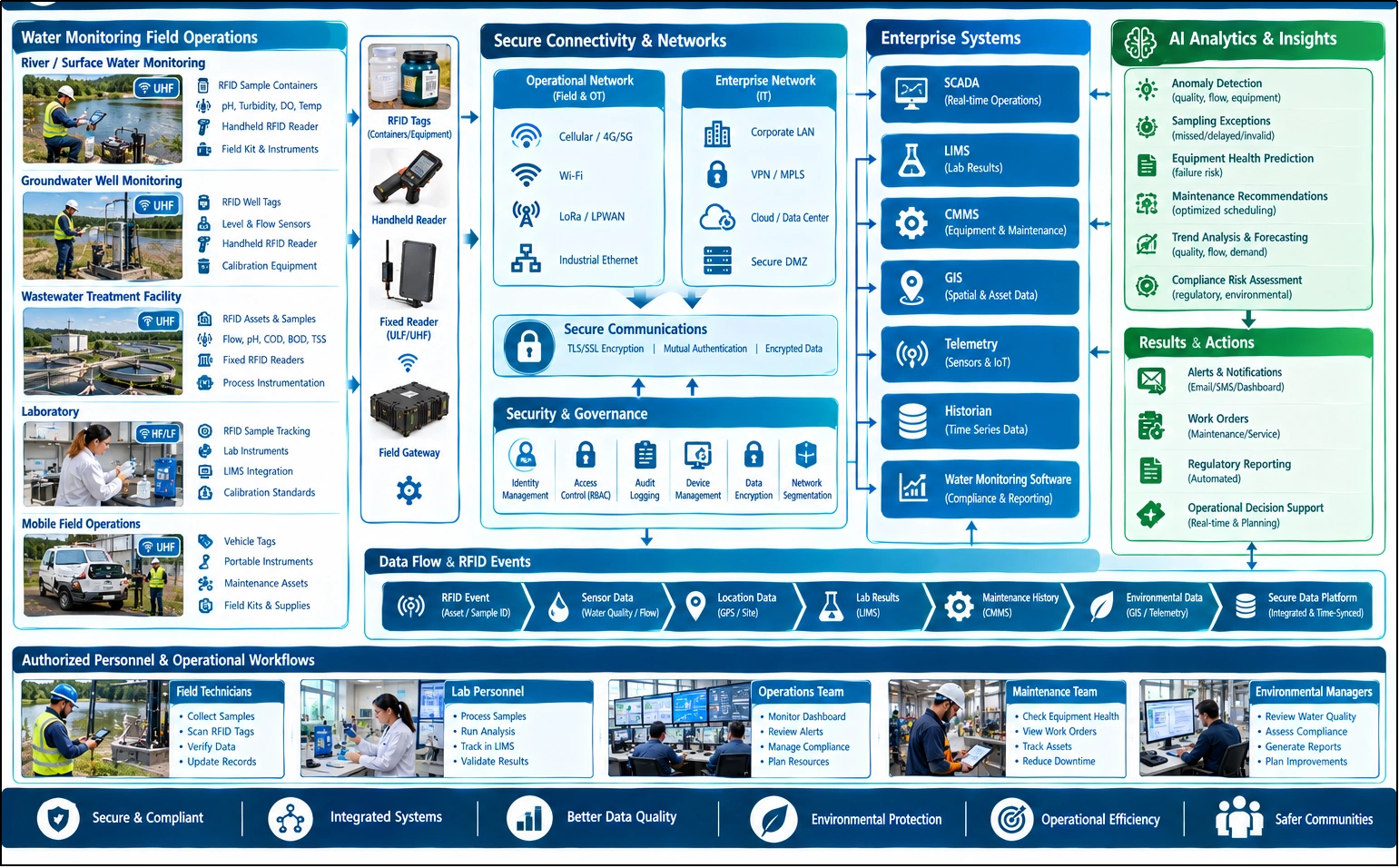
This enterprise diagram shows RFID-tagged water-monitoring assets and samples moving through secure connectivity into SCADA, LIMS, CMMS, GIS, telemetry, and water-monitoring systems. It highlights encrypted communications, identity and access controls, audit logging, AI analytics, alerts, and authorized operational workflows.
Water Monitoring Deployment Lessons and Engineering Best Practices
Several implementation practices consistently improve the reliability of AI and RFID water monitoring systems.
- Start with a measurable operational problem rather than deploying RFID simply because identification technology is available.
- Use RFID where physical identity or movement is difficult to capture manually.
- Select tag construction based on actual water, chemical, temperature, abrasion, and mounting conditions.
- Perform an RF site survey before finalizing reader locations.
- Maintain a unique relationship between RFID identifiers and enterprise asset or sample identifiers.
- Preserve timestamps and location information for important RFID events.
- Treat RFID data as operational context rather than as a substitute for measurement quality controls.
- Keep AI models connected to validated water-quality data and documented business rules.
- Establish human review for consequential water-quality decisions.
- Monitor model performance after deployment because environmental conditions and equipment behavior change.
- Integrate with existing SCADA, LIMS, CMMS, GIS, and telemetry systems where appropriate.
- Design for intermittent field connectivity through local buffering and synchronization.
- Establish clear ownership for RFID infrastructure, water-quality data, AI models, and integration interfaces.
- Test failure modes, including reader failure, missing tags, damaged tags, network loss, incorrect identity mappings, and abnormal measurements.
- Use commissioning and acceptance tests that reproduce actual field conditions.
- Track business KPIs continuously after implementation.
GAO’s experience supplying RFID and IoT hardware products and systems can be relevant when organizations need to evaluate identification, monitoring, connectivity, and integration requirements across complex water monitoring environments.
Key Takeaways for AI and RFID in Water Monitoring
AI and RFID address different but complementary parts of water monitoring. AI analyzes measurements, historical records, environmental conditions, equipment behavior, and operational events. RFID establishes reliable digital identities for physical samples, instruments, field kits, calibration equipment, and maintenance assets.
A well-engineered solution can help water monitoring organizations:
- Improve sample and equipment traceability.
- Reduce manual identification and transcription errors.
- Detect abnormal water-quality measurements earlier.
- Improve sampling schedule visibility.
- Identify equipment requiring calibration or maintenance.
- Connect field, laboratory, maintenance, and monitoring records.
- Improve visibility across distributed monitoring locations.
- Strengthen data quality and operational accountability.
- Support predictive maintenance for monitoring equipment.
- Provide better evidence for operational and compliance workflows.
The most effective deployments begin with a clearly defined water monitoring workflow, measurable KPIs, suitable RFID hardware, reliable data integration, and AI models validated against real operational conditions.
GAO has supported organizations with RFID and IoT hardware products and systems and brings experience across enterprise identification, connected monitoring, and industrial applications. GAO Group has served organizations in the United States and Canada for three decades, including Fortune 500 companies, leading R&D organizations, universities, and government agencies. This experience supports practical evaluation of RFID hardware, connected systems, integration requirements, and deployment considerations for complex operational environments.
Building the Future of Industrial AI and IoT with Aperture Venture Studio and GAO RFID Inc.
For more than three decades, GAO Group has invested heavily in R&D across industrial RFID, BLE, and IoT. As generative AI became increasingly useful for industrial applications, we expanded our work into AI-enabled solutions relevant to water monitoring, including asset traceability, sampling workflows, equipment maintenance, and environmental data analysis. We have also founded Aperture Venture Studio to support the development and scaling of practical AI and IoT solutions for industrial and environmental challenges such as water monitoring. Aperture Venture Studio brings together technical experts, operational executives, investors, and industry participants. Through the Aperture Ventures Summit and TekSummit, advanced AI and IoT topics are explored for practical applications. We welcome Advisors, technical contributors, Employees, Investors, and Customers.