
AI and RFID for Water Utilities
AI-Driven Asset and Field Operations for Water Utilities
Artificial Intelligence of Things (AIoT) combines artificial intelligence with connected sensors, equipment, and industrial systems to improve operational decisions. For water utilities, AI applications supported by RFID can improve visibility across treatment plants, pumping stations, reservoirs, laboratories, warehouses, service vehicles, and field maintenance operations. UHF RFID is particularly useful for identifying and locating tagged valves, pumps, meters, tools, chemical containers, spare parts, and maintenance equipment, while HF and LF RFID can support specialized identification requirements. AI can correlate RFID events with work orders, asset histories, telemetry, maintenance records, and inventory transactions to identify anomalies, predict operational needs, and prioritize field activities. The resulting water utility solution can reduce time spent searching for equipment, improve maintenance traceability, strengthen inventory accuracy, and provide better operational intelligence. GAO supplies RFID, BLE, and IoT hardware products and systems that can support these connected water utility workflows.
How AI and RFID Support Modern Water Utility Operations
Water utilities operate interconnected physical assets whose condition, location, maintenance status, and availability directly affect water treatment, distribution, wastewater processing, and service continuity. A typical utility may manage thousands of pumps, motors, valves, meters, pipes, chemical containers, instruments, tools, safety assets, mobile maintenance equipment, and replacement components across geographically distributed facilities.
AI becomes valuable when operational data from these assets can be captured consistently and associated with the correct asset identity. RFID provides one practical identification layer. Rather than relying exclusively on manual asset numbers, paper records, barcode scans, or technician recollection, an RFID-enabled water utility system can automatically capture the identity of tagged equipment when it passes through defined read zones or is inspected using handheld readers.
AI applications can then use those events alongside other operational data.
AI asset tracking can analyze RFID location and movement events to determine where maintenance equipment, instruments, pumps, valves, and spare parts are being used or stored.
AI inventory management can compare RFID-confirmed stock movements with inventory records and identify discrepancies involving water treatment chemicals, replacement components, fittings, meters, and maintenance supplies.
AI predictive maintenance can combine asset identity, maintenance history, sensor readings, runtime information, inspection results, and work-order data to identify equipment requiring attention.
AI field service optimization can use asset histories and work-order information to prioritize maintenance activities and reduce unnecessary trips to remote pumping stations, reservoirs, or distribution facilities.
AI traceability can associate maintenance activities, inspections, replacements, calibration events, and component movements with individual utility assets.
AI anomaly detection can identify unusual patterns such as unexpected asset movement, repeated component replacement, abnormal inventory consumption, or maintenance activity inconsistent with historical records.
The practical value comes from connecting physical asset identification with operational context. RFID by itself answers questions such as which tagged asset was detected and when. AI can help answer more complex questions such as whether the asset movement is expected, whether maintenance is overdue, which assets are likely to require intervention, and what operational action should follow.
GAO’s experience supplying RFID and IoT hardware products and systems can help organizations establish the physical data-capture layer required for these applications. The engineering objective is not simply to attach tags to equipment, but to determine which operational events should be captured and how those events should influence water utility workflows.
AI-Powered RFID and IoT Integration for Smart Water Utility Operations
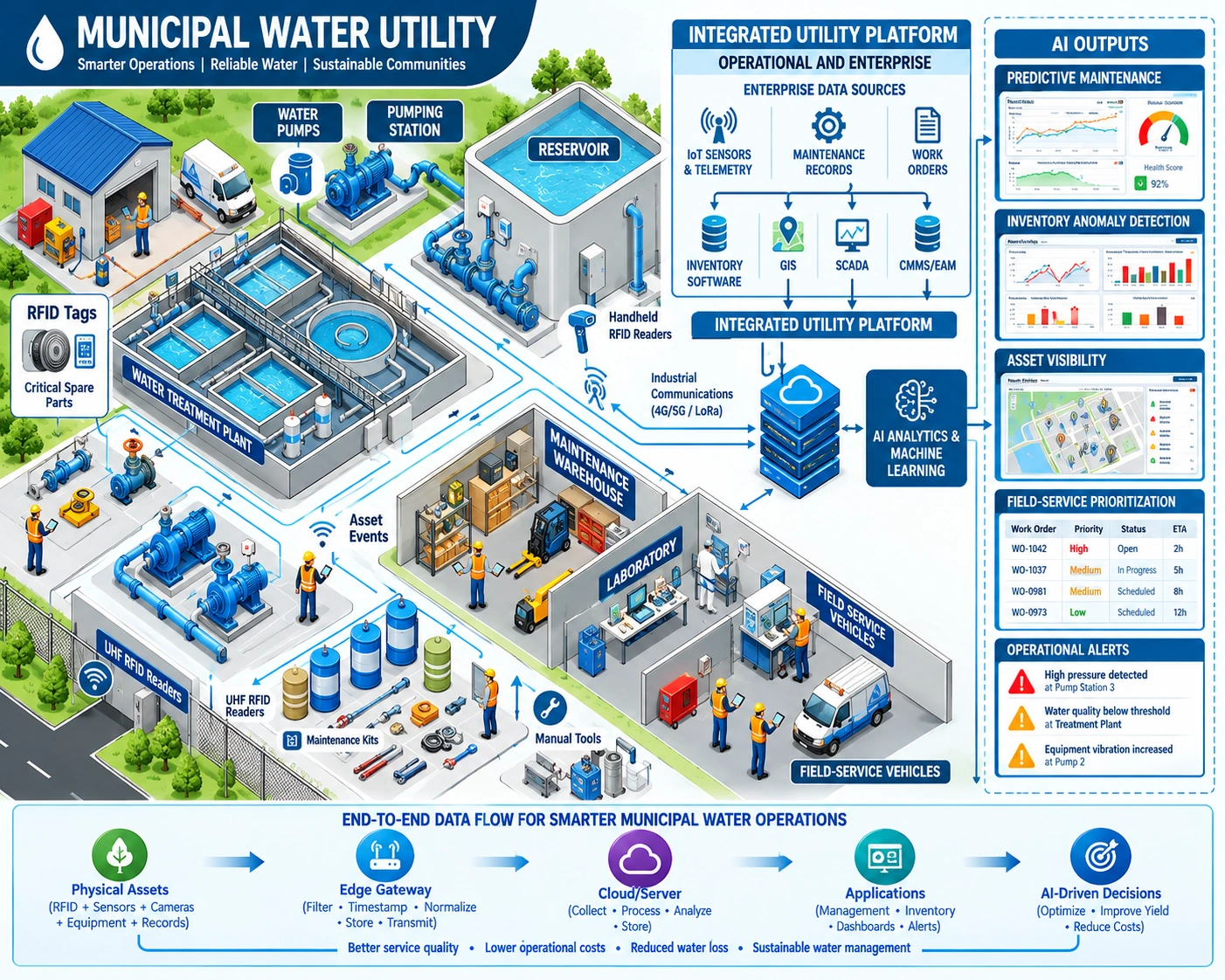
This comprehensive enterprise infographic illustrates the integration of AI, RFID technology, and operational data across a modern municipal water utility. It connects physical assets—from treatment plants and pumping stations to reservoirs, warehouses, and laboratories—with advanced digital systems like SCADA, CMMS/EAM, and GIS. The visual demonstrates how AI analytics process RFID-tracked asset events and IoT sensor data to generate predictive maintenance insights, detect inventory anomalies, improve asset visibility, and prioritize field-service activities, ultimately driving data-driven operational decisions and alerts.
Water Utility Use Cases for AI-Enabled Asset Intelligence
AI Asset Tracking Across Treatment Plants and Pump Stations
Water treatment facilities contain large numbers of mechanical, electrical, instrumentation, and maintenance assets. Pumps, motors, actuators, valves, analyzers, calibration equipment, portable instruments, lifting equipment, tools, and replacement assemblies can move between maintenance shops, treatment areas, warehouses, and field locations.
RFID can establish an electronic identity for these assets. UHF RFID is generally well suited to longer-range identification of tagged equipment and inventory when the physical environment supports reliable reads. Handheld readers can complement fixed readers where technicians need to locate or verify individual assets.
AI can use the resulting event history to identify unusual movement patterns, missing equipment, recurring transfers, or assets that remain unused for extended periods. A water utility can use these insights to improve asset utilization and reduce the time technicians spend locating equipment.
AI-Powered Predictive Maintenance for Pumps, Valves, and Motors
Predictive maintenance becomes more useful when sensor observations and maintenance records are connected to an unambiguous asset identity. RFID can associate inspection or service events with the correct pump, motor, valve, meter, actuator, or instrumentation assembly.
AI models can evaluate historical work orders, equipment runtime, vibration measurements, temperature readings, pressure data, inspection findings, failure history, and component replacement patterns. RFID does not replace condition monitoring sensors. Instead, it provides an identification mechanism that helps ensure the operational data is attributed to the correct physical asset.
A practical deployment can therefore combine RFID with vibration sensors, industrial gateways, PLC data, SCADA information, CMMS or EAM records, and AI analytics. The system can flag assets with increasing failure risk and route recommendations into maintenance planning rather than relying exclusively on fixed preventive-maintenance intervals.
AI Inventory Management for Water Treatment and Maintenance Stores
Water utilities maintain inventories of mechanical components, electrical parts, pipe fittings, meters, seals, gaskets, filters, PPE, tools, instrumentation, and other maintenance supplies. Treatment operations may also require controlled management of chemical containers and related handling records.
RFID can automate selected receiving, storage, issue, transfer, and return events. AI can analyze consumption patterns, seasonal demand, maintenance schedules, historical failures, and inventory discrepancies to improve replenishment decisions.
The most effective deployments distinguish between assets that require individual identity and consumables that can be managed at an item, container, case, or batch level. Tagging everything indiscriminately can increase implementation cost without creating proportional operational value.
AI-Enabled Field Service and Work-Order Verification
Water utility technicians frequently travel between treatment facilities, reservoirs, pumping stations, wells, distribution assets, and customer-service locations. A technician may need specific tools, replacement parts, test instruments, meters, or assemblies before leaving the maintenance depot.
An RFID-enabled workflow can verify that required equipment has been collected and returned. AI can use work-order requirements, technician activity, asset history, and previous service patterns to identify missing resources or recommend preparation steps.
This approach can reduce avoidable return trips and improve work-order readiness. For geographically distributed utilities, even small reductions in unnecessary travel can produce measurable operational and labor savings.
AI Traceability for Meters, Valves, Instruments, and Replacement Components
Traceability is particularly valuable for utility assets subject to inspection, calibration, replacement, or regulatory recordkeeping. RFID can establish a persistent identity that follows an asset through receiving, deployment, inspection, repair, storage, and retirement.
AI can examine historical records to identify recurring replacement patterns, unusual maintenance frequency, or groups of components associated with higher failure rates. Such analysis can support engineering reviews and capital planning.
For example, if particular valve assemblies repeatedly require intervention under similar operating conditions, AI-assisted analysis can identify the pattern for engineering review. RFID contributes reliable asset identity and event history, while the AI system provides analytical interpretation.
Water Utility AIoT Data Flow From Physical Assets to Decisions
A technically sound deployment begins with the physical operating environment rather than the AI model. Engineers first determine which water utility events have operational value and then design the identification, communications, data-processing, and integration layers around those events.
Data Acquisition at Utility Facilities
The data-capture layer can include fixed RFID readers, handheld RFID readers, RFID antennas, IoT sensors, PLCs, RTUs, industrial instrumentation, barcode scanners, mobile devices, and existing telemetry systems.
UHF RFID is often relevant for warehouse inventory, equipment identification, maintenance areas, and controlled read zones. HF RFID can be appropriate for shorter-range identification or specific proximity-based interactions, while LF RFID can be useful in specialized environments where its characteristics match the application.
Tag selection requires attention to water exposure, metal surfaces, chemical environments, temperature, mechanical abrasion, mounting method, and expected read distance. A tag that performs well on a plastic inventory container may perform poorly when mounted directly against a metal valve body or motor housing.
Communication and Edge Processing
RFID readers transmit identification events to a local gateway, workstation, server, or application depending on the deployment design. Industrial Ethernet, Wi-Fi, cellular connectivity, or other utility-approved communications can transport the information between operational locations and central systems.
Edge processing can filter duplicate reads, apply business rules, normalize device messages, and continue selected functions during network interruptions. This is particularly important for remote pumping stations and geographically distributed water infrastructure where reliable wide-area connectivity cannot always be assumed.
Middleware and Enterprise Software Integration
RFID events become significantly more valuable when they are associated with existing utility records. Middleware can normalize reader data and map tag identifiers to asset records.
Relevant systems may include:
CMMS and EAM software for work orders, maintenance history, asset hierarchies, inspections, and preventive-maintenance schedules
SCADA systems for supervisory monitoring and control of treatment and distribution processes
GIS software for spatial relationships among facilities, pipelines, valves, hydrants, meters, reservoirs, and other geographically distributed assets
ERP and inventory software for purchasing, stock control, financial records, and materials management
Laboratory information systems where RFID-supported identification is useful for samples, instruments, or laboratory workflows
Mobile workforce applications for field inspections, maintenance execution, and service documentation
Data historians and IoT databases for time-series measurements and equipment telemetry
AI analytics software for anomaly detection, prediction, classification, forecasting, and decision support
The integration layer should preserve the original event timestamp, reader or device identity, asset identifier, location context, and relevant confidence information. This creates a traceable data record that can be audited when an AI recommendation needs investigation.
AIoT-Enabled Data Flow for Water Utility Asset Management and Predictive Maintenance
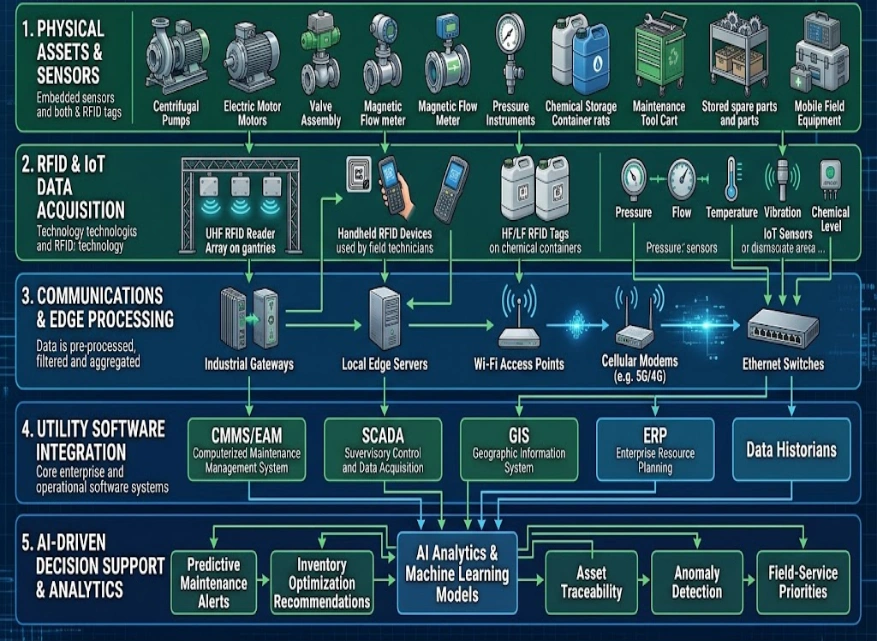
This detailed technical diagram illustrates the layered data path within an AIoT-enabled water utility, from physical assets to actionable decisions. It progresses from sensor-equipped equipment like pumps and valves through data acquisition using RFID and IoT sensors, into communications and edge processing, before integrating with core utility software systems. Finally, AI analytics process this aggregated data to generate outputs such as predictive maintenance alerts, inventory optimization, and field-service priorities.