
Overview
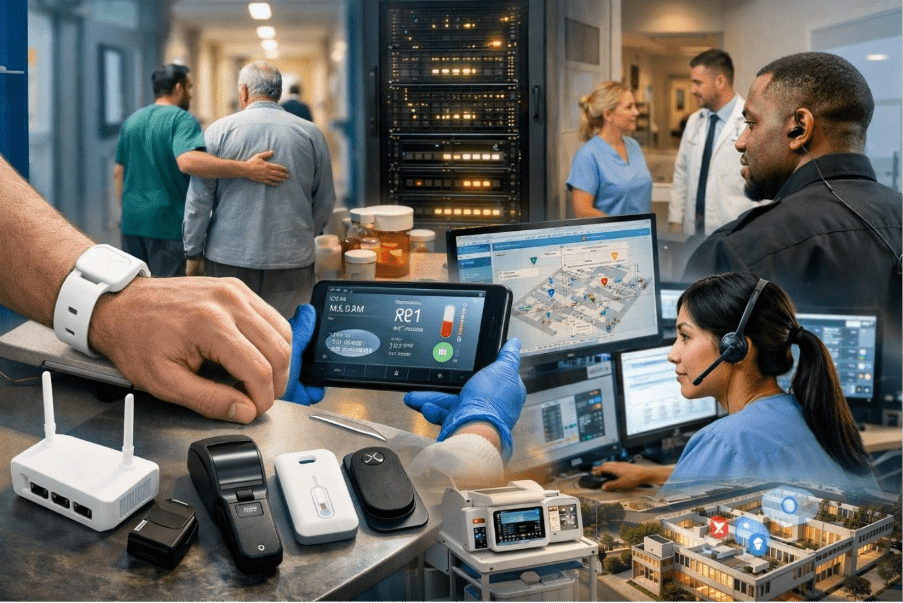
Mental health care facilities manage complex environments where patient safety, staff coordination, and regulatory compliance must operate simultaneously. Technologies such as BLE, RFID, IoT, and M2M enable real-time location awareness, secure asset tracking, environmental monitoring, and patient safety management. These technologies help address operational challenges including patient wandering risks, equipment loss, delayed emergency response, and limited visibility into facility operations.
Healthcare providers increasingly deploy sensor networks, wearable tags, and connected gateways to improve situational awareness and automate monitoring tasks. GAO solutions deployed in mental health care industries help resolve these challenges by enabling reliable indoor tracking, automated alerts, and secure data integration with healthcare IT systems.
Speak or Attend a Session Related to Mental health care Industries at TekSummit

GAO IoT Hardware Products Widely Deployed in Mental Health Care Industries
BLE Devices and Gateways
RFID Tags
IoT & M2M Connectivity Devices
GAO Solutions Widely Deployed in Mental Health Care Industries
Mental Health Facility Equipment & Asset Tracking Systems
Clinical Supplies & Medication Inventory Management Systems
Mental Health Facility Access Control & Secure Zone Systems
Patient, Staff & Visitor Tracking Systems
Facility Parking & Transport Coordination Systems
Behavioral Health Facility Construction & Infrastructure Systems
Specialized Mental Health Treatment & Clinical Systems
Mental Health Education & Training Asset Systems
GAO Case Studies in Mental Health Care Industries
United States Case Studies
New York City, New York
- Problem
Large psychiatric care facilities in New York City reported incidents of patient wandering within secured wards. Staff relied on manual supervision and badge checks which created gaps during shift changes and emergencies.
- Solution
BLE wearable tags and RFID-enabled wristbands were deployed throughout several psychiatric wards. BLE gateways installed across hallways and entrances continuously detected tag signals and transmitted location data through an IoT gateway network. Alert thresholds were configured to notify staff when patients approached restricted exits. GAO engineers assisted with system architecture planning and remote deployment support.
- Result
Patient wandering incidents decreased by approximately 38 percent within the first operational year. Staff response time to alerts improved significantly. Lesson learned: accurate indoor tracking requires careful calibration of gateway placement due to signal reflection within hospital structures.
Boston, Massachusetts
- Problem
Behavioral health units in Boston struggled with locating mobile medical equipment during emergencies. Staff spent considerable time searching for portable monitoring devices.
- Solution
Passive UHF RFID tags were attached to critical equipment including mobile diagnostic tools and medication carts. RFID readers at key ward entry points captured asset movement events and updated a centralized inventory dashboard connected through IoT infrastructure.
- Result
Equipment retrieval time decreased by nearly 45 percent. Facilities teams reported improved inventory accountability and reduced equipment replacement costs. Trade-off identified: initial tagging required a structured asset audit before deployment.
Chicago, Illinois
- Problem
Staff safety concerns were increasing due to occasional patient agitation events in psychiatric wards.
- Solution
Wearable RFID-based duress alert badges were issued to healthcare personnel. When activated, the badges transmitted location data to the nearest receivers which relayed the alert to security staff through the M2M platform.
- Result
Emergency response times dropped from several minutes to under one minute in most incidents. Staff feedback indicated improved perception of workplace safety. System evaluation showed that periodic battery replacement planning is necessary for wearable devices.
Seattle, Washington
- Problem
Mental health facilities required improved monitoring of environmental conditions such as temperature and humidity in medication storage areas.
- Solution
RFID sensor tags capable of temperature monitoring were installed on medication storage units. Data transmitted through IoT gateways enabled automated compliance reporting.
- Result
Environmental compliance reporting accuracy improved significantly. Facilities identified potential storage risks earlier than manual monitoring methods allowed. Deployment highlighted the importance of sensor calibration schedules.
Houston, Texas
- Problem
Psychiatric hospitals in Houston experienced operational inefficiencies due to incomplete visibility of patient movement patterns across wards.
- Solution
A combined BLE and RFID tracking infrastructure was implemented to capture patient movement data anonymously while maintaining privacy requirements. Gateways relayed location events to a secure analytics platform.
- Result
Operational workflow improvements reduced patient transfer delays by roughly 25 percent. Healthcare administrators gained new insights into ward capacity usage.
Los Angeles, California
- Problem
Emergency departments managing psychiatric patients required improved coordination between clinical teams and security personnel.
- Solution
IoT-enabled staff communication devices integrated with location tracking tags were deployed. The system automatically routed alerts to the nearest trained staff members during behavioral incidents.
- Result
Incident response coordination improved substantially. Staff collaboration across departments became more efficient. Lesson learned involved aligning alert workflows with existing clinical procedures.
Denver, Colorado
- Problem
Facility administrators needed accurate reporting for compliance audits related to patient supervision protocols.
- Solution
RFID-enabled patient wristbands integrated with ward entry monitoring readers provided automated logs of patient movement.
- Result
Compliance documentation accuracy improved while administrative workload decreased. Auditors reported higher confidence in digital supervision records.
Atlanta, Georgia
- Problem
Behavioral health centers reported difficulty locating specialized therapy equipment shared across multiple units.
- Solution
RFID asset tracking tags were deployed on therapy equipment and rehabilitation devices. Location data was captured using strategically placed readers.
- Result
Asset utilization improved by roughly 30 percent. Procurement teams reduced unnecessary equipment purchases after gaining accurate utilization data.
Canadian Case Studies
Toronto, Ontario
- Problem
Large mental health hospitals in Toronto required stronger safeguards against patients leaving secured units unnoticed.
- Solution
BLE-based wearable tracking devices were issued to patients admitted to controlled psychiatric units. Gateways installed at exits monitored tag signals and triggered alerts for staff.
- Result
Unauthorized exit attempts dropped by nearly 40 percent. Healthcare administrators noted that deployment success depended heavily on staff training.
Vancouver, British Columbia
- Problem
Behavioral health clinics required better visibility into high-value diagnostic equipment usage.
- Solution
Passive RFID tags and readers were deployed to track equipment movement and maintenance schedules. IoT connectivity provided centralized monitoring across multiple clinics.
- Result
Maintenance compliance improved significantly and equipment downtime was reduced. Facilities teams identified the importance of tagging consistency across departments.
Montreal, Quebec
- Problem
Psychiatric treatment centers needed improved monitoring of medication refrigeration units.
- Solution
Temperature-sensing RFID tags connected through IoT gateways continuously monitored refrigeration conditions and transmitted alerts if thresholds were exceeded.
- Result
Medication storage compliance reached 99 percent reporting accuracy. The system demonstrated that automated monitoring can reduce manual inspection workloads.
Join TekSummit: A Highly Impactful Global Virtual Conference with Sessions Dedicated to Mental health care Industries
TekSummit is a global virtual conference highlighting the latest advancements in BLE, RFID, IoT, AI, Cloud, T&M, and their applications. We have many sessions dedicated to or related to the Mental health care Industries.
Speaking at TekSummit is by invitation only, based on the analysis of our research team and recommendations by industry experts. If you have received an invitation and you are interested in presenting, please email us an abstract of your presentation on a topic of your choice.
However, if you do not have an invitation, please feel free to email us your proposal on the topic of your expertise to the TekSummit Review Committee.
Everyone is welcome to attend TekSummit free of charge, including technical and management professionals, as well as students.
Our products and systems have been developed and deployed for a wide range of industrial applications. They are available off-the-shelf or can be customized to meet your needs. If you have any questions, our technical experts can help you.
For any further information on GAO’s products and systems, to request evaluation kits, free samples, recorded video demos, or explore partnership opportunities, please fill out this form or email us.