
AI and RFID for Apparel Manufacturing
How AI Is Transforming Apparel Manufacturing Operations
AI for apparel manufacturing combines machine learning, computer vision, predictive analytics, optimization, and connected production data to improve how garments, materials, work orders, and finished products move through a factory. RFID provides a practical source of item-level and batch-level identification data for fabric rolls, cut components, work-in-process bundles, finished garments, cartons, and other production assets.
The resulting system can connect physical production events with manufacturing execution software, ERP, warehouse management systems, quality systems, and business intelligence tools. AI can then identify production bottlenecks, detect unusual material movements, estimate order completion risks, improve inventory visibility, and support demand and production planning.
For apparel manufacturers, the value is not simply knowing where an item is. The objective is to turn reliable production and inventory events into operational decisions. A validated RFID event can indicate that a fabric roll entered cutting, a bundle moved to a sewing line, a garment reached finishing, or a carton entered finished-goods storage. AI models can use these events together with production schedules, machine information, quality results, labor data, and historical throughput to identify conditions requiring attention.
GAO provides RFID and IoT hardware products and systems that can support these data-capture requirements across apparel production and material-handling environments.
AI + RFID Powered Apparel Manufacturing Architecture
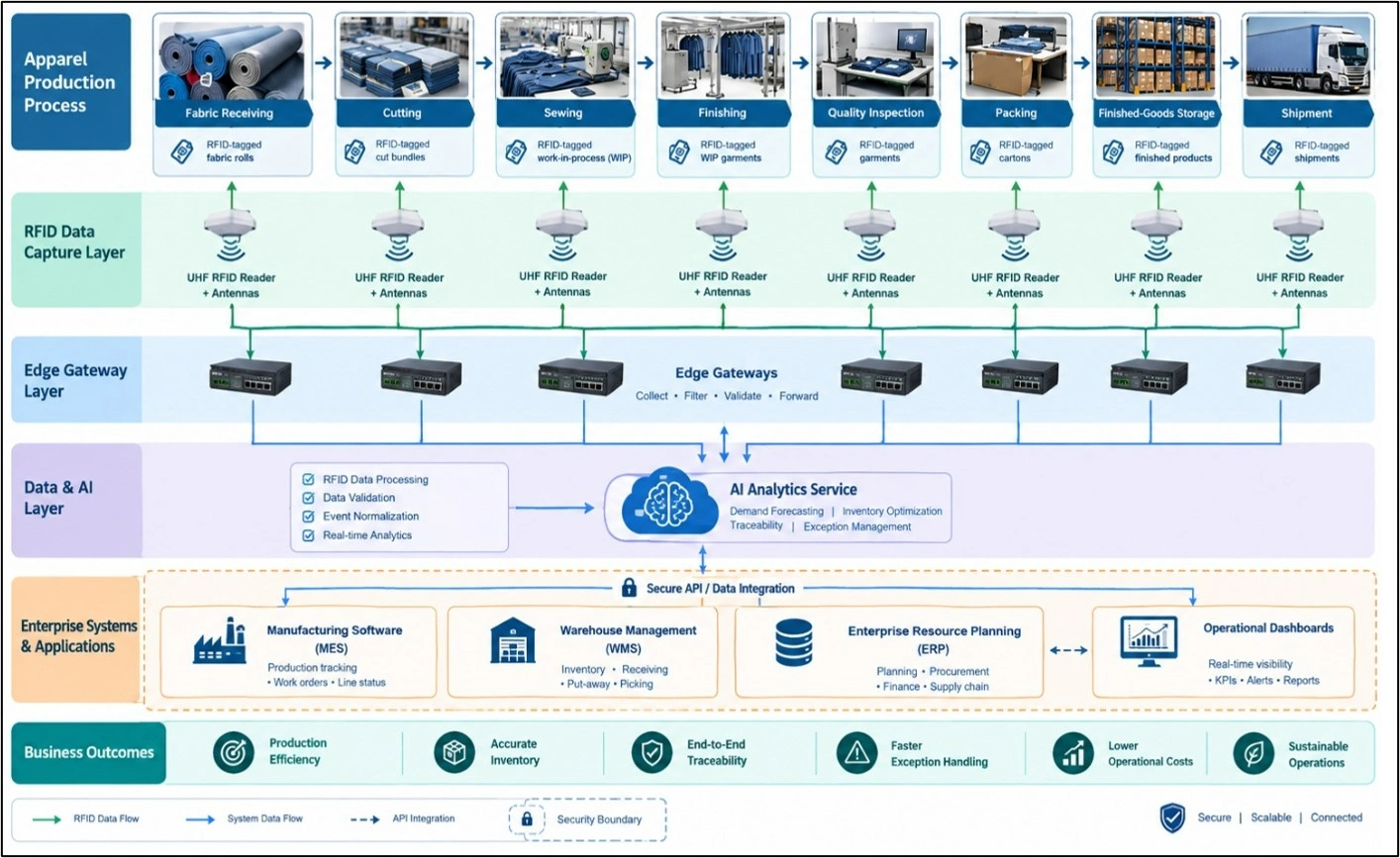
This architecture diagram illustrates how AI, RFID, edge computing, and enterprise systems connect across an apparel manufacturing environment. It follows data from fabric receiving, cutting, sewing, finishing, quality inspection, packing, finished-goods storage, and shipment through RFID readers and antennas into edge gateways. The edge layer collects, filters, validates, and forwards operational data to AI analytics services. Manufacturing software, warehouse management systems, ERP, and operational dashboards consume integrated data for production tracking, inventory visibility, traceability, and exception management. Secure API and data integration connect the technology layers while AI-driven analytics support production efficiency, accurate inventory, faster issue resolution, and informed operational decision-making.
AI and RFID Fundamentals for Apparel Manufacturing
Apparel manufacturing involves highly variable materials, short production cycles, multiple workstations, changing styles, size-color combinations, subcontracted processes, and strict shipment deadlines. These characteristics make accurate production traceability particularly important.
RFID acts as an identification and data-capture layer within this environment. Depending on the process requirement, apparel manufacturers may use UHF RFID for longer-range item, carton, and material identification, HF RFID for selected short-range identification scenarios, and LF RFID where low-frequency characteristics are appropriate. RFID selection should be based on read distance, tag attachment, material composition, reader placement, process speed, interference conditions, and required identification granularity.
AI adds interpretation and prediction to the captured operational data.
Relevant AI methods include:
- Machine learning: Analyze historical production and movement data to identify throughput patterns, process deviations, and order-risk conditions.
- Predictive analytics: Estimate completion delays, inventory requirements, equipment-related disruptions, or unusual production behavior.
- Computer vision: Inspect garment appearance, stitching, color consistency, labels, packaging, and selected quality characteristics.
- Anomaly detection: Identify unusual RFID movement sequences, missing process events, unexpected bundle locations, or inventory discrepancies.
- Optimization models: Support production sequencing, line balancing, material allocation, and order prioritization.
- Edge AI: Process selected production or inspection information close to manufacturing equipment when low latency or local processing is required.
The most useful implementation does not treat RFID data and AI analytics as separate projects. RFID events should be normalized, associated with production orders and product identifiers, and made available to the AI and manufacturing software through controlled interfaces.
Apparel Manufacturing Applications for AI-Driven Operations
AI applications should be selected according to specific apparel manufacturing problems rather than deployed simply because data is available. High-value applications generally occur where production events, inventory status, quality information, and planning decisions intersect.
AI Production Tracking and Work-in-Process Visibility
Work-in-process visibility is a major requirement for apparel factories producing multiple styles, sizes, colors, and customer orders simultaneously.
RFID-tagged bundles or garment units can generate process events as work moves through cutting, sewing, finishing, inspection, and packing. AI can analyze event sequences against expected routing and production schedules.
A production system can use this information to identify:
- Bundles remaining at a workstation longer than expected.
- Orders approaching their planned completion date with insufficient production progress.
- Unexpected movement between production areas.
- Work centers consistently producing below expected throughput.
- Missing or delayed process events.
- Accumulation of work-in-process between sewing and finishing.
The practical engineering challenge is event quality. A false read, missed read, duplicate read, or incorrectly associated tag can produce misleading analytics. Reader placement, antenna orientation, read-zone design, tag attachment, shielding, and middleware filtering therefore have a direct effect on AI accuracy.
AI Inventory Management for Fabric and Trims
Fabric rolls, lining materials, buttons, zippers, labels, thread, and other trims can create complex inventory-control requirements. Material availability also directly affects production scheduling.
AI-based inventory analysis can combine RFID movement events with ERP inventory records, purchase orders, bills of materials, production schedules, and historical consumption.
Potential applications include:
- Detecting differences between recorded and observed material locations.
- Predicting fabric and trim requirements for scheduled production.
- Identifying slow-moving or aging inventory.
- Detecting unusual material consumption.
- Supporting replenishment decisions.
- Linking material availability with production-order risk.
- Improving traceability from incoming material to finished garment.
For example, an AI system could identify that a production order is approaching its planned start date while a required fabric roll has not reached the cutting area. Instead of waiting for a manual shortage report, the system can flag the condition for production planning or materials management.
AI + RFID Apparel Manufacturing Inventory Workflow
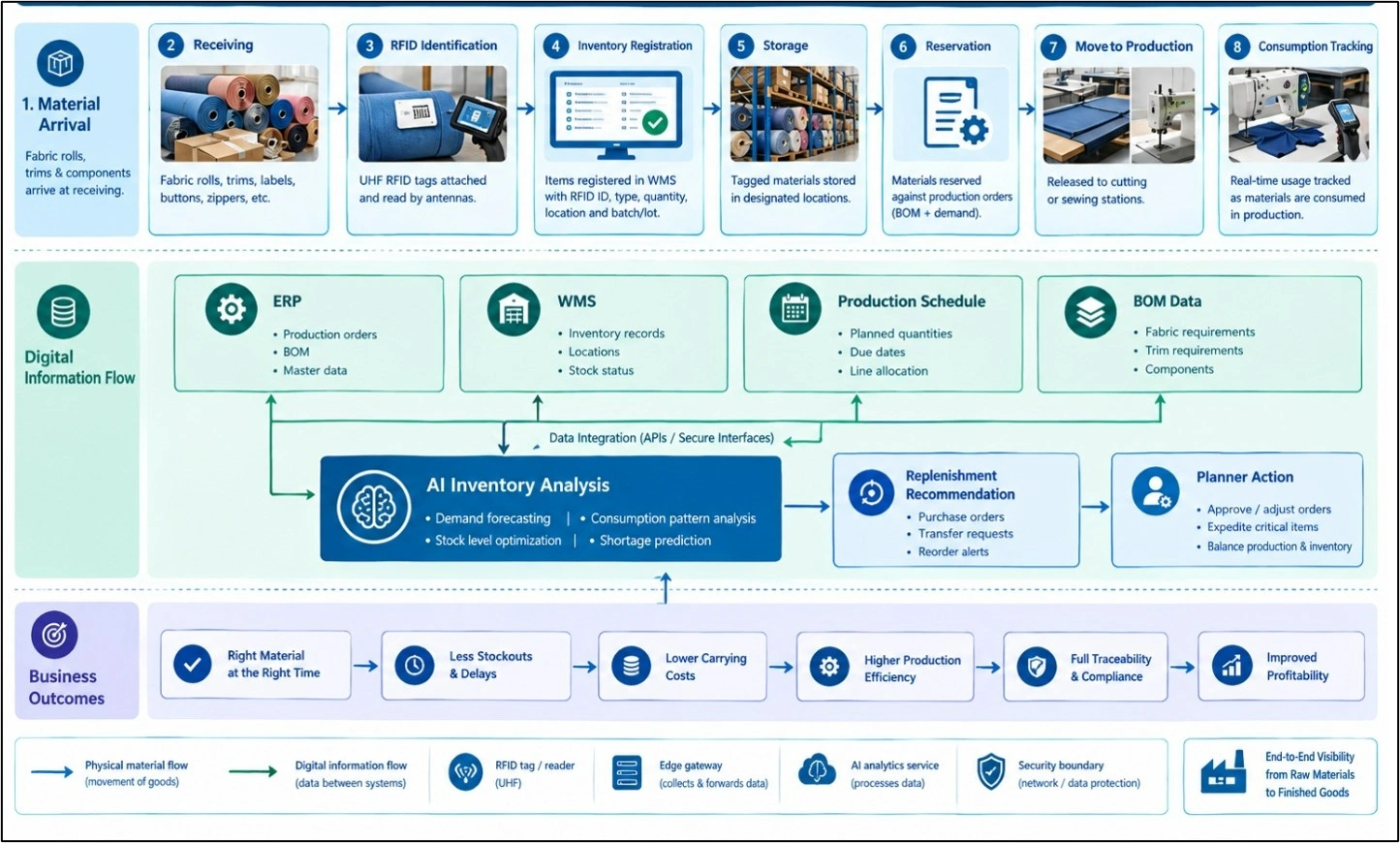
This workflow diagram illustrates how apparel manufacturing materials move from receiving to production while inventory data is captured and analyzed in real time. It shows fabric rolls and garment trims arriving at receiving, RFID identification and inventory registration, warehouse storage, and material reservation against production orders. Materials then move to cutting and sewing, where RFID enables consumption tracking. ERP, WMS, bill-of-materials data, and production schedules feed AI inventory analysis for shortage prediction and replenishment recommendations. The workflow concludes with planner action, connecting AI-generated insights to inventory control and production planning for improved material availability, reduced stockouts, better inventory accuracy, and more efficient apparel manufacturing operations.
AI Production Planning and Line Balancing
Apparel production frequently requires production planners to distribute work across sewing lines while considering style complexity, operator capability, machine availability, order priority, and required shipment dates.
AI can evaluate historical throughput and current RFID-based work-in-process information to identify production constraints. A planning system can compare expected versus actual progress and highlight lines or operations that require intervention.
Useful inputs can include:
- Production orders and due dates.
- Standard minute values and operation times.
- Historical line throughput.
- Current work-in-process quantities.
- RFID movement events.
- Machine availability.
- Quality and rework information.
- Labor and workstation capacity.
- Material availability.
The resulting recommendations can support line balancing and production sequencing. Human planners should remain responsible for operational approval where recommendations affect customer commitments, labor allocation, or production changes.
AI Quality Control and Defect Detection
Quality control is particularly important because garment defects can become expensive to correct after downstream operations or shipment.
Computer vision can support inspection for selected visible characteristics such as seam irregularities, missing components, label placement, fabric appearance, or packaging conditions. AI can also correlate quality results with production history.
RFID adds traceability by linking a garment, bundle, or production batch with its movement history. When a quality issue is discovered, the system can help identify the associated production order, workstation sequence, material lot, and processing history.
This combination can help quality teams move from isolated defect records toward process-level analysis.
AI Order Traceability and Finished-Goods Management
Finished garments often need to be consolidated by customer order, style, size, color, destination, or shipment requirement. RFID can provide identification events during finishing, packing, storage, and dispatch.
AI can analyze these events to identify:
- Missing units within an order.
- Incorrect carton composition.
- Delayed order consolidation.
- Unexpected finished-goods movements.
- Shipment-risk conditions.
- Inventory inconsistencies between physical stock and software records.
This creates a connection between shop-floor production status and outbound fulfillment.
From RFID Event Capture to AI-Driven Apparel Decisions
A technically sound apparel AI solution should establish a controlled data path from physical operations to business action.
The operational sequence typically begins with identification at the point where a material, bundle, garment, carton, or asset changes state or location. RFID readers capture tag information, while gateways and middleware filter duplicate reads and associate events with relevant process zones.
The normalized event can then be associated with identifiers such as:
- Style number.
- SKU.
- Size and color.
- Production order.
- Bundle ID.
- Fabric roll ID.
- Carton ID.
- Workstation or sewing line.
- Production batch.
- Storage location.
- Timestamp and process stage.
The resulting data can be transmitted to factory servers, private enterprise servers, or cloud-hosted software depending on operational and IT requirements.
AI services analyze the accumulated information together with production schedules, quality data, inventory records, and historical performance. The output may be an alert, forecast, anomaly score, prioritization recommendation, or operational dashboard.
The final stage is action. Production supervisors may reassign work, materials personnel may investigate a shortage, quality teams may isolate affected production, warehouse personnel may locate finished goods, or planners may revise production priorities.
AI + RFID Apparel Manufacturing End-to-End Data Flow
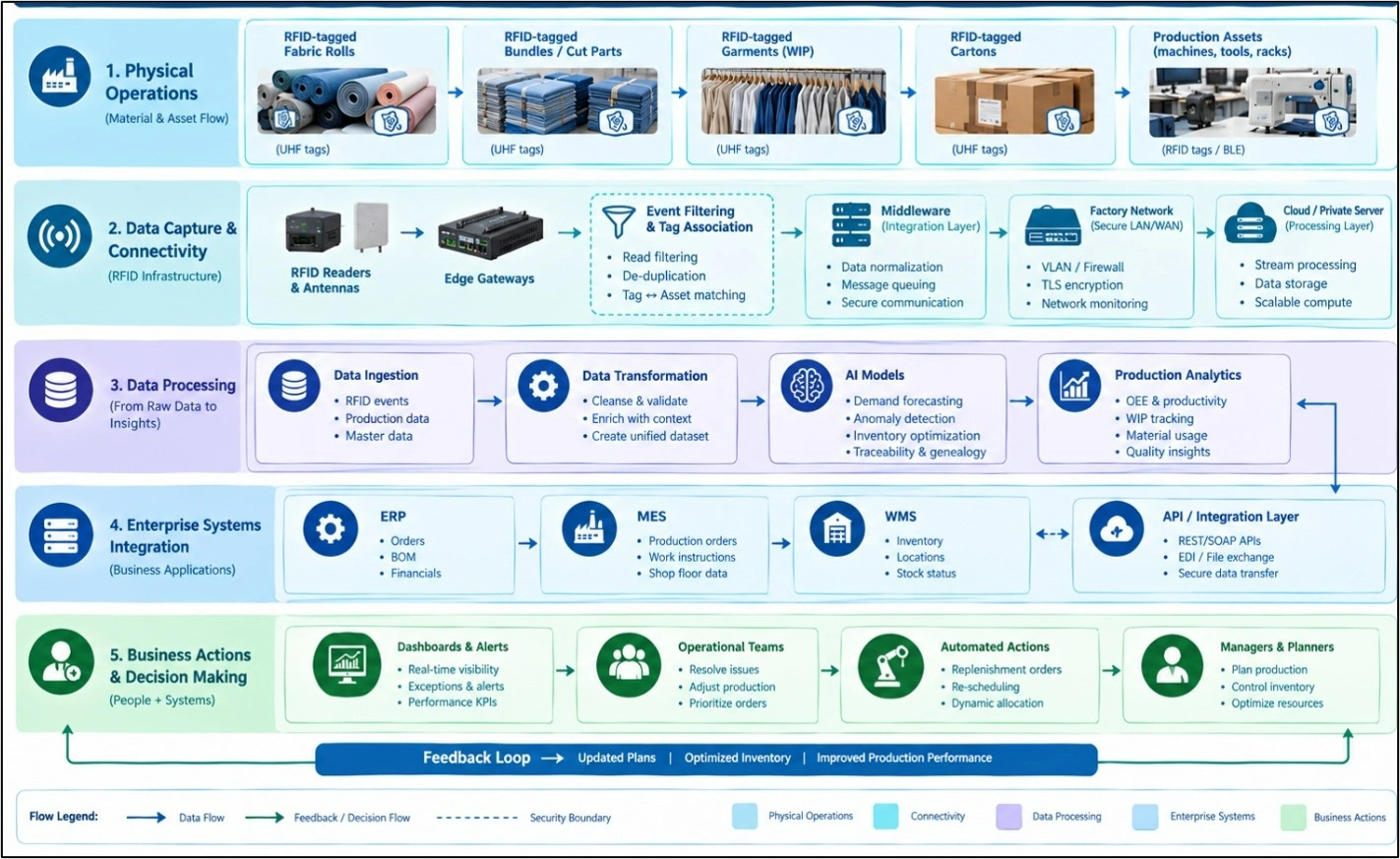
This end-to-end data flow diagram illustrates how apparel manufacturing data travels from physical production activities to AI-driven operational decisions. RFID-tagged fabric rolls, cut bundles, garments, cartons, and production assets generate data through RFID readers and antennas. Edge gateways perform event filtering and tag association before sending validated information through the factory network to middleware and cloud or private server environments. AI models analyze production and inventory data, while ERP, MES, and WMS systems provide enterprise context. Dashboards and alerts present actionable insights to operations teams, whose decisions feed back into production planning and inventory control for continuous improvement.
Technical Components for AI-Driven Apparel Manufacturing
AI-driven apparel manufacturing depends on coordinated data capture, production software, connected equipment, analytics, and operational controls. RFID provides item-level or bundle-level identification, while AI converts production and inventory events into forecasts, anomaly alerts, quality insights, and workflow recommendations.
GAO supplies RFID readers, antennas, tags, handheld devices, RFID printing and encoding equipment, and related IoT hardware that can support apparel manufacturing deployments.
RFID Hardware and Data Capture
UHF RFID is generally appropriate for many apparel manufacturing processes because it supports longer read ranges and can capture multiple tagged items without requiring direct line-of-sight. HF RFID can be considered for shorter-range identification points where controlled proximity reading is preferred. LF RFID is more specialized and may be appropriate where its propagation characteristics fit a particular equipment or identification requirement.
Typical apparel manufacturing hardware includes:
- UHF RFID fixed readers installed at production checkpoints, inventory entrances, packing stations, or dispatch areas
- RFID antennas positioned to create controlled read zones around conveyors, doors, workstations, and staging areas
- Handheld RFID readers for cycle counts, exception handling, material searches, and verification
- RFID printer-encoders for creating and encoding garment, bundle, carton, or component labels
- RFID tags selected according to garment material, label construction, read distance, and attachment method
- Edge gateways or industrial computers for local event processing
- Ethernet and Wi-Fi networking for reader and gateway connectivity
- Industrial power, mounting hardware, protective enclosures, and structured cabling where required
Tag performance should be validated against actual apparel materials and packaging rather than relying only on laboratory specifications. Fabric composition, tag orientation, stacked garments, metallic accessories, foil-based packaging, and dense cartons can influence read behavior.
Production and Business Software
The software layer converts RFID observations and manufacturing data into operational events. A typical implementation connects RFID middleware with apparel manufacturing systems such as:
- ERP for orders, purchasing, inventory, and financial records
- MES for production orders, work-in-process, routing, and production status
- WMS for raw-material, component, finished-goods, and warehouse transactions
- PLM for product specifications, styles, sizes, colors, and material information
- QMS for inspection results, nonconformances, corrective actions, and quality records
- TMS or shipping software for outbound logistics and shipment execution
- BI software for management reporting and operational dashboards
- AI services for forecasting, anomaly detection, classification, optimization, and predictive analysis
RFID middleware should normally perform filtering, duplicate-event suppression, reader identification, zone association, timestamp normalization, and business-event generation before data reaches AI models.
Communication and Integration Layer
A practical integration design may use Ethernet, Wi-Fi, TCP/IP, HTTPS, REST APIs, MQTT, or other protocols supported by the selected devices and software. Machine-level integration can use industrial interfaces such as OPC UA where appropriate and supported by the production equipment.
The objective is not to transmit every raw RFID observation directly into an analytics database. The system should transform raw observations into meaningful events such as:
- Bundle entered cutting area
- Bundle released to sewing
- Work-in-process remained at a station beyond expected dwell time
- Finished carton reached packing
- Shipment carton passed dispatch verification
- Expected component was missing from an order
- Unexpected item appeared in a controlled production zone
This event-oriented data model reduces unnecessary processing and gives AI models more useful operational context.
AI Models for Apparel Production and Inventory Decisions
AI can operate on RFID events together with production, quality, order, machine, labor, and inventory data. The strongest use cases usually combine multiple data sources rather than treating RFID observations as the entire analytical input.
Forecasting and Production Planning
Time-series forecasting can estimate demand for finished garments, raw materials, trims, packaging materials, and production capacity. Historical orders, seasonal patterns, style changes, production lead times, and current inventory can be incorporated into the forecasting process.
Optimization models can then help evaluate:
- Production quantities by style, size, and color
- Material availability
- Cutting and sewing capacity
- Order priorities
- Expected line congestion
- WIP accumulation
- Shipment deadlines
The resulting recommendations should remain connected to actual production constraints. A mathematically optimal production schedule is not useful if a required fabric roll, trim, machine, or trained operator is unavailable.
Anomaly Detection and Exception Management
Anomaly detection can identify production behavior that differs from expected patterns. Examples include unusually long bundle dwell times, unexpected material movements, repeated process delays, abnormal inventory changes, or unusual scan sequences.
RFID events provide evidence of physical movement, while MES, ERP, WMS, and quality records provide context.
An AI-generated alert might indicate that a bundle has remained between cutting and sewing longer than the normal process interval. Supervisors can then investigate material shortages, machine downtime, labor constraints, rework, or routing problems.
AI Quality Analytics
Computer vision and machine learning can analyze garment images, stitching patterns, fabric surfaces, measurements, and inspection results. RFID can associate the inspected garment, bundle, or production lot with its production history.
This creates a stronger traceability relationship between:
- Garment or bundle identity
- Style and SKU
- Production line
- Sewing operation
- Inspection station
- Defect classification
- Rework history
- Operator or workstation records where appropriate
- Final disposition
AI quality analysis should support inspectors rather than automatically replacing required quality controls unless the process has been validated for the intended application.
Cloud-Hosted and Customer-Managed Server Deployment
Apparel manufacturers can select a cloud-hosted SaaS deployment, a customer-managed server environment, or a hybrid design combining factory-level processing with centralized analytics.
Cloud-Hosted SaaS Deployment
A cloud-hosted solution can centralize data from multiple apparel factories, warehouses, and distribution locations. This approach is useful when organizations need shared analytics, centralized dashboards, remote monitoring, and multi-site AI model management.
Typical data flow:
RFID readers → Edge gateway → Secure network → Cloud software → AI analytics → Dashboard/API → ERP/MES/WMS
Benefits include:
- Centralized software management
- Easier multi-factory analytics
- Remote access for authorized personnel
- Centralized model deployment and monitoring
- Scalable storage and computing resources
- Easier aggregation of historical production data
Connectivity remains an important engineering consideration. Factory operations that require immediate local decisions should not depend entirely on an external network connection.
Customer-Managed Server Deployment
A customer-managed server can operate inside a factory, private data center, or controlled corporate environment. This option may suit manufacturers with strict internal IT requirements, local processing requirements, or specific data governance policies.
Typical design:
RFID readers → Factory network → Local server → AI/data services → MES/ERP/WMS → Local dashboards
Advantages can include:
- Local processing
- Reduced dependence on wide-area connectivity
- Greater control over infrastructure
- Integration with existing internal systems
- Local retention of selected operational data
The customer becomes responsible for server capacity, operating-system maintenance, backup procedures, cybersecurity controls, redundancy, patching, and monitoring.
Hybrid Deployment
Hybrid deployment can place time-sensitive processing at the factory while sending selected data to centralized services.
For example, an edge gateway can detect a carton passing a dispatch checkpoint and immediately validate the expected shipment contents. Aggregated production history can then be transferred to centralized analytics for forecasting and multi-site performance analysis.
Cybersecurity and Data Protection
RFID-enabled apparel manufacturing systems should be secured as connected industrial systems rather than treated as isolated identification equipment.
Security controls should address devices, networks, applications, APIs, databases, user accounts, and operational data.
Recommended controls include:
- TLS encryption for supported network communications
- Device authentication and controlled credential management
- PKI or certificate-based authentication where appropriate
- Role-based access control for operators, supervisors, IT administrators, and analysts
- Network segmentation between RFID equipment, production systems, office networks, and external services
- Secure API authentication and authorization
- Audit logging for important configuration and business events
- Regular firmware and software patching
- Backup and recovery procedures
- Monitoring for unusual device or network behavior
- Least-privilege access to production and business systems
RFID-specific risks can include unauthorized tag reading, tag cloning, inappropriate reader access, incorrect tag association, and fraudulent movement events. Application controls should therefore validate whether an RFID event is consistent with the expected order, location, production stage, and business process.
GAO can support organizations by supplying RFID and IoT hardware products that form part of a broader secured deployment designed around the customer’s network and operational requirements.
Commissioning and Testing in Apparel Facilities
RFID deployment should be commissioned against real garments, real bundles, actual production speeds, and normal factory conditions.
RF Site Survey
The initial survey should identify:
- Reader installation locations
- Antenna orientation
- Read-zone boundaries
- Nearby metal structures
- Electrical equipment
- Conveyor and workstation geometry
- Human movement patterns
- Tag orientation
- Expected item density
- Network and power availability
The objective is controlled identification rather than maximum theoretical read distance. Excessive read range can create false reads from neighboring production areas.
Tag and Read-Performance Validation
Representative samples should include different:
- Fabric types
- Garment sizes
- Colors and styles
- Tag placements
- Bundle configurations
- Carton configurations
- Packaging materials
Testing should measure read accuracy, missed reads, duplicate events, false reads, and performance at actual operating speeds.
Integration and User Acceptance Testing
Integration testing should verify that RFID events produce correct business transactions.
Examples include:
- Correct SKU assignment
- Correct work order association
- Correct production-stage update
- Correct inventory movement
- Correct carton contents
- Correct shipment verification
- Correct exception generation
User acceptance testing should involve production supervisors, warehouse personnel, quality teams, IT staff, and other operational stakeholders.
Realistic RFID Deployment in an Apparel Factory
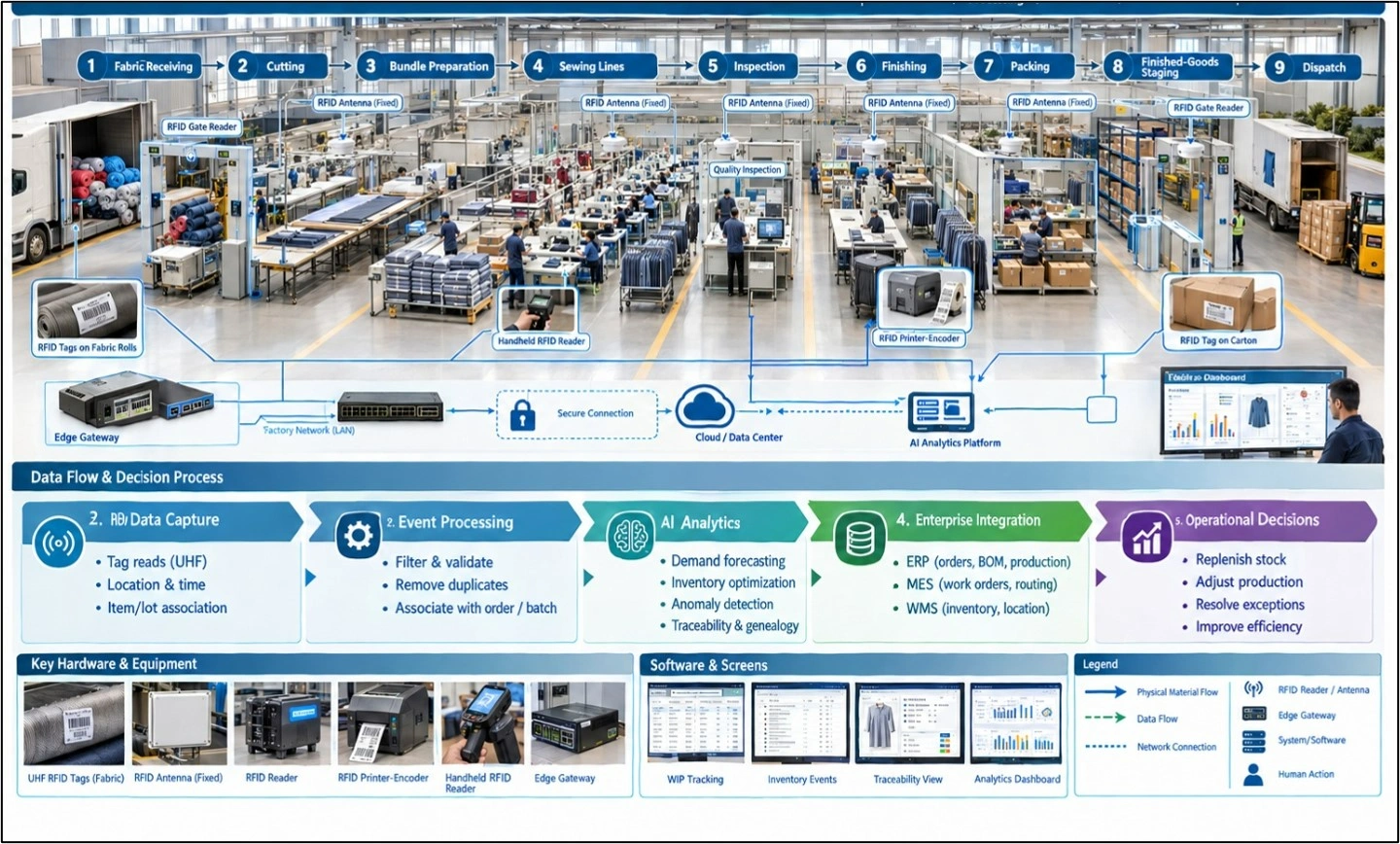
Illustrates RFID hardware deployment across apparel manufacturing operations, from fabric receiving to dispatch.Shows fixed RFID readers, antennas, handheld readers, printer-encoders, and edge gateways at key checkpoints.Demonstrates RFID event capture and processing through factory networks, AI analytics, and ERP/MES/WMS systems.Highlights how real-time production and inventory data supports operational decision-making.
Implementation Lifecycle for Apparel Manufacturers
A controlled implementation reduces the risk of deploying hardware before the business process and data model are understood.
Planning and Process Mapping
Start by mapping the selected apparel workflow from physical material movement to the final business decision.
Useful starting processes include:
- Fabric receiving and roll inventory
- Cutting and bundle tracking
- Sewing-line WIP visibility
- Finished-goods inventory
- Packing verification
- Shipment validation
Document the current process, manual checkpoints, existing software, data gaps, expected KPIs, and operational exceptions.
Pilot Deployment
A pilot should use a limited production area with measurable operational objectives. The goal is to prove read performance, event accuracy, system integration, and user acceptance before scaling.
Baseline measurements should be captured before deployment so the manufacturer can compare actual improvements.
Optimization and Scale-Up
After the pilot, adjust reader placement, antenna orientation, tag selection, event rules, dashboards, AI thresholds, and integration logic.
Scaling should occur process by process or facility by facility rather than simply duplicating the initial configuration without validation.
Maintenance and Continuous Improvement
Long-term operation requires:
- RFID reader health monitoring
- Antenna inspection
- Tag-quality monitoring
- Network monitoring
- Software and firmware updates
- AI model performance monitoring
- Data-quality checks
- Periodic read-zone validation
- Backup and recovery testing
- User training and process review
Production conditions change over time. New garment materials, packaging methods, factory layouts, and product lines can affect system performance and should trigger appropriate validation.
Apparel Manufacturing KPIs for AI and RFID Programs
A strong KPI framework should measure both technology performance and business outcomes.
Relevant measures include:
- WIP visibility percentage
- Inventory accuracy
- RFID read accuracy
- Missed-read rate
- False-read rate
- Bundle dwell time
- Cut-to-sew cycle time
- Sewing-line throughput
- Order completion adherence
- Production schedule variance
- First-pass yield
- Defect escape rate
- Rework rate
- Stockout frequency
- Pick and pack accuracy
- Shipment accuracy
- Forecast accuracy
- Exception resolution time
- Finished-goods inventory aging
RFID read accuracy should not be treated as the final business KPI. A technically strong RFID installation has limited value if the resulting information does not improve production control, inventory accuracy, quality, or order execution.
Practical Engineering Recommendations
Apparel manufacturers evaluating AI-driven production and inventory solutions should consider the following practices:
- Start with a measurable manufacturing problem rather than beginning with hardware selection.
- Establish baseline production, inventory, quality, and fulfillment KPIs.
- Select RFID frequency and tag types according to the actual garment and packaging environment.
- Test tags on representative fabrics, bundles, cartons, and accessories.
- Design controlled read zones to reduce false reads.
- Convert raw RFID observations into validated business events.
- Integrate RFID events with MES, ERP, WMS, PLM, or QMS systems where they add operational value.
- Use AI for forecasting, anomaly detection, quality analysis, and optimization where sufficient historical data exists.
- Keep time-sensitive factory decisions local when network availability could create unacceptable delays.
- Apply cybersecurity controls from the initial design rather than after deployment.
- Validate AI recommendations against real production constraints.
- Pilot one process before scaling across multiple production lines or facilities.
- Train operators and supervisors on exception handling, not only normal workflows.
- Monitor both RFID performance and business outcomes after deployment.
- Revalidate the system when factory layouts, products, packaging, or production processes change.
Business Benefits of AI-Driven Apparel Manufacturing
AI can turn production and inventory data into more actionable operational intelligence. RFID strengthens this capability by providing a machine-readable identity for selected garments, bundles, cartons, materials, or production units.
Potential benefits include:
- Better visibility into work-in-process
- More accurate inventory records
- Earlier identification of production delays
- Improved production planning
- Faster exception investigation
- Better order traceability
- More reliable packing and shipment verification
- Improved quality traceability
- Reduced dependence on manual status updates
- Stronger cross-system data consistency
- Better historical information for production analysis
The actual benefit depends on process design, data quality, integration depth, RFID performance, AI model quality, and adoption by factory personnel.
[Visual Recommendation 6: AI Apparel Manufacturing KPI Dashboard
Ideal placement: Near the benefits and KPI sections.
Purpose: Show how operational data can be presented to production and supply-chain decision-makers.
Detailed generation prompt: Design a professional manufacturing analytics dashboard for an apparel factory. Include KPI cards for WIP visibility, inventory accuracy, sewing throughput, bundle dwell time, order adherence, first-pass yield, defect rate, shipment accuracy, and RFID read accuracy. Include charts for production by line, WIP aging, order progress, quality exceptions, inventory by style and size, and AI-generated production alerts. Use apparel-specific labels such as cutting, sewing, finishing, inspection, packing, and dispatch. Show restrained enterprise UI styling with clear data hierarchy and no unsupported performance claims. After the visual is created, generate Visual Title, Short Description, and Alt Text based on the completed visual.]
AI-Enabled Apparel Manufacturing: From Visibility to Operational Intelligence
The strongest implementations treat AI, RFID, manufacturing software, and connected equipment as complementary components of a production control system. RFID supplies trusted physical movement events. MES, ERP, WMS, PLM, and QMS provide business context. AI models analyze those combined signals to identify patterns, predict future conditions, and prioritize operational action.
The resulting workflow can be expressed as:
Physical apparel process → RFID and machine data → Event processing → Business-system context → AI analysis → Exception or prediction → Human decision → Operational action → Measured outcome
This closed-loop approach is more useful than deploying identification technology without a defined decision process.
Building AI-Driven Apparel Manufacturing Operations
AI-driven apparel manufacturing can connect production visibility, inventory intelligence, quality analysis, and order execution into a more measurable operational process. RFID is an important enabling technology when garment, bundle, carton, or material identity must be captured automatically at defined production checkpoints.
Successful implementation depends on more than installing readers and tags. Manufacturers should design the data model, validate RF performance, integrate production systems, establish cybersecurity controls, test AI models, define measurable KPIs, and continuously monitor operational results.
GAO supports organizations with RFID, BLE, and IoT hardware products and systems that can be incorporated into apparel manufacturing solutions according to specific production, inventory, and traceability requirements.
Recommended Next Steps for Apparel Manufacturers
Manufacturers evaluating this approach can begin with a focused assessment of one high-value process such as cutting-to-sewing WIP tracking, finished-goods inventory, or shipment verification.
The assessment should define the physical workflow, current data sources, target KPIs, RFID deployment points, required integrations, AI use case, security requirements, and preferred cloud or customer-managed server model.
A controlled pilot can then establish actual read performance and business value before expansion across additional lines, warehouses, or facilities.
Building the Future of Industrial AI and IoT with Aperture Venture Studio and GAO
Aperture Venture Studio and GAO bring together practical expertise in industrial AI, IoT, RFID, connected equipment, analytics, and digital transformation. Their work can help organizations evaluate operational requirements, select appropriate technologies, integrate connected hardware with business software, and develop measurable AI-enabled workflows. GAO supplies RFID, BLE, and IoT hardware products and systems for applications involving asset identification, production visibility, inventory management, and operational monitoring. Combining engineering analysis with practical deployment experience supports manufacturers seeking reliable, scalable, and measurable industrial AI and IoT solutions.