
AI and RFID for Consumer Electronics Manufacturing
AI-Driven Consumer Electronics Manufacturing Enabled by RFID Technology
Consumer electronics manufacturing is evolving rapidly as manufacturers face increasing pressure to produce high-quality products while reducing production costs, accelerating product launches, and maintaining complete traceability across complex global supply chains. Artificial intelligence (AI), supported by RFID technology, is transforming how smartphones, tablets, laptops, wearables, gaming devices, smart home equipment, and other consumer electronic products are manufactured, inspected, tracked, and delivered.
Rather than functioning as isolated technologies, AI and RFID work together to create intelligent manufacturing systems that continuously collect production data, analyze operational conditions, predict manufacturing issues, optimize production scheduling, and automate decision making. RFID provides reliable identification and real-time visibility of components, work-in-progress assemblies, finished products, returnable transport items, tooling, and production assets, while AI converts this operational data into actionable intelligence for manufacturing optimization.
For more than three decades, GAO has supplied RFID and industrial IoT hardware solutions to organizations throughout the United States and Canada. Our experience supporting Fortune 500 companies, research organizations, universities, and government agencies enables us to understand the operational requirements of modern consumer electronics manufacturing and the growing role of AI-enabled manufacturing intelligence.
AI-Enabled Consumer Electronics Manufacturing Workflow Using RFID and AI Analytics
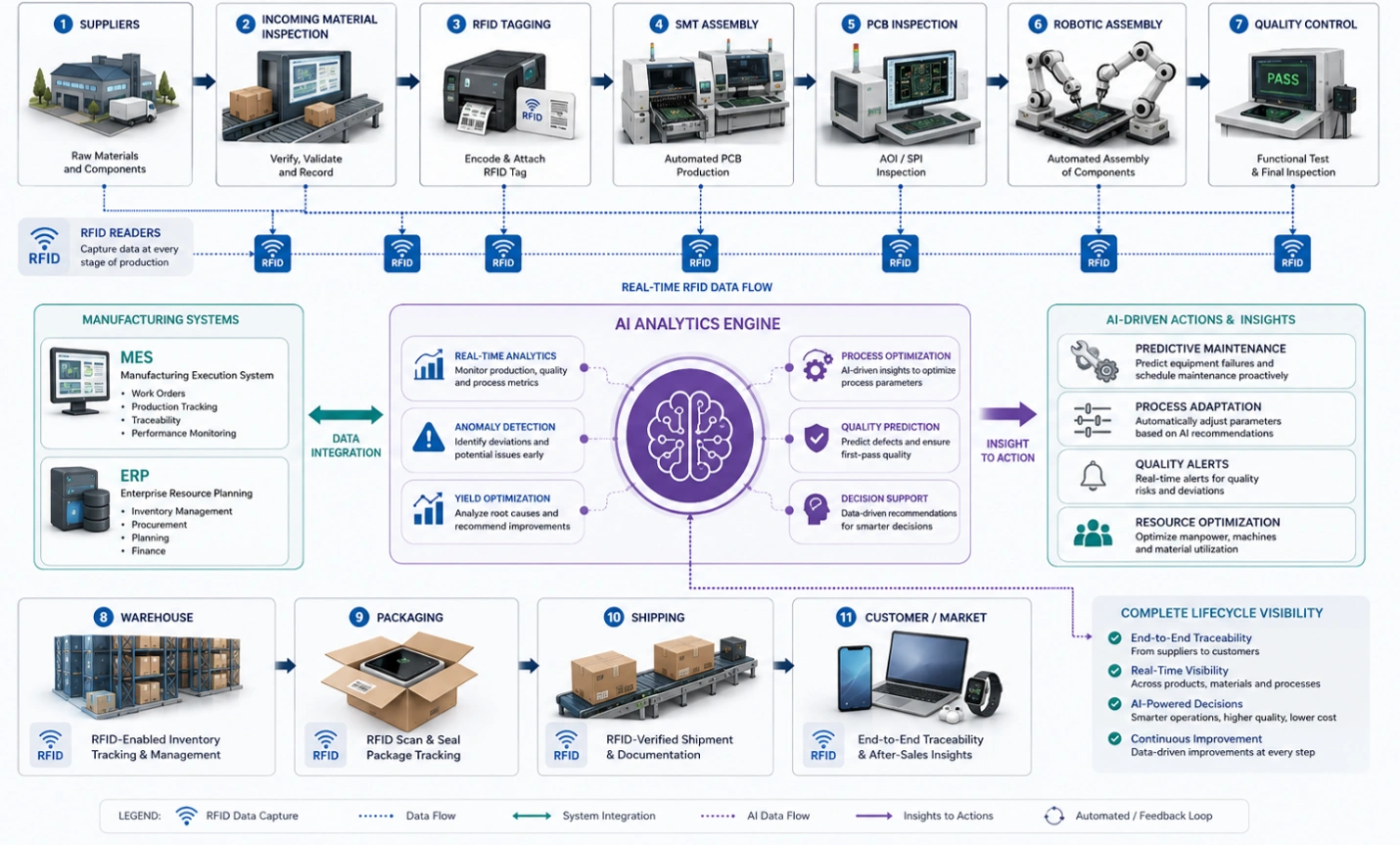
AI-Powered Manufacturing Intelligence for Consumer Electronics Production
Consumer electronics manufacturing differs significantly from many other manufacturing sectors because of its extremely short product life cycles, rapid engineering changes, miniaturized components, highly automated assembly processes, and strict quality requirements. Products frequently move through hundreds of manufacturing operations before shipment, making continuous visibility essential.
AI-powered manufacturing systems supported by RFID enable manufacturers to monitor every stage of production, from incoming electronic components to final packaging and distribution. Instead of relying solely on historical production reports, AI continuously analyzes manufacturing data to identify quality risks, production bottlenecks, equipment abnormalities, and inventory shortages before they affect production output.
Modern consumer electronics factories generate enormous volumes of operational information from:
- Surface Mount Technology (SMT) production lines
- Printed Circuit Board Assembly (PCBA) processes
- Automated optical inspection (AOI) systems
- X-ray inspection equipment
- Functional testing stations
- Burn-in testing systems
- Automated guided vehicles (AGVs)
- Industrial robots
- Warehouse automation systems
- RFID readers
- Barcode scanners
- Environmental monitoring sensors
- Manufacturing Execution Systems (MES)
- Enterprise Resource Planning (ERP) software
AI aggregates these diverse data sources into predictive manufacturing intelligence that supports engineering teams, production supervisors, quality managers, maintenance personnel, supply chain planners, and factory management.
Unlike traditional automation that follows predefined rules, AI continuously learns from production data, enabling adaptive optimization of manufacturing operations.
Understanding RFID as the Foundation for AI-Driven Consumer Electronics Manufacturing
RFID provides the digital identity layer that enables AI systems to understand what is happening throughout consumer electronics manufacturing operations. Every tagged component, PCB panel, assembly fixture, reusable carrier, pallet, container, testing rack, or finished product becomes a continuously traceable manufacturing asset.
Depending on operational requirements, manufacturers may deploy multiple RFID technologies throughout the production environment.
- UHF RFID enables long-range identification of pallets, finished products, warehouse inventory, returnable containers, and logistics assets.
- HF RFID is commonly used where controlled reading distances are required, including electronic workstations, tooling management, production fixtures, and work-in-progress tracking.
- LF RFID may be selected for specialized industrial applications where environmental conditions require highly reliable short-range identification.
The value of RFID extends beyond identification. Every RFID read event contributes contextual manufacturing information that AI systems use for operational intelligence, including:
- Product identity
- Manufacturing batch
- Component genealogy
- Production station
- Operator association
- Equipment utilization
- Production timestamps
- Material movement
- Process completion
- Test history
- Warehouse location
- Shipping status
As production complexity increases, AI benefits from richer operational datasets generated by RFID, enabling more accurate forecasting, anomaly detection, production optimization, and quality prediction.
Within consumer electronics manufacturing, RFID also supports regulatory compliance, counterfeit prevention, warranty verification, product recall management, and lifecycle traceability.
GAO supplies RFID readers, antennas, tags, and industrial identification hardware that integrate with modern manufacturing software to help organizations improve production visibility while supporting future AI initiatives.
Industry Challenges Driving AI Adoption in Consumer Electronics Manufacturing
Consumer electronics manufacturers operate in one of the world’s most competitive production environments. Product launches occur rapidly, demand fluctuates significantly, and manufacturing quality expectations continue to rise.
AI supported by RFID addresses numerous operational challenges unique to this sub-industry.
High Product Variety
Manufacturers often produce multiple smartphone models, wearable devices, tablets, routers, laptops, gaming accessories, and smart home products on shared production lines. AI dynamically analyzes production schedules while RFID confirms that the correct components, tooling, and work instructions are associated with each product variant.
Extremely Complex Component Traceability
Modern electronic products may contain thousands of individual components sourced from hundreds of suppliers. RFID enables end-to-end tracking of component lots, printed circuit boards, batteries, displays, integrated circuits, connectors, cameras, and assembled modules. AI analyzes this traceability data to identify quality trends, supplier performance issues, and manufacturing deviations.
Rapid Engineering Changes
Engineering Change Orders (ECOs) frequently modify bills of materials, firmware versions, production processes, and testing procedures. RFID ensures materials follow updated production routes while AI validates process compliance and identifies potential production risks.
Zero-Defect Manufacturing Objectives
Consumer expectations demand exceptional product reliability. AI analyzes inspection images, functional test results, environmental conditions, and RFID-generated production histories to predict defect patterns before failures become widespread.
Inventory Accuracy
Component shortages can halt production lines within minutes. RFID provides accurate inventory visibility while AI forecasts component consumption, identifies replenishment requirements, and minimizes excess inventory without increasing stockout risks.
Equipment Availability
Surface mount placement machines, solder reflow ovens, robotic assembly cells, laser marking systems, automated inspection equipment, and testing stations require maximum uptime. AI predicts maintenance requirements using production history, equipment performance, and RFID-based asset utilization data to reduce unexpected downtime.
Traditional vs. AI-Enabled RFID Manufacturing in Consumer Electronics: A Comparative Analysis
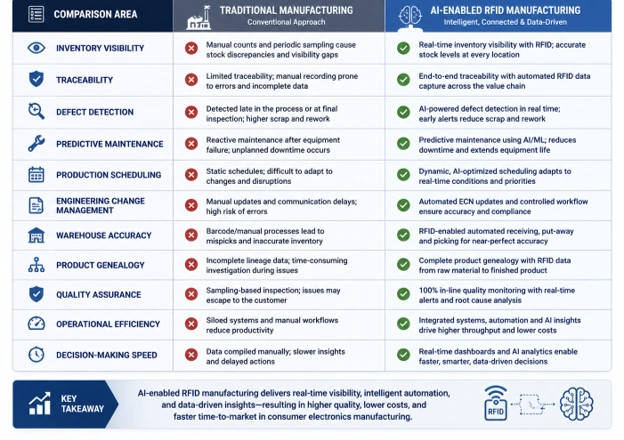
AI Deployment Scenarios Across Consumer Electronics Manufacturing Operations
Consumer electronics manufacturing requires synchronized coordination between suppliers, warehouse operations, SMT production lines, PCB assembly, robotic workstations, quality inspection, testing laboratories, packaging lines, and distribution centers. AI systems supported by RFID enable continuous monitoring and intelligent decision-making throughout these interconnected operations, improving manufacturing efficiency, product quality, and supply chain resilience.
Intelligent Incoming Material Verification
Production begins with the receipt of electronic components such as integrated circuits (ICs), microprocessors, memory chips, displays, batteries, sensors, connectors, printed circuit boards (PCBs), and passive components. RFID-tagged pallets, reels, trays, and containers enable rapid identification as materials enter the warehouse.
AI analyzes RFID data together with supplier quality records, procurement information, and historical inspection results to:
- Identify high-risk supplier shipments
- Detect unexpected delivery variations
- Predict material shortages before production begins
- Recommend inspection priorities
- Improve supplier performance evaluation
- Reduce receiving bottlenecks
This intelligence allows procurement and warehouse teams to prioritize critical materials while maintaining production continuity.
AI-Assisted Surface Mount Technology (SMT) Production
SMT lines are among the most automated processes within consumer electronics manufacturing. Thousands of electronic components are placed on printed circuit boards every hour using high-speed placement machines.
RFID identifies:
- Component reels
- Feeder carts
- PCB carriers
- Production batches
- Work orders
- Tooling assemblies
AI continuously evaluates production metrics including:
- Placement accuracy
- Component consumption
- Machine utilization
- Feeder replacement frequency
- Production throughput
- Defect rates
- Line balancing efficiency
Rather than responding after production problems occur, AI identifies emerging trends that may indicate nozzle wear, feeder alignment issues, incorrect component loading, or production imbalance.
Intelligent Work-in-Progress (WIP) Tracking
Consumer electronics products typically pass through dozens or even hundreds of manufacturing steps before completion. Maintaining accurate visibility into work-in-progress inventory is essential for production planning and delivery commitments.
RFID automatically records movement between:
- SMT production
- Automated Optical Inspection (AOI)
- X-ray inspection
- Manual assembly
- Robotic assembly
- Functional testing
- Burn-in testing
- Firmware programming
- Packaging
- Finished goods storage
AI analyzes this real-time movement data to:
- Detect production bottlenecks
- Optimize routing decisions
- Predict completion times
- Balance workloads across production lines
- Improve manufacturing cycle times
- Reduce unnecessary material movement
AI-Driven Quality Assurance
Quality inspection generates large volumes of structured and unstructured manufacturing data. Inspection images, functional test results, electrical measurements, repair records, and process histories collectively provide valuable insights into production quality.
RFID ensures every inspection result is associated with the correct product, production batch, operator, equipment, and manufacturing history.
AI combines these datasets to:
- Predict defect probability
- Identify recurring failure patterns
- Detect process drift
- Recommend corrective actions
- Improve first-pass yield
- Reduce false inspection failures
- Enhance root cause analysis
Instead of evaluating isolated defects, AI examines complete manufacturing histories to uncover relationships that traditional statistical methods often overlook.
Predictive Maintenance for Manufacturing Equipment
Equipment reliability directly influences production output. SMT placement machines, solder paste printers, reflow ovens, selective soldering systems, laser markers, robotic assembly stations, automated storage systems, and testing equipment all require scheduled maintenance.
RFID tracks maintenance tools, spare parts, calibration equipment, and service activities, while AI evaluates:
- Equipment utilization
- Operating hours
- Failure history
- Maintenance frequency
- Environmental conditions
- Production schedules
- Sensor readings
Predictive maintenance enables engineering teams to schedule repairs during planned downtime, minimizing production disruptions and extending equipment life.
Operational Workflow from RFID Data Capture to AI-Driven Manufacturing Decisions
Successful AI-enabled consumer electronics manufacturing depends on a continuous flow of trusted operational data. RFID serves as the primary identification technology, while AI transforms captured information into manufacturing intelligence that supports automated and human decision-making.
The workflow typically includes the following stages:
Data Acquisition
RFID readers positioned throughout production facilities automatically identify tagged components, work-in-progress assemblies, production fixtures, pallets, containers, finished products, and material handling equipment.
Additional operational data is collected from:
- Industrial sensors
- PLCs
- Machine controllers
- AOI systems
- X-ray inspection equipment
- Functional testers
- Vision systems
- Environmental monitoring devices
- Warehouse automation equipment
This multi-source data collection provides comprehensive visibility into manufacturing operations.
Communication and Data Transport
Collected information is securely transmitted using industrial communication technologies such as:
- Ethernet/IP
- PROFINET
- Modbus TCP
- OPC UA
- MQTT
- REST APIs
- HTTPS
- Wi-Fi 6
- Private 5G
- Industrial Ethernet
These communication methods enable reliable data exchange between production equipment, RFID infrastructure, manufacturing software, and AI applications while maintaining low latency and high availability.
Edge Processing
Certain manufacturing decisions require immediate response times that cannot depend solely on cloud connectivity. Edge computing systems process RFID events and production data close to manufacturing equipment.
Typical edge functions include:
- RFID event filtering
- Duplicate read elimination
- Local rule execution
- Production validation
- Temporary buffering
- Equipment synchronization
- Real-time anomaly detection
Edge processing reduces network traffic while supporting time-sensitive manufacturing operations.
Enterprise Software Integration
Validated RFID and production data are integrated with business software that coordinates manufacturing and supply chain activities.
Common enterprise systems include:
- Manufacturing Execution Systems (MES)
- Enterprise Resource Planning (ERP)
- Warehouse Management Systems (WMS)
- Product Lifecycle Management (PLM)
- Quality Management Systems (QMS)
- Computerized Maintenance Management Systems (CMMS)
- Supply Chain Management (SCM) software
- Manufacturing analytics software
AI consumes information from these systems to produce holistic operational insights rather than isolated production metrics.
GAO supports organizations by supplying RFID hardware that integrates with existing manufacturing software, helping manufacturers preserve previous technology investments while expanding AI-driven operational capabilities.
Technology Components Supporting AI-Enabled Consumer Electronics Manufacturing
Effective AI-driven manufacturing depends on coordinated interaction between RFID hardware, industrial networking, computing resources, enterprise software, cybersecurity controls, and AI models. Rather than functioning independently, these components operate as a unified manufacturing solution that supports continuous visibility, predictive analytics, and intelligent automation.
The primary technology components include:
- UHF RFID readers for warehouse inventory, logistics assets, and finished goods tracking.
- HF RFID readers for workstation identification, tooling management, fixture verification, and work-in-progress control.
- RFID antennas designed to support conveyor systems, automated storage systems, production cells, dock doors, and warehouse portals.
- Passive RFID tags attached to electronic component carriers, reusable containers, pallets, production fixtures, returnable transport items, and finished products.
- Industrial edge servers that aggregate RFID events, execute local AI inference, and support low-latency manufacturing decisions.
- AI software employing machine learning, deep learning, computer vision, anomaly detection, predictive analytics, and reinforcement learning to optimize production scheduling, defect detection, maintenance planning, and inventory forecasting.
- Secure communication infrastructure using protocols such as MQTT, OPC UA, REST APIs, and industrial Ethernet to exchange data reliably between manufacturing equipment, enterprise software, and AI systems.
- Cybersecurity mechanisms including role-based access control (RBAC), TLS encryption, device authentication, secure firmware updates, audit logging, and network segmentation to protect manufacturing operations and sensitive production data.
Enterprise Architecture for AI-Enabled RFID Consumer Electronics Manufacturing
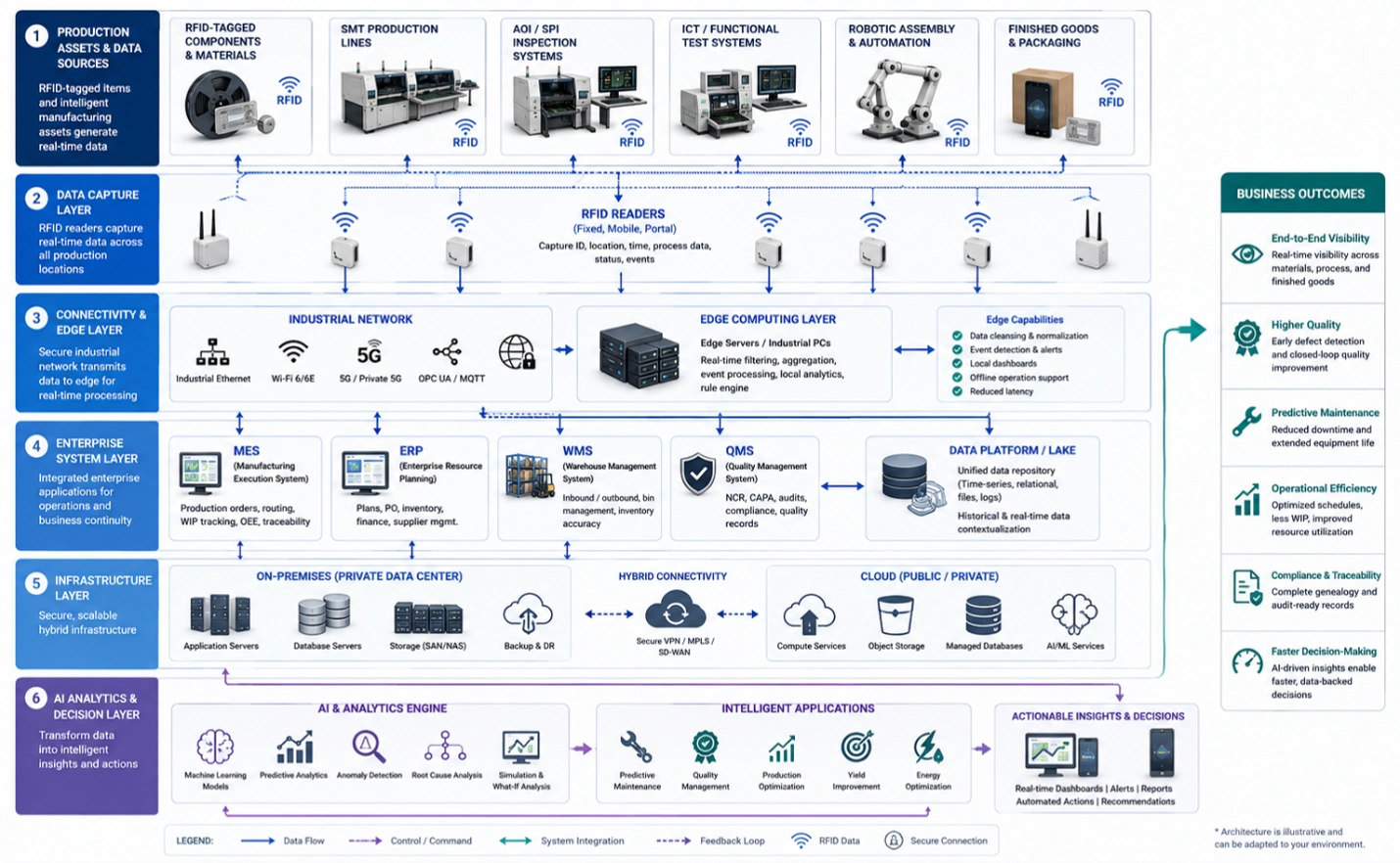
Deployment Models, AI Software, RFID Infrastructure, and Security for Consumer Electronics Manufacturing
Selecting the appropriate deployment model is a strategic decision for consumer electronics manufacturers because production environments vary significantly in operational scale, cybersecurity requirements, latency expectations, and IT governance. High-volume factories producing smartphones, laptops, wearables, gaming devices, networking equipment, and smart home products require AI systems that process manufacturing data efficiently while integrating with RFID infrastructure, industrial automation, and enterprise software.
GAO has supported manufacturers by providing RFID hardware and industrial identification solutions that integrate with both cloud-hosted and privately managed manufacturing software, allowing organizations to adopt AI capabilities while preserving existing production investments.
Cloud Deployment for Distributed Manufacturing Operations
A cloud-hosted deployment is well suited for organizations operating multiple manufacturing facilities, regional distribution centers, contract manufacturing partners, or global supply chains. RFID readers continuously collect identification events from production assets and securely transmit them to cloud-hosted AI software for analysis.
Typical cloud-hosted capabilities include:
- Enterprise-wide production visibility across multiple factories
- Centralized inventory and warehouse monitoring
- AI-based demand forecasting
- Global supplier performance analytics
- Predictive quality monitoring across manufacturing sites
- Centralized dashboard reporting for executives and operations managers
- Automatic software updates and AI model improvements
- Scalable computing resources for high-volume production data
Cloud deployment allows engineering teams to compare production performance across facilities, identify recurring manufacturing issues, and standardize quality management practices without maintaining extensive computing infrastructure at every location.
Cloud-hosted AI is particularly beneficial for organizations that manufacture consumer electronics through geographically distributed production networks or outsource assembly to Electronics Manufacturing Services (EMS) providers.
Server Deployment for Low-Latency Factory Operations
Many consumer electronics manufacturers prefer privately managed server deployments because production decisions often require deterministic response times, local control of intellectual property, and compliance with internal cybersecurity policies.
Server deployments may operate on:
- Factory edge servers
- Private data centers
- Manufacturing control rooms
- Regional enterprise servers
- Customer-managed virtualization environments
Instead of transmitting every RFID event to the cloud, manufacturing data is processed locally, enabling AI to respond within milliseconds.
Common server-based AI applications include:
- Real-time production validation
- Automated routing decisions
- Machine vision inference
- Defect detection during assembly
- Robotic process coordination
- Production line balancing
- Tool verification
- Automated quality control
- Manufacturing execution synchronization
Local processing also minimizes dependency on external network connectivity while ensuring production continues during temporary internet disruptions.
Organizations producing proprietary semiconductor assemblies, confidential electronic products, or government-related electronics frequently choose privately managed deployments to maintain greater control over manufacturing information.
Hybrid Deployment Strategies
Many consumer electronics manufacturers combine cloud and privately managed server deployments to balance operational performance with enterprise-wide visibility.
A hybrid deployment commonly operates as follows:
- RFID readers capture identification events throughout production.
- Edge servers validate production activities and execute time-sensitive AI inference.
- MES software coordinates manufacturing operations.
- ERP software manages procurement, inventory, and production planning.
- Aggregated manufacturing data is synchronized with cloud analytics for long-term reporting, forecasting, and executive decision support.
This approach allows factories to achieve low-latency operational control while benefiting from centralized AI insights across multiple production sites.
AI Models Supporting Consumer Electronics Manufacturing
AI solutions for consumer electronics manufacturing rely on multiple analytical techniques rather than a single algorithm. Different AI models address distinct operational challenges, from production scheduling to defect prediction and inventory optimization.
Machine Learning
Machine learning analyzes historical production data to identify patterns that improve manufacturing efficiency. Typical applications include:
- Production throughput forecasting
- Inventory demand prediction
- Supplier performance evaluation
- Equipment utilization analysis
- Production scheduling optimization
- Manufacturing cost forecasting
Deep Learning
Deep learning models process large and complex datasets generated during electronics manufacturing, particularly images captured by inspection systems.
Common applications include:
- Automated Optical Inspection (AOI)
- X-ray inspection analysis
- Solder joint evaluation
- PCB defect classification
- Display panel inspection
- Cosmetic defect detection
These models continuously improve inspection accuracy by learning from validated production outcomes.
Computer Vision
Computer vision enables automated visual inspection of products and manufacturing processes. When combined with RFID-generated product identity, inspection results are permanently linked to individual products, production batches, operators, and equipment.
Typical applications include:
- Missing component detection
- Incorrect component placement
- Connector verification
- Label inspection
- Packaging validation
- Barcode and RFID verification
- Assembly completeness checks
Predictive Analytics
Predictive analytics combines RFID data with production histories to forecast future manufacturing conditions.
Examples include:
- Component shortage prediction
- Maintenance scheduling
- Yield forecasting
- Quality trend analysis
- Production bottleneck prediction
- Warranty risk estimation
Anomaly Detection
Manufacturing operations generate thousands of normal production events every minute. AI-based anomaly detection identifies unusual behavior that may indicate quality issues, equipment degradation, cybersecurity events, or operational errors before they escalate into production disruptions.
RFID Hardware, Enterprise Software, Communication Protocols, and Supporting Infrastructure
An AI-enabled consumer electronics manufacturing solution depends on coordinated interaction between industrial hardware, enterprise software, and secure communication technologies.
RFID Infrastructure
Typical RFID hardware includes:
- Fixed UHF RFID readers at warehouse portals, conveyor systems, and shipping docks
- HF RFID readers at production workstations and tooling stations
- Passive RFID tags for pallets, reusable containers, PCB carriers, production fixtures, and finished products
- Industrial RFID antennas optimized for manufacturing environments
- Handheld RFID readers for inventory audits, maintenance, and exception handling
This infrastructure provides continuous visibility of materials, work-in-progress assemblies, production assets, and finished goods throughout the manufacturing lifecycle.
Enterprise Software Integration
AI solutions derive greater value when integrated with existing manufacturing software. Common integrations include:
- Manufacturing Execution Systems (MES)
- Enterprise Resource Planning (ERP)
- Warehouse Management Systems (WMS)
- Product Lifecycle Management (PLM)
- Quality Management Systems (QMS)
- Computerized Maintenance Management Systems (CMMS)
- Supply Chain Management (SCM) software
- Business Intelligence (BI) reporting tools
Integration enables AI to evaluate production data within its broader operational context rather than analyzing isolated RFID events.
Communication Technologies
Reliable communication ensures timely exchange of manufacturing information between RFID infrastructure, industrial equipment, and AI software.
Common communication technologies include:
- OPC UA
- MQTT
- Modbus TCP
- Ethernet/IP
- PROFINET
- REST APIs
- HTTPS
- Wi-Fi 6
- Private 5G
- Industrial Ethernet
These technologies support interoperability while enabling secure communication across manufacturing environments.
Cybersecurity and Data Protection
Consumer electronics manufacturers manage valuable intellectual property, proprietary product designs, firmware, and sensitive production information. AI-enabled RFID systems should therefore incorporate robust cybersecurity controls, including:
- Multi-factor authentication (MFA) for administrative access
- Role-based access control (RBAC) to restrict user permissions
- TLS encryption for data transmitted between RFID devices, servers, and enterprise software
- Secure firmware updates and device authentication for RFID infrastructure
- Network segmentation separating production systems from corporate IT networks
- Continuous audit logging to support traceability and regulatory compliance
- Security monitoring to detect unauthorized access or anomalous device behavior
- Regular vulnerability assessments and patch management for servers, edge devices, and connected equipment
These measures help safeguard manufacturing operations while maintaining data integrity, availability, and confidentiality.
AI-Enabled RFID Architecture for Consumer Electronics Manufacturing: Edge Computing, Enterprise Systems, and Secure Data Flow
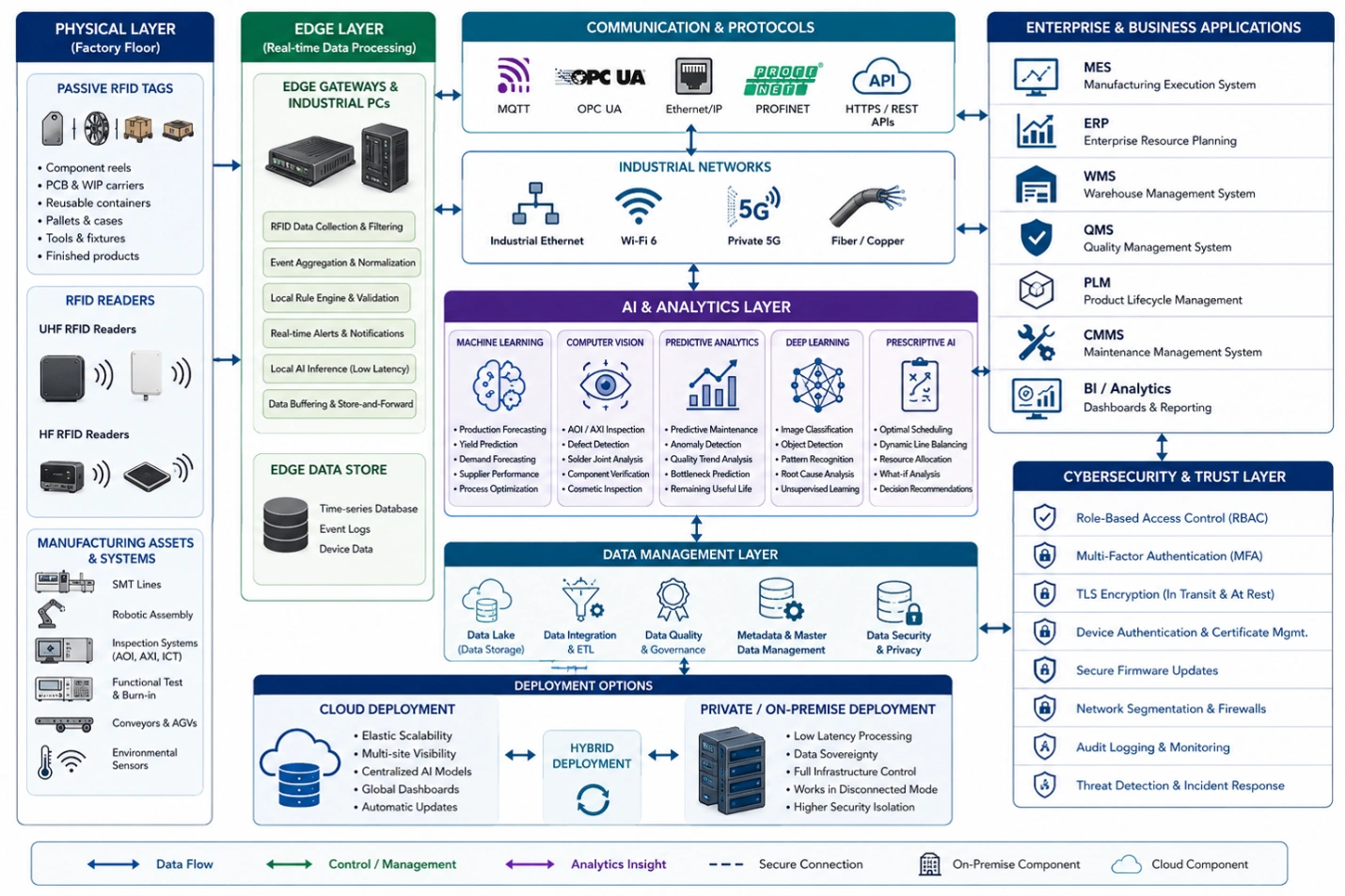
Key Technical Capabilities and Business Benefits of AI-Enabled Consumer Electronics Manufacturing
AI-powered manufacturing supported by RFID delivers measurable operational improvements across consumer electronics production by combining continuous asset visibility with intelligent data analysis. Instead of relying on reactive decision-making, manufacturers can optimize production using predictive insights derived from real-time manufacturing data.
End-to-End Product Traceability
RFID enables every component, work-in-progress assembly, production fixture, and finished product to maintain a unique digital identity throughout manufacturing. AI correlates these identification events with production history, inspection results, firmware versions, equipment utilization, and operator activities.
Benefits include:
- Complete product genealogy from incoming materials to customer shipment
- Faster root cause analysis during quality investigations
- Improved product recall management
- Enhanced warranty verification
- Better counterfeit prevention
- Increased regulatory and customer compliance
Improved Manufacturing Quality
AI continuously analyzes RFID data alongside inspection images, electrical test results, process parameters, and production histories to identify conditions associated with defects.
Operational improvements include:
- Higher first-pass yield
- Reduced scrap and rework
- Earlier detection of process drift
- More consistent assembly quality
- Faster corrective actions
- Continuous process improvement through data-driven insights
Smarter Inventory and Warehouse Management
RFID provides accurate, automated visibility of electronic components, reels, trays, pallets, returnable containers, and finished products. AI converts this information into inventory intelligence that supports production planning and supply chain optimization.
Business value includes:
- Reduced inventory discrepancies
- Improved inventory turnover
- Lower carrying costs
- Better material availability
- Fewer production interruptions caused by component shortages
- Improved warehouse utilization
Higher Equipment Availability
Manufacturing equipment represents a significant capital investment. AI evaluates RFID-based asset utilization together with operational and maintenance data to predict service requirements before failures occur.
Expected benefits include:
- Reduced unplanned downtime
- Improved Overall Equipment Effectiveness (OEE)
- Longer equipment service life
- Better maintenance scheduling
- More efficient spare parts management
- Increased production throughput
Faster Engineering Change Management
Consumer electronics products evolve rapidly, requiring frequent Engineering Change Orders (ECOs). RFID verifies that the correct materials, firmware versions, and work instructions are associated with each product variant, while AI monitors compliance throughout production.
This reduces:
- Incorrect component installation
- Production delays
- Rework caused by outdated processes
- Configuration errors
- Product launch risks
Better Executive Decision Support
AI transforms operational manufacturing data into actionable business intelligence by generating dashboards, forecasts, and performance analytics.
Decision-makers gain visibility into:
- Production efficiency
- Yield performance
- Supplier quality
- Inventory trends
- Equipment utilization
- Capacity planning
- Manufacturing costs
- Delivery performance
These insights support strategic planning while improving day-to-day factory operations.
Engineering Best Practices and Implementation Recommendations
Successful implementation of AI-enabled RFID solutions requires careful planning that aligns technology deployment with operational objectives. Consumer electronics manufacturers should adopt a phased approach that minimizes operational disruption while maximizing return on investment.
Recommended engineering practices include:
- Conduct a comprehensive assessment of production workflows, identifying areas where RFID data can enhance AI-driven decision-making.
- Define measurable Key Performance Indicators (KPIs) such as Overall Equipment Effectiveness (OEE), First Pass Yield (FPY), inventory accuracy, production cycle time, equipment availability, defect rates, and on-time delivery performance.
- Standardize RFID tag selection, reader placement, and antenna configurations to ensure reliable data capture across warehouses, SMT lines, testing stations, packaging areas, and distribution operations.
- Integrate RFID infrastructure with existing MES, ERP, WMS, PLM, QMS, and CMMS software to create a unified manufacturing information environment.
- Begin AI deployment with high-value use cases such as predictive maintenance, intelligent inventory management, quality inspection, and production scheduling before expanding to additional manufacturing processes.
- Establish data governance policies that ensure data quality, consistency, traceability, retention, and security.
- Implement cybersecurity controls including role-based access control, encryption, secure device management, network segmentation, and continuous monitoring.
- Continuously validate AI models using updated production data to maintain prediction accuracy as products, components, and manufacturing processes evolve.
- Provide cross-functional training for production operators, quality engineers, maintenance teams, IT personnel, and management to encourage successful adoption of AI-assisted manufacturing workflows.
Drawing on decades of experience supporting organizations throughout North America, GAO provides RFID hardware and technical expertise that help manufacturers implement reliable identification systems that integrate with modern AI-enabled manufacturing software.
AI-Enabled RFID Deployment Decision Tree for Consumer Electronics Manufacturing
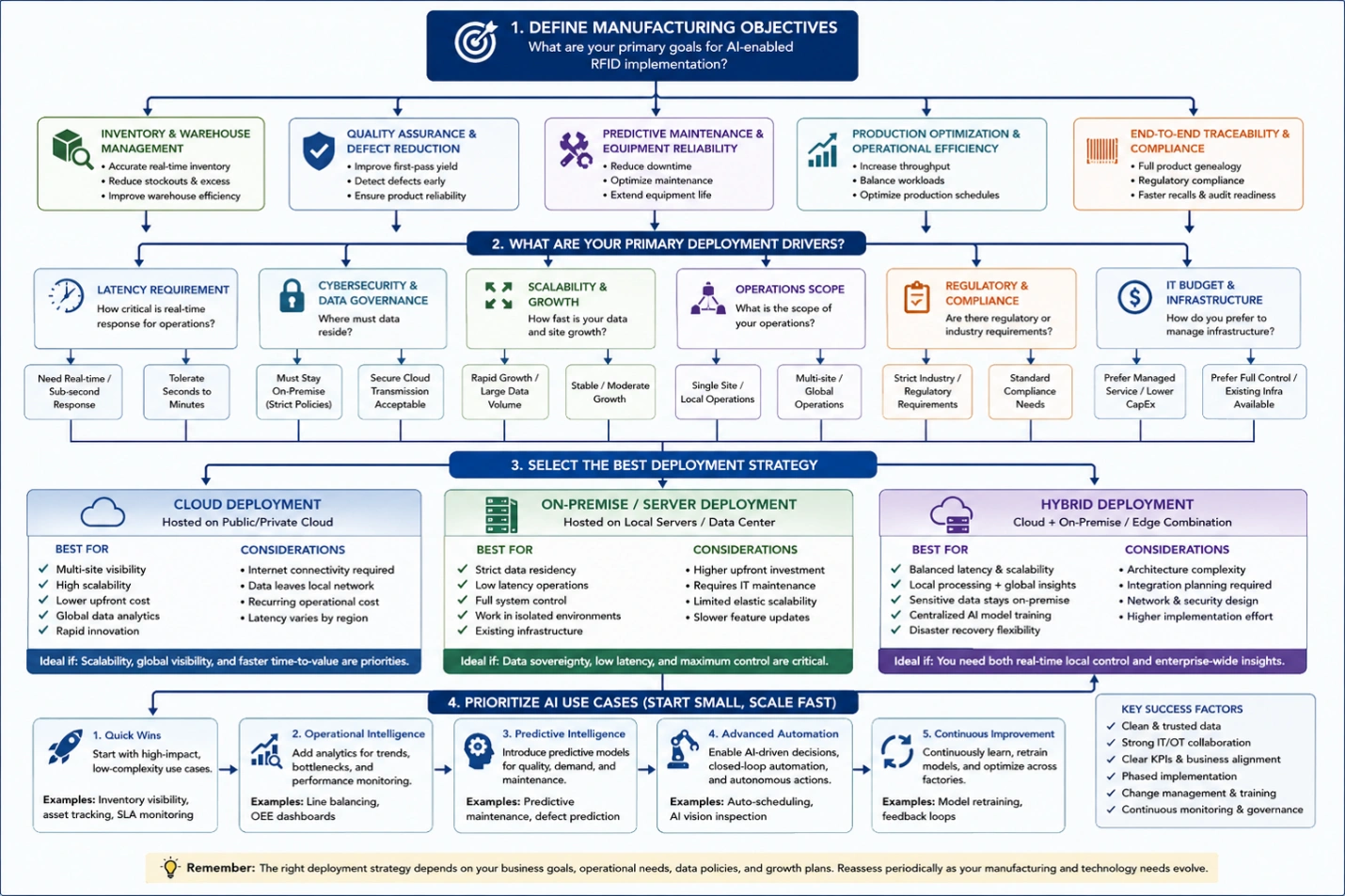
Advancing Consumer Electronics Manufacturing with AI-Enabled RFID Solutions
Consumer electronics manufacturing continues to demand higher product quality, shorter development cycles, resilient supply chains, and greater operational efficiency. AI supported by RFID enables manufacturers to move beyond basic identification and automation toward intelligent manufacturing systems capable of predictive analysis, adaptive production optimization, and comprehensive product traceability.
By integrating RFID data with AI, machine vision, enterprise software, and industrial communication technologies, manufacturers can improve inventory accuracy, reduce defects, optimize equipment utilization, strengthen quality management, and enhance decision-making across the entire production lifecycle.
Headquartered in New York City and Toronto, GAO is recognized among the world’s leading B2B suppliers of RFID and BLE technologies. For more than three decades, we have supported Fortune 500 companies, leading research organizations, universities, and government agencies across the United States and Canada through sustained investment in research and development, rigorous quality assurance processes, and expert technical support delivered remotely and onsite. Our experience enables organizations to deploy RFID-based identification systems that form a reliable foundation for AI-driven consumer electronics manufacturing initiatives.
Building the Future of Industrial AI and IoT with Aperture Venture Studio and GAO
For more than three decades, GAO Group of Companies has invested extensively in research and development of industrial RFID, BLE, and IoT technologies. As generative AI has demonstrated increasing value in manufacturing, we have expanded our development of AI-enabled IoT solutions, combining RFID, BLE, edge intelligence, and advanced analytics to address the evolving needs of consumer electronics manufacturing.
Through Aperture Venture Studio , we continue to accelerate the advancement of AI and IoT technologies that support intelligent manufacturing, industrial automation, and digital transformation across a wide range of industries. Aperture has attracted experienced AI and IoT technical experts, entrepreneurial and operational leaders, influential investors, and leading technology organizations committed to advancing industrial innovation.
Our initiatives also include the Aperture Ventures Summit and TekSummit, where industry professionals discuss emerging developments in artificial intelligence, RFID, IoT, industrial automation, edge computing, and smart manufacturing. These collaborative efforts have fostered diverse technical communities that encourage knowledge sharing and practical engineering innovation.
We welcome you to connect with us as:
- Advisors, co-founders, or employees
- Investors
- Customers seeking advanced AI, RFID, BLE, and IoT solutions
Together, we can help shape the future of intelligent consumer electronics manufacturing through practical, reliable, and scalable AI-enabled industrial technologies.