
AI and RFID for Gene Therapy
AI and RFID for Gene Therapy
AI-enabled gene therapy operations increasingly depend on accurate identification, traceability, process data, and timely decisions across research, manufacturing, quality control, clinical logistics, and long-term product management. RFID provides automated identification and location data for materials, samples, containers, equipment, and other physical assets, while AI can correlate those events with laboratory, manufacturing, environmental, and quality data. The result is a more complete operational view of gene therapy workflows, from vector and plasmid materials through cell processing, cryogenic storage, release, shipment, and administration.
For gene therapy organizations, the value is not simply replacing barcode scans. AI can identify abnormal workflow patterns, predict inventory or equipment issues, support chain-of-custody verification, and prioritize operational exceptions. RFID can supply the physical event data required for those models. Together, these technologies support more controlled, auditable, and data-driven gene therapy operations while complementing existing LIMS, MES, QMS, ELN, WMS, ERP, and cold-chain systems.
AI-Enabled RFID Gene Therapy Lifecycle from Raw Materials to Patient Follow-Up
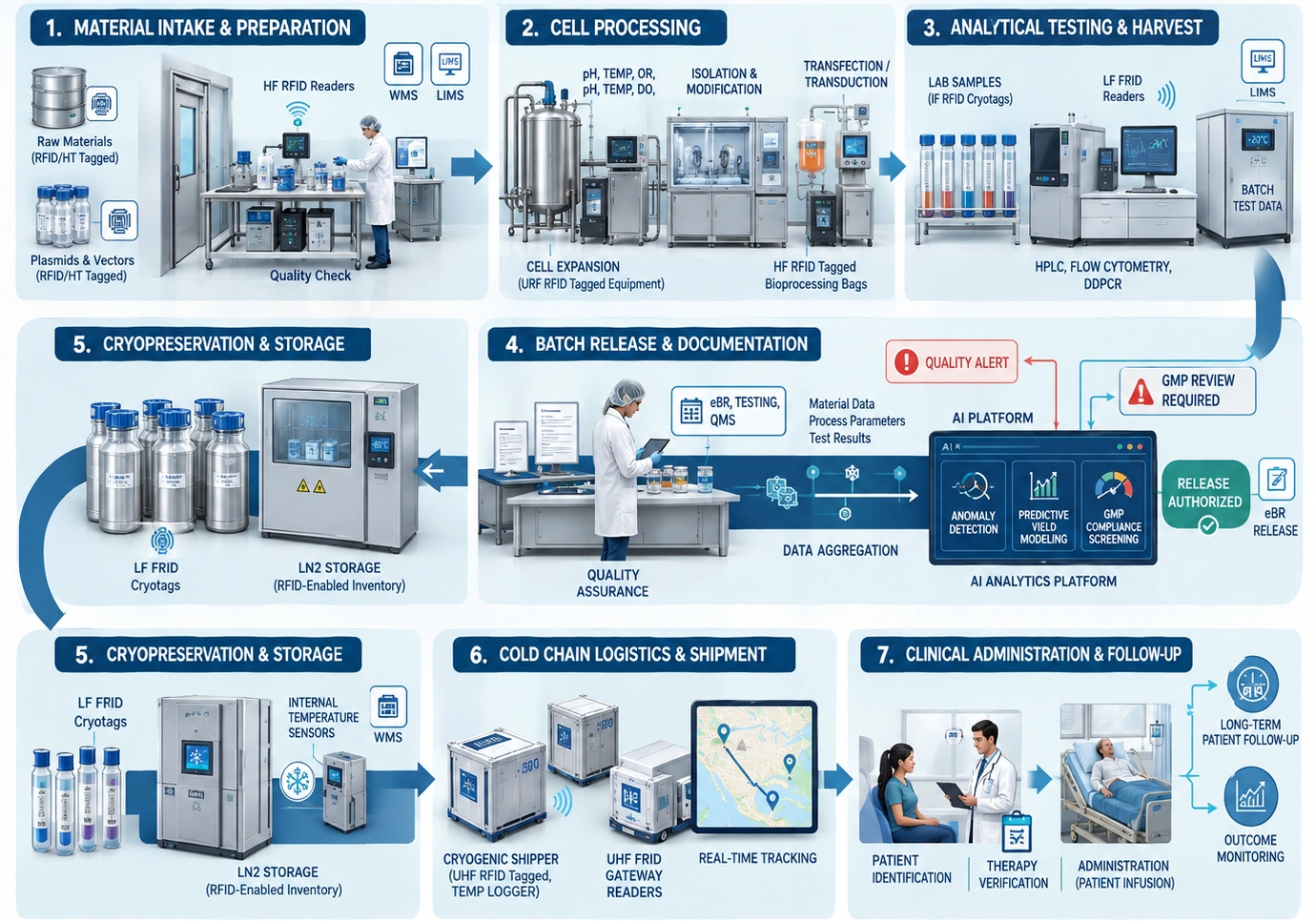
This end-to-end infographic illustrates the complex gene therapy lifecycle, from raw material intake to patient follow-up. It details how diverse RFID technologies—UHF for bulk logistics, HF for process materials, and LF for cryovials—seamlessly integrate with core biopharmaceutical systems like LIMS, MES, and QMS. A central AI analytics platform aggregates data across the ecosystem, highlighting human decision points and how intelligent monitoring and alerts optimize production, support regulatory compliance, and secure the cold chain.
What AI and RFID Mean for Gene Therapy Operations
Gene therapy differs from conventional pharmaceutical manufacturing because the identity and condition of biological materials can remain tightly connected to the manufacturing process. Autologous cell therapies can introduce patient-specific material into manufacturing workflows, while viral vectors, plasmids, nucleic acids, media, reagents, single-use assemblies, cryogenic containers, and intermediate materials may move through controlled processing steps. A tracking failure can therefore become more than an inventory discrepancy. It can affect chain of identity, chain of custody, batch genealogy, quality investigations, scheduling, or product disposition.
AI and IoT, commonly called AIoT, combines artificial intelligence with connected devices, sensors, equipment, and industrial systems. For gene therapy, AIoT can connect physical observations with laboratory and manufacturing information. RFID contributes automated identification events, while other sensors can provide temperature, humidity, equipment state, location, vibration, or environmental information. AI models can then evaluate these data streams against validated business rules and operational objectives.
FDA guidance emphasizes that gene therapy CMC information must support product safety, identity, quality, purity, and strength, including potency. More recent FDA guidance also addresses specific considerations for genome-editing products, including product design, manufacturing, testing, nonclinical safety, and clinical development.
This makes reliable operational data important throughout the gene therapy lifecycle. RFID does not determine whether a therapeutic product is safe or potent. Instead, it can strengthen the identification and traceability layer that supports the processes used to manufacture, test, store, transfer, and manage those products.
Gene Therapy Workflows Where AI Creates Operational Value
Material and Reagent Traceability
Gene therapy manufacturing can involve plasmids, viral-vector components, media, buffers, enzymes, nucleic acids, reagents, single-use assemblies, filters, bags, tubing, and other controlled materials. RFID identification can associate physical items with material numbers, lot numbers, expiration dates, storage requirements, and approved-use status.
AI can analyze consumption history and manufacturing schedules to identify unusual material usage, potential shortages, expiration exposure, or deviations from expected process patterns. The objective is not to let an AI model independently release material. Instead, AI can prioritize exceptions for qualified personnel.
Chain of Identity and Chain of Custody
Autologous workflows require particularly strong control over the relationship between patient-derived starting material and the resulting therapeutic product. RFID can provide automated identification events at controlled transfer points, while scanners, readers, electronic signatures, and workflow software can create supporting records.
AI can compare expected process sequences against observed events. For example, a system may identify an unexpected movement, missing scan event, unusual processing interval, or mismatch between a scheduled work order and a physical container. Such alerts can trigger human investigation before the material advances to another process stage.
Cell Processing and Manufacturing
Gene-modified cells may pass through collection, receipt, processing, activation, transduction or gene-editing steps, expansion, harvesting, formulation, filling, cryopreservation, and storage. The exact process varies by therapy.
RFID can associate process containers, equipment, tools, consumables, and intermediate materials with manufacturing records. AI can combine these events with MES data, equipment parameters, environmental observations, and laboratory results to detect process patterns.
For example, an AI model may identify that particular equipment conditions, processing durations, material lots, or environmental variables correlate with an elevated probability of an investigation. Such analysis should support qualified process monitoring and continuous improvement rather than replace validated release testing.
Cryogenic Storage and Controlled Logistics
Cryopreserved gene therapy materials can require controlled storage and transportation conditions. RFID can identify cryogenic racks, boxes, canisters, shipping containers, and individual tagged items where the tag and reader design are suitable for the physical environment.
AI can combine RFID location events with temperature-monitoring data and shipment information. The system can identify unexpected dwell times, missing handoffs, repeated access events, or deviations from expected movement patterns.
Quality Control and Laboratory Traceability
Laboratories supporting gene therapy may perform identity, purity, potency, sterility, microbial, vector, genomic, cellular, and other analytical testing depending on the product and development stage.
AI can help correlate sample metadata, analytical results, instrument information, process history, and material genealogy. RFID can reduce manual identification steps for compatible sample containers, racks, instruments, and laboratory assets.
The strongest implementation approach treats RFID as one source of trusted event data rather than as a replacement for LIMS controls, laboratory procedures, validated analytical methods, or quality review.
Gene Therapy AI Use Cases Supported by Physical Traceability
AI applications become more useful when models receive reliable operational data. Relevant use cases include:
- AI-assisted material demand forecasting based on manufacturing schedules, historical consumption, lead times, and expiration windows.
- AI inventory risk detection for critical vectors, reagents, single-use components, and controlled materials.
- AI exception detection for unexpected material movements or missing workflow events.
- AI-assisted batch genealogy analysis connecting materials, equipment, operators, process steps, and analytical results.
- AI-driven cold-chain anomaly detection using RFID location events and environmental sensor data.
- AI-assisted equipment utilization analysis for cell-processing equipment, freezers, incubators, centrifuges, bioreactors, and other controlled assets.
- AI maintenance prediction using equipment telemetry, operating cycles, alarms, and service history.
- AI-assisted deviation investigation by correlating process events, equipment history, material lots, and environmental conditions.
- AI scheduling support for constrained manufacturing resources and specialized laboratory equipment.
- AI-assisted laboratory asset utilization analysis for instruments, sample-management equipment, and controlled storage.
- AI-based detection of unusual dwell times between gene therapy manufacturing steps.
- AI-assisted logistics monitoring for temperature-sensitive and time-sensitive therapeutic materials.
The most practical systems use AI to prioritize decisions rather than automate regulated decisions without appropriate validation, oversight, and change control.
Gene Therapy Data Flow From Physical Event to AI Decision
A practical AI and RFID implementation can be understood as a sequence of connected operational layers.
Data Acquisition
RFID readers capture tag identifiers when materials, containers, equipment, or assets pass through designated checkpoints. Depending on the application, UHF RFID may support longer-range identification, HF RFID may support shorter-range controlled interactions, and LF RFID may be considered for specialized low-frequency identification environments.
Other data sources can include temperature sensors, freezer monitoring, equipment controllers, environmental monitoring systems, laboratory instruments, MES transactions, LIMS records, QMS events, ERP data, WMS records, and electronic batch records.
Edge Processing and Event Filtering
Reader middleware can filter duplicate reads, normalize identifiers, associate readers with physical locations, and transform raw RFID observations into meaningful events. This is important because an RFID reader can detect the same tag multiple times while a container remains in a read zone.
A useful event might therefore be expressed as a controlled movement such as:
Material ID → Location → Timestamp → Workflow Step → Authorized Event
rather than storing every raw radio observation as a business transaction.
Middleware and Enterprise Integration
The normalized event stream can be integrated with LIMS, MES, QMS, ERP, WMS, ELN, laboratory systems, CMMS, and other software. APIs, message brokers, database interfaces, OPC UA where appropriate, and other integration methods can connect physical identification events with existing software.
For regulated gene therapy environments, integration design should preserve auditability, data integrity, access controls, system validation requirements, and appropriate electronic-record controls.
FDA’s Part 11 guidance addresses electronic records and electronic signatures when regulated records are maintained or submitted electronically, including considerations such as validation, audit trails, record retention, and electronic signatures.
AI Processing
AI services can operate on historical and real-time data depending on the use case. Machine learning models can identify patterns in inventory, manufacturing, equipment, logistics, and quality-related data. Computer vision may complement RFID in controlled visual inspection or asset verification applications. Edge AI can be used when low latency or local processing is important.
AI outputs should be traceable to source data and presented with appropriate confidence, thresholds, business rules, and escalation paths. For regulated workflows, model governance should include version control, validation where applicable, change management, access controls, and documented human oversight.
Operational Decision and Action
The final stage converts an analytical result into an operational action. Examples include requesting a material review, escalating a potential temperature excursion, scheduling maintenance, checking an unexpected container movement, initiating an inventory investigation, or notifying a quality team.
The human workflow remains essential. AI can identify and prioritize exceptions, but qualified personnel and established procedures determine the appropriate regulated response.
RFID Hardware and Software for Gene Therapy Environments
RFID selection should follow the physical and operational characteristics of the gene therapy workflow rather than beginning with a generic reader specification.
UHF RFID is useful where multiple tagged items must be identified over a controlled area, such as material staging, inventory zones, equipment tracking, storage areas, and logistics checkpoints. Reader antenna placement, tag orientation, liquid content, metal surfaces, packaging, read-zone boundaries, and interference must be evaluated through site testing.
HF RFID is useful for shorter-range controlled interactions where deliberate tag presentation is desirable. It can be appropriate for certain laboratory identification, controlled access points, and item-level interactions where the read distance is intentionally constrained.
LF RFID operates at lower frequencies and can be relevant to specialized identification applications where its physical characteristics match the operating environment. It is generally not selected simply because it is RFID. The application, materials, read distance, tag form factor, and integration requirements should determine the frequency technology.
Relevant hardware can include:
- Fixed RFID readers at controlled doors, staging areas, storage entrances, and manufacturing checkpoints.
- RFID antennas designed around the geometry and materials of the read zone.
- Handheld RFID readers for inventory verification, cycle counts, and exception investigation.
- RFID tags designed for plastic containers, packaging, equipment, racks, cases, and other compatible assets.
- Industrial or laboratory-grade edge computers and gateways.
- Temperature and environmental sensors for cold-chain and storage monitoring.
- Network infrastructure supporting Ethernet, Wi-Fi, or other approved communication methods.
- Local displays or operator terminals for workflow confirmation.
- Server or cloud resources for event processing, data storage, analytics, and AI services.
The software layer may include RFID reader management, device monitoring, event filtering, tag-to-asset association, workflow rules, API integration, dashboards, alerting, analytics, and AI services.
GAO supplies RFID, BLE, and IoT hardware products and systems that can be incorporated into applications requiring automated identification, asset visibility, location awareness, and connected operational data. Gene therapy deployment should still begin with application engineering, site assessment, validation requirements, and integration specifications rather than simply selecting hardware from a catalog.
Cloud Version and Server Version for Gene Therapy AI Systems
A cloud-hosted SaaS deployment can be appropriate when geographically distributed operations need centralized analytics, remote monitoring, scalable computing, or consolidated operational reporting. Cloud deployment can also simplify access to computational resources for AI workloads, subject to the organization’s data governance, security, validation, and regulatory requirements.
A privately hosted Server Version can be more appropriate where the organization requires direct control over infrastructure, network segmentation, data residency, latency, integration with internal systems, or restricted laboratory and manufacturing networks. Server deployment can use customer-managed servers, private data centers, edge servers, factory or laboratory servers, or other privately hosted infrastructure.
A hybrid arrangement can also be practical. RFID event processing may occur locally to maintain operational continuity, while selected datasets are transferred to centralized analytics or AI services. The design should define which records remain local, which information is replicated, how connectivity interruptions are handled, and how synchronization conflicts are resolved.
For either deployment model, engineering teams should address:
- Identity and access management.
- Role-based permissions.
- Encryption in transit and at rest where appropriate.
- Network segmentation.
- Device authentication.
- Secure RFID reader configuration.
- Audit logging.
- Backup and recovery.
- Software and firmware change control.
- System validation and qualification requirements.
- Data retention and archival policies.
- AI model versioning and monitoring.
- Disaster recovery and business continuity.
- Controlled interfaces with LIMS, MES, QMS, ERP, WMS, and other validated systems.
Real-Time Asset Intelligence: Integrated RFID Deployment in a Gene Therapy Facility
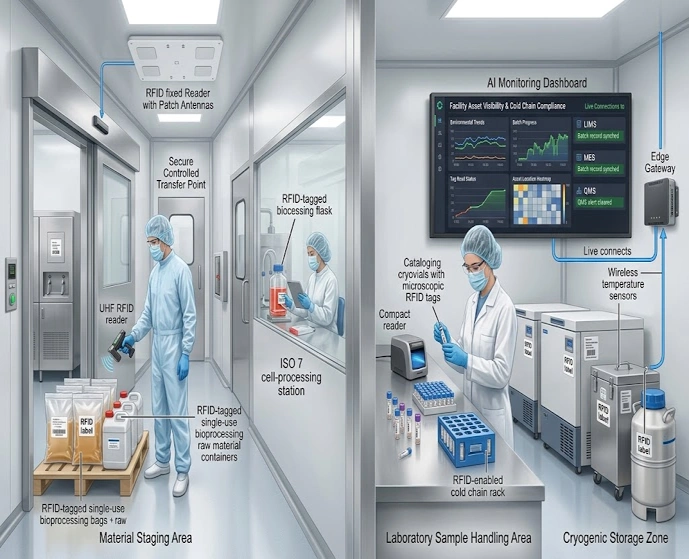
A photorealistic diagram illustrating a gene therapy facility where RFID hardware seamlessly integrates physical assets—from material staging and cell processing to cryo-storage—with a digital ecosystem of LIMS, MES, QMS, and an AI monitoring dashboard for total visibility.
Engineering Considerations for AI and RFID Gene Therapy Deployment
The physical environment is a major determinant of RFID performance. Gene therapy facilities can contain stainless-steel equipment, liquid-filled containers, freezers, cryogenic storage systems, cleanroom barriers, insulated packaging, and dense laboratory work areas. These conditions can alter radio-frequency performance and create unwanted reads if reader zones are not engineered carefully.
A pilot should therefore measure actual read performance using representative containers, tags, packaging, equipment, and environmental conditions. Test plans should include read accuracy, missed reads, duplicate events, false reads, read-zone containment, tag placement, operator workflow, network behavior, and recovery from reader or network failures.
AI deployment requires a similar discipline. Models should be trained or configured against representative operational data, evaluated for false positives and false negatives, monitored after deployment, and connected to clear operational responses. A technically impressive model that produces too many irrelevant alerts can create alert fatigue and reduce trust among manufacturing and quality personnel.
Gene therapy organizations should also distinguish between operational analytics and regulated decision-making. An AI model may be highly useful for identifying unusual inventory movement or predicting equipment maintenance requirements without becoming the system that independently determines product release or patient suitability.
GAO’s experience supplying connected identification and IoT systems can support the hardware, integration, and deployment engineering required to connect physical gene therapy operations with software-based monitoring and analytics. The appropriate implementation remains dependent on the facility’s validated processes, risk assessment, network design, quality system, and intended use.
AI-Driven Capabilities for Gene Therapy Operations
Combining AI with automated identification and connected sensing can improve visibility across gene therapy workflows without changing the underlying GMP responsibilities of manufacturing and quality teams. The greatest value comes from correlating physical events with process, laboratory, equipment, and environmental information.
Intelligent Traceability and Genealogy
A gene therapy system can associate material identifiers, containers, equipment, locations, process steps, and timestamps to create a more complete digital record of material movement. AI can analyze this event history to identify missing transitions, unexpected movement sequences, abnormal dwell times, or relationships between material lots and manufacturing events.
This is particularly useful when investigating deviations. Instead of manually reconstructing a material’s movement from disconnected records, investigators can use correlated RFID events and enterprise-system records as supporting evidence.
AI Inventory Management for Gene Therapy Materials
Inventory management becomes more difficult when materials have different storage requirements, expiration dates, lot controls, and manufacturing allocations. AI can analyze consumption patterns and production schedules to forecast requirements while RFID provides automated identification of physical inventory.
Potential outputs include:
- Expiration-risk alerts for controlled reagents and consumables.
- Predicted shortages of manufacturing-critical materials.
- Identification of inventory that has remained outside an expected location.
- Material utilization trends by manufacturing campaign.
- Detection of discrepancies between recorded and physically observed inventory.
- Prioritization of cycle counts and inventory investigations.
The objective is to reduce manual reconciliation while preserving existing material-release and inventory-control procedures.
Predictive Maintenance for Gene Therapy Equipment
Cell-processing and laboratory environments rely on specialized equipment such as centrifuges, incubators, freezers, bioreactors, filling equipment, analytical instruments, and environmental monitoring devices.
AI can analyze equipment operating hours, alarm history, maintenance records, temperature behavior, vibration measurements where available, and utilization patterns. RFID can identify the physical equipment and associate it with its service history and location.
This can help maintenance teams move from purely calendar-based intervention toward risk-informed maintenance scheduling, where appropriate.
AI-Assisted Exception Management
A practical AI system should reduce the time required to identify important exceptions rather than generate large volumes of notifications.
For example, a rules-and-AI system could combine:
RFID Movement + Location + Time + Material Status + Manufacturing Step + Environmental Data
to determine whether an event deserves investigation.
A missing movement event may be insignificant in one context and highly important in another. Context-aware analytics can therefore provide greater value than simple RFID alerts.
Gene Therapy Deployment Lifecycle
Successful implementation requires more than installing RFID readers. The physical identification system, AI software, integration interfaces, operating procedures, and quality controls should be designed as one coordinated solution.
Requirements and Risk Assessment
The project should begin by defining the intended use and identifying the gene therapy workflows where automated data capture provides measurable value.
Important questions include:
- Which materials, containers, samples, equipment, or locations require identification?
- Which events currently depend on manual scanning or documentation?
- Which workflow errors have the greatest operational or quality impact?
- Which systems contain the authoritative record for each data element?
- Which areas require controlled RFID read zones?
- Which processes operate inside classified or controlled environments?
- Which records are subject to quality-system or regulatory requirements?
- Which AI outputs are advisory and which could affect regulated processes?
A risk assessment should consider misidentification, missed reads, duplicate reads, unauthorized movement, network interruption, sensor failure, data synchronization problems, and incorrect AI alerts.
RFID Site Survey and Hardware Selection
A site survey should evaluate room geometry, construction materials, metal surfaces, liquid-filled containers, packaging, shelving, doors, freezers, cleanroom boundaries, and network availability.
Representative tags should be tested against the actual materials they will identify. Laboratory containers and packaging can behave differently from dry cardboard or plastic test objects commonly used during demonstrations.
The objective is not maximum read range. Controlled read zones are generally more valuable than excessive range because unintended reads can create inaccurate workflow events.
Commissioning and Integration
Commissioning should verify reader placement, antenna orientation, tag readability, event filtering, network connectivity, time synchronization, software interfaces, and failure recovery.
Integration testing should verify that an RFID event creates the expected software transaction without corrupting existing records.
Interfaces to LIMS, MES, QMS, ERP, WMS, ELN, CMMS, and environmental monitoring systems should be tested according to their intended use and applicable validation procedures.
Qualification, Validation, and Change Control
Whether an AI or RFID system falls under formal computerized-system validation depends on its intended use and the records or decisions it supports.
The organization should establish appropriate requirements, risk assessment, testing, qualification or validation activities, traceability, access control, audit trails, change management, backup procedures, and operational monitoring.
AI adds another consideration: model changes can alter system behavior even when the underlying software infrastructure remains unchanged. Organizations should therefore establish a controlled process for model updates, performance monitoring, data-quality review, and rollback.
Training and Operational Adoption
Operators should understand what RFID events mean, how exceptions are handled, and what to do when identification fails.
A robust fallback procedure is important. If a reader, network connection, tag, or gateway fails, the workflow should provide a controlled alternative rather than encouraging operators to bypass the identification process.
Cybersecurity and Data Integrity for Gene Therapy AIoT
Gene therapy systems can connect physical equipment, laboratory networks, manufacturing systems, cloud services, and business applications. Security must therefore cover both information technology and operational technology.
Relevant controls include:
- Network segmentation between RFID devices, laboratory systems, manufacturing networks, and general corporate networks.
- Role-based access controls for operators, engineers, quality personnel, administrators, and analysts.
- Strong authentication for system and device access.
- Secure communication between readers, gateways, servers, and cloud services.
- Device configuration management and controlled firmware updates.
- Centralized logging of security and operational events.
- Monitoring for unauthorized reader, gateway, or account activity.
- Backup and recovery procedures.
- Controlled API credentials and service accounts.
- Protection against unauthorized modification of tag-to-asset associations.
- Data retention and archival controls.
- Periodic access reviews.
- Incident-response procedures.
Data integrity is equally important. An AI model cannot compensate for unreliable source data. Incorrect asset identifiers, unsynchronized clocks, missing events, duplicate transactions, or poorly defined master data can produce misleading analytics.
The system should therefore distinguish between raw observations, normalized events, validated business transactions, analytical datasets, and AI-generated recommendations.
Standards and Regulatory Considerations for Gene Therapy
Gene therapy deployments should be evaluated against the regulatory framework applicable to the product, facility, stage of development, data, and intended use. Requirements vary between research, clinical development, commercial manufacturing, logistics, and administration.
Important U.S. and international references can include:
- U.S. FDA requirements and guidance for human gene therapy products.
- FDA current Good Manufacturing Practice requirements.
- FDA regulations concerning biologics and biological products.
- 21 CFR Part 11 for applicable electronic records and electronic signatures.
- EU GMP requirements where European operations are involved.
- EudraLex Volume 4 and relevant annexes for applicable European manufacturing operations.
- EU Annex 11 for computerized systems where applicable.
- ICH Q7 for applicable active pharmaceutical ingredient manufacturing principles.
- ICH Q8 for pharmaceutical development.
- ICH Q9 for quality risk management.
- ICH Q10 for pharmaceutical quality systems.
- ICH Q12 for lifecycle management where applicable.
- ISO 9001 for quality-management principles where relevant.
- ISO/IEC 27001 for information-security management.
- ISO/IEC 27002 for information-security controls.
- ISO 14971 where applicable to medical-device components or systems.
- ISO 14644 for controlled environments where applicable.
- GS1 identification and data standards where supply-chain interoperability is required.
- Applicable regional privacy and data-protection requirements.
These references should not be treated as a universal checklist. The quality and regulatory teams should determine which requirements apply to the specific gene therapy product, process, facility, computerized system, and jurisdiction.
Practical Gene Therapy Use Cases for GAO Solutions
GAO can support organizations that require physical identification and connected sensing for gene therapy workflows by providing RFID, BLE, and IoT hardware products and systems.
- RFID-based raw-material and reagent inventory management.
- Controlled identification of manufacturing containers.
- RFID-assisted equipment tracking.
- Cryogenic storage location management.
- Laboratory asset identification.
- RFID-enabled material staging.
- Automated movement recording between controlled areas.
- Inventory cycle counting.
- Single-use component tracking.
- Cold-chain logistics visibility when RFID is combined with appropriate environmental sensors.
- Manufacturing-tool accountability.
- Maintenance asset identification.
- Sample and rack tracking where tag materials and processes permit.
- AI-assisted exception monitoring.
- Integration of physical identification events with LIMS, MES, QMS, ERP, WMS, and related software.
The exact RFID frequency and tag design should be selected according to the material, container, operating environment, read distance, workflow, and regulatory requirements.
Why AI-Enabled Traceability Matters for Gene Therapy
Gene therapy manufacturing increasingly requires the ability to connect physical materials with digital manufacturing and quality records. Manual identification can introduce delays and create gaps between what physically occurred and what was recorded electronically.
RFID can improve the capture of physical events. AI can then use those events alongside laboratory, manufacturing, equipment, and environmental data to identify patterns and exceptions.
The resulting value includes:
- Greater visibility into material movement.
- Faster reconstruction of manufacturing events.
- Better inventory planning.
- Earlier detection of operational anomalies.
- Improved equipment utilization.
- More responsive maintenance planning.
- Better cold-chain monitoring when combined with environmental sensors.
- Reduced repetitive manual identification.
- More actionable operational analytics.
- Stronger evidence for investigations and continuous improvement.
These benefits depend on correct system engineering. Tag placement, reader configuration, event filtering, master data, software integration, network reliability, cybersecurity, validation, and operator procedures all influence the quality of the resulting information.
GAO Experience Supporting RFID and IoT Deployment
Headquartered in New York City and Toronto, Canada, GAO is recognized among the world’s leading B2B and B2G suppliers of BLE and RFID technologies. GAO’s work spans RFID, BLE, IoT hardware products, and connected systems that can support organizations requiring automated identification, asset visibility, and operational data capture.
GAO, together with sister companies GAO Research Inc. and GAO Tek Inc., forms GAO Group, with operations based in New York City and Toronto, Canada. For three decades, GAO Group has served customers across the United States and Canada, including Fortune 500 companies, leading research and development organizations, prestigious universities, and government agencies.
That experience is relevant to gene therapy projects because successful deployments require more than readers and tags. Physical installation, radio-frequency performance, software integration, network connectivity, application requirements, testing, and ongoing technical support all influence project outcomes.
GAO has invested heavily in research and development and maintains quality-assurance processes for its products and systems. Expert support can be provided remotely or onsite depending on project requirements.
Recommended Implementation Approach for Gene Therapy Organizations
Organizations evaluating AI-enabled RFID should begin with a clearly bounded workflow rather than attempting to instrument every process simultaneously.
- Select a high-value workflow such as material staging, equipment tracking, cryogenic storage, or controlled material movement.
- Document the current process and identify manual identification points.
- Define authoritative records and master-data ownership.
- Conduct an RFID site survey using representative materials and containers.
- Test UHF, HF, or LF RFID according to the physical requirements of the application.
- Establish read-zone boundaries and exception-handling rules.
- Integrate identification events with the appropriate operational software.
- Establish cybersecurity, access control, logging, and backup requirements.
- Define AI use cases that have measurable operational value.
- Test AI outputs against representative historical or controlled datasets.
- Establish human review and escalation procedures.
- Conduct commissioning and applicable qualification or validation activities.
- Train operators, engineering personnel, IT administrators, and quality users.
- Measure KPIs before and after deployment.
- Expand the solution only after the initial workflow demonstrates reliable performance.
A phased deployment reduces technical risk and makes it easier to establish measurable return from the solution.
Key Takeaways for AI and RFID in Gene Therapy
AI-enabled gene therapy operations benefit when physical identification, laboratory information, manufacturing data, environmental monitoring, and enterprise software can be connected into reliable operational records. RFID can automate identification and movement events, while AI can interpret those events alongside other data sources to detect anomalies, forecast operational requirements, support maintenance, improve inventory management, and accelerate investigations.
The most important engineering lesson is that RFID should be deployed around clearly defined workflows, controlled read zones, reliable master data, and validated integration requirements. AI should then be applied to well-understood business problems with measurable outcomes, appropriate human oversight, cybersecurity controls, and model governance.
Organizations evaluating these capabilities can work with GAO to assess RFID hardware, IoT sensing, software integration, deployment models, and technical support requirements for gene therapy environments.
Building the Future of Industrial AI and IoT with Aperture Venture Studio and GAO RFID Inc.
For more than three decades, GAO Group of Companies has invested heavily in R&D of industrial RFID, BLE, and IoT. As generative AI has become useful for industrial applications, we have expanded our work in AI and IoT, including RFID and BLE, with a focus on practical applications such as gene therapy traceability, connected laboratory operations, manufacturing visibility, and intelligent asset management.
Aperture Venture Studio supports the development and scaling of AI and IoT initiatives relevant to these applications by bringing together technical experts, operational executives, investors, and leading companies. We have also developed the Aperture Ventures Summit and TekSummit to discuss advanced AI and IoT topics.
These activities contribute to technical communities focused on practical AIoT deployment. We welcome organizations and professionals interested in contributing as advisors, co-founders or employees, investors, or customers.