
AI and RFID for Packaging Manufacturing
Overview of AI and RFID for Packaging Manufacturing
AI and RFID for Packaging Manufacturing combine AI-driven analysis with connected identification and tracking to improve the control of raw materials, work-in-process (WIP), tooling, finished goods, production assets, and warehouse movements. RFID provides machine-readable identification and location events, while AI analyzes those events with production, quality, maintenance, inventory, and order data to support faster operational decisions.
Packaging manufacturers face high SKU counts, frequent changeovers, short production runs, similar-looking substrates, demanding production schedules, and complex material flows. These conditions make manual scans and disconnected records difficult to maintain accurately. AI can identify production anomalies, forecast material requirements, optimize sequencing, predict equipment failures, detect quality issues, and identify causes of waste. RFID supplies reliable event data at receiving, production, staging, storage, picking, and shipping points.
The resulting solution can connect packaging operations with MES, ERP, WMS, QMS, CMMS/EAM, print MIS, PLC, SCADA, and other enterprise systems. This creates stronger traceability and better control of packaging materials and production assets without requiring every operational transaction to depend on manual data entry.
Fundamentals of AI and RFID in Packaging Manufacturing
Packaging manufacturing involves multiple material transformations and handling stages. A typical order may begin with paper, paperboard, film, foil, resin, ink, adhesive, coating, or other production materials before progressing through printing, coating, extrusion, lamination, slitting, die cutting, folding, gluing, forming, packing, palletizing, warehousing, and shipment.
Each stage can create traceability requirements. A parent roll may be slit into several rolls, a printed web may become multiple packaging SKUs, packaging blanks may move between production cells, and finished cases may be consolidated onto pallets. Maintaining the relationship between the original material lot, production order, machine, tooling, quality result, WIP state, and finished shipment can become difficult when records depend on handwritten forms or isolated barcode transactions.
RFID addresses the identification and event-capture portion of this problem. UHF RFID is particularly useful for longer-range identification of rolls, cases, pallets, tooling, containers, and mobile assets. HF RFID can support shorter-range identification and controlled workstation transactions, while LF RFID can be considered for specialized identification requirements where its operating characteristics are appropriate.
AI adds the analytical layer. Instead of simply recording that a roll entered a production area, an AI-enabled solution can evaluate the roll’s material identity, production order, machine assignment, historical consumption, quality information, and expected output. It can then help determine whether the material is appropriate for the scheduled job, whether consumption is deviating from historical norms, or whether a downstream shortage is likely.
The value therefore comes from combining identification events with operational context.
Why AI Matters to Packaging Manufacturers
AI is particularly valuable where packaging operations generate large volumes of production and material data but still require experienced personnel to interpret that information.
High-value applications include:
- AI production scheduling based on substrate availability, machine capacity, tooling, changeover requirements, customer due dates, and job priorities
- AI changeover analysis for presses, slitters, folder-gluers, bag machines, pouch machines, corrugators, and other equipment
- AI quality analysis using machine-vision results, process measurements, RFID genealogy, and production history
- AI predictive maintenance using vibration, motor current, temperature, runtime, fault codes, and maintenance records
- AI waste analysis covering trim waste, setup waste, rejects, material losses, and production deviations
- AI inventory forecasting for substrates, inks, adhesives, packaging components, tooling, spare parts, and finished goods
- AI anomaly detection for unusual material consumption, unexpected WIP movement, machine behavior, or production delays
- AI root-cause analysis linking quality defects or production losses to materials, equipment, operators, jobs, tooling, or process conditions
RFID makes many of these applications more practical by improving the identity and movement data available to the AI models.
Packaging Manufacturing Applications and Deployment Scenarios
Raw Material and Substrate Traceability
Paper rolls, film rolls, foil, paperboard sheets, resin, inks, adhesives, coatings, and other materials can be associated with RFID identities and production records. Receiving personnel can identify material automatically and associate the RFID record with supplier, lot, purchase order, material specification, and warehouse location.
AI can analyze consumption rates against production schedules and historical usage. This can help identify material shortages before they interrupt a press, extrusion line, laminator, or converting operation.
Parent Roll and WIP Tracking
Parent rolls and master rolls frequently move between receiving, storage, slitting, printing, coating, laminating, and converting operations. Similar physical appearances can make manual identification difficult.
RFID events can establish where a roll was received, staged, processed, and transferred. AI can evaluate movement histories against planned production routes and identify unexpected dwell time, missing process events, or material that remains in WIP longer than expected.
Production Order and Job Traceability
Packaging plants may execute numerous production orders with similar specifications but different customers, dimensions, graphics, substrates, coatings, or quantities. RFID can associate physical materials and WIP with a job number or production order.
AI can use these relationships to identify job-sequencing risks, material mismatches, delayed operations, and potential order-fulfillment problems.
Tooling, Plates, Cylinders, and Dies
Printing and converting operations depend on plates, cylinders, dies, rollers, tooling, and other reusable production assets. Lost or incorrectly staged tooling can extend makeready and changeover time.
RFID can provide identity and movement records for these assets. AI can analyze tooling utilization, expected availability, maintenance history, usage cycles, and production schedules to identify likely conflicts before a job reaches the machine.
Quality Hold, Quarantine, and Release
Packaging manufacturers may place materials or finished goods on quality hold because of print defects, dimensional deviations, seal problems, incorrect substrates, customer specifications, or other quality issues.
RFID can associate physical inventory with hold, quarantine, inspection, and release states. AI can identify recurring patterns between quality failures and specific material lots, machines, tooling, jobs, or process conditions.
Finished Goods and Pallet Traceability
Finished packaging may be accumulated as bundles, cases, cartons, pallets, or other shipping units. RFID can record movement from production completion through staging, warehouse storage, picking, dock staging, and loading.
AI can compare expected shipment contents with actual movement events and help identify potential shipping discrepancies before a truck departs.
Operational Challenges AI and RFID Can Address
Packaging manufacturing has several characteristics that make accurate operational data particularly important:
- High SKU counts increase the probability of material and finished-goods identification errors.
- Frequent changeovers make tooling, substrate, job, and production-order coordination difficult.
- Short production runs increase the proportion of time spent on setup and makeready.
- Similar-looking rolls, sheets, cases, and packaging components can be difficult to distinguish visually.
- High-speed web processes create narrow windows for identifying materials and detecting process deviations.
- Ink, adhesive, coating, solvent, paper dust, and other plant conditions can affect equipment and data-capture reliability.
- Metal machinery can create RF reflection and multipath conditions around RFID read zones.
- Forklift traffic and pallet movement create dynamic identification environments.
- Quality holds can create inventory discrepancies when physical goods and software records are not synchronized.
- Legacy PLC, SCADA, MES, ERP, WMS, QMS, and print MIS systems may store related information in separate databases.
- Manual transactions can create gaps between the actual physical movement of material and the recorded production event.
- Unplanned downtime can disrupt production sequencing and cause downstream material and labor conflicts.
- Tooling shortages can delay changeovers even when raw material and machine capacity are available.
- Shipment errors can occur when similar finished packaging SKUs are staged in adjacent warehouse locations.
AI and RFID should therefore be deployed around specific operational bottlenecks rather than treated as isolated technology projects.
End-to-End AI and RFID Operational Workflow
A practical Packaging Manufacturing deployment can follow a data-to-decision workflow:
- Physical identification
RFID tags are associated with raw materials, rolls, sheets, WIP, tooling, pallets, finished goods, MRO items, or selected mobile assets. - RFID event capture
Fixed readers, antennas, handheld readers, portals, conveyor read points, workstation readers, or vehicle-mounted readers capture identification events. - Local processing
An edge gateway or industrial computer filters duplicate reads, validates tag data, applies local business rules, buffers events during network interruptions, and forwards relevant events. - Communications
Data can move through Ethernet, Wi-Fi, private wireless networks, cellular connectivity, or other suitable plant communications. Industrial interfaces may connect the solution with PLC, SCADA, OPC UA, MQTT, REST APIs, or other enterprise integration mechanisms. - RFID middleware
Middleware converts raw RFID observations into meaningful business events such as:- Material received
- Roll moved to storage
- Roll issued to production
- WIP entered printing
- Tooling assigned to job
- Finished pallet completed
- Quality hold initiated
- Inventory moved to quarantine
- Shipment staged
- Pallet loaded
- Enterprise software integration
Business events can be synchronized with ERP, MES, WMS, QMS, CMMS/EAM, print MIS, TMS, and related systems. - AI processing
AI models analyze RFID events together with production schedules, machine data, quality records, inventory data, maintenance history, and order information. - Operational recommendations
The system can identify anomalies, forecast shortages, recommend production sequences, flag potential quality problems, identify maintenance risks, and highlight inventory discrepancies. - Automation and human decisions
Approved recommendations can trigger alerts, workflow tasks, production adjustments, maintenance work orders, inventory actions, or shipment verification processes. - Continuous feedback
Actual production outcomes are returned to the analytical system so models and operational rules can be evaluated and improved.
Technical System Foundation for AI and RFID in Packaging Manufacturing
A production-grade AI and RFID solution requires coordinated hardware, software, communications, data processing, AI models, and enterprise integration.
RFID Hardware Layer
The hardware layer can include UHF, HF, or LF RFID tags selected according to the physical asset and read environment. UHF RFID is commonly suited to rolls, cases, pallets, and larger movement zones, while HF or LF may be appropriate for shorter-range workstation or specialized identification requirements.
Readers and antennas should be positioned around actual operational transactions rather than simply around convenient network locations. Examples include receiving lanes, roll-storage exits, press-side staging, tooling rooms, WIP transfer points, palletizers, finished-goods storage, and shipping docks.
Packaging plants require particular attention to antenna placement, read-zone containment, tag orientation, conveyor speed, pallet density, metal machinery, liquids, RF interference, and the physical construction of the tagged item.
GAO supplies RFID hardware products and systems that can support identification and tracking requirements across manufacturing, warehouse, asset, and logistics operations.
Edge and Data Processing
An edge computer or gateway can process RFID events close to the manufacturing operation. Local processing is useful when a plant needs low-latency event handling, network resilience, or local filtering before data reaches enterprise systems.
Edge processing can remove duplicate reads, validate expected tag identities, detect missing events, associate RFID observations with machine or workstation context, and temporarily store events during network outages.
AI Processing
AI models can operate at the edge, on private servers, or in cloud infrastructure depending on latency, data volume, security, connectivity, and enterprise requirements.
Possible models include anomaly detection, time-series forecasting, classification, predictive maintenance models, optimization algorithms, computer vision models, and machine-learning models that correlate material, production, quality, and machine variables.
Packaging-specific AI inputs may include:
- RFID movement events
- Production order status
- Machine runtime
- Press speed
- Changeover duration
- Material consumption
- Scrap quantity
- Quality inspection results
- Machine fault codes
- Maintenance history
- Warehouse inventory
- Customer due dates
- Shipping schedules
Communication and Integration Layer
The communication layer should support reliable transfer between RFID readers, edge systems, factory networks, enterprise servers, and cloud infrastructure.
Depending on the plant’s existing environment, integration may use Ethernet, Wi-Fi, TCP/IP, MQTT, HTTPS, REST APIs, OPC UA, database interfaces, or vendor-specific industrial interfaces.
Integration should preserve the relationship between physical identifiers and business identifiers such as SKU, job number, production order, lot, batch, pallet ID, tooling ID, warehouse location, and shipment number.
Cloud Version
Cloud Version means a cloud-hosted SaaS deployment managed within cloud infrastructure.
This approach can fit packaging manufacturers operating multiple plants that need centralized access to RFID events, inventory information, production analytics, maintenance analysis, and operational dashboards. It can simplify centralized software administration and support multi-site reporting when connectivity and enterprise policies permit.
Cloud deployment is particularly useful when organizations want common analytical services across several facilities without maintaining the complete application stack at every plant.
Server Version
Server Version means software deployed on edge servers, customer-managed servers, private data centers, factory servers, or other privately hosted enterprise infrastructure. It is not limited to on-premises-only deployment.
This model can fit packaging plants that require greater control over data processing, network connectivity, cybersecurity boundaries, latency, integration with factory systems, or operational continuity during external network interruptions.
A hybrid model can also be used. RFID event processing and time-sensitive AI functions can remain close to the production operation while selected analytics, reporting, or model-management functions operate in cloud infrastructure.
Security and Supporting Infrastructure
Enterprise deployments should use network segmentation, role-based access control, encrypted communications, secure credentials, controlled API access, logging, software patching, backup procedures, and monitoring.
OT networks should be separated appropriately from business IT networks while maintaining controlled integration paths. RFID readers and edge computers should be treated as connected industrial assets rather than unmanaged peripheral devices.
Reliable power, network redundancy, time synchronization, environmental protection, equipment mounting, tag durability, and maintenance procedures also affect deployment performance.
Deployment Engineering Considerations
A successful deployment should begin with a defined business workflow and measurable operational problem.
For example, a plant seeking better parent-roll traceability should first map receiving, storage, issuing, slitting, printing, WIP transfer, and consumption transactions. Engineers can then determine where RFID identification creates measurable value and where existing barcode or machine interfaces should remain.
Read-zone testing should account for actual roll construction, packaging materials, metal equipment, pallet configurations, forklift movement, conveyor speed, and tag placement. AI models should similarly be trained and evaluated against actual packaging production data rather than generic manufacturing datasets.
The result is a system in which RFID provides trusted physical-event data and AI converts that data into operational analysis, predictions, recommendations, and controlled actions.
Advanced AI Applications for Packaging Manufacturing
AI becomes more valuable when RFID event data is combined with machine, production, quality, inventory, and order information. The objective is not simply to track an asset but to understand what its movement means within a packaging production workflow.
AI Production Scheduling and Sequencing
Packaging plants frequently schedule jobs around substrate availability, press capabilities, tooling, customer specifications, color requirements, changeover complexity, and delivery commitments.
AI can evaluate these constraints simultaneously and recommend production sequences that reduce unnecessary changeovers and material movement. RFID provides real-time confirmation of whether required rolls, plates, cylinders, dies, tooling, and other production resources are actually available at the required location.
The solution can compare the planned schedule with physical availability and identify conflicts before they become production delays.
AI Changeover Optimization
Frequent changeovers can reduce productive machine time. Presses, slitters, folder-gluers, bag machines, pouch machines, corrugators, laminators, and other converting equipment may require different combinations of tooling, materials, inks, adhesives, plates, dies, and machine settings.
RFID can identify the physical resources associated with a job. AI can analyze historical changeover duration and determine which combinations of jobs, tooling, materials, and machines have produced longer-than-normal setups.
Production teams can use these findings to sequence compatible jobs, prepare required tooling earlier, and reduce avoidable makeready delays.
AI Predictive Maintenance
Packaging machinery can generate large quantities of condition and operational data. Examples include vibration, motor current, bearing temperature, runtime, fault codes, pressure, speed, and other machine variables.
AI models can identify patterns associated with developing equipment problems. RFID can strengthen the maintenance record by identifying the machine, component, spare part, tooling asset, or maintenance kit involved in each intervention.
Applications can include:
- Press drive and motor condition monitoring
- Corrugator component monitoring
- Laminator and coater maintenance
- Slitter-rewinder bearing and drive analysis
- Die-cutter maintenance
- Folder-gluer equipment monitoring
- Conveyor and palletizer monitoring
- Extrusion equipment condition analysis
- Injection and blow molding equipment maintenance
The resulting workflow can connect an anomaly to a maintenance recommendation, spare-part availability, technician assignment, and work-order status.
AI Quality and Defect Analysis
Quality problems in packaging can involve print registration, color variation, substrate defects, dimensional errors, die-cutting problems, adhesive performance, laminate defects, seal integrity, label placement, or other customer-specific specifications.
AI can combine machine-vision results and process measurements with RFID genealogy. A defective finished unit can therefore be traced back to the production order, substrate lot, material batch, machine, tooling, and relevant process events.
This supports faster root-cause analysis and helps quality teams distinguish isolated defects from recurring process conditions.
AI Waste and Yield Optimization
Material waste can result from trim losses, startup waste, setup adjustments, rejected material, incorrect production settings, damaged rolls, or quality failures.
AI can compare planned material consumption with actual consumption and identify abnormal loss patterns. RFID can provide physical movement records for material rolls and WIP, helping establish where material entered and exited the production process.
Manufacturers can use these insights to improve yield, reduce scrap, and determine which jobs or process conditions consistently generate higher waste.
AI Inventory Forecasting
Inventory requirements extend beyond finished packaging. Plants must manage substrates, inks, adhesives, coatings, films, foils, resin, tooling, spare parts, MRO materials, packaging components, and WIP.
AI can forecast future requirements using production schedules, customer orders, historical consumption, supplier lead times, current inventory, and RFID-confirmed material movements.
This can help reduce both material shortages and excess inventory.
Edge, Cloud, and Server Processing
Packaging manufacturing requires processing decisions at different time scales.
Machine-level events may require immediate local processing, while production analysis may be performed periodically, and multi-site forecasting may benefit from centralized computing.
Edge Processing
Edge processing is appropriate for time-sensitive operational events.
Examples include:
- RFID read filtering at a production workstation
- Detection of an unexpected material entering a read zone
- Local verification of a pallet before shipment
- Machine anomaly detection requiring rapid response
- Local buffering during network interruptions
- Triggering a workstation alert
Keeping these functions near the plant can reduce dependency on external connectivity.
Server Processing
Private or customer-controlled servers can host RFID middleware, databases, AI services, integration services, dashboards, and other software.
Server deployment can be suitable where manufacturing organizations require direct control over data storage, integration with factory systems, local processing, or cybersecurity boundaries.
It can also support plants with limited external connectivity or requirements for continued operation during WAN disruptions.
Cloud Processing
Cloud processing can support centralized analytics across multiple packaging plants. It is useful for enterprise reporting, historical analysis, AI model management, demand forecasting, benchmarking, and centralized operational visibility.
Cloud deployment should still account for plant connectivity, data ownership, cybersecurity requirements, latency, regulatory obligations, and business continuity.
Hybrid Processing
A hybrid approach can divide processing according to operational requirements.
RFID event capture and immediate decisions can occur locally, while selected data is forwarded to private servers or cloud infrastructure for broader analytics.
For a multi-site packaging manufacturer, this can provide local operational resilience while enabling enterprise-wide analysis of production performance, material utilization, maintenance patterns, inventory, and shipment performance.
Communication and Enterprise Integration
AI and RFID systems create the greatest business value when their events become part of existing manufacturing workflows rather than another isolated application.
MES Integration
MES integration can connect RFID events with production orders, routing, work centers, machine status, WIP, production quantities, and job completion.
A roll entering a production area, for example, can be associated with the active production order and machine without requiring a separate manual transaction.
ERP Integration
ERP systems can provide purchase orders, inventory records, customer orders, material masters, production orders, and financial information.
RFID-confirmed physical events can be compared with ERP records to identify inventory discrepancies and improve material accounting.
WMS Integration
WMS integration is important for plants managing substantial finished-goods and raw-material inventories.
RFID can support receiving, put-away, location confirmation, picking, staging, pallet movement, and shipping verification.
AI can analyze movement patterns and identify unusual dwell times, inventory discrepancies, or warehouse congestion.
QMS Integration
QMS integration allows RFID identities to be associated with inspection results, quality holds, quarantine states, release decisions, nonconformances, and corrective actions.
This is especially valuable when packaging production involves customer-specific specifications or regulated end-use markets.
CMMS and EAM Integration
Maintenance systems can receive equipment and asset events associated with RFID identities.
A tooling asset, spare part, machine component, or maintenance kit can therefore be associated with its movement history, usage, maintenance activity, and replacement status.
Print MIS and Production Systems
Print MIS and production-management systems can provide job specifications, estimating information, customer requirements, production routing, and job status.
RFID can connect the physical job materials and tooling to these records, while AI can analyze actual production performance against estimated requirements.
Cybersecurity for AI and RFID in Packaging Manufacturing
Connected RFID readers, edge computers, industrial networks, enterprise servers, and cloud services expand the number of systems requiring cybersecurity controls.
A packaging deployment should establish clear boundaries between RFID infrastructure, OT networks, IT systems, and external services.
Recommended controls include:
- Network segmentation between OT and enterprise networks
- Role-based access control
- Unique user and device credentials
- TLS-protected communications where supported
- VPN or controlled remote-access mechanisms
- Secure API authentication
- Firewall and access-control policies
- Centralized event logging
- Software and firmware patch management
- Backup and recovery procedures
- Configuration management
- Endpoint protection for applicable servers and computers
- Monitoring of unusual network activity
- Controlled administrative privileges
- Offline or local operating capability where production continuity requires it
RFID itself should not be treated as a security boundary. The reader, edge computer, middleware, database, APIs, and enterprise systems must all be secured according to the organization’s OT and IT security policies.
AI introduces additional concerns. Training data should be governed, model access should be controlled, changes to production recommendations should be auditable, and automated actions should have appropriate authorization.
Implementation and Commissioning
A packaging manufacturer should begin with a narrowly defined operational problem rather than attempting to tag every asset in the plant simultaneously.
Phase 1: Workflow Assessment
Document the physical movement of materials and assets.
Typical workflows include:
- Receiving raw materials
- Storing parent rolls
- Issuing materials to production
- Moving WIP between processes
- Preparing tooling
- Executing production orders
- Placing material on quality hold
- Completing finished goods
- Staging pallets
- Loading outbound shipments
Identify where manual transactions, barcode scans, inventory discrepancies, production delays, or traceability gaps occur.
Phase 2: RFID Site Survey
Evaluate candidate RFID read zones under actual plant conditions.
Testing should consider:
- Tag placement
- Material composition
- Roll and pallet configuration
- Metal machinery
- Conveyor speed
- Forklift traffic
- Antenna orientation
- Read-zone boundaries
- RF interference
- Environmental exposure
- Required read reliability
A laboratory result should not automatically be treated as a production deployment result.
Phase 3: Data and Integration Mapping
Define relationships between RFID identities and enterprise identifiers.
Examples include:
RFID Tag ID → Asset ID → SKU → Material Lot → Production Order → Machine → Quality Record → Finished Pallet → Shipment
These relationships establish the data foundation required for traceability and AI analysis.
Phase 4: Pilot Deployment
A pilot should focus on a measurable workflow such as parent-roll tracking, tooling management, finished-pallet verification, or shipment validation.
Baseline metrics should be recorded before deployment.
Phase 5: AI Model Development
AI models should be developed using actual plant data and validated against known production outcomes.
The manufacturer should establish thresholds for false positives, missed events, alert frequency, and human review.
Phase 6: Production Commissioning
Commissioning should validate:
- RFID read performance
- Tag durability
- Data accuracy
- Middleware event processing
- Network resilience
- Enterprise integration
- User permissions
- AI alert behavior
- Backup and recovery
- Operational procedures
Phase 7: Scale-Out
After the pilot demonstrates measurable value, the deployment can expand to additional production lines, warehouses, material categories, tooling groups, and plants.
GAO can support organizations by providing RFID hardware products and systems for manufacturing, warehouse, asset-tracking, and logistics applications as deployment requirements expand.
Key KPIs for AI and RFID Packaging Manufacturing
Performance should be measured using operational outcomes rather than RFID read counts alone.
| KPI | Measurement Focus |
|---|---|
| Inventory accuracy | Physical inventory versus system records |
| Material traceability | Percentage of material genealogy captured |
| WIP visibility | Percentage of WIP with current status and location |
| Production schedule adherence | Actual versus planned production timing |
| OEE | Availability, performance, and quality |
| Changeover time | Time between completed jobs |
| Unplanned downtime | Production time lost to unexpected failures |
| Mean time between failures | Equipment reliability |
| Mean time to repair | Maintenance response and recovery |
| Scrap rate | Material lost during production |
| Material yield | Usable output relative to material input |
| Order accuracy | Correct SKU, quantity, and customer allocation |
| Shipment accuracy | Correct pallet or case loaded |
| Finished-goods dwell time | Time between production completion and shipment |
| WIP aging | Time WIP remains in intermediate states |
| Tooling availability | Required tooling available when scheduled |
| Quality hold duration | Time between hold and release |
| Recall traceability time | Time required to identify affected material or goods |
| Warehouse travel time | Movement effort for material and finished goods |
| Production throughput | Output over a defined period |
AI should be evaluated using business metrics such as reduced downtime, lower scrap, improved schedule adherence, fewer shipment errors, and faster traceability rather than model accuracy alone.
Regulations, Standards, and Compliance Considerations
Packaging manufacturers should identify requirements applicable to their products, materials, facilities, and customers.
Relevant areas may include:
- RFID frequency and radio regulations applicable to the deployment region
- EPC Gen2 / ISO/IEC 18000-63 requirements for UHF RFID implementations
- ISO/IEC 15693 or ISO/IEC 14443 for applicable HF deployments
- Applicable LF RFID specifications for specialized identification applications
- Product labeling and customer identification requirements
- Food-contact packaging requirements where applicable
- Pharmaceutical and healthcare packaging traceability requirements where applicable
- Hazardous-material handling requirements where applicable
- Occupational safety requirements
- Electrical and equipment safety requirements
- Environmental and waste-management requirements
- Data-protection and cybersecurity obligations applicable to enterprise data
- Customer-specific serialization and traceability requirements
- Quality-management requirements such as ISO 9001 where adopted
- Industry-specific quality and validation requirements
- Record-retention requirements
- Supplier and material certification requirements
Standards selection should be based on the actual packaging product, market, facility, radio environment, customer requirements, and applicable jurisdiction. RFID frequency selection should also be validated against local spectrum regulations rather than assumed to be globally identical.
Business Benefits of AI and RFID for Packaging Manufacturing
A properly engineered deployment can produce benefits across production, quality, maintenance, warehouse, and supply-chain operations.
Improved Traceability
Manufacturers can establish stronger relationships between raw materials, production orders, WIP, finished goods, quality records, and shipments.
Better Inventory Control
RFID event capture can reduce dependence on manual transactions, while AI can identify discrepancies and forecast future material requirements.
Higher Production Visibility
Operations teams can see where materials, WIP, tooling, and finished goods physically move through the plant.
Reduced Changeover Losses
AI can identify sequencing opportunities and RFID can verify that required tooling and materials are available before production begins.
Lower Unplanned Downtime
Predictive-maintenance models can identify equipment conditions associated with developing failures and connect those conditions with maintenance workflows.
Lower Material Waste
AI can identify abnormal material consumption and correlate scrap with production conditions, machines, materials, tooling, and jobs.
Faster Quality Investigation
RFID genealogy combined with AI analysis can reduce the time needed to identify potentially affected material, production orders, and finished goods.
More Accurate Shipping
RFID can verify pallet and case identities during staging and loading, reducing the risk of shipping the wrong SKU or quantity.
Engineering Tradeoffs and Deployment Considerations
AI and RFID should not be treated as a universal replacement for existing identification technologies.
Barcode systems may remain cost-effective for controlled workstation transactions. RFID becomes more valuable when non-line-of-sight identification, bulk reading, automatic movement detection, or reduced manual handling provides measurable value.
RFID performance also depends heavily on physical deployment. A packaging plant with large amounts of metal equipment, dense pallets, conductive materials, or difficult tag orientations may require carefully engineered read zones.
AI similarly requires sufficient data quality. An AI model cannot compensate for missing production records, inconsistent material identities, incorrect timestamps, or poorly defined process states.
Manufacturers should therefore evaluate:
- Business value per tagged asset
- Required read reliability
- Tag cost and mounting method
- Reader and antenna requirements
- Plant RF conditions
- Network availability
- Integration complexity
- Data-retention requirements
- AI model maturity
- Cybersecurity requirements
- User adoption
- Maintenance responsibilities
- Expected return on investment
Recommended Deployment Strategy
A practical Packaging Manufacturing program can prioritize workflows according to business value and implementation complexity.
Priority 1: Traceability-critical workflows
Start with parent rolls, high-value materials, WIP, finished pallets, quality holds, or customer-critical products.
Priority 2: High-frequency movement workflows
Target areas with frequent forklift, conveyor, pallet, or material movement where automatic identification can eliminate repeated manual transactions.
Priority 3: Production constraints
Add tooling, changeover, machine, and job relationships where production scheduling or availability creates measurable delays.
Priority 4: AI optimization
Once reliable operational data is available, introduce predictive maintenance, production scheduling, waste analysis, inventory forecasting, anomaly detection, and quality analytics.
Priority 5: Multi-site optimization
After individual plants establish reliable data and workflows, aggregate selected information for enterprise-level benchmarking and forecasting.
This staged approach reduces deployment risk while creating a progressively richer operational data set.
Key Insights for Packaging Manufacturing Decision-Makers
- RFID is most valuable when it captures physical events that are difficult or expensive to record manually.
- AI becomes more useful when RFID events are linked to production, quality, maintenance, inventory, and order data.
- UHF RFID is generally well suited to longer-range tracking of rolls, cases, pallets, and mobile assets, while HF and LF can address specialized shorter-range identification requirements.
- Parent-roll genealogy can connect incoming material lots to downstream packaging products.
- RFID can help verify tooling and material availability before changeovers.
- AI can use RFID-confirmed events to detect WIP delays and unexpected production conditions.
- Predictive maintenance becomes stronger when machine condition data is associated with identifiable equipment and maintenance assets.
- Quality traceability improves when physical products can be connected to material lots, production orders, tooling, and inspection records.
- Cloud Version provides cloud-hosted SaaS deployment, while Server Version supports edge servers, customer-managed servers, private data centers, factory servers, and other privately hosted enterprise infrastructure.
- Edge processing is valuable for time-sensitive plant decisions and network-resilience requirements.
- Cybersecurity must cover RFID devices, edge computers, networks, middleware, APIs, servers, and cloud services.
- The strongest business case usually comes from measurable improvements in traceability, inventory accuracy, downtime, changeover performance, waste, quality, or shipping accuracy.
- Deployment should begin with a defined workflow and baseline KPI rather than a plant-wide tagging exercise.
AI and RFID in Packaging Manufacturing Operations
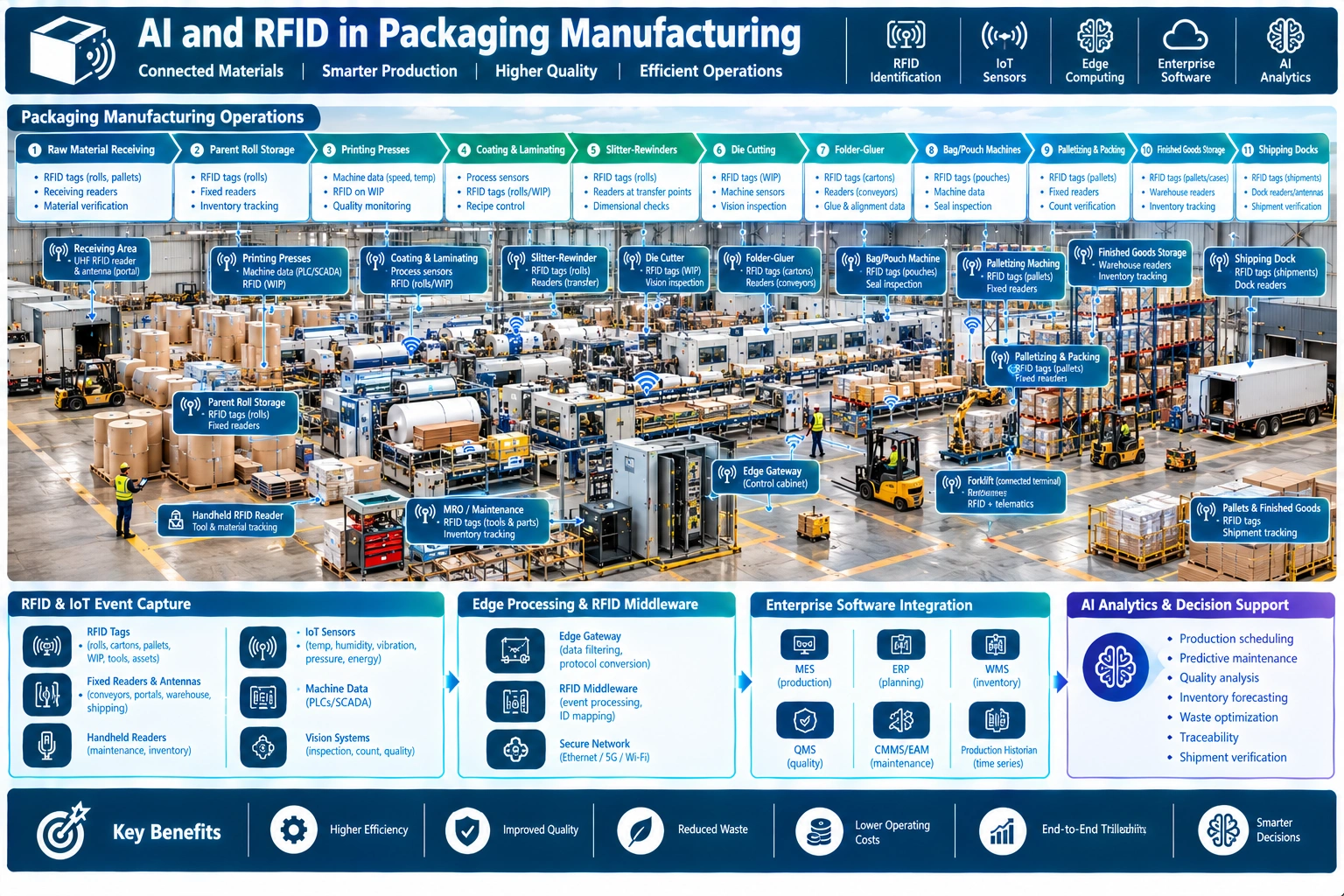
This visual maps RFID-enabled packaging manufacturing from raw-material receiving and parent-roll storage through printing, laminating, converting, palletizing, warehousing, and shipping. RFID and machine data flow through edge processing, enterprise systems, and AI analytics to improve production, quality, maintenance, inventory, traceability, and shipment decisions.
Realistic RFID Deployment in a Packaging Plant and Warehouse
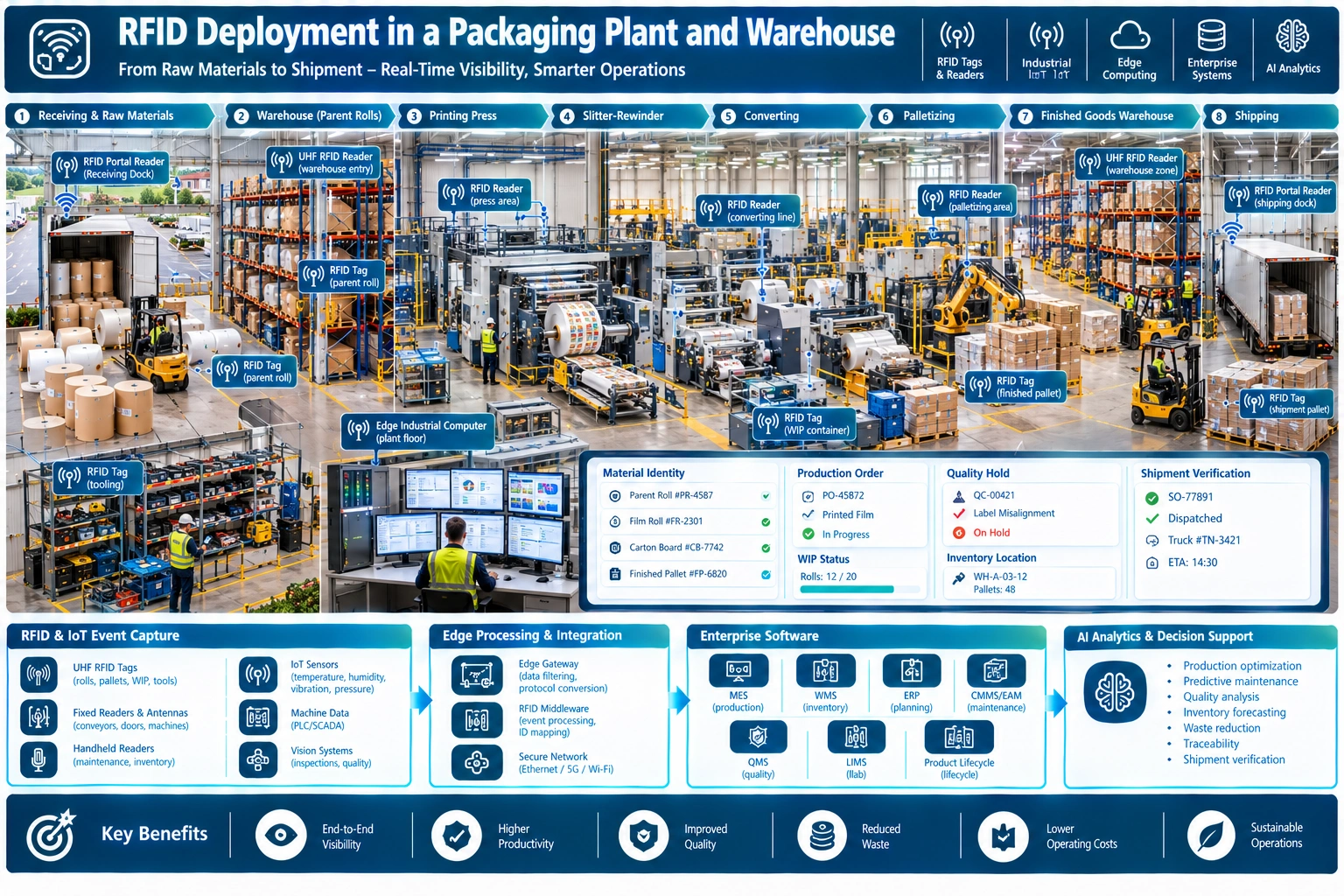
This visual shows RFID deployment across receiving, parent-roll storage, printing, converting, WIP staging, palletizing, finished-goods warehousing, and shipping. Fixed RFID readers, tagged materials, tools, containers, and pallets connect through edge computing to production, inventory, quality, and shipment management systems.
GAO’s Role in AI and RFID for Packaging Manufacturing
GAO provides RFID, BLE, IoT hardware products and systems that can be applied to manufacturing, material tracking, warehouse operations, asset identification, and logistics workflows. For Packaging Manufacturing, these capabilities can support RFID-enabled identification of rolls, WIP, tooling, pallets, finished goods, and selected production assets.
GAO’s engineering-oriented approach allows deployments to be considered in relation to actual production workflows, plant environments, integration requirements, and operational KPIs rather than treating RFID as an isolated identification technology.
GAO RFID Inc. is headquartered in New York City and Toronto, Canada, and is ranked among the top 10 leading B2B and B2G, and to a lesser degree B2B2C and B2D, BLE and RFID suppliers in the world. GAO RFID Inc., GAO Research Inc., and GAO Tek Inc. form the GAO Group, with operations based in New York City and Toronto, Canada.
For three decades, GAO Group has served customers in the United States and Canada, including Fortune 500 companies, leading research and development organizations, prestigious universities, and U.S. and Canadian government agencies. The group has invested heavily in R&D, stringent quality assurance, and expert technical support delivered remotely or onsite.
For packaging manufacturers evaluating RFID and AI, GAO can help supply the hardware products and systems required to establish the physical identification and data-capture layer supporting broader manufacturing and logistics workflows.
Building the Future of Industrial AI and IoT with Aperture Venture Studio and GAO RFID Inc.
For more than three decades, GAO Group of Companies has invested heavily in R&D involving industrial RFID, BLE, and IoT. As generative AI became useful in industrial applications, we expanded our work in AI and IoT, including RFID and BLE, and founded Aperture Venture Studio to advance practical AI and IoT solutions for industries such as Packaging Manufacturing and Printing & Packaging. Aperture brings together AI and IoT technical experts, operational executives, investors, and leading companies. We also support technical discussions through Aperture Ventures Summit and TekSummit. We welcome advisors, employees, investors, and customers interested in advancing AI and IoT for Packaging Manufacturing operations.