
AI and RFID for Poultry
AI-Powered Poultry Operations with RFID-Based Tracking and Automation
AI for poultry combines computer vision, machine learning, predictive analytics, connected sensors, and RFID identification to improve flock monitoring, biosecurity, traceability, equipment management, and operational decision-making. RFID provides reliable identification and location information for poultry assets, equipment, containers, feed inventory, breeding records, and selected bird-management processes, while AI converts operational data into predictions, anomaly detection, and actionable recommendations.
A poultry operation can combine UHF RFID for longer-range identification, HF RFID for controlled short-range identification, and LF RFID where low-frequency identification characteristics are appropriate. These technologies can work alongside environmental sensors, cameras, BLE devices, GPS IoT, gateways, and farm management software. AI can analyze temperature, humidity, ventilation, feed and water consumption, bird movement, mortality patterns, weight data, equipment status, and RFID events to identify abnormal conditions and support earlier intervention.
The resulting poultry solution can help producers monitor flock conditions, automate asset identification, strengthen traceability, improve labor efficiency, detect equipment problems, and coordinate actions across hatcheries, broiler houses, layer houses, breeder operations, processing facilities, feed storage, and distribution activities.
AI and RFID-Enabled Poultry Operations: Smart Farm Data, Analytics and Automation
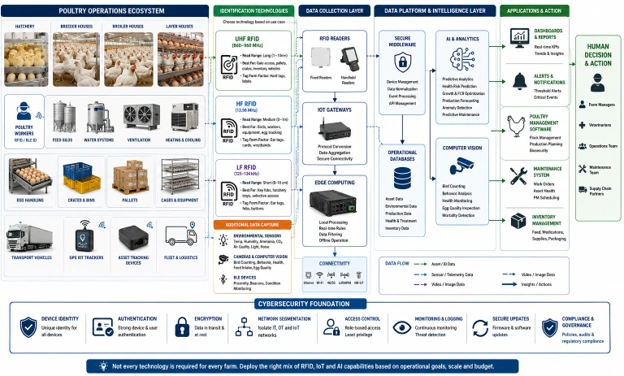
This infographic illustrates how RFID, IoT sensors, computer vision, edge computing, AI analytics, and secure data platforms connect poultry assets and operations. It shows how farm data moves from identification and sensing through analytics to dashboards, alerts, management systems, and human decision-making, supported by cybersecurity controls.
What AI and RFID Mean for Modern Poultry Production
AI and RFID address different but complementary requirements in poultry operations. RFID identifies and tracks tagged objects or animals where the selected tag and reader configuration support the required application. AI interprets data from RFID events, environmental sensors, cameras, equipment telemetry, production records, and other sources to detect patterns and support decisions.
RFID Identification Across Poultry Operations
RFID can create a machine-readable identity for assets and operational items that are difficult to manage reliably through manual labels or visual inspection.
Potential poultry applications include:
- Tracking poultry transport crates and containers
- Identifying feed and inventory assets
- Managing equipment and maintenance assets
- Tracking breeding or production records where individual or group identification is operationally appropriate
- Monitoring movement of tagged assets between poultry houses and processing or storage areas
- Supporting egg, tray, pallet, and packaging traceability
- Automating receiving and dispatch records
- Associating equipment, batches, locations, and production events with digital records
UHF RFID is generally useful where longer read ranges and rapid identification of multiple tagged items are required. HF RFID can support controlled short-range identification, while LF RFID can be appropriate for specific low-frequency identification applications. The correct RFID selection depends on tag geometry, material, reader placement, environmental conditions, required read distance, throughput, and interference considerations.
AI for Poultry Health and Environmental Monitoring
AI can combine environmental measurements with flock behavior and production data to identify abnormal conditions. Temperature, relative humidity, ammonia-related measurements, ventilation status, lighting, water consumption, feed consumption, and bird activity can provide signals for anomaly detection.
Computer vision can analyze poultry-house imagery for behavior, distribution, density, movement patterns, visible abnormalities, and other measurable characteristics. AI outputs should be treated as decision-support signals and validated against veterinary, animal-health, and production practices before they are used for consequential interventions.
AI-Driven Traceability
Poultry traceability requires reliable association between birds, batches, houses, feed, equipment, processing events, storage locations, and transportation activities. RFID events can provide timestamped identification records that complement production and enterprise software.
AI can help detect unusual movement patterns, missing records, duplicate events, unexpected dwell times, or inconsistencies between physical movements and digital records. This can help operations personnel investigate exceptions rather than manually review every transaction.
GAO supplies RFID hardware and related IoT technologies that can form the identification and data-capture layer for poultry traceability systems. System integrators can combine these devices with poultry management, inventory, maintenance, quality, and enterprise software.
AI and RFID Applications Across Poultry Operations
Flock Monitoring and Early Anomaly Detection
AI can combine flock behavior, environmental conditions, feed and water consumption, mortality records, and production history to identify deviations from expected patterns.
Anomaly detection can flag unusual reductions in water consumption, changes in movement, abnormal environmental conditions, or equipment-related changes. The objective is to prioritize inspection and intervention rather than automatically assign a diagnosis.
Poultry Asset Tracking
RFID can identify crates, cages, equipment, feed containers, tools, trays, pallets, and other operational assets. Reader events can establish where an asset was last detected and help identify movement between poultry houses, hatchery areas, processing zones, storage areas, and loading locations.
AI can use these records to identify unusual dwell times, recurring bottlenecks, asset shortages, or abnormal movement patterns.
Feed and Inventory Management
Feed represents a major operational input for poultry producers. RFID identification can support inventory workflows for feed-related equipment, containers, and handling assets, while connected measurement systems can monitor silo levels and consumption.
AI models can compare expected and actual feed consumption and identify deviations that warrant investigation. Combining feed records with flock age, population, environmental conditions, and production data can provide more useful analysis than examining feed consumption alone.
Water Consumption Monitoring
Water consumption can provide an important operational signal in poultry houses. IoT flow meters and related sensors can provide continuous measurements, while AI can identify deviations from historical or expected patterns.
RFID can associate measurements or inspection events with specific houses, equipment, maintenance activities, or operational assets. Alerts can help personnel investigate possible leaks, equipment faults, environmental issues, or changes in flock behavior.
Ventilation, Heating, and Environmental Control
Poultry-house environmental systems include fans, inlets, heaters, cooling systems, controllers, sensors, and ventilation equipment. IoT telemetry can capture operating status and environmental conditions.
AI can identify relationships between equipment operation and house conditions and can support predictive maintenance or optimization. Local control logic should remain available where loss of network connectivity could affect critical environmental conditions.
Egg and Production Traceability
Layer operations require traceability across eggs, trays, packing activities, storage, transport, and downstream handling. RFID can provide machine-readable identification for trays, pallets, reusable containers, and selected equipment.
AI can analyze production and traceability records to identify process bottlenecks, unusual throughput patterns, or inconsistencies requiring investigation.
Hatchery and Breeder Operations
Hatchery operations involve eggs, incubation equipment, environmental conditions, batches, transfer events, and production records. RFID can support identification and movement tracking for reusable equipment, containers, trays, and selected batch-management processes.
AI can correlate environmental and production information to identify patterns associated with hatchery performance and operational anomalies.
Processing and Cold-Chain Traceability
RFID can support identification of pallets, containers, reusable transport assets, and other items moving through processing and distribution. Temperature sensors and connected monitoring devices can add environmental information where required.
AI can detect abnormal dwell times, temperature excursions, asset movement inconsistencies, and other exceptions. Such systems should complement established food-safety, quality-control, and traceability procedures rather than replace them.
Poultry Data-to-Decision Workflow
A practical AI and RFID poultry solution moves information through several stages, from physical identification and sensing to analytics and operational action.
RFID and Sensor Data Capture
The workflow starts with RFID readers, environmental sensors, cameras, equipment sensors, flow meters, weighing systems, and other connected devices.
RFID readers capture tag identifiers and reader-event information. Sensors capture environmental and equipment measurements. Cameras generate images or video for computer-vision applications. The data sources should be selected according to a defined operational requirement rather than simply maximizing the number of connected devices.
Connectivity and Gateway Processing
RFID readers and IoT sensors can communicate through wired Ethernet, industrial interfaces, Wi-Fi, BLE, cellular IoT, LoRaWAN, or other suitable connectivity methods depending on the deployment.
Gateways can aggregate heterogeneous devices, normalize data, perform protocol conversion, and forward events to local or centralized software. Edge processing can filter duplicate RFID reads, validate sensor values, buffer data during network interruptions, and execute selected AI inference or operational rules locally.
Secure Middleware and Data Storage
Middleware receives RFID events and sensor measurements and maps them to poultry locations, assets, batches, equipment, and operational records. Device identity and authentication help prevent unauthorized equipment from entering the system.
Time-series storage is useful for environmental and equipment telemetry, while relational or event-oriented databases can maintain RFID transactions, asset identities, production records, and workflow events.
Data quality controls should identify duplicate reads, missing events, impossible movement sequences, sensor drift, invalid timestamps, and communication failures before those records are used for AI training or operational reporting.
AI Analytics and Computer Vision
AI models can process poultry production data to identify anomalies, forecast conditions, classify imagery, estimate equipment failure risk, and support operational recommendations.
Possible techniques include:
- Time-series forecasting for environmental and consumption trends
- Anomaly detection for flock, equipment, and RFID-event patterns
- Classification models for poultry imagery and operational conditions
- Regression models for production and consumption forecasting
- Computer vision for behavior and visible condition assessment
- Predictive maintenance models for fans, pumps, feeders, heaters, and other equipment
- Optimization models for selected operational scheduling problems
Model outputs should retain relevant timestamps, locations, confidence information, and source data so personnel can investigate recommendations.
Poultry Management Software and Human Action
AI and RFID outputs become operationally useful when connected to poultry management software, inventory systems, maintenance systems, quality systems, dashboards, alerts, and enterprise applications.
A farm manager might receive an alert that a poultry house has an unusual water-consumption pattern. The system can associate the alert with the relevant house, recent RFID or equipment events, environmental measurements, and maintenance history. Personnel can then inspect the relevant water line, meter, controller, or flock condition.
Human approval should remain part of workflows involving animal-health decisions, significant environmental-control changes, maintenance actions, or other consequential interventions.
AI and RFID Poultry Data-to-Decision Workflow: From Sensing to Intelligent Action
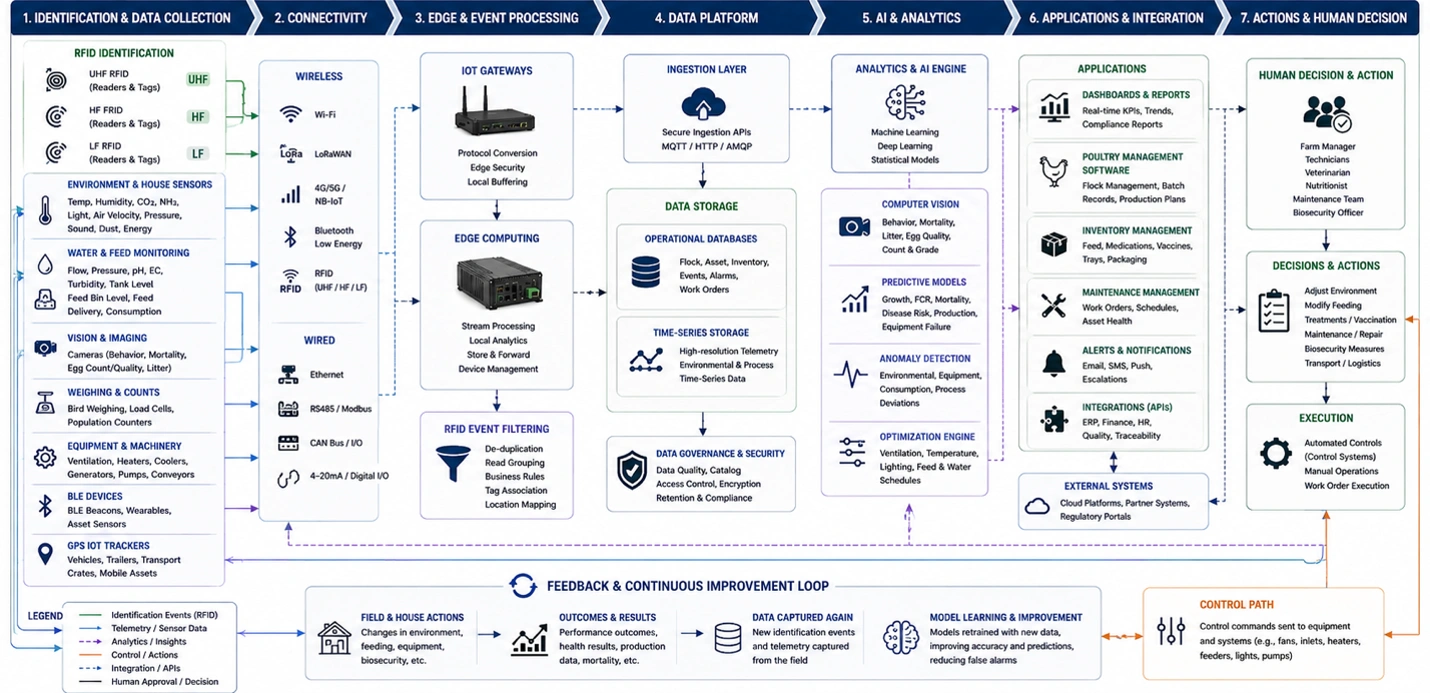
AI and RFID Poultry WorkflowThis technical workflow shows how RFID identification, poultry-house sensors, cameras, weighing systems, equipment, BLE devices, and GPS trackers feed connected edge and data platforms. AI analytics, computer vision, predictive models, and integrated applications transform this data into recommendations, alerts, operational controls, and human decisions, with a continuous feedback loop for improvement.
RFID, AI, Hardware, Software, and Deployment Technologies for Poultry
UHF, HF, and LF RFID
RFID selection should begin with the physical application. UHF RFID can support longer-range reading and rapid identification of multiple tags, making it relevant to portals, dock doors, asset movement, and inventory workflows where tag and reader performance are suitable.
HF RFID generally operates over shorter distances and can be useful where controlled proximity identification is required. LF RFID operates at lower frequencies and can be appropriate for selected animal-identification or specialized industrial applications.
Reader antenna placement, tag orientation, reader power, metal structures, liquids, dense tagged populations, electromagnetic interference, and required read accuracy all influence actual performance. Poultry environments can contain metal equipment, wire structures, moisture, feed containers, and moving assets, so a site test is important before large-scale installation.
RFID Tags and Readers
Tag selection depends on mounting surface, operating temperature, moisture exposure, cleaning procedures, read distance, attachment method, and whether the tagged object is reusable.
Readers may be fixed, portal-based, handheld, mobile, or integrated into equipment. Fixed readers can automate repeatable checkpoints, while handheld readers can support exception handling, maintenance, inventory audits, and commissioning.
AI Models and Edge AI
AI workloads can be centralized or executed close to the poultry house. Edge AI can process selected camera or sensor data locally, reducing latency and upstream bandwidth requirements.
Centralized AI services are better suited to computationally intensive model training, cross-site analysis, historical comparison, and centralized model management. A hybrid approach can keep immediate detection and operational rules local while using centralized infrastructure for deeper analytics.
Cloud Version
A Cloud Version uses cloud-hosted software and managed infrastructure for centralized data processing, remote access, multi-farm visibility, scalable storage, analytics, and software management.
Cloud deployment is often appropriate for poultry organizations operating multiple geographically distributed facilities that require centralized visibility and shared analytics. It depends on adequate connectivity and requires careful consideration of data governance, cybersecurity, availability, integration, and operational continuity.
Server Version
A Server Version deploys software on edge servers, customer-managed servers, private data centers, farm servers, or other privately hosted enterprise infrastructure. It is not limited to a traditional on-premises server room.
Private deployment can be appropriate where poultry operations require greater control over data, local processing, connectivity independence, integration with existing private systems, or specific organizational governance requirements. It also places more responsibility on the operator for infrastructure maintenance, security updates, backups, monitoring, and disaster recovery.
Poultry Management and Enterprise Software Integration
RFID and AI data should integrate with poultry management software rather than remain isolated in a separate application. Relevant systems can include flock management software, hatchery management systems, inventory management, maintenance management, quality systems, warehouse management, ERP systems, laboratory or diagnostic systems, and transportation software.
APIs, event interfaces, database integration, and standardized data models can help connect RFID events and AI outputs with existing workflows.
Cybersecurity for Connected Poultry Systems
Connected poultry operations require security across RFID readers, IoT gateways, cameras, controllers, edge servers, databases, and management software.
Important controls include:
- Unique device identity and authentication
- Encryption for data in transit and at rest
- Network segmentation between IoT devices and business systems
- Role-based access control
- Secure firmware and software updates
- Audit logging
- Monitoring and threat detection
- Credential lifecycle management
- Backup and recovery procedures
- Secure device commissioning and decommissioning
GAO’s RFID and IoT technologies can support the connected hardware layer, while the complete poultry solution should apply security controls across devices, networks, software, and operational processes.
Technical and Business Benefits of AI-Powered Poultry Operations
Combining AI with RFID identification and connected poultry-house systems can improve visibility across flock management, asset movement, equipment operation, inventory, traceability, and maintenance. The value comes from associating physical events with time, location, production context, and historical records so that poultry personnel can act on exceptions rather than manually review every activity.
More Accurate Poultry Asset Visibility
RFID creates machine-readable identification for crates, trays, pallets, equipment, containers, and other tagged assets. Automated reader events reduce dependence on handwritten records and manual asset searches.
AI can analyze movement histories to identify assets that remain in unexpected locations, spend unusually long periods in a process area, or repeatedly contribute to operational bottlenecks. The result is better asset utilization and more reliable inventory information.
GAO supplies RFID readers, tags, antennas, handheld devices, and related technologies that can provide the identification infrastructure required for these workflows.
Earlier Detection of Poultry-House Anomalies
AI can establish expected patterns for temperature, humidity, water consumption, feed consumption, ventilation, bird activity, and other monitored variables. Deviations from these patterns can generate prioritized alerts.
Anomaly detection is particularly useful when several measurements change together. For example, an unusual change in water consumption combined with environmental or equipment telemetry can provide more useful context than a single threshold alarm.
The system should distinguish between an operational anomaly and an animal-health diagnosis. Poultry health decisions should remain subject to appropriate professional assessment.
Improved Traceability and Chain-of-Custody Records
RFID events can create timestamped records as tagged assets, containers, trays, pallets, or other identified items pass through defined checkpoints.
When integrated with production and inventory records, these events can strengthen traceability across hatchery, poultry-house, processing, storage, and transportation workflows. AI can identify inconsistencies such as unexpected movement sequences, duplicate events, missing checkpoints, or abnormal dwell times.
More Effective Predictive Maintenance
Connected poultry equipment generates operating information that can be used for condition monitoring. Relevant assets can include ventilation fans, pumps, feeders, drinker systems, heaters, cooling equipment, generators, compressors, conveyors, and processing equipment.
AI models can identify changes from normal operating behavior and prioritize equipment inspections. Linking alerts to maintenance records helps technicians determine whether a recurring anomaly corresponds to a known failure mode or maintenance requirement.
Better Feed and Water Management
Feed and water consumption can be analyzed against flock population, age, environmental conditions, historical performance, and production expectations.
AI can identify unusual consumption patterns and support investigation of leaks, equipment faults, environmental changes, or changes in flock behavior. These insights can improve resource monitoring while providing another operational signal for poultry-house management.
Improved Workforce Efficiency
Automated RFID identification and sensor monitoring can reduce repetitive data-entry tasks and manual asset searches. Instead of recording every movement manually, personnel can focus on exceptions, inspections, maintenance, flock management, and other higher-value activities.
Dashboards should therefore prioritize actionable events, not simply display every available sensor measurement.
Multi-Site Poultry Visibility
Cloud-hosted software can aggregate information from multiple poultry houses, farms, hatcheries, processing locations, or storage facilities. Managers can compare production conditions, equipment health, RFID workflows, and alerts across locations.
Privately hosted server deployments can provide similar centralized capabilities within customer-managed infrastructure where data governance, local processing, connectivity independence, or existing IT requirements favor that approach.
Stronger Operational Security
Security controls can protect RFID readers, gateways, cameras, sensors, controllers, edge servers, databases, and poultry management software.
Unique device identity, authentication, encryption, network segmentation, access control, secure updates, monitoring, and audit logging help limit unauthorized access and provide visibility into security-relevant events.
Poultry KPIs for AI and RFID Deployment
Poultry technology projects should be measured using operational outcomes as well as technical system metrics. Useful KPIs include:
| KPI Area | Example KPI | Operational Significance |
|---|---|---|
| RFID | Tag read accuracy | Measures identification reliability |
| RFID | Unread or missed-event rate | Identifies reader, tag, antenna, or placement problems |
| Asset Management | Asset location accuracy | Measures visibility of crates, trays, equipment, and containers |
| Asset Management | Asset utilization rate | Shows whether reusable assets are being efficiently deployed |
| Traceability | Traceability event completeness | Measures continuity of movement records |
| Traceability | Average asset dwell time | Identifies process bottlenecks |
| Flock Monitoring | Anomaly detection lead time | Measures how quickly abnormal patterns are identified |
| Environment | Time within target environmental range | Measures poultry-house environmental stability |
| Water | Water consumption per bird | Supports consumption monitoring and anomaly detection |
| Feed | Feed conversion-related monitoring | Supports production and resource analysis |
| Equipment | Unplanned downtime | Measures maintenance and reliability improvements |
| Maintenance | Mean time to detect equipment anomalies | Measures monitoring responsiveness |
| Operations | Manual data-entry hours | Measures administrative workload reduction |
| Alerts | Actionable-alert rate | Measures whether alerts support useful intervention |
| Connectivity | Data delivery rate | Measures communications reliability |
| Sensors | Valid measurement rate | Indicates data quality |
| AI | Precision and recall for validated models | Measures model usefulness for selected applications |
| Production | Forecast error | Measures predictive performance |
| Cold Chain | Temperature excursion duration | Supports storage and transportation monitoring |
| Security | Unauthorized access events | Measures effectiveness of security controls |
Baseline values should be collected before deployment whenever possible. Post-deployment performance can then be compared with the baseline to determine whether the RFID and AI solution is delivering measurable operational improvement.
Implementation Strategy for AI and RFID Poultry Systems
Define the Poultry Workflow Before Selecting Technology
Start with a specific operational problem such as lost transport assets, incomplete traceability, excessive manual inventory work, abnormal water consumption, equipment downtime, or delayed detection of environmental deviations.
Define the physical event that must be captured, the required identification or measurement, the responsible poultry role, the decision that follows, and the KPI used to measure improvement.
Map RFID Read Points and Sensor Locations
RFID deployment requires careful consideration of where an asset or tagged item must be identified. Reader locations can include receiving areas, loading docks, hatchery checkpoints, poultry-house entrances, processing areas, storage zones, and other controlled transition points.
Sensor placement requires similar discipline. Environmental sensors should represent relevant poultry-house conditions rather than simply measuring locations that are convenient to install.
A site survey should evaluate metal structures, water exposure, electrical equipment, reader antenna orientation, tag placement, electromagnetic interference, temperature, cleaning procedures, and physical access for maintenance.
Select the Appropriate RFID Frequency
UHF, HF, and LF RFID should not be treated as interchangeable technologies.
UHF RFID is appropriate for applications requiring longer read distances or rapid identification of multiple tagged assets when the physical environment supports reliable reads. HF RFID can be useful for controlled short-range identification. LF RFID can address selected low-frequency animal or asset-identification applications.
Tag selection should consider material, mounting surface, moisture, cleaning chemicals, temperature, attachment method, expected service life, and read performance.
Establish Connectivity and Edge Processing
Determine whether RFID readers and sensors should use Ethernet, Wi-Fi, BLE, cellular IoT, LoRaWAN, or another communication method based on location, bandwidth, latency, power, and network availability.
Edge computing can filter duplicate RFID events, perform local data validation, buffer records during temporary outages, and execute selected AI inference close to poultry houses or processing areas.
Critical environmental-control functions should not depend exclusively on remote cloud connectivity. Local controls and defined fail-safe behavior should remain available when communications are interrupted.
Establish Data Quality and Event Governance
RFID systems can generate repeated reads when a tagged item remains within a reader’s field. Event filtering, de-duplication, timestamp validation, and business rules are therefore necessary.
Data systems should also detect missing events, impossible movement sequences, duplicate identifiers, invalid sensor measurements, and clock synchronization problems.
Clear rules should define how long RFID events, sensor telemetry, production information, and AI outputs are retained and who can access them.
Validate AI Before Automating Decisions
AI should initially operate in a decision-support role for applications where model errors could have significant operational or animal-health consequences.
Compare predictions and alerts against actual observations, maintenance records, production outcomes, and qualified personnel assessments. Track false positives and false negatives rather than relying only on overall accuracy.
Computer-vision models should be tested across different poultry-house lighting conditions, stocking densities, camera positions, bird ages, equipment configurations, and environmental conditions relevant to the deployment.
Integrate RFID and AI with Existing Poultry Software
A useful system should connect with existing poultry management and business processes.
Potential integration targets include:
- Poultry and flock management software
- Hatchery management systems
- Inventory and warehouse management systems
- Maintenance management systems
- Quality-management software
- ERP systems
- Transportation and logistics systems
- Processing systems
- Environmental-control systems
- Reporting and analytics software
APIs, event interfaces, and standardized data structures can reduce duplicated records and help connect physical RFID events with digital production workflows.
Pilot Before Full Deployment
A pilot can focus on one poultry house, hatchery workflow, asset category, processing checkpoint, or maintenance use case.
Measure RFID read performance, sensor reliability, network availability, data quality, AI accuracy, alert usefulness, workforce response, maintenance requirements, and KPI changes.
Expansion should follow demonstrated performance rather than simply increasing the number of connected devices
AI and RFID Poultry Deployment Decision Tree: Selecting the Right Farm Technologies
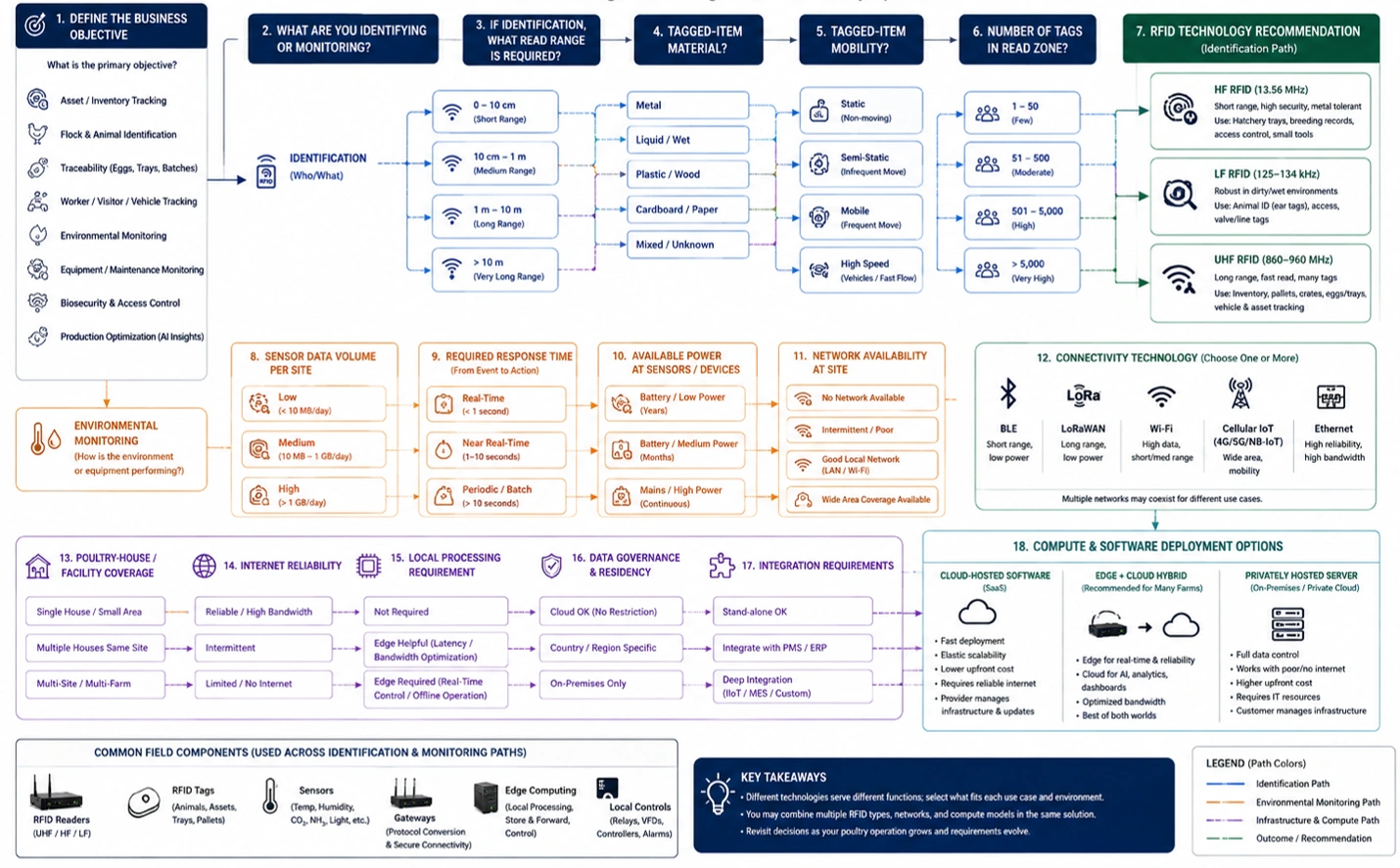
AI and RFID Poultry Deployment Decision TreeThis technical decision tree guides poultry teams from business objectives through RFID, sensing, connectivity, edge computing, AI, and software deployment choices. It emphasizes selecting technologies according to read range, environment, data volume, response time, network conditions, governance, and integration needs, with multiple technologies able to coexist where appropriate.
Poultry AI and RFID Deployment Lifecycle
A controlled deployment lifecycle reduces technical and operational risk.
The initial stage defines the poultry use case, baseline KPI, affected workflow, stakeholders, and expected outcome. The next stage evaluates poultry-house conditions, RFID read points, sensor locations, network coverage, power availability, existing control systems, and data governance requirements.
Hardware is then selected and commissioned. RFID tags should be tested on the actual materials and assets that will be tagged. Readers and antennas should be tested at intended read points. Environmental sensors should be calibrated and checked against reference measurements.
The data layer should then be integrated with edge processing, middleware, databases, AI services, and poultry management software. Cybersecurity controls should be verified before production operation.
A pilot phase should measure system reliability and operational usefulness. Model performance, RFID read accuracy, data completeness, alert quality, user response, and maintenance workload should all be assessed.
After validation, the solution can be expanded to additional poultry houses, facilities, assets, or workflows. Continuous maintenance should include reader inspection, antenna checks, tag replacement, sensor calibration, firmware updates, security monitoring, model evaluation, and software maintenance.
AI-Enabled Poultry Deployment Lifecycle: From Requirements to Controlled Scale-Up
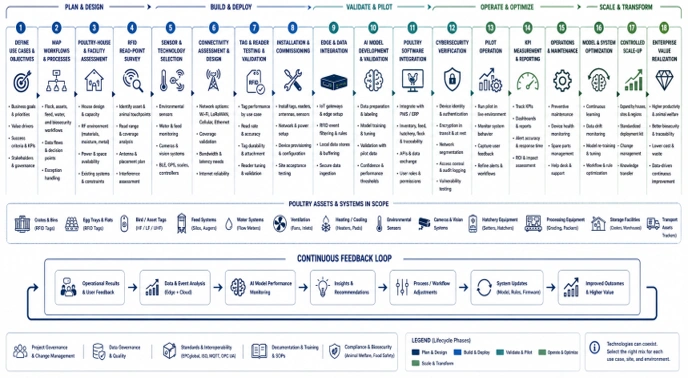
AI-Enabled Poultry Lifecycle InfographicThis lifecycle diagram maps 18 stages of AI and RFID poultry deployment, from use-case definition and poultry-house assessment through technology selection, installation, integration, validation, pilot operation, KPI measurement, maintenance, optimization, and controlled scale-up. It also highlights representative poultry assets, governance and cybersecurity requirements, and a continuous feedback loop that uses operational results to improve models, workflows, and system performance.
AI and RFID Poultry Reference Solution
Practical Recommendations for Poultry Technology Leaders
AI and RFID projects should be designed around poultry workflows and measurable operational outcomes.
- Define the poultry problem before selecting RFID readers, sensors, cameras, or AI models.
- Use UHF, HF, or LF RFID according to the required read range, tagged material, environment, and identification workflow.
- Test RFID tags on the actual crates, trays, equipment, containers, or other assets before deployment.
- Survey reader and antenna locations because poultry-house structures, metal equipment, moisture, and tag orientation can affect read performance.
- Use environmental sensors that represent meaningful poultry-house conditions and establish calibration procedures.
- Separate RFID identification events from continuous sensor telemetry in the data model.
- Apply event filtering and de-duplication to prevent repeated RFID reads from becoming misleading operational records.
- Use edge processing and local buffering where poultry-house connectivity is intermittent or low latency is important.
- Maintain local fail-safe controls for critical environmental equipment.
- Validate AI models against actual poultry-house observations and production outcomes before enabling automated actions.
- Measure false-positive and false-negative rates for AI detection systems.
- Integrate RFID events and AI alerts with poultry management, inventory, maintenance, traceability, and enterprise software.
- Establish device identity, authentication, encryption, network segmentation, access control, monitoring, and secure-update procedures before production deployment.
- Track RFID read accuracy, data completeness, alert quality, equipment downtime, resource consumption, traceability completeness, and other poultry-specific KPIs.
- Start with a controlled pilot and expand only after technical performance and operational value have been demonstrated.
- Establish ongoing maintenance for tags, readers, antennas, sensors, gateways, software, AI models, and cybersecurity controls.
GAO supports organizations with RFID, BLE, IoT, sensing, wireless, and related B2B technology products and systems that can contribute to poultry identification, monitoring, asset tracking, and connected-equipment solutions. GAO Group companies are based in New York City and Toronto, Canada, and have served customers in the United States and Canada for three decades, including Fortune 500 companies, R&D organizations, universities, and government agencies. The group emphasizes R&D, quality assurance, and technical support delivered remotely or onsite.
Applying AI and RFID to Measurable Poultry Operations
AI and RFID can provide poultry producers with more reliable identification, continuous operational data, earlier anomaly detection, stronger traceability, and improved visibility across poultry houses, hatcheries, processing operations, storage facilities, and transportation workflows.
The strongest implementations begin with a defined poultry business problem and then select the appropriate combination of RFID, sensors, connectivity, edge computing, AI, and software integration. UHF, HF, and LF RFID serve different identification requirements, while AI can turn RFID events, environmental telemetry, imagery, and equipment data into actionable information.
For poultry technology leaders, the practical priorities are reliable data capture, validated AI models, secure connected systems, integration with existing poultry software, measurable KPIs, and controlled deployment. GAO can support these initiatives with RFID, BLE, IoT, sensing, tracking, and related technologies, along with technical expertise and support.
Explore GAO’s RFID and IoT technology solutions to identify the hardware, systems, and technical capabilities appropriate for your poultry operation.
Building the Future of Industrial AI and IoT with Aperture Venture Studio and GAO Tek Inc.
For more than three decades, GAO Group of Companies has invested heavily in R&D of industrial RFID, BLE, and IoT. As generative AI has become useful in industrial applications, we have been developing AI and IoT technologies, including RFID and BLE, and have founded Aperture Venture Studio to build, launch, and scale next-generation AI and IoT companies for practical industry applications such as connected poultry operations, traceability, asset tracking, and intelligent monitoring.
Aperture has attracted AI and IoT technical experts, entrepreneurial and operational executives, influential investors, and leading companies. We have also developed Aperture Ventures Summit and TekSummit to discuss advanced AI and IoT topics. As a result, we have built diversified ecosystems and vibrant technical communities for AI and IoT.
We welcome you to join us as:
- Advisors, co-founders, or employees
- Investors
- Customers