
AI and RFID for infrastructure projects
Understanding AI-Driven Infrastructure Projects Supported by RFID
Infrastructure projects differ significantly from conventional building projects because they involve large geographical areas, multiple contractors, distributed supply chains, extensive regulatory oversight, and long construction durations. Artificial Intelligence enhances infrastructure delivery by continuously evaluating operational data to identify schedule risks, optimize resource allocation, improve equipment utilization, forecast procurement needs, and support proactive project management.
RFID serves as one of the enabling identification technologies within AIoT solutions by automatically identifying and tracking construction materials, fabricated components, heavy equipment, tools, inspection assets, safety equipment, and workforce credentials. Instead of manually entering asset information, RFID captures reliable identification data that becomes valuable input for AI models.
AI and RFID together improve:
- Infrastructure asset visibility
- Material traceability
- Equipment utilization
- Construction quality management
- Predictive maintenance
- Workforce coordination
- Supply chain transparency
- Procurement optimization
- Construction safety monitoring
- Executive project reporting
Infrastructure owners increasingly integrate AI with Building Information Modeling (BIM), Digital Twins, GIS systems, ERP software, scheduling software, document management systems, and engineering workflows to establish continuous operational awareness throughout project execution.
AI-Powered Infrastructure Project with RFID-Enabled Construction Intelligenc
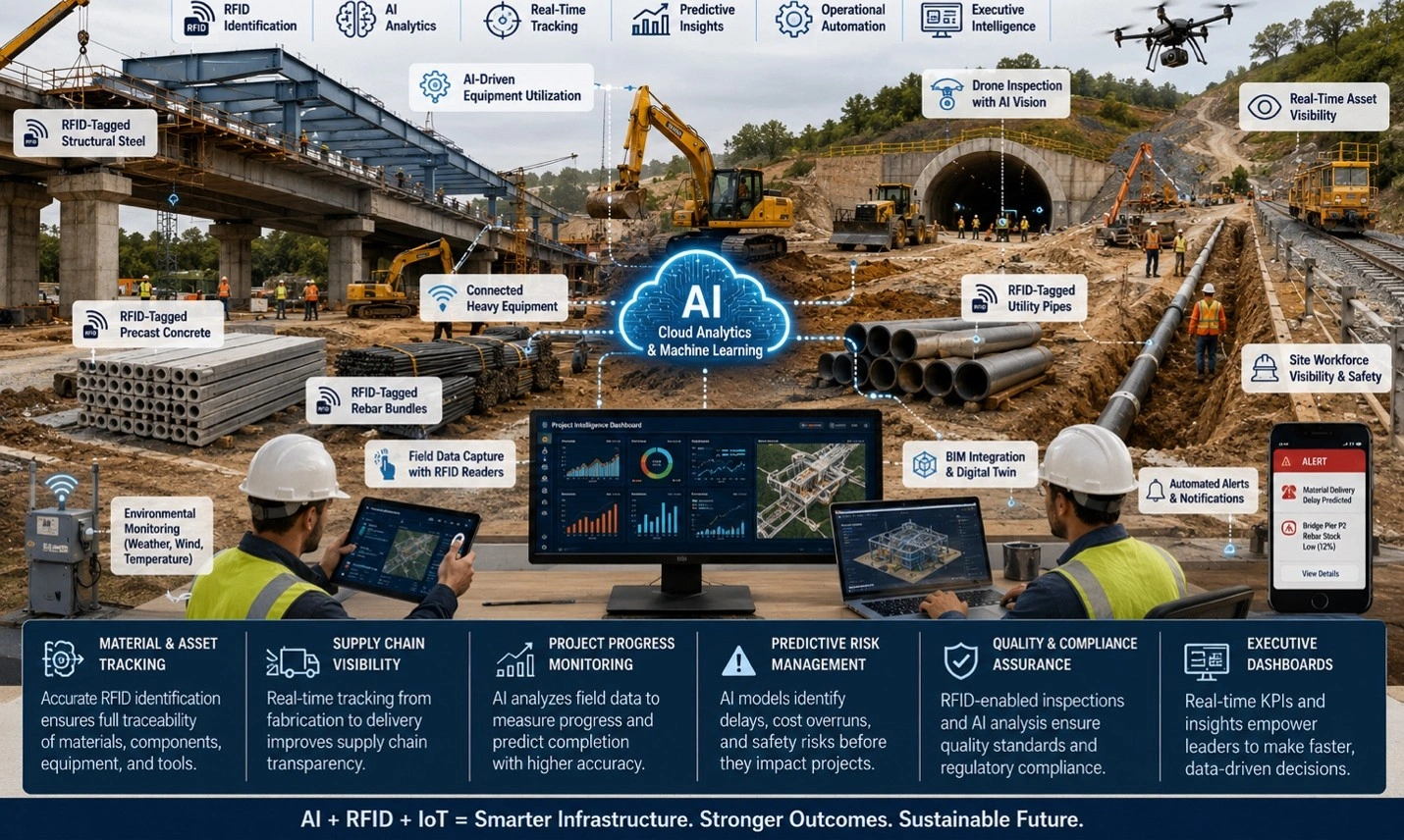
Core Concepts Behind AI-Powered Infrastructure Projects
Modern infrastructure construction generates enormous amounts of operational data originating from engineering surveys, procurement activities, material deliveries, equipment telemetry, environmental monitoring, drone inspections, quality testing, workforce management, scheduling software, and digital engineering systems.
Artificial Intelligence converts this information into practical recommendations that support project teams throughout construction.
AI capabilities commonly include:
- Predictive scheduling
- Progress forecasting
- Computer vision for construction monitoring
- Resource optimization
- Procurement forecasting
- Delay prediction
- Cost variance prediction
- Risk scoring
- Automated quality inspection
- Safety analytics
- Intelligent reporting
RFID contributes continuous identification data for:
- Precast concrete components
- Structural steel
- Utility pipes
- Tunnel segments
- Electrical equipment
- Bridge components
- Construction tools
- Mobile equipment
- Inspection instruments
- Safety equipment
Because AI models depend upon accurate operational information, reliable RFID data significantly improves prediction accuracy while reducing manual data collection errors.
AI Applications Across Infrastructure Projects
Infrastructure construction includes multiple project categories, each presenting unique engineering challenges.
Transportation Infrastructure
AI supports:
- Highway construction scheduling
- Bridge erection monitoring
- Pavement quality prediction
- Railway construction sequencing
- Airport asset coordination
- Traffic management during construction
RFID identifies:
- Steel girders
- Concrete barriers
- Bridge bearings
- Rail components
- Construction vehicles
Utility Infrastructure
Applicable projects include:
- Water distribution
- Wastewater treatment
- Electrical substations
- Power transmission
- Gas pipelines
- Telecommunications
AI improves:
- Utility installation sequencing
- Material forecasting
- Inspection planning
- Maintenance readiness
- Equipment allocation
Energy Infrastructure
Projects include:
- Renewable energy farms
- Transmission corridors
- Battery facilities
- Hydroelectric projects
AI enables:
- Equipment utilization optimization
- Construction risk prediction
- Workforce allocation
- Supply chain optimization
Smart City Development
Integrated systems include:
- Intelligent transportation
- Connected street lighting
- Public safety infrastructure
- Municipal communications
- Environmental monitoring
AI combines infrastructure information from multiple systems to improve operational efficiency while RFID assists in tracking installed municipal assets.
AI-Enabled Infrastructure Project Workflow with RFID Tracking and Intelligent Construction Management
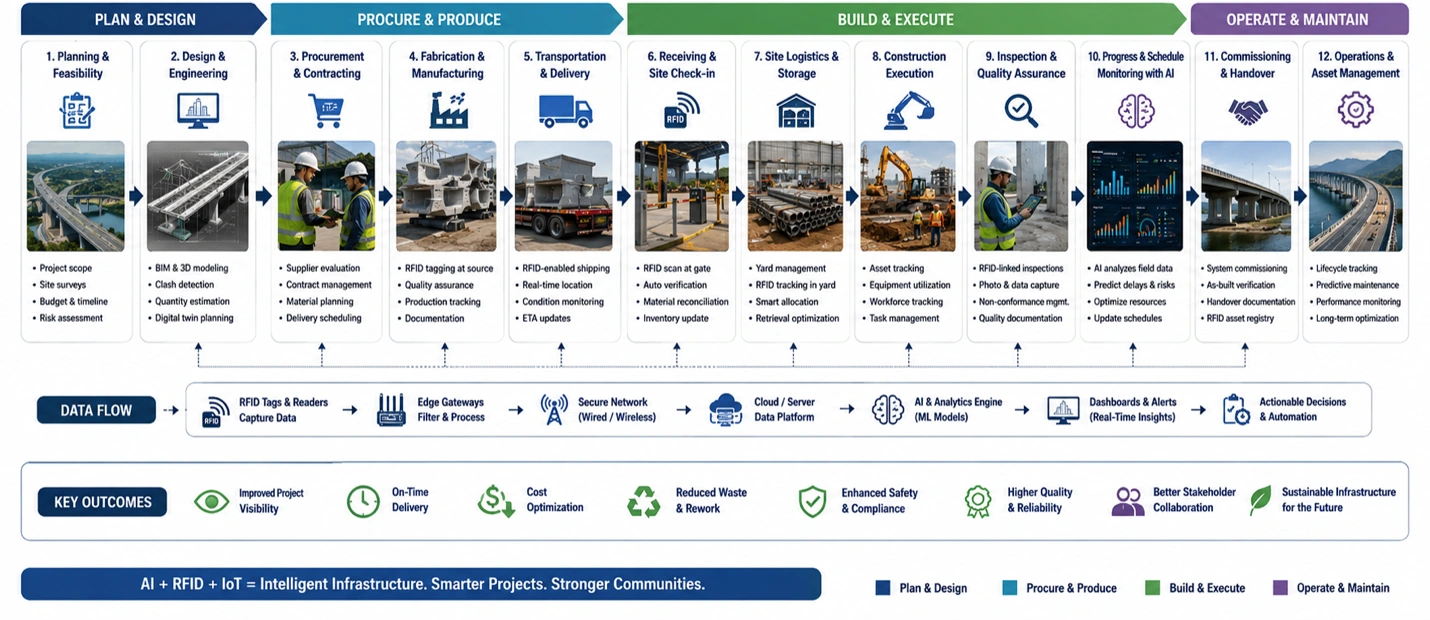
Operational Workflow from Data Collection to AI Decision-Making
Infrastructure projects generate operational intelligence through multiple connected systems.
The workflow generally includes:
- RFID identification of materials, fabricated assemblies, equipment, tools, and workforce credentials
- Fixed and mobile RFID readers capturing identification events
- Edge gateways filtering operational data before transmission
- Secure wired and wireless communications transferring data
- AI software correlating RFID events with BIM models, schedules, GIS data, and procurement records
- Construction management software updating project progress
- Predictive analytics identifying schedule risks, material shortages, and equipment utilization issues
- Executive dashboards presenting KPIs for project leadership
- Automated alerts supporting rapid operational decisions
The result is a continuously updated representation of infrastructure project progress, enabling project teams to react to changing site conditions before they affect schedules or budgets.
Real-World RFID Deployment for AI-Driven Infrastructure Construction Projects
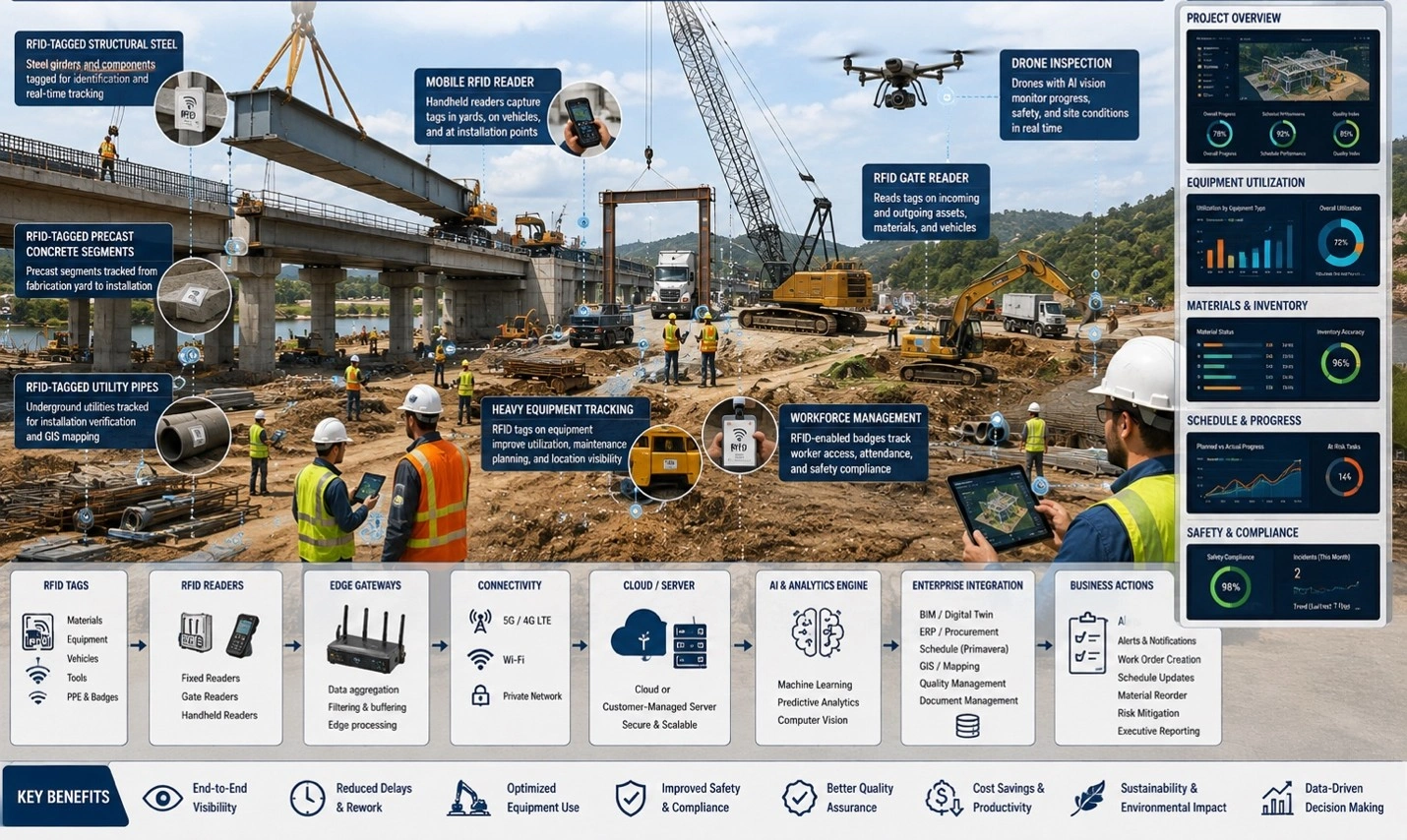
Technologies That Power AI-Driven Infrastructure Projects
Successful AI-powered infrastructure solutions rely on the integration of intelligent software, identification technologies, communications networks, enterprise applications, and construction management systems rather than any single technology.
Core components include:
- UHF RFID for long-range identification of construction materials, heavy equipment, pallets, containers, and structural components.
- HF RFID for maintenance records, quality documentation, inspection checkpoints, and controlled-access applications.
- LF RFID for harsh environments where short-range identification and resistance to interference are priorities.
- Fixed RFID readers at site entrances, storage yards, fabrication facilities, and logistics checkpoints.
- Handheld RFID readers used by inspectors, warehouse personnel, and field engineers.
- Edge gateways that aggregate RFID events, filter unnecessary data, and reduce network traffic before forwarding information to AI software.
- AI analytics software that identifies schedule risks, predicts material shortages, optimizes fleet utilization, and generates executive recommendations.
- BIM software synchronized with RFID-generated field data to compare planned and actual construction progress.
- ERP, procurement, quality management, scheduling, document control, and maintenance software integrated to support a unified construction management process.
- Cloud deployments for geographically distributed infrastructure programs requiring centralized management, rapid scalability, remote collaboration, and simplified software maintenance.
- Customer-managed server deployments for organizations requiring greater control over data governance, regulatory compliance, integration with existing private infrastructure, or operation in environments with limited internet connectivity.
Cloud Version Versus Customer-Managed Server Version
Selecting the appropriate deployment model depends on project size, security policies, regulatory obligations, communication infrastructure, and operational requirements. Both deployment approaches support AI-enabled infrastructure projects, but each offers distinct advantages.
Cloud Version
Cloud-hosted software is well suited for geographically distributed infrastructure projects involving multiple contractors, agencies, and field offices.
Benefits include:
- Centralized project visibility across multiple construction sites
- Rapid software deployment and scalability
- Simplified maintenance and software updates
- Remote collaboration between owners, contractors, consultants, and inspectors
- High availability with built-in disaster recovery
- Easy integration with mobile devices and cloud-based BIM collaboration
- Elastic computing resources for AI model training and large-scale analytics
Cloud deployments are particularly valuable for transportation agencies, utility operators, EPC contractors, and multinational engineering organizations managing multiple infrastructure projects simultaneously.
Customer-Managed Server Version
Customer-managed server deployments provide organizations with greater control over software, data governance, integration, and security.
Advantages include:
- Complete ownership of operational data
- Integration with existing private data centers
- Reduced dependence on external internet connectivity
- Support for highly customized workflows
- Greater flexibility for regulatory compliance
- Lower latency for local processing
- Enhanced control over cybersecurity policies
Customer-managed deployments are often preferred by government agencies, defense-related infrastructure programs, utilities, and organizations with strict security or compliance requirements.
Cloud vs. Customer-Managed Server Deployments for AI-Enabled Infrastructure Project
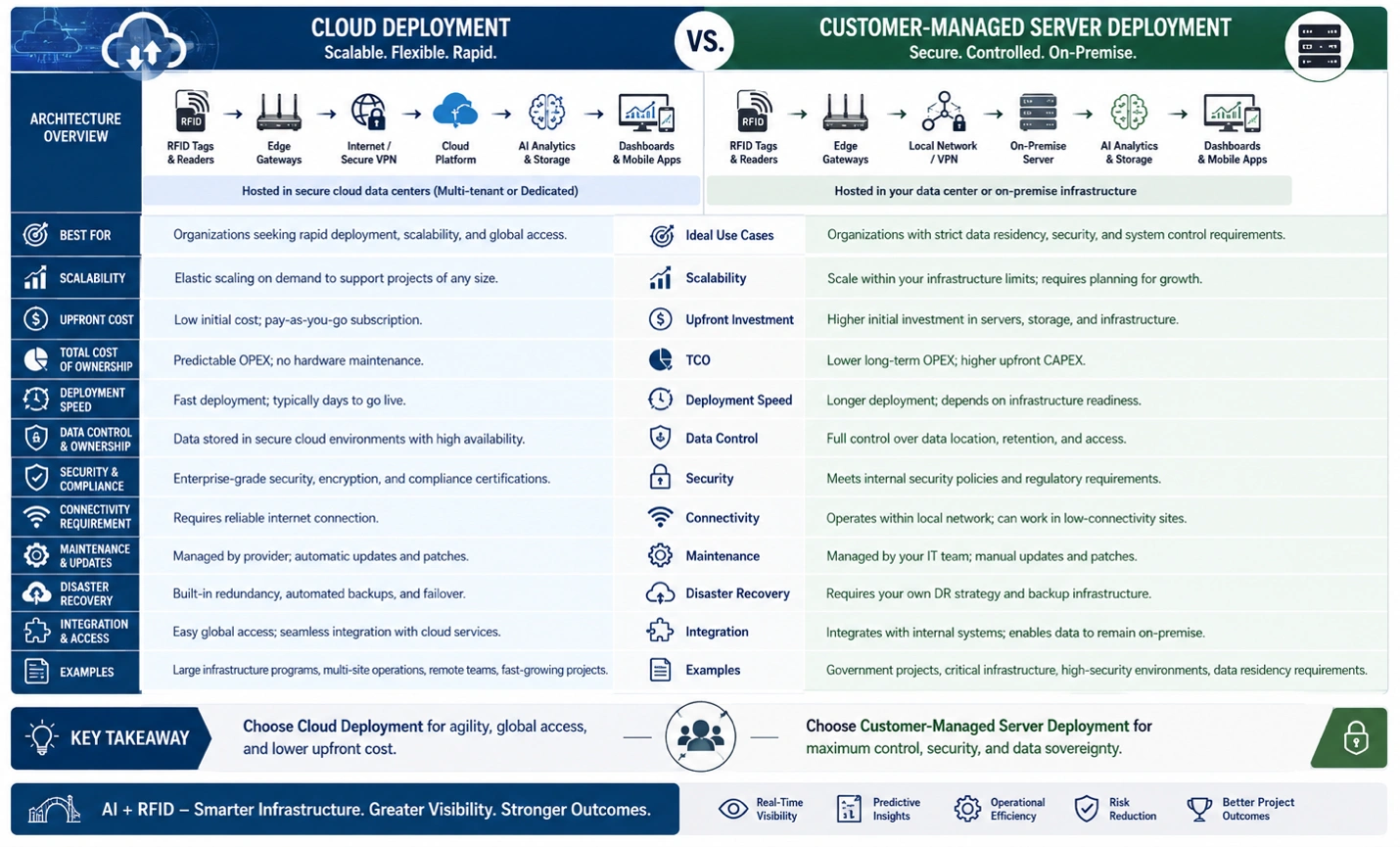
Software Integration Across Infrastructure Projects
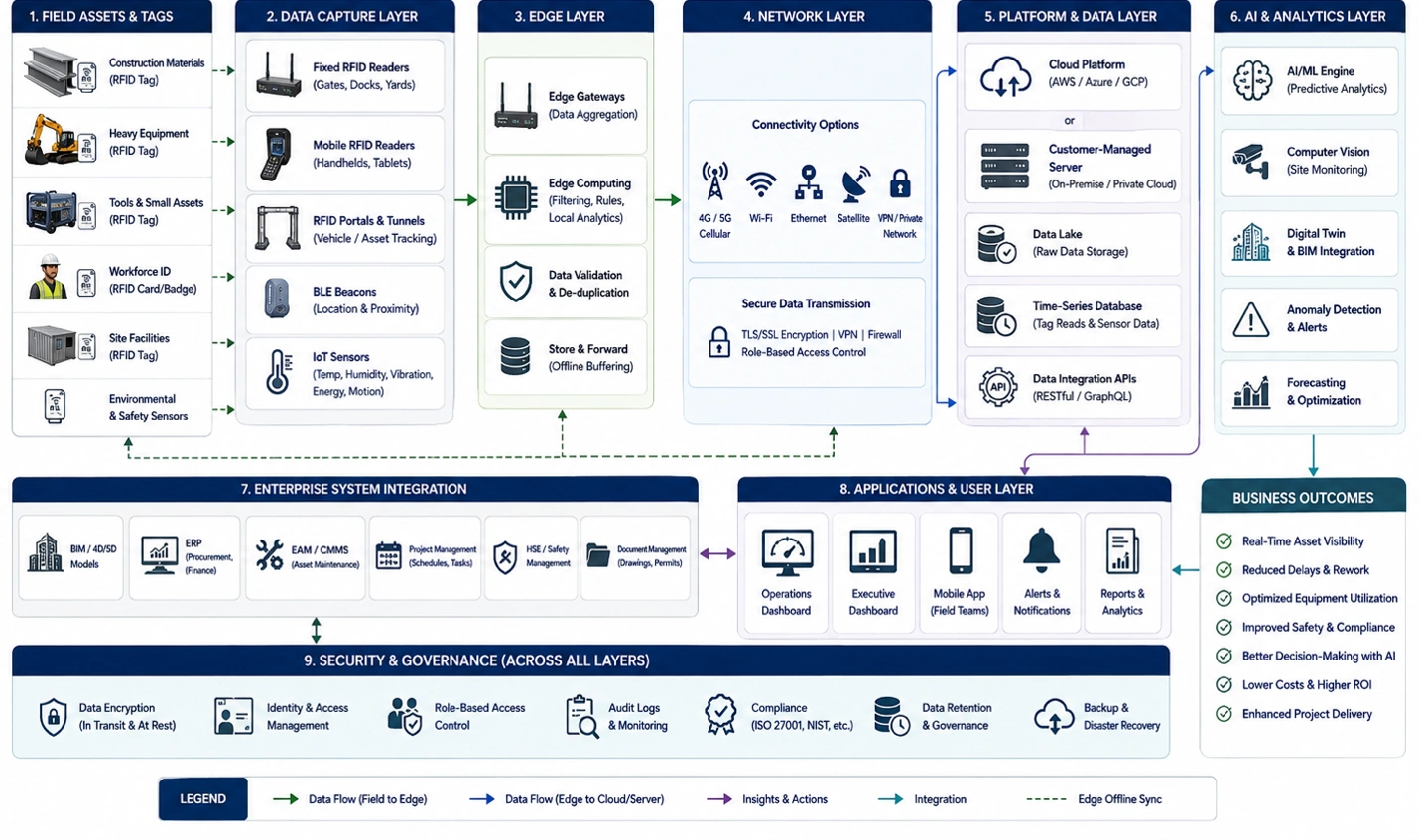
AI-powered infrastructure management depends on connected software rather than isolated applications. RFID-generated field information becomes significantly more valuable when integrated across engineering, construction, procurement, maintenance, and financial systems.
Typical integrations include:
- BIM software
- ERP software
- Project management software
- Procurement systems
- GIS software
- Scheduling software
- Asset management systems
- Quality management software
- Maintenance management software
- Document control systems
- Drone inspection software
- Digital Twin software
- Executive reporting dashboards
- Mobile field applications
GAO has supplied RFID hardware and IoT solutions that enable organizations to collect high-quality operational data for integration with existing construction software while minimizing disruption to established workflows.
Infrastructure Project System Integration for AI-Powered RFID Operation
Technical and Business Benefits of AI-Powered Infrastructure Projects
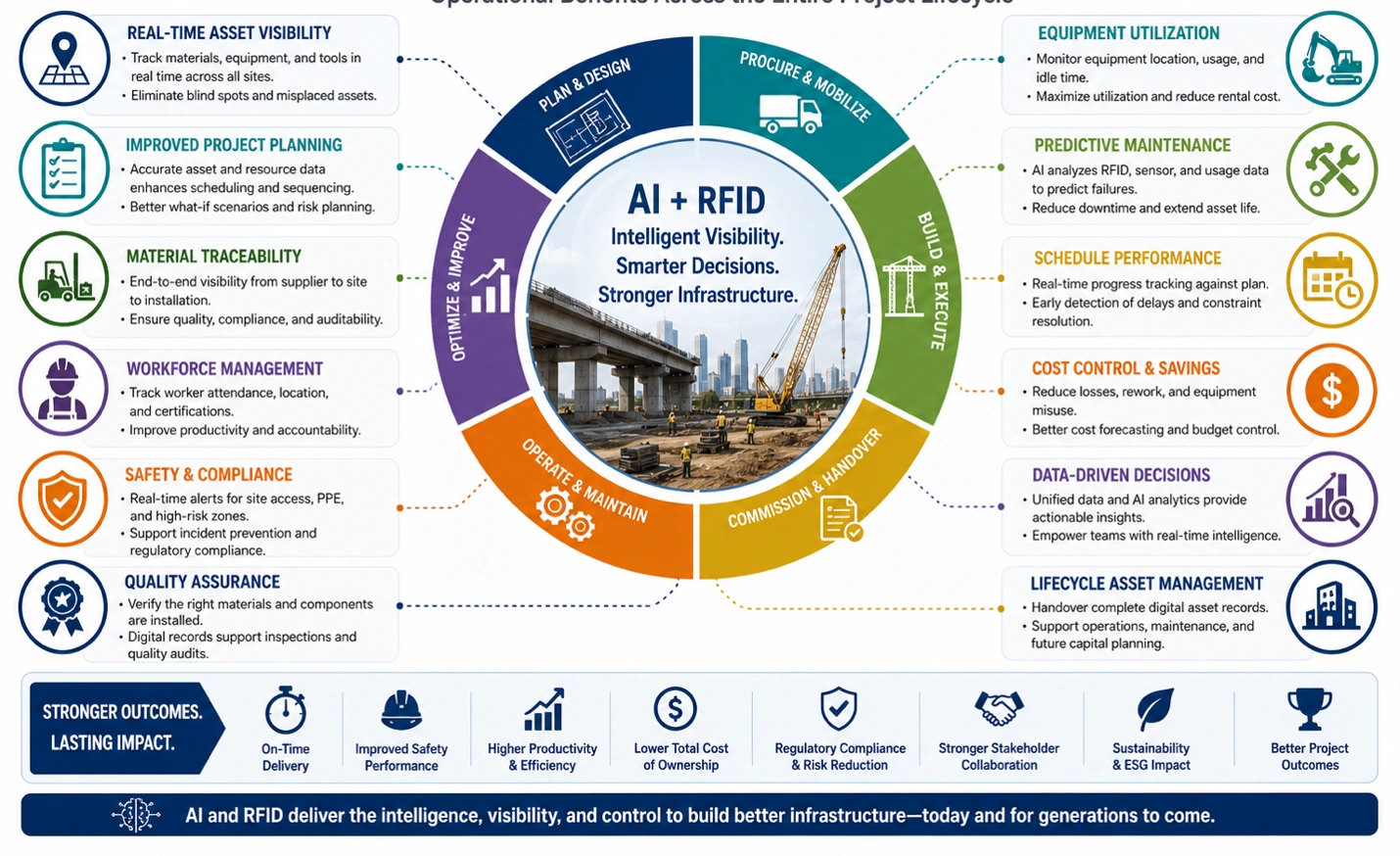
AI-supported infrastructure delivery provides measurable improvements throughout planning, construction, commissioning, and long-term asset management.
Improved Project Visibility
Continuous identification of materials, equipment, and assets enables project teams to monitor construction progress with greater confidence while reducing manual reporting.
Enhanced Schedule Performance
AI analyzes historical trends, labor availability, weather forecasts, procurement status, and field progress to identify potential schedule delays before they become critical.
Optimized Equipment Utilization
Heavy equipment represents one of the largest operational costs within infrastructure projects. AI evaluates equipment usage patterns to reduce idle time and improve fleet productivity.
Better Procurement Planning
Procurement teams gain improved visibility into inventory levels, supplier performance, delivery schedules, and material consumption, helping reduce shortages and excess inventory.
Higher Construction Quality
RFID-supported material traceability combined with AI-assisted inspection analysis helps ensure that the correct components are installed according to engineering specifications while improving documentation and regulatory compliance.
Improved Workforce Safety
AI evaluates incident trends, equipment movements, workforce locations, and environmental conditions to identify elevated safety risks and recommend preventive actions.
Reduced Project Costs
Better forecasting, optimized scheduling, efficient resource allocation, and early identification of operational issues help reduce rework, equipment downtime, and unnecessary expenditures.
Improved Sustainability
AI supports more efficient use of materials, equipment, and transportation resources while reducing waste, fuel consumption, and carbon emissions across infrastructure projects.
[Visual Recommendation 6]
AI-Enabled Infrastructure Project Lifecycle with RFID-Driven Operational Intelligence
Advancing Infrastructure Projects with AI-Powered Intelligence
Infrastructure construction continues to evolve as organizations seek greater visibility, improved predictability, enhanced collaboration, and better operational performance. AI-powered decision support, enabled by RFID identification and AIoT technologies, helps transform construction information into actionable intelligence that supports every stage of project delivery.
Successful implementations require careful planning, appropriate hardware selection, secure communications, reliable software integration, strong cybersecurity practices, and continuous optimization. Organizations should begin with clearly defined operational objectives, identify measurable KPIs, integrate AI with existing engineering systems, and establish governance procedures that maintain data quality throughout the project lifecycle.
GAO continues to help infrastructure owners, contractors, engineering firms, and public agencies deploy RFID, BLE, and IoT hardware products and systems that provide reliable operational data for AI-driven infrastructure management. Our engineering expertise, decades of experience, and commitment to quality help organizations implement intelligent construction solutions that improve efficiency, safety, compliance, and long-term infrastructure performance.
Building the Future of Industrial AI and IoT with Aperture Venture Studio and GAO RFID Inc.
For more than three decades, GAO Group has invested extensively in the research and development of industrial RFID, BLE, IoT, and AI technologies that support infrastructure modernization and digital construction. As Artificial Intelligence has become increasingly valuable for large-scale infrastructure projects, we have expanded our AIoT capabilities and established Aperture Venture Studio to accelerate the development and growth of advanced AI and IoT solutions for infrastructure and other critical industries. Through Aperture Ventures Summit and TekSummit, we bring together AI experts, IoT specialists, operational leaders, investors, and technology innovators to advance industrial intelligence. We welcome advisors, professionals, investors, and organizations interested in collaborating with us to shape the future of intelligent infrastructure solutions.